How to choose a GCC partner in India, 9 things to check

See how Findigs, Accompany Health, Veramatic and Podifi built their teams.
Real teams, real results, from faster hiring to lasting retention.
Quick look:
| Choosing a GCC partner in India comes down to how they recruit, because any partner can incorporate an entity and run payroll. Decide the end state first: your own entity, an employer of record, or a staged transfer. Then test the partner on eight more areas, from recruitment and security to contracts and the operation after launch. Ask for a written plan to the first offers, and judge each partner against it. |
|---|
To choose a GCC partner, start with the result you want in India and work back to the firm that can deliver it. A GCC partner is the firm that sets up and runs your India center, covering the entity, the hiring, the workspace, and the ongoing operation.
Every serious partner can handle incorporation and payroll. What separates them is the quality of the people who end up in the seats.
This guide is for founders, CTOs, and operations leaders at growth-stage companies who have decided on India and are now comparing partners. For the categories of firms in the market, start with our map of the GCC provider landscape.
Not every company needs a partner. With India operating experience and people already on the ground, setting up alone is a reasonable call.
1. Decide the end state first
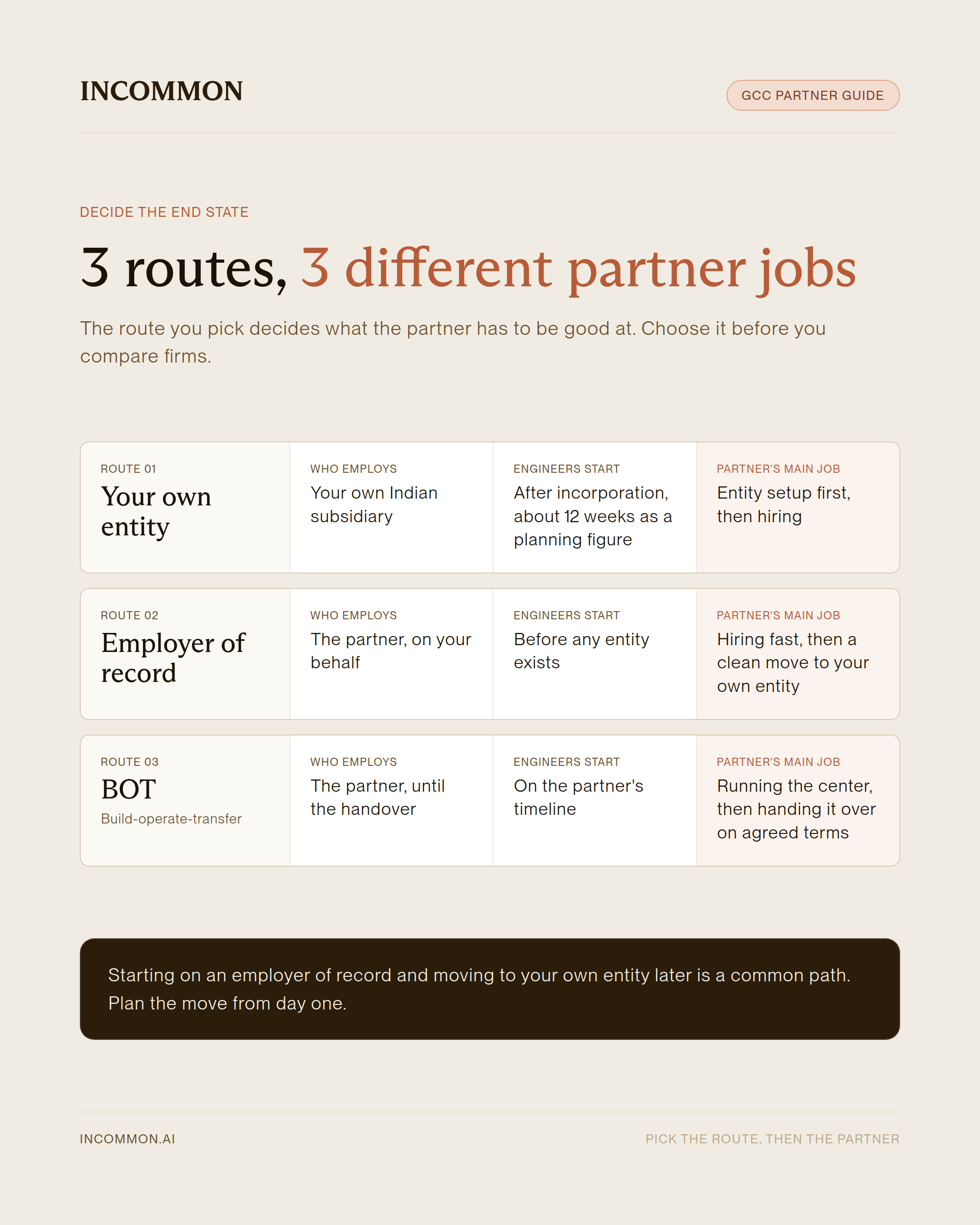
A partner can only plan toward an outcome that is named. There are three common routes, and each one changes what you need from the firm.
- Your own entity: a wholly owned Indian subsidiary that you control from day one. Incorporation takes about 12 weeks as a planning figure
- Employer of record: the partner employs the team for you, so engineers start before any entity exists. With InCommon, Podifi had 9 engineers live in 6 weeks, employed through employer of record with no wait for incorporation
- Build-operate-transfer: the partner runs the center for an agreed period, then hands it over. Our BOT model guide explains the phases
Plenty of companies start on an employer of record and move to their own entity later. The EOR versus entity comparison shows when each fits.
Whichever route you pick, ask every partner to map it from day one to the end state. In writing.
2. How they recruit
Read the recruitment section of every proposal twice. Entity setup and payroll look much the same across the market, but the people in the seats do not.
Start with where candidates come from before a role exists. India’s best engineers are rarely actively looking for positions, so focus on passive sourcing.
Next, ask who vets each candidate and whether that person has done the job being hired for. A recruiter can match keywords on a CV, but only someone who has done the work can test depth.
Then ask for three things you can check:
- Send-to-hire rate: the share of candidates sent who get hired. As a benchmark, 33% of the candidates we send are hired
- Replacement terms: what happens when a hire leaves early. We give a six-month replacement guarantee on every candidate
- The India leader: where the first leader comes from. We source managing directors from people currently running India centers, and someone who has held the role runs the final interview
A partner who answers with a process diagram instead of figures has told you something.
Weigh the India leader most heavily of the three. That person hires the first 10 people, and everyone after is measured against the standard those 10 set.
Ask how deep the shortlist goes, too. We put the top five candidates in front of you for the managing director role, and you make the appointment.
When the managing director arrives too late, the first hires set the standard without them. Put the leader's start date in the plan.
3. Data security and IP
Your India team will touch production systems, customer data and code you own. So the security setup on their side should be your own, applied locally. Not the partner's default.
Ask whose security baseline runs on the devices, and who manages the endpoints. Then ask what happens to laptops and access on the day someone leaves. We track every asset, then return or wipe it that same day.
IP is a contract question as much as a technical one. Employment agreements need a clear assignment of code and inventions to your company, agreed with counsel before the first offer.
India's data protection law applies too. Our GCC compliance guide covers the DPDP Act and its phased Rules.
4. What the price includes
Partners price in different shapes. Compare what each quote covers before you compare totals, and get inclusions, exclusions and third-party costs in writing.
The usual gaps are workspace, devices, statutory filings, the transfer pricing study and replacement hires. A lower monthly fee often moves cost somewhere you only find later. A hire who leaves in month four is the expensive outcome, because the search, the notice period and the ramp all start again.
For a realistic baseline, compare quotes with what a GCC in India costs across its first two years. A breakdown of what an India employee costs covers everything between salary and the full cost to company.
5. Communication and the reporting line
Ask who the India team reports to. If the answer is the partner, you are buying an outsourced team, whatever the contract calls it.
The team's reporting line should run to your engineering leadership, with the partner running everything around the work. This one detail is the clearest difference between GCC versus outsourcing.
Then ask how the partner reports to you. A monthly review call, plus a dashboard you can check between calls, is a reasonable minimum for a team of 20 or more people. Name one owner on each side.
6. How the team grows
Your first team is seldom your last. Ask how the partner adds people after the first wave, and how long each wave takes.
A repeatable unit makes growth easy to plan. We use cross-functional pods of 8, led by senior engineers. Stacking 3 or 4 pods builds a full center of 30 to 35 people. For Accompany Health, we built a team of 22 people within 10 weeks, with 100% retention across the build.
Speed varies with the route you take as well. Our published builds range from 4 weeks to 4 months to a live team.
Ask each partner for its own range and the cases behind it. The GCC setup timeline shows where the months usually go.
7. Fit with how you work
Fit runs in both directions. The partner will interview for your culture, so they need to understand it well beyond the job description.
Ask how they learn your standard before the sourcing starts. A good answer involves a discovery call, a look at your past hires, and a written scorecard, all agreed upon before anyone is contacted. Meeting the people who will vet your candidates tells you more than any reference call.
8. Contracts, ownership and exit
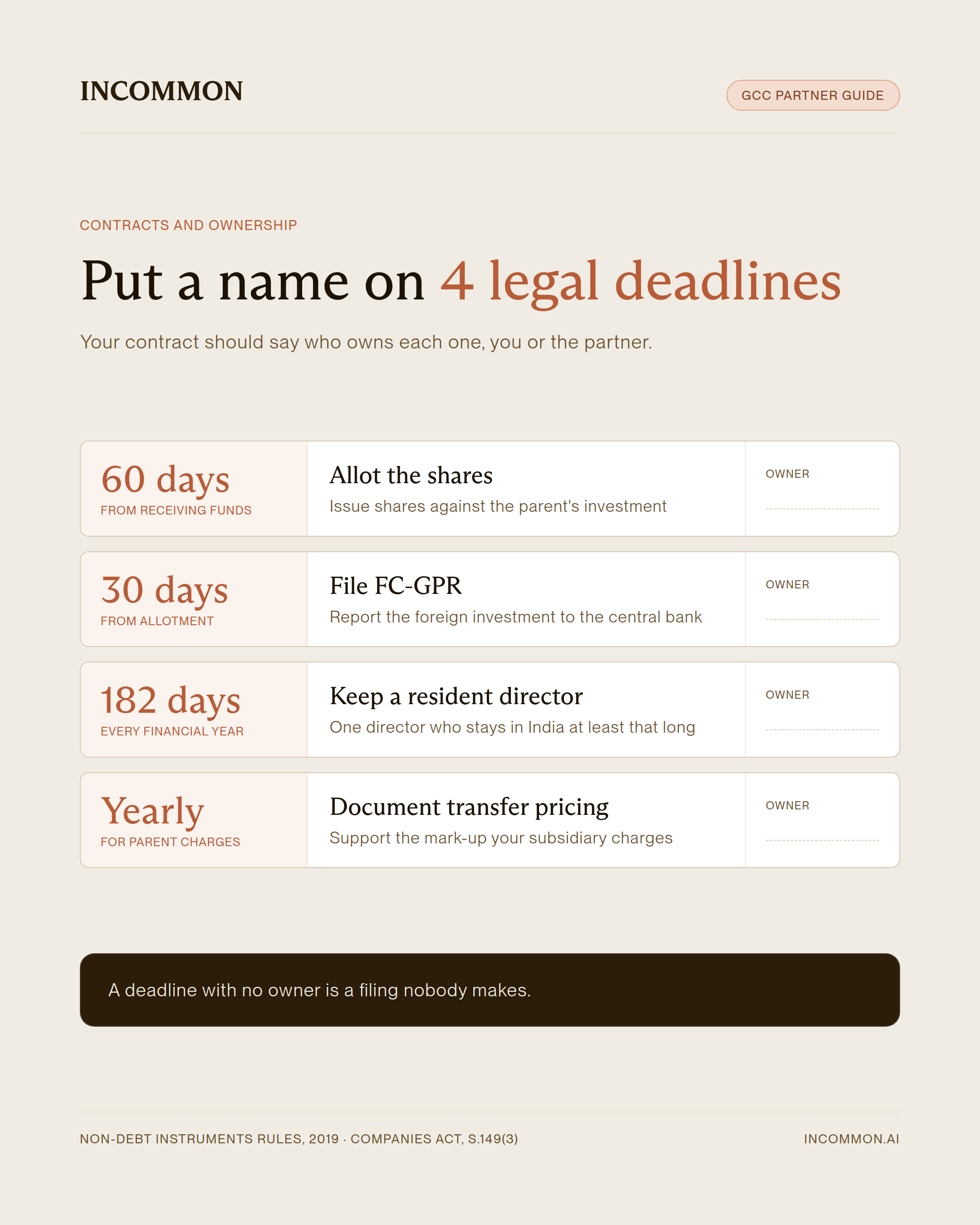
Pay as much attention to how the agreement ends as how it begins. Get these four critical answers in writing before signing:
Who owns the entity, and from which day?
Who acts as the resident director that Indian company law requires?
Who files the foreign investment reports after shares are allotted?
How do you move the team in-house or to another partner, and at what cost?
The middle two carry legal deadlines. Section 149(3) of the Companies Act requires a director who stays in India for at least 182 days in the financial year.
Meanwhile, the FC-GPR filing must be completed within 30 days of allotment. Our guide to subsidiary registration walks through each step.
We manage compliance and coordinate with your counsel. Your own lawyer should still review the agreement.
9. The operation after launch
The bulk of a partner's work happens after the team joins. Payroll, compliance, accounting, and annual filings all recur, and so does recruitment, because teams grow and people leave.
Ask who owns each of these in month 13. Then check the transfer pricing arrangement, because an Indian subsidiary charging its parent needs a defensible mark-up, documented every year.
People change on both sides over the years, so ask how knowledge stays in place when they do. Look for written runbooks, documented decisions, and a handover note for every role, kept in a system your team can access.
A partner that hands over a center and a list of obligations has only done half of the job. The biggest problems GCCs face tend to show up well after launch, so this area deserves the same scrutiny as setup. Setup is the easy part.
Questions to ask on a first call
The table pairs eight areas with one question each, and the third column shows the kind of answer that should worry you:
| Area | Ask | A weak answer |
|---|---|---|
| End state | What does the route from day one to ownership look like? | We can discuss structure later |
| Recruitment | What share of the candidates you send get hired? | A process diagram, no figure |
| India leader | Where does the first leader come from? | We will post the role |
| Security | Whose baseline runs on the devices? | Our own, by default |
| Price | What does this quote exclude? | It is all-inclusive, with nothing in writing |
| Reporting line | Who does the team report to? | Our delivery manager |
| Contracts | How do we exit or move the team in-house? | No clause, or a penalty with no figure |
| After launch | Who runs compliance in month 13? | You will have an HR person by then |
A partner who answers all eight in writing, before you sign, has already shown you how they work. Silence is an answer too.
These are the same questions we expect to answer ourselves.
Everything you need to build and run your India GCC.
Entity, hiring, workspace and ongoing operations under one agreement.
Final thoughts
Capability slides from different partners can look alike. You will notice the difference in up to three places:
- The recruitment numbers
- The reporting line
- The exit clause
Give those answers more weight than the pitch, and get each one in writing before the contract goes to legal review. Then pick the partner whose plan you would defend to your board six months in.
Frequently asked questions
How do you choose a GCC partner in India?
Start with the end state you want: your own entity, an employer of record, or build-operate-transfer. Then test each partner on recruitment, security, what the price includes, the reporting line, how the team grows, fit, contracts and the operation after launch. Ask for a written plan to the first offers.
What should you ask a GCC partner about recruitment?
Ask where candidates come from before a role exists, who vets them and whether that person has done the job. Then ask for figures you can check: the send-to-hire rate, the replacement terms, and where the India leader comes from.
Who should an India team report to when you use a GCC partner?
The team should report to your engineering leadership, with the partner running everything around the work. If the team reports to the partner, you are buying an outsourced team, whatever the contract calls it.
What should a GCC partner's quote include?
Get inclusions, exclusions and third-party costs in writing. The usual gaps are workspace, devices, statutory filings, the transfer pricing study and replacement hires. Compare what each quote covers before you compare totals.
What contract terms matter with a GCC partner?
Confirm who owns the entity and from which day, who acts as the resident director, who files the FC-GPR report after shares are allotted, and how you move the team in-house or to another partner. Section 149(3) of the Companies Act requires a director who stays in India for at least 182 days in the financial year, and FC-GPR is due within 30 days of allotment.
Do you need a GCC partner to set up in India?
Not always. A company with India operating experience and people already on the ground can reasonably set up alone. Others use a partner to handle the entity, the hiring, the workspace and the ongoing operation.
Written by
CEO, InCommon
Piyush Kedia is the CEO of InCommon, a talent infrastructure company that helps US and global enterprises set up and scale Global Capability Centers (GCCs) in India. He works with founders, CTOs, and heads of talent to design smaller, AI native GCC teams that focus on judgment work, not just headcount, so India offices stay senior, stable, and production ready. Before InCommon, Piyush built Blue Vector into a 50 person creative agency serving brands such as Trump Towers, Audi, and Porsche, giving him a front row view of how high performing teams are hired, managed, and grown.