How to spot red flags when hiring offshore software engineers

See how Findigs, Accompany Health, Veramatic and Podifi built their teams.
Real teams, real results, from faster hiring to lasting retention.
Quick look:
| Hiring offshore engineers widens your talent pool and can speed up delivery, but it comes with risk. The red flags to watch for are poor communication, unrealistic promises, a thin portfolio, weak problem-solving, no grip on best practices, low commitment, and careless handling of security. Catching them in the interview saves money, time, and frustration, and a small task or live exercise is the most reliable way to test for them. |
|---|
Interviewing offshore software engineers
Hiring offshore software engineers looks like the perfect solution on paper. It offers:
- A global talent pool
- Flexible costs
- Work that continues around the clock
But not every hire works out.
Some lead to missed deadlines, risky security gaps, and code that is impossible to maintain. Others vanish mid-project or hand over work that is copy-pasted with little thought.
The truth is simple: spotting warning signs early is the difference between hiring an engineer who drives results and one who leaves behind disorder. This guide walks through the biggest red flags and how to identify them before making a costly decision. For the questions to ask in the interview itself, see our interview playbook.
Why red flags in interviews matter
The interview is your first filter. Portfolios and resumes can look impressive, but an interview reveals how a candidate thinks, explains, and interacts.
Ignoring red flags at this stage can does have its consequences:
| Risk | Why it hurts |
|---|---|
| Wasted time and money | Fixing bad code often costs more than hiring right the first time. |
| Missed deadlines | A weak hire can throw off an entire delivery schedule. |
| Security risks | Developers work with sensitive data. Poor practices can open serious vulnerabilities. |
| Team frustration | One unreliable developer can slow down an entire team. |
Catching red flags during the interview is your best chance to avoid all four.
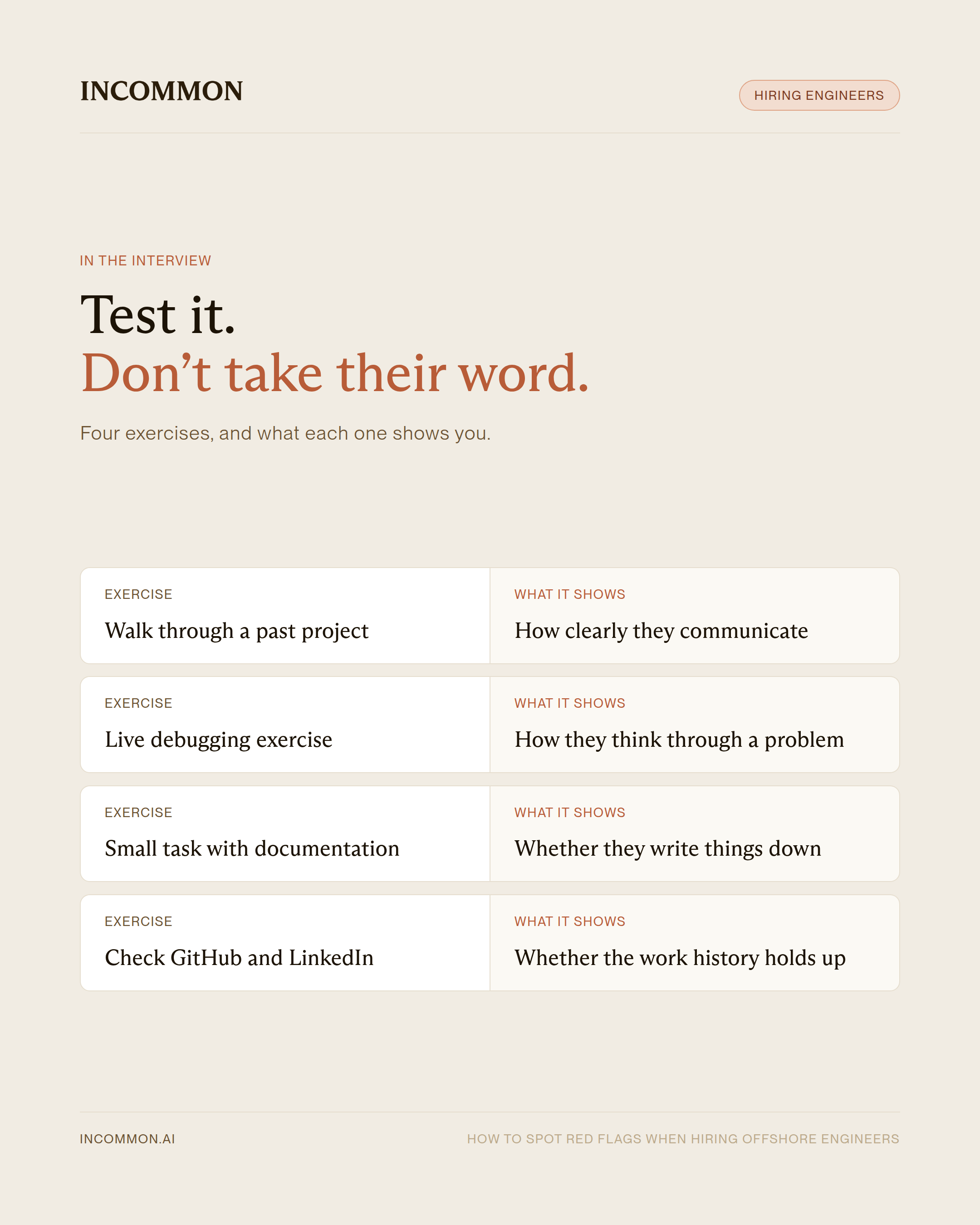
Top red flags to watch for
1. Lack of clear communication skills
Why it matters
Offshore work depends on smooth collaboration across time zones. If an engineer cannot explain ideas, ask questions, or document their work, projects stall.
Signs to watch for
- Answers that are vague or off-topic
- Heavy reliance on yes/no replies
- Struggles to explain technical concepts simply
How to test
Ask them to walk through a past project in detail. Give them a small task that requires documentation. Pay attention to whether their English is clear and confident.
2. Overpromising and unrealistic guarantees
Why it matters
If a candidate claims they can deliver a full-stack app in two weeks, your alarm bells should ring. Overpromising usually points to either inexperience or dishonesty.
Signs to watch for
- Delivery timelines that sound impossible
- Evasion when asked about risks
- No clear roadmap to back up bold claims
How to test
Request past project timelines. Ask for a step-by-step breakdown of how they'd tackle your project. Check testimonials to see if their promises match delivery.
3. Lack of portfolio or inconsistent work history
Why it matters
A strong engineer shows proof of work. Without a portfolio or a work history that adds up, it is hard to know whether they are reliable.
Signs to watch for
- Generic or cookie-cutter projects only
- Unexplained employment gaps
- No GitHub, code samples, or open-source contributions
How to test
Ask for links to live projects or working code. Cross-check LinkedIn with resume claims. Have them walk you through a past project end to end.
4. Poor problem-solving and debugging skills
Why it matters
Great engineers don't just code, they solve problems. Weak debugging skills lead to fragile systems that break easily.
Signs to watch for
- Difficulty handling open-ended coding challenges
- Shallow or unclear explanations of past debugging
- Heavy dependence on copy-paste solutions
How to test
Set a live debugging exercise. Ask about a time they fixed a major issue. Look at how they structure their thought process, not just the final answer.
5. Lack of familiarity with industry best practices
Why it matters
Best practices keep systems stable, scalable, and secure. Engineers who ignore them create messes that teams can spend months cleaning up.
Signs to watch for
- Avoids discussing Git or version control
- Weak or missing documentation habits
- No exposure to CI/CD pipelines, testing, or scalability design
How to test
Ask how they'd structure a scalable app. Request a sample of technical documentation. Discuss security challenges they've solved.
6. Low commitment and a weak work ethic
Why it matters
Offshore hiring succeeds when engineers are consistent and reliable. Freelancers juggling multiple clients or disappearing for days at a time derail projects.
Signs to watch for
- Delayed responses or vanishing during hiring
- Unwillingness to commit long-term
- Missed deadlines without explanation
How to test
Ask about current workload and other commitments. Review their history for long-term roles. Set availability expectations upfront.
7. Security and data privacy risks
Why it matters
Engineers often work with sensitive company data. Weak security practices put your business at serious risk.
Signs to watch for
- Avoids discussing security protocols
- Hesitates to sign NDAs
- Suggests using unsecured tools or channels
How to test
Use secure collaboration systems from day one. Implement role-based access controls. Only hire from trusted sources with a strong security record.
8. Minor red flags that also matter
Not every small issue is a dealbreaker, but small red flags add up. A candidate who is slow to respond, vague about availability, or dismissive of all past employers is signaling risk.
Pay attention to:
- Hesitation around NDAs
- Reluctance to use your tech stack
- Negative talk about all former clients
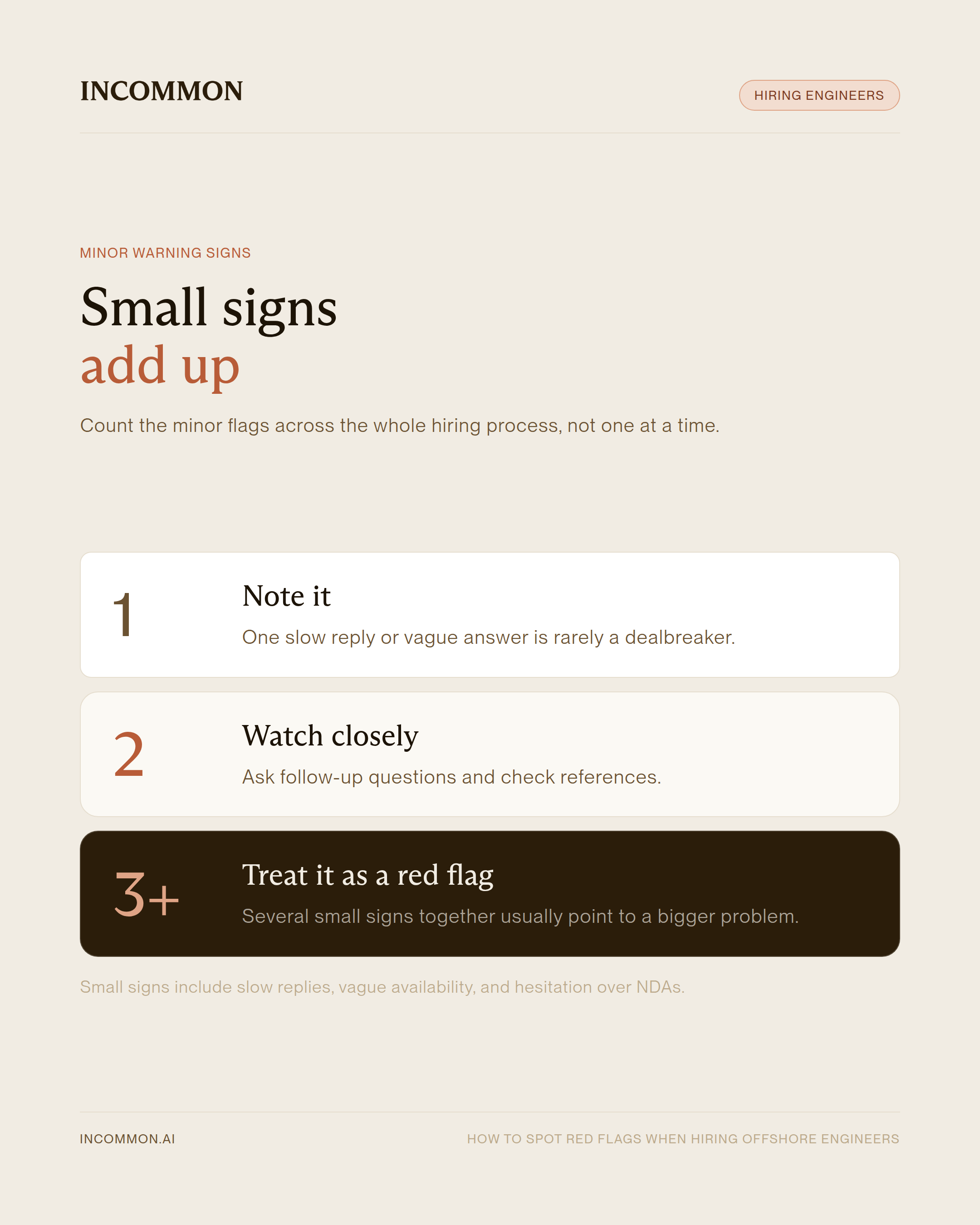
Individually, these may seem minor. Together, they usually point to bigger problems later.
To see what careful hiring produces over time, look at the teams we have helped build.
See how Findigs, Accompany Health, Veramatic and Podifi built their teams.
Real teams, real results, from faster hiring to lasting retention.
Final thoughts
Catching red flags early prevents wasted money, missed deadlines, and frustrated teams:
- Communication is key: If they can't explain clearly, expect confusion later
- Overpromising is dangerous: Too-good-to-be-true timelines rarely work
- Portfolio matters: If they can't show proof of experience, it's a red flag
- Problem-solving is non-negotiable: Weak debugging means fragile code
- Even minor red flags add up: Small issues now can become big failures later
Hiring offshore engineers can work very well, but only if you spot the warning signs before you commit.
Frequently asked questions
What are the biggest red flags when hiring offshore software engineers?
Watch for unclear communication, unrealistic delivery promises, a thin or inconsistent work history, weak debugging skills, no grasp of best practices like version control and testing, low commitment, and careless attitudes to security.
How do I test an offshore engineer's skills before hiring?
Give them a small coding or debugging task with a clear deadline. Review not just the solution but also their process.
What if the engineer has no portfolio?
Ask for code samples, GitHub contributions, or a walkthrough of past projects. No proof of work is a serious red flag.
How can I confirm they will commit long-term?
Discuss current workload, ask for client references, and set expectations on availability from the start.
What security steps should I take before hiring?
Always use NDAs, secure collaboration tools, and limited access to sensitive data until trust is built.
Are small red flags ever okay?
One or two minor issues may not be critical. But multiple small red flags combined usually mean trouble.
Written by
CEO, InCommon
Piyush Kedia is the CEO of InCommon, a talent infrastructure company that helps US and global enterprises set up and scale Global Capability Centers (GCCs) in India. He works with founders, CTOs, and heads of talent to design smaller, AI native GCC teams that focus on judgment work, not just headcount, so India offices stay senior, stable, and production ready. Before InCommon, Piyush built Blue Vector into a 50 person creative agency serving brands such as Trump Towers, Audi, and Porsche, giving him a front row view of how high performing teams are hired, managed, and grown.