How to manage conflict between offshore and onshore teams

See how Findigs, Accompany Health, Veramatic and Podifi built their teams.
Real teams, real results, from faster hiring to lasting retention.
Quick look:
| Conflict between offshore and onshore teams usually comes from communication gaps, time zones, cultural differences, uneven workloads, or a lack of trust. Watch for early signs such as quieter channels, slipping deadlines, more complaints, and disengaged meetings. Prevent it with clear instructions, regular updates, one shared source of truth, and planned overlap hours. When conflict does happen, act quickly, give people a private way to raise concerns, focus on the problem rather than the person, and follow up. |
|---|
Conflict in the workplace is inevitable. Throw in teams separated by oceans, cultures, and time zones, and you've got a recipe for tension.
Offshore and onshore teams face unique challenges that can lead to misunderstandings, inefficiency, and frustration. But conflicts, when managed well, can become opportunities to build stronger relationships.
In this article, we'll break down the common causes of offshore-onshore team conflict and provide smart strategies to handle them effectively. For the wider picture of running an India team day-to-day, see our guide to offshore team management.
Understanding the roots of conflict
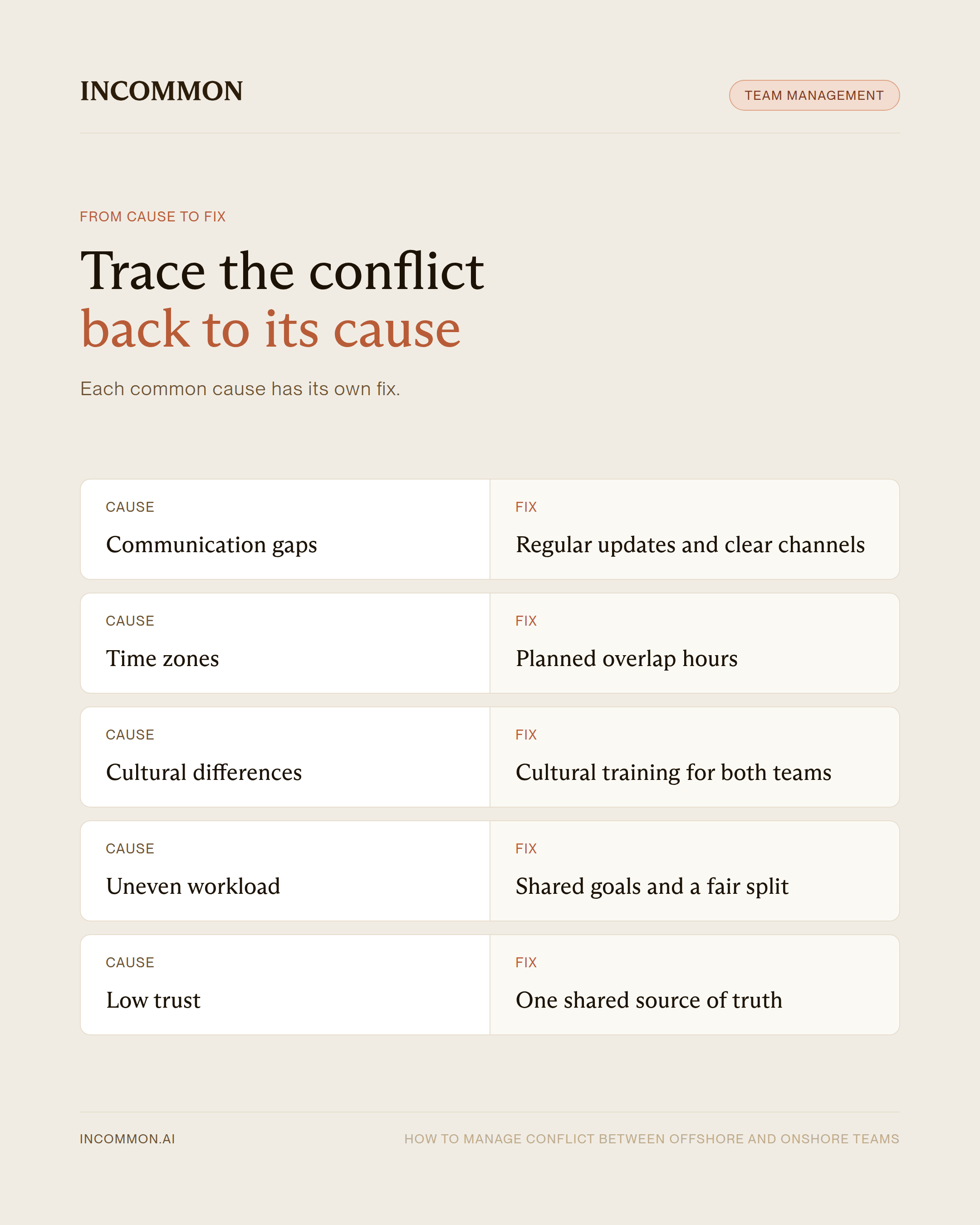
Conflicts are usually the result of unmet expectations, communication issues, or a lack of clarity. Let's unpack some common triggers:
1. Communication gaps
Offshore teams might miss details due to unclear instructions or assumptions. Onshore teams may get frustrated when updates aren't timely. Emails and Slack messages can't always capture tone, and context often gets lost in translation.
2. Time zone challenges
The phrase "Can this wait until tomorrow?" takes on new meaning when tomorrow is already someone else's today. Misaligned working hours can delay responses, extend project timelines, and create frustration on both sides.
3. Cultural misunderstandings
Cultural differences can lead to differing work styles, communication approaches, and even conflict resolution preferences. What one team sees as assertiveness, another might see as aggression.
4. Uneven workload distribution
If one team feels they're carrying more weight than the other, resentment is inevitable. Offshore teams may feel overburdened with mundane tasks, while onshore teams might think they're doing all the strategic heavy lifting.
5. Lack of trust
Remote teams can feel invisible. If one side perceives the other as unreliable or uncommitted, it creates a cycle of mistrust and micromanagement.
How to spot conflict early
Conflict doesn't always come with a visible warning signal or a red light. Here's how to catch the signs before they escalate:
1. Drop in communication
If your once chatty Slack channel now feels like a ghost town, something might be brewing.
2. Missed deadlines
Deadlines slipping without explanation? This could indicate a breakdown in coordination or motivation.
3. Increased complaints
Team members venting more than usual? Complaints about "the other team" often hint at deeper frustrations.
4. Lack of engagement
If meetings feel like pulling teeth, you might have disengaged team members, often a symptom of unresolved tension.
Strategies to manage conflict
When offshore-onshore conflicts arise, the goal is not to assign blame. The fastest way to defuse tension is to step back, identify whether the issue is caused by communication, ownership, timing, or expectations, and then address it with a clear operating rhythm:
1. Build clarity into everything
Ambiguity is the enemy of teamwork. Provide clear instructions, expectations, and timelines. Use project management tools to assign tasks with detailed descriptions. Clarity prevents "I thought you meant..." scenarios.
2. Overcommunicate (but not overwhelm)
Communication should keep people informed without overwhelming them. Schedule regular check-ins, weekly progress updates, and clear channels for immediate concerns. Use concise language to avoid misinterpretation.
3. Use a single source of truth
Confusion often stems from multiple people using different tools or processes. Choose one central platform, whether it's Asana, Jira, or something else, where everyone can access the same information.
4. Plan around time zones
Instead of complaining about time differences, plan around them. Create overlapping hours for important discussions and allow asynchronous communication for less urgent tasks. Tools like shared calendars can make scheduling a breeze.
5. Lean on cultural intelligence
Offer training on cultural nuances for both teams. Encourage empathy, patience, and open-mindedness.
Conflict resolution tactics
Despite your best efforts, conflicts will happen. Here's how to tackle them head-on:
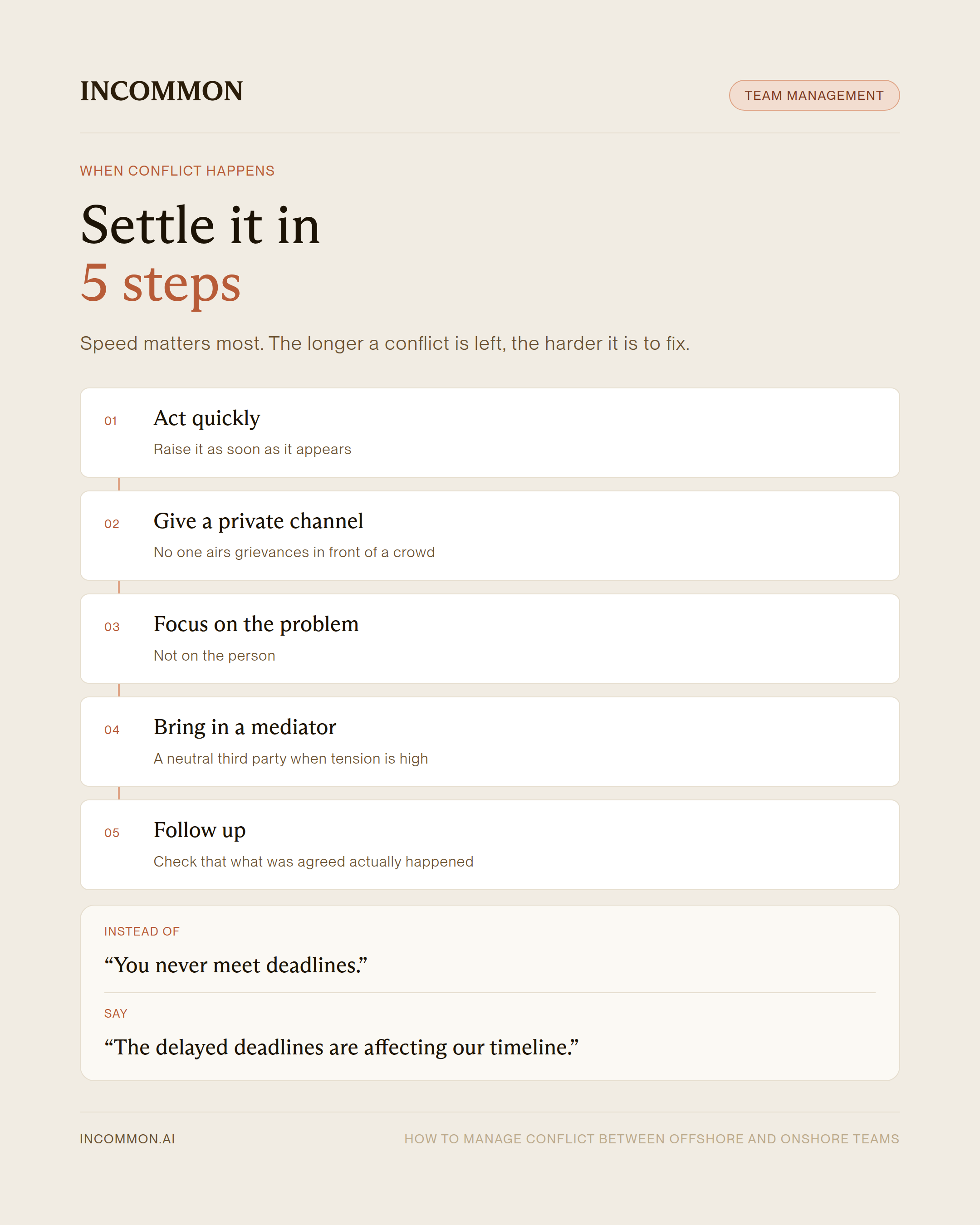
1. Act quickly
Conflict is like spilled coffee: the longer it is left, the harder it is to clean up. Address issues as soon as they arise to prevent escalation.
2. Create a safe space for feedback
No one wants to air grievances in front of a crowd. Provide private, judgment-free channels where team members can share concerns without fear of backlash.
3. Focus on the problem, not the people
Blame games solve nothing. Keep discussions about the issue at hand, not personal faults. For example, instead of "You never meet deadlines," say, "The delayed deadlines are impacting our timeline."
4. Find a neutral mediator
If tensions are high, bring in a neutral third party to mediate. This could be a project manager, HR representative, or even someone from outside the immediate team.
5. Follow up on resolutions
Agreeing on a solution is only step one. Ensure that actions are taken and review their effectiveness over time.
The teams we have built are good examples of both offices working as one.
See how Findigs, Accompany Health, Veramatic and Podifi built their teams.
Real teams, real results, from faster hiring to lasting retention.
Tools that support better collaboration
Technology can't solve every problem, but the right tools can make a big difference:
1. Communication tools
Slack, Microsoft Teams, or Zoom keep conversations flowing. Make sure everyone knows when to use which platform.
2. Project management software
Trello, Asana, or Monday.com let every team member track tasks and see progress.
3. Time zone converters
Tools like World Time Buddy make scheduling across time zones painless.
4. File sharing platforms
Google Drive, Dropbox, or SharePoint allow easy access to shared documents and prevent "I can't find that file" frustrations.
5. Feedback tools
Platforms like Polly or 15Five enable anonymous feedback, helping you uncover hidden concerns.
Building long-term harmony
Effective conflict management isn't about putting out fires. It's about preventing them in the first place:
1. Set shared goals
When everyone is working toward the same outcome, it's easier to overlook differences. Regularly remind teams of their shared objectives.
2. Celebrate wins together
Recognize contributions from both teams equally. Celebrate milestones to create a sense of unity and shared success.
3. Build personal connections
It's harder to be annoyed with someone you know. Encourage casual interactions, like virtual coffee chats or team-building activities.
The bottom line
Offshore and onshore conflicts don't have to derail your projects.
Conflicts are a natural part of working with diverse, distributed teams. The key is to approach them with curiosity, patience, and a commitment to find solutions. Clear communication, the right tools, and a little cultural intelligence can turn tensions into teamwork.
Who knows? What starts as a disagreement could lead to stronger bonds and even better collaboration.
All it takes is a bit of effort and the right approach.
Frequently asked questions
What causes conflict between offshore and onshore teams?
The common causes are communication gaps, misaligned working hours, cultural differences in work and communication styles, uneven workloads, and a lack of trust between the two sides.
How can you spot conflict between teams early?
Watch for quieter communication channels, deadlines slipping without explanation, more complaints about the other team, and disengaged meetings.
How do you prevent conflict between offshore and onshore teams?
Give clear instructions and timelines, communicate regularly without overloading people, keep one central platform as the source of truth, plan overlap hours, and offer cultural training to both teams.
What should you do when conflict happens?
Act quickly, give people a private way to raise concerns, keep the discussion on the problem rather than personal faults, bring in a neutral mediator if needed, and follow up on what was agreed.
Which tools help offshore and onshore teams work together?
Communication tools like Slack, Microsoft Teams, or Zoom, project management software like Trello or Asana, time zone converters, shared file platforms, and anonymous feedback tools.
How do you build long-term harmony between distributed teams?
Set shared goals, celebrate wins from both teams equally, and encourage personal connections through casual chats and team-building activities.
Written by
CEO, InCommon
Piyush Kedia is the CEO of InCommon, a talent infrastructure company that helps US and global enterprises set up and scale Global Capability Centers (GCCs) in India. He works with founders, CTOs, and heads of talent to design smaller, AI native GCC teams that focus on judgment work, not just headcount, so India offices stay senior, stable, and production ready. Before InCommon, Piyush built Blue Vector into a 50 person creative agency serving brands such as Trump Towers, Audi, and Porsche, giving him a front row view of how high performing teams are hired, managed, and grown.