Offshore team management, how to run an India team well

See how Findigs, Accompany Health, Veramatic and Podifi built their teams.
Real teams, real results, from faster hiring to lasting retention.
Quick look:
| Offshore team management works when the India team is run as part of your company. Put its reporting line inside your engineering organization, hire a local leader before the team, and plan the day around a short overlap with written handoffs. Hold one standard for reviews, pay, and access across both offices. Then give the team a product area to own within its first two quarters, because teams left on maintenance work leave. |
|---|
To manage an India team well, treat it as part of your company from the first hire. The reporting line runs to your engineering leadership, and a local leader runs the team day to day.
The same standards apply in both offices. Much of the friction blamed on distance comes from skipping one of those three.
This guide is for founders, CTOs, and engineering leaders at growth-stage companies running, or about to run, a team in India. It assumes the decision to set up there is made and covers what happens after.
For the setup itself, our guide to setting up a GCC walks through the sequence.
What offshore team management means
Offshore team management is the work of running a team that works for you from another country. Here, that country is India, and the team is ideally your own global capability center, with the people on your payroll.
That distinction shapes everything below. An outsourced team belongs to a vendor, which manages the people while you manage a contract.
Outsourcing is the better fit for a fixed project with a clear end, or for work you never plan to own. The GCC versus outsourcing comparison sets out that trade in detail. This piece covers the case where the team is yours.
Decide who the team reports to
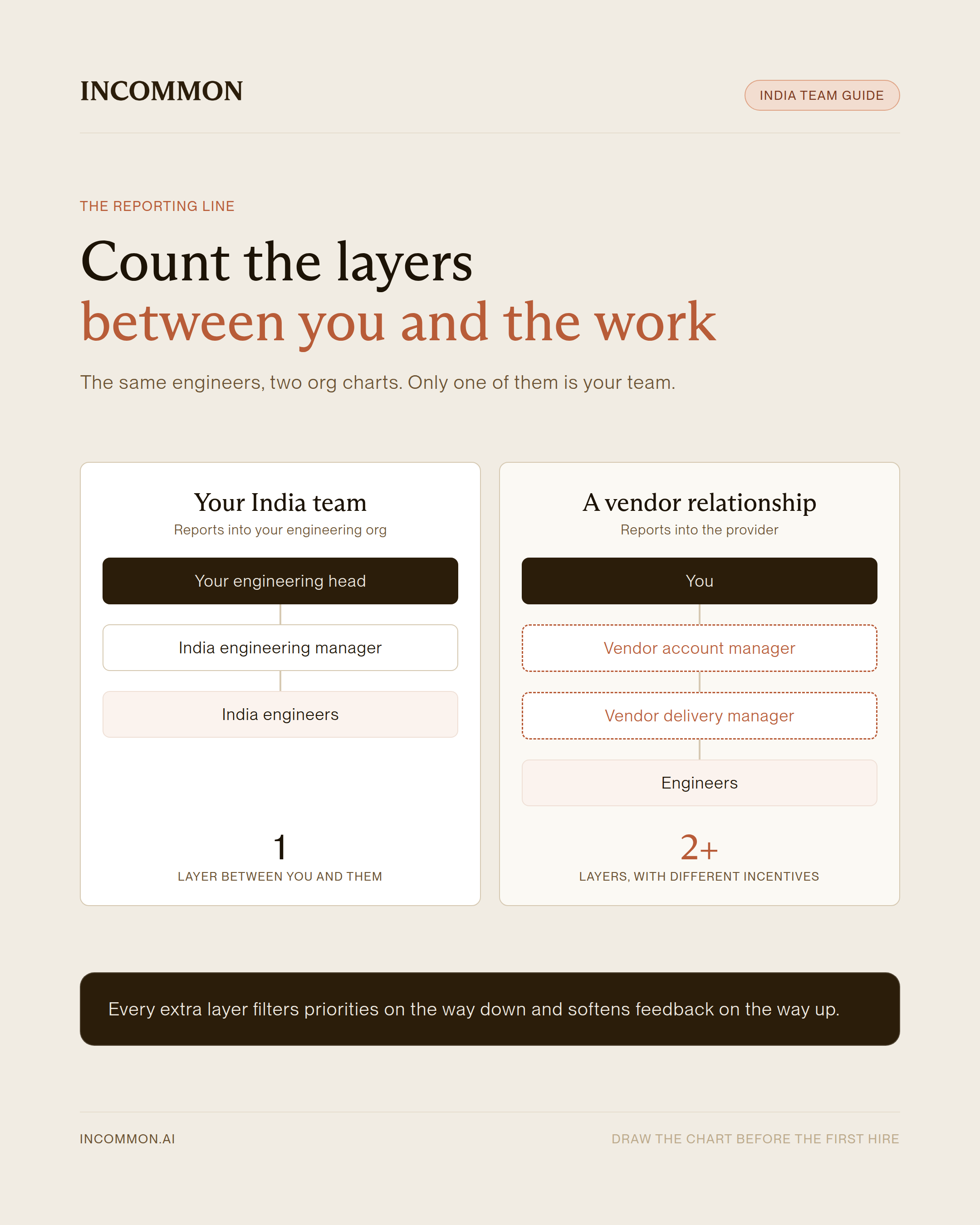
Start with the org chart. The India engineers should report into your engineering leadership the same way a team in your home office does.
A reporting line through a provider or an agency adds a second management layer between you and the work. Priorities pass through someone with a different incentive, and feedback arrives late and softened. That pattern is one of the GCC failure modes that shows up early.
So draw the chart before the first hire. Each India engineer has a manager, and each manager has a counterpart in your home office. If the chart only works with a vendor box in the middle, you have a vendor relationship.
Hire the India leader first
The first appointment dictates the next 30. Hire the India leader before the team, even if it delays the first engineers by a month or two.
That person carries jobs nobody else on the ground can do:
- Set the standard: the first 10 hires define what good looks like, and everyone after is measured against them
- Keep head office trust: for most of your company, the India team is whatever this person reports
- Win better work: a center that stays on maintenance work loses its strongest people
The leader also starts from nothing. There is no HR function, no process, and no local employer brand on day one, so they create all three.
The strongest candidates are usually running an India center already, so they are not applying. We source managing directors from people in those roles, and someone who has held the role runs the final interview.
Notice periods mean a leader you choose today rarely starts next month, which is why the search happens first.
Work with the time difference
India runs on IST, which is UTC+5:30 all year with no daylight saving. The gap to your office changes with the season on your side:
| Home office | Hours ahead in India | A workable overlap |
|---|---|---|
| London | 4.5 to 5.5 | Most of the India afternoon |
| New York | 9.5 to 10.5 | 1.5 to 2.5 hours, if India starts late morning |
| San Francisco | 12.5 to 13.5 | Under an hour, unless one side stretches the day |
The table shows why the approach differs by city. A London office gets half a working day in common. A San Francisco office gets an early call and not much else.
Two hours of overlap is enough when the rest of the day runs on writing. Put decisions in the ticket, and end each day with a short handoff note.
It needs three lines:
- What shipped today
- What is blocked
- What needs a decision from the other side by morning
Keep meetings for the work that needs a conversation. Nothing else.
Less overlap with strong handoffs works much better than more overlaps with weak ones.
Share the inconvenience as well. If India always takes the 9pm call, rotate it so your side sometimes joins at 7 am. The same people carrying every late call is how a team decides it is second class.
Set a weekly rhythm
A steady cadence does more for a distributed team than any single tool. Here is a rhythm that works for a team of 10 to 30 people.
- Daily: a written standup in the team channel, posted before the overlap window opens
- Weekly: one live sync inside the overlap, for decisions that stalled in writing
- Monthly: a review between the India leader and your engineering head, covering delivery, hiring and anything at risk
- Quarterly: planning with the India leads in the room, in person when you can manage it
Keep the weekly sync short. A 30-minute meeting that ends with owners and dates beats an hour of status updates, because the status already went out in writing. Go around the room for blockers, so they surface from both offices and not only from whoever speaks first.
Write the rules down as well. A one-page working agreement says what goes in chat, what belongs in a ticket or a doc, and what needs a call, along with how fast each should get a reply. Record the weekly sync for anyone outside the overlap window, and keep the notes in the same tracker both offices use.
Prepare your home office
The home team's reaction shapes how the first India hires are received. Tell them early what the India team will own, and that it adds capacity to the roadmap rather than replacing anyone. If roles at home are changing, say so plainly, because people fill a silence with the worst explanation.
Tension between the two offices can still build later. Our guide to offshore and onshore team conflict covers how to spot it early and resolve it.
Onboard the first hires properly
The first month decides how a new engineer sees the job. Laptops, accounts, and access should all be ready before day one, so nobody spends their first week waiting for credentials.
Pair each new hire with a buddy in your home office as well as one in India. Give them something small but impactful to ship in the first week. Action in week one says more about the team than any welcome presentation.
For the first few India leads, spending time in your home office pays back fast.
Send them early. Two or three weeks there builds the relationships that carry the team through its first hard quarter.
Give the team work worth owning
Teams that only receive tickets leave. Give the India team a product area, a service, or a customer problem to own within its first two quarters. The roadmap decisions for that area should move with it.
Pick the first area with care. It needs a clear boundary and few dependencies on your home office, such as an internal platform, a data pipeline, or one product surface. A tangled area hands the new team its hardest problem on day one.
Ownership also fixes the handoff problem. A team that owns a service end to end needs fewer approvals across the time gap. It ships, reports, and moves on.
Retention is the measure that tells you whether this works. With InCommon, Findigs had 60 underwriters hired in four months, with 90% retention. At Veramatic, the team reached 21 people live in four weeks, with 92% retention across the build.
The biggest problems GCCs face include a lack of ownership, and it rarely fixes itself. Hand over the team something that carries actual impact by the second quarter.
Run one standard across both offices
The India team should live under the rules everyone else follows.
That means one set of levels, one review cycle, one set of promotion criteria, and the same tools.
Pay is set locally, but the method stays the same. Benchmark against the India market and use the full cost, which our breakdown of what an India employee costs lays out line by line.
Leave policy differs too. Plan the calendar around India's holidays and leave rules rather than your own.
Promotions are where double standards show first. Requiring offshore engineers to relocate to HQ for promotions will drive them to leave.
Keep security and access in one place
Apply your security baseline to every India device. Manage the endpoints, run access through the single sign-on your home office already uses, and keep an asset register for every laptop and peripheral. There should be no exceptions in these cases.
On the day someone leaves, their access closes, and the device is returned or wiped. That routine is monotonous, but it is the whole control.
IP needs the same care. Every employment agreement should assign code and inventions to your company, so agree on the clause with counsel before the first offer goes out.
India's data protection law now applies to personal data your team handles as well. Our GCC compliance guide covers the DPDP Act and what changes for an India entity.
Meet in person
Video carries the work but not the relationship. Bring your engineering leads to India early, ideally while the first hires are still joining.
After that, aim for a visit in each direction every year. Plan it around quarterly planning, so the trip produces decisions as well as goodwill.
Budget for it. The cost is small next to a senior hire who leaves because they never get to meet the people they worked for.
What to measure
Measure the India team the way you measure every team. Delivery against the roadmap, quality in production, and retention by quarter cover most of it.
Watch for three early signals of trouble:
- Decisions wait a day for a reply
- India engineers go quiet in planning
- Resignations cluster in one team during the first year
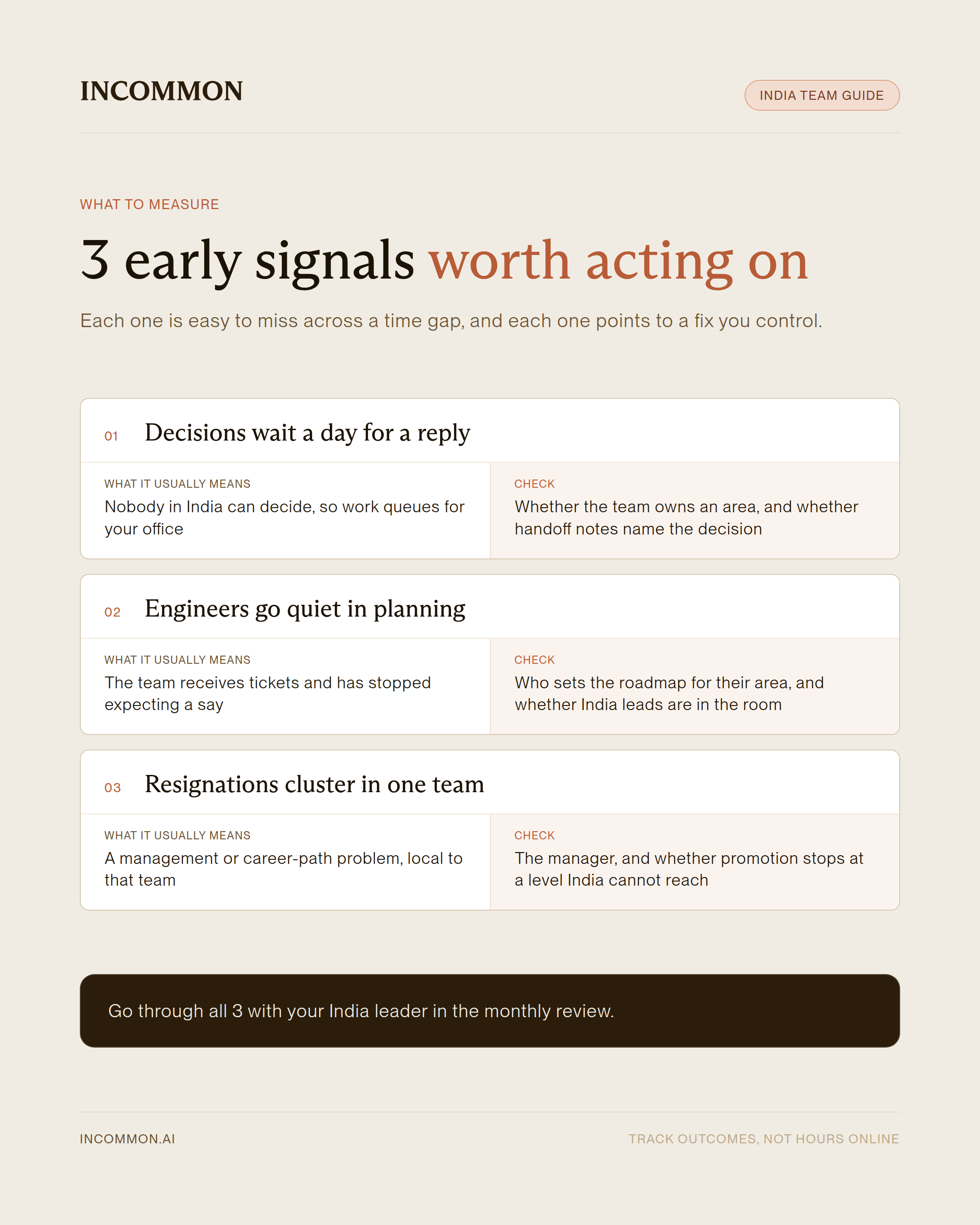
Avoid hours online and response times. Those numbers reward presence across the time gap, and the gap is the one thing the team cannot change. Track outcomes, and review them with the India leader every month.
That operating rhythm is what kept the teams we have built in place.
See how Findigs, Accompany Health, Veramatic and Podifi built their teams.
Real teams, real results, from faster hiring to lasting retention.
Final thoughts
Distance makes every weak habit more expensive. A vague reporting line, an absent leader, or a second-class promotion path all hurt a home office team too, just more slowly.
Fix those three first. The overlap hours, the handoff notes, and the visits will then do the rest of the work.
Frequently asked questions
What is offshore team management?
Offshore team management is the work of running a team that works for you from another country. It works best when the team is your own, such as a global capability center in India, with its reporting line inside your engineering organization.
How do you manage an India team across time zones?
India runs on IST, UTC+5:30, with no daylight saving. London gets most of the India afternoon in common, New York gets 1.5 to 2.5 hours if India starts late morning, and San Francisco gets under an hour. Run the rest of the day on written handoffs and rotate the late calls.
Who should an India team report to?
India engineers should report into your engineering leadership, the same way a home office team does. A reporting line through a provider adds a second management layer, so priorities get filtered and feedback arrives late.
Should you hire the India leader before the team?
Yes. The first 10 hires set the standard everyone after is measured against, and the leader sets that standard. Notice periods mean a leader chosen today rarely starts next month, so the search goes first.
How do you keep an India team engaged?
Give the team a product area, service or customer problem to own within its first two quarters. Use one set of levels, reviews and promotion criteria across both offices, and plan a visit in each direction every year.
What should you measure for an India team?
Measure delivery against the roadmap, quality in production and retention by quarter. Avoid hours online and response times, which reward presence across the time gap rather than outcomes.
Written by
CEO, InCommon
Piyush Kedia is the CEO of InCommon, a talent infrastructure company that helps US and global enterprises set up and scale Global Capability Centers (GCCs) in India. He works with founders, CTOs, and heads of talent to design smaller, AI native GCC teams that focus on judgment work, not just headcount, so India offices stay senior, stable, and production ready. Before InCommon, Piyush built Blue Vector into a 50 person creative agency serving brands such as Trump Towers, Audi, and Porsche, giving him a front row view of how high performing teams are hired, managed, and grown.