Why Global Capability Centers Fail: Six Failure Modes and the Early Signals

See how Findigs, Accompany Health, Veramatic and Podifi built their teams.
Real teams, real results, from faster hiring to lasting retention.
Quick look:
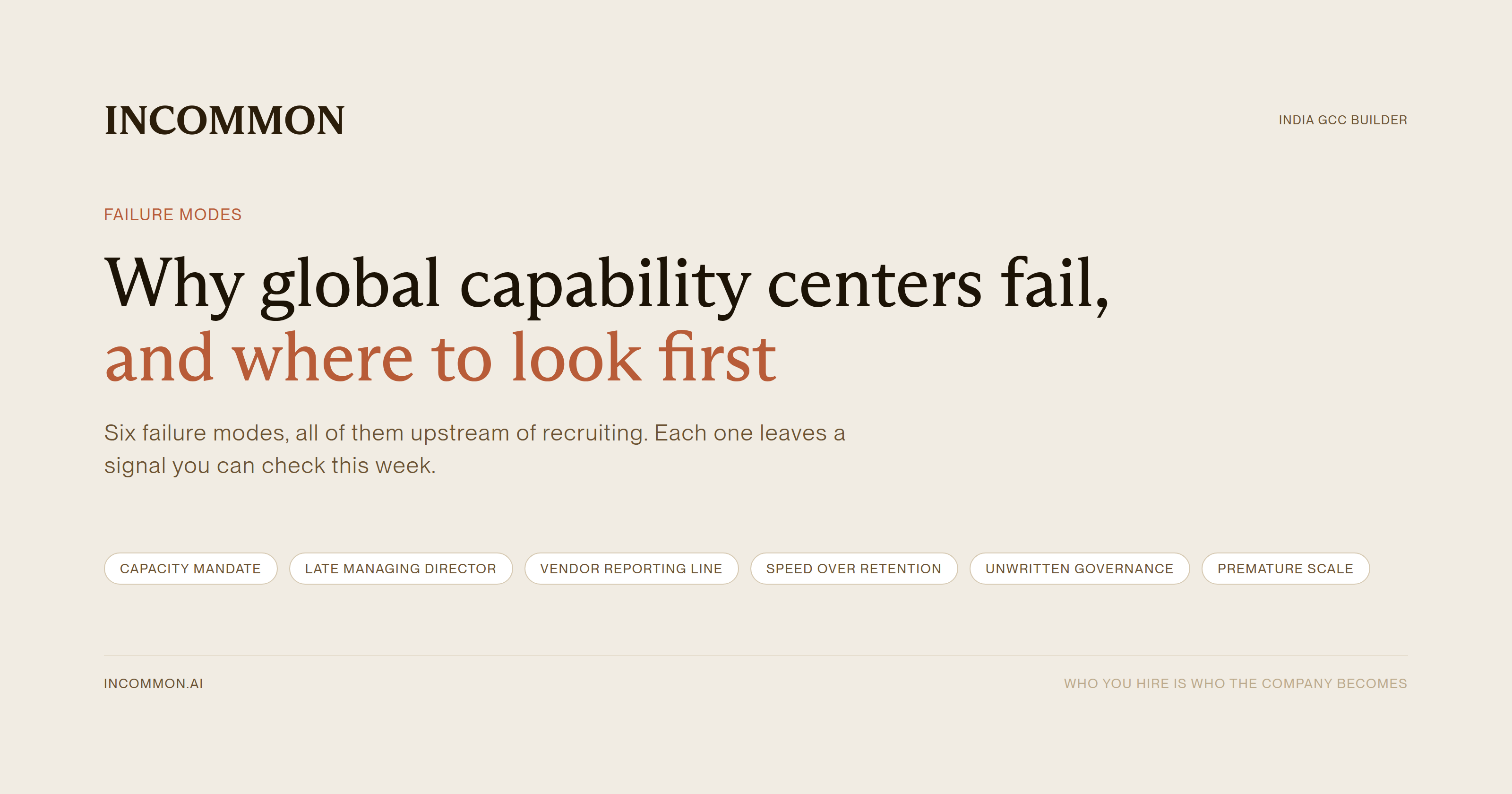
| GCCs fail for six reasons, and engineering quality is not one of them. Three concern ownership: a capacity mandate, a late or powerless managing director, and a reporting line that runs into a provider. Three concern what happens next: speed measured ahead of retention, unwritten governance, and volume added before the first team owns anything. All six share a cause. The parent company makes operating decisions before the center has the people or context to challenge them. |
|---|
Why GCCs fail usually comes down to the parent company asking for capacity instead of ownership, delaying local leadership, or keeping decisions at headquarters.
The result is a team that waits for direction, struggles to hire senior people, and grows before it has delivered anything meaningful. In our work, Indian engineering quality has rarely been the issue.
This piece is for CTOs and VPs Engineering opening an India center, or 6 months into one that is harder to run than expected. Read the checks below as practical tests rather than a verdict. Every signal is visible this week.
These checks concern the first operating choices, not a general diagnosis of every GCC problem. They work best before routine work makes an unclear structure feel normal and hard to fully reverse.
Why do global capability centers fail?
The answer begins before recruiting, real estate, or payroll. A global capability center is part of your organization. However, that structure only pays off when the team owns a defined outcome and can act on it without asking.
Authority is where it usually has problems. Headquarters keeps product choices, budget calls, and routine approvals, then expects an India team to move with autonomy. This gap can turn capable engineers into a queue for decisions.
None of this is specific to India. The problems facing GCCs tend to surface once a center is already running. This piece works backward from those problems to the six decisions that cause them.
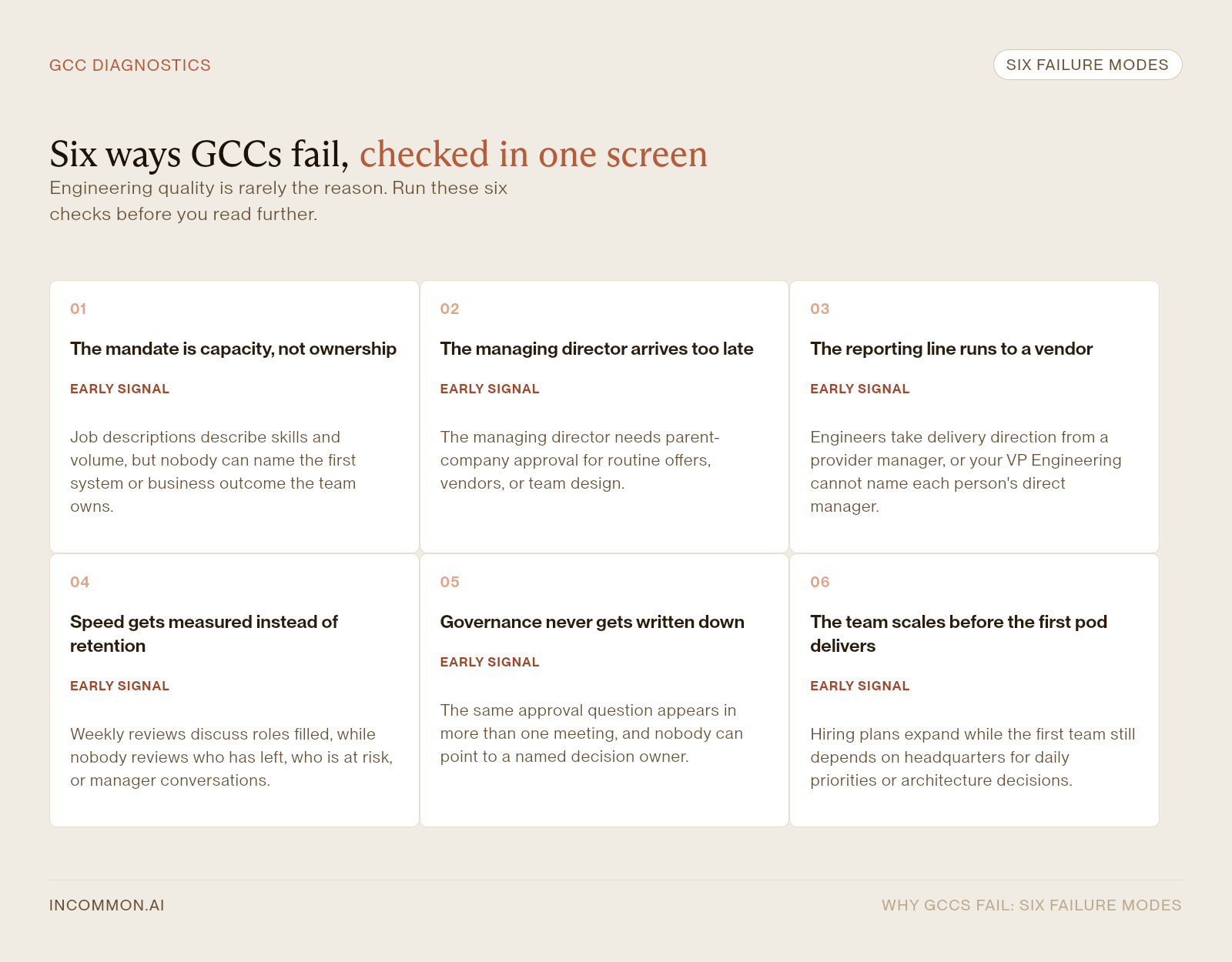
The first choice is the mandate. It tells everyone what the center is here to own.
The mandate is capacity, not ownership
A mandate framed as "engineering capacity" can sound flexible, but it leaves the team without a clear remit. Engineers do not know which system they are responsible for, product leaders do not know who makes trade-offs, and headquarters keeps making the calls by default. Moving work to India changes little if nobody can point to an outcome the team owns.
A group that receives tickets without a product or platform outcome cannot make decisions.
Senior engineers see that quickly. They join work with a shape, a customer, and a counterpart who can answer hard questions.
Early signal: Your job descriptions describe skills and volume, while nobody can name the first system or business outcome the team owns.
Preemptive fix: Start with a senior-led, cross-functional team of 8 people. We call this a delivery pod. Give that pod a bounded outcome, a product counterpart, and access to the people who set priorities. 3 or 4 such teams can support a center of 30 to 35 people.
A bounded outcome changes the hiring conversation. You are no longer asking a senior engineer to join a capacity pool. For Accompany Health, we put 22 people live in 10 weeks, with 100% retention across the build.
The team worked on the core product with regulated health-data experience from day one. The GCC setup roadmap starts in the same place: define the business case before moving to execution.
The managing director arrives too late
The office, city, and organization chart sometimes get fixed before the managing director starts. The new leader inherits decisions that should have benefited from local judgment. A title without decision rights creates a coordinator who escalates everything.
That arrangement often looks tidy on paper. It slows down as soon as compensation, office needs, or hiring priorities change. The managing director becomes the messenger between teams rather than the person accountable for the center.
Early signal: The managing director needs parent-company approval for routine offers, vendors, or team design.
Preemptive fix: Bring the leader in before long-term choices harden. Write down which decisions belong locally, which need engineering leadership, and which remain with the parent company. A useful leader has a clear budget boundary, direct access to product leadership, and a way to resolve disagreements.
Our India office work begins with what the team must deliver, then maps roles and seniority. Local leadership should be part of that work. With decision rights in place, the next question becomes who the team reports to.
The reporting line runs to a provider
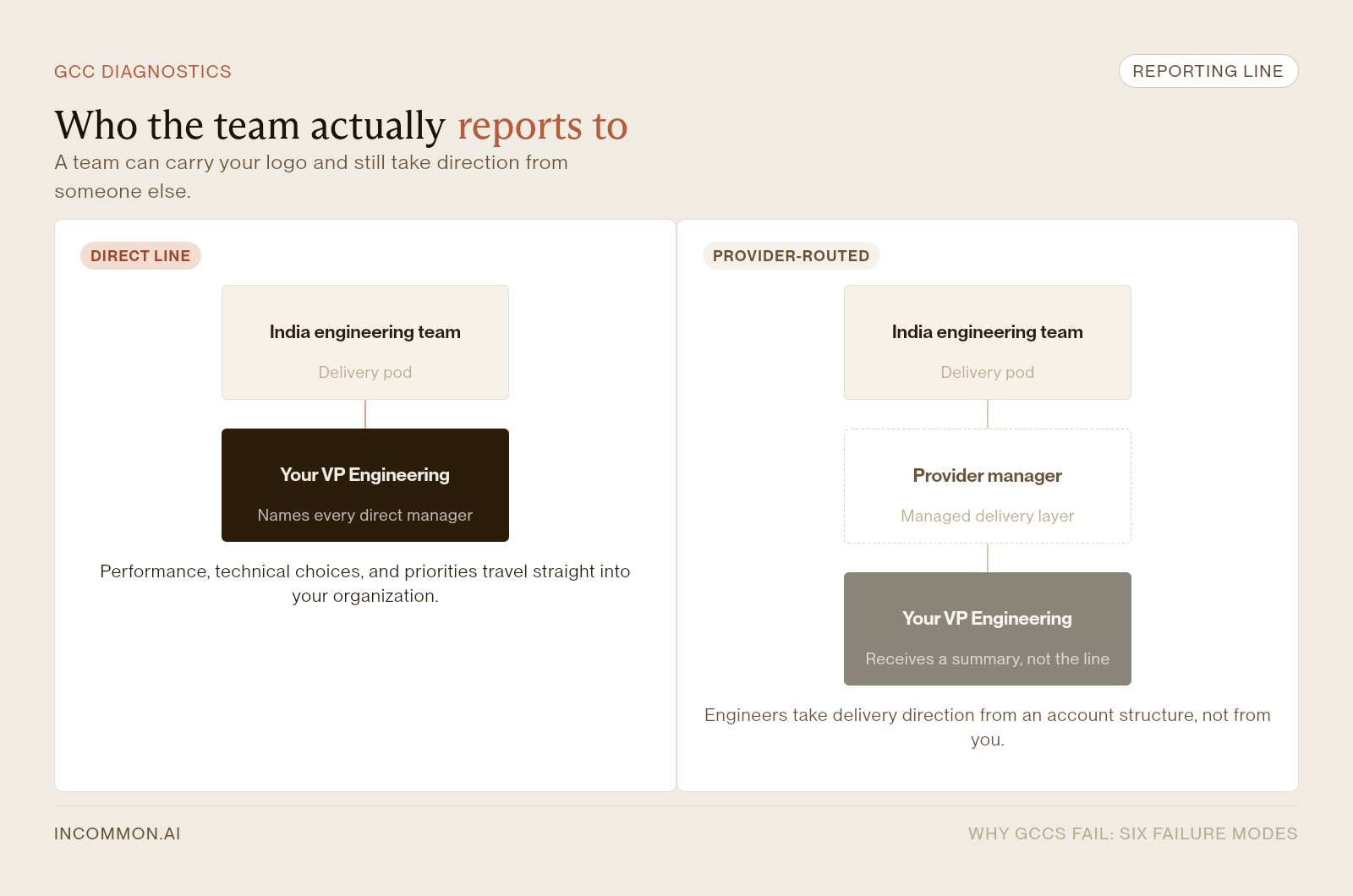
A team can carry your logo and still work through someone else's priorities. A provider here means an external company that handles setup or operations, such as employment, workspace, payroll, compliance, or delivery administration. If the reporting line runs through that provider, your engineering leaders receive a managed delivery layer instead of direct organizational ownership.
The distinction shows up in ordinary work. Performance conversations, technical choices, and priorities travel through an account structure. A provider can support the center, but it cannot stand between your engineers and your engineering leadership.
Early signal: Engineers take delivery direction from a provider manager, or your VP Engineering cannot name each person's direct manager.
Preemptive fix: Set a reporting line into your organization. Give every delivery pod named product and engineering counterparts, plus working sessions where decisions happen. A provider can support employment, workspace, payroll, or administration while your leaders own the work.
A direct line makes the next mistake easier to see. It changes what you measure.
Speed gets measured instead of retention
A fast hiring dashboard can conceal a team that starts looking elsewhere before it has settled. Departures in month 4 create another search, another ramp, and more management time for the same role.
The cost is not abstract. Your existing engineers carry the context while the replacement learns it.
Speed belongs on the dashboard. Track it alongside retention, manager quality, role clarity, and whether new hires have meaningful work.
Early signal: Weekly reviews discuss roles filled, while nobody reviews who has left, who is at risk, or whether managers have held career conversations.
Preemptive fix: Set retention checks from the first month. Review pay, manager contact, onboarding context, and role scope with the same discipline as open roles. Fix the issue that makes the person leave instead of treating every departure as a recruiting problem.
The measure we care about at InCommon is who is still there later. 33% of the candidates we send are hired, and every candidate carries a 6-month replacement guarantee.
We hired 60 underwriters for Findigs in 4 months, and 90% are still in place. That figure is worth more than a faster one, because it held across 60 hires rather than a handful. When retention is part of the measure, governance has to support it.
Governance never gets written down
Teams lose time when routine choices need an overnight answer from the parent company. The first few delays feel manageable. Soon an offer, pay-band exception, vendor choice, access exception, or architecture call is waiting for a person who did not know they owned it.
Meetings cannot repair an unwritten operating model. People leave with different recollections of what was agreed, then every exception becomes a fresh negotiation.
Early signal: The same approval question appears in more than one meeting, and nobody can point to a named decision owner.
Preemptive fix: Create a decision register before the center grows. List recurring decisions, the owner, the required input, the escalation path, and the expected response time. Keep it close to the teams using it, then update it when a decision exposes a gap.
This is more specific than generic advice to improve alignment. The future-ready GCC workforce guide covers the capabilities a team needs. Governance decides whether those capabilities get used.
Scaling before the first pod delivers
Adding people feels like progress when the center is new. If the first group has no clear outcome, the next group inherits the same uncertainty. More people then create more handoffs, more status work, and more questions for headquarters.
Start with ownership that a small group can carry. Let that group establish how work enters, who decides, and what good delivery looks like. Then add the next pod around another defined outcome.
Early signal: Hiring plans expand while the first team still depends on headquarters for daily priorities or architecture decisions.
Preemptive fix: Hold the next wave until the first pod has shipped its agreed work and can explain its operating rhythm. That does not mean waiting for perfection. It means proving that ownership works before multiplying its coordination needs.
The GCC workforce trends piece is useful context for role expectations. Here, the order matters more: ownership first, volume second.
The next step is to make those observations routine instead of waiting for a quarterly review.
The signals month by month
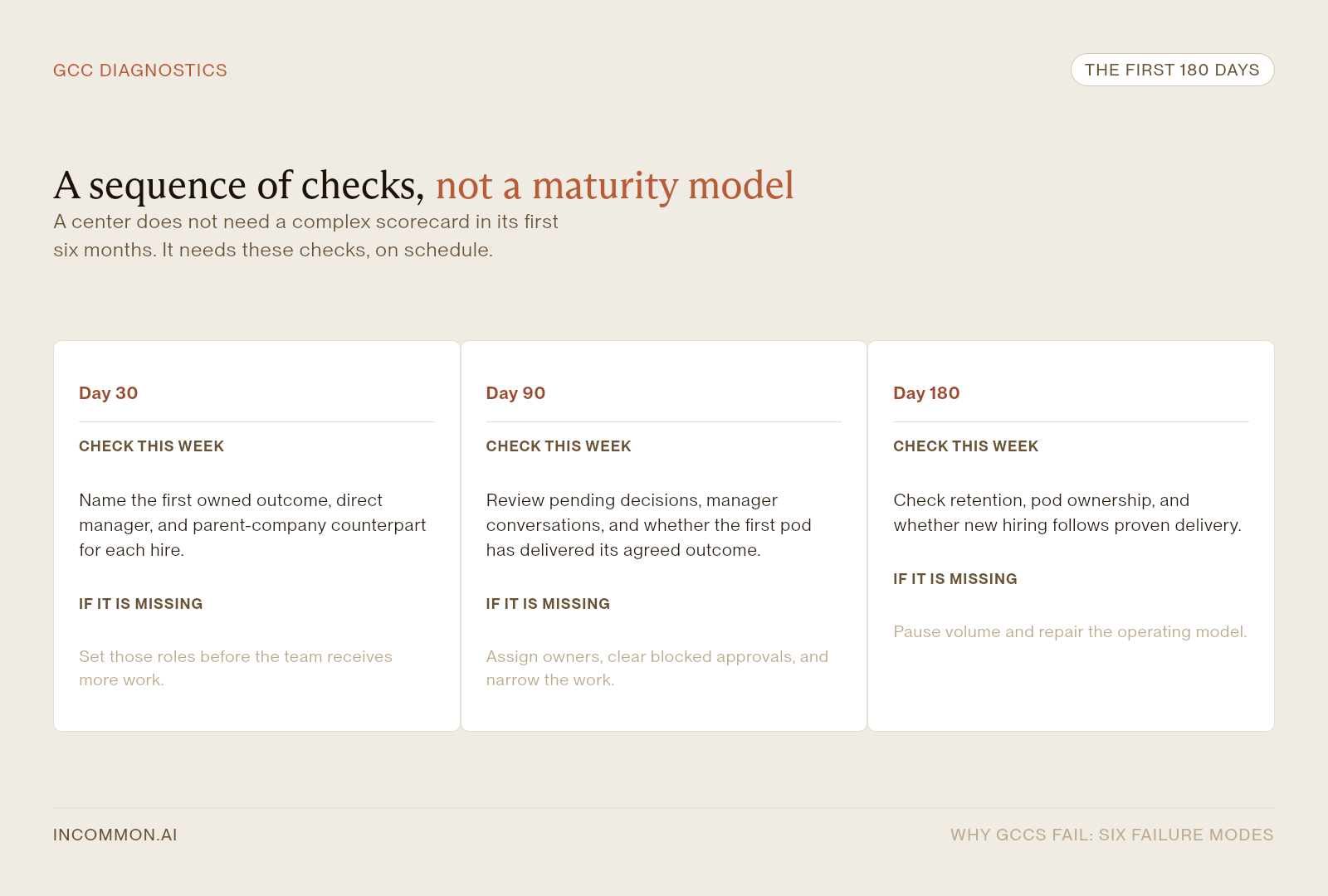
A center does not need a complex scorecard in its first 6 months. It needs a few checks that reveal whether ownership, leadership, reporting, retention, governance, and scale are working together:
| Timing | Check This Week | If It Is Missing |
|---|---|---|
| 30 days | Name the first owned outcome, direct manager, and parent-company counterpart for each hire. | Set those roles before the team receives more work. |
| 90 days | Review pending decisions, manager conversations, and whether the first pod has shipped its agreed outcome. | Assign owners, clear blocked approvals, and narrow the work. |
| 180 days | Check retention, pod ownership, and whether new hiring follows proven delivery. | Pause volume and repair the operating model. |
What a provider cannot fix
A provider cannot choose your mandate. It cannot shorten a slow interview loop if your leaders do not make time, or supply product context your team has not shared. It also cannot invent named counterparts inside your organization.
The parent company has to decide who makes interview time and who answers product questions within 24 hours. It has to give someone authority to unblock a decision, rather than leaving the team to chase a meeting across time zones.
That authority needs a named owner before the first offer goes out. If nobody owns it, the team waits, candidates move on, and local leaders learn to escalate instead of act. A missed response time is a decision in itself.
The responsibility also applies when priorities change. The parent company must say who can revise a role, pause a requisition, or settle a conflict between product urgency and the hiring bar. Local leaders need the answer before a candidate, manager, or delivery pod is left waiting.
A provider can arrange the operational work around those decisions, but it cannot make them for you. Interview capacity, product access, and authority must come from the people accountable for the outcome. When they do not, more process only gives the delay somewhere to hide.
At InCommon, we put the operating foundations in place: a managing director, the first pod, employment, and compliance. You retain the decisions that determine what the team owns, how it prioritizes work, and who can unblock it.
These foundations are what we put in place on every team we build.
See how Findigs, Accompany Health, Veramatic and Podifi built their teams.
Real teams, real results, from faster hiring to lasting retention.
Final thoughts
The six failure modes are connected. An unclear mandate weakens the managing director's role, which blurs the reporting line and turns governance into a queue. Scale adds pressure to every gap.
Start with the earliest visible signal. Give the first pod an outcome, put decisions with named owners, and measure whether people stay long enough to own their work. Get those three right early, and the center becomes part of the company rather than a place work gets sent.
Frequently asked questions
What Is The Most Common Reason A GCC Fails?
The most common of the GCC failure reasons is an unclear mandate. When a team is asked for general capacity instead of a defined outcome, decisions stay elsewhere and senior people cannot see what they own.
How Long Before You Know It Is Working?
You can see the early conditions within 30 days. By 90 days, the first pod should have named counterparts, a working decision path, and evidence that it owns an agreed outcome.
Can A Failing GCC Be Turned Around?
Yes, if the parent company changes the operating conditions. Start by narrowing the mandate, assigning decision owners, repairing the reporting line, and pausing added volume until the first team has ownership.
Is Retention The Main Problem?
Retention is an important symptom, not the only diagnosis. People leave when role scope, manager access, product context, or career direction stay unclear, which are common global capability center challenges.
Does Size Affect GCC Failure Risk?
Size exposes unresolved issues faster. A 30 to 40 person center needs clear pod ownership and governance because each new team increases the number of handoffs and decisions.
What Should The First 90 Days Look Like?
The first 30 days should establish the mandate, direct managers, and named counterparts. By day 90, review pending decisions, retention signals, and whether the first pod has delivered its agreed outcome. Those checks surface GCC problems before they become part of the routine.
Written by
CEO, InCommon
Piyush Kedia is the CEO of InCommon, a talent infrastructure company that helps US and global enterprises set up and scale Global Capability Centers (GCCs) in India. He works with founders, CTOs, and heads of talent to design smaller, AI native GCC teams that focus on judgment work, not just headcount, so India offices stay senior, stable, and production ready. Before InCommon, Piyush built Blue Vector into a 50 person creative agency serving brands such as Trump Towers, Audi, and Porsche, giving him a front row view of how high performing teams are hired, managed, and grown.