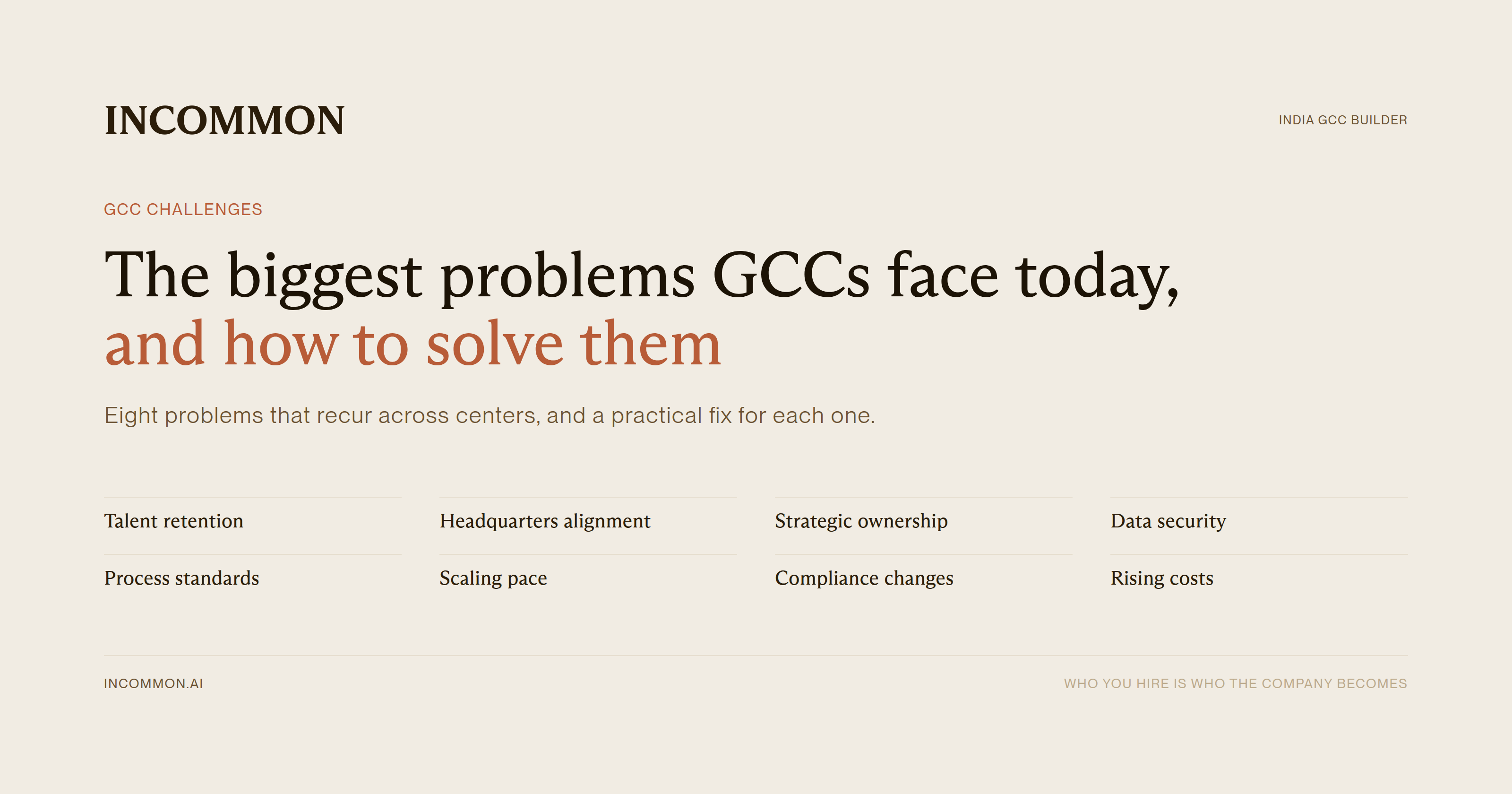
The Biggest Problems GCCs Are Facing Today (And How to Solve Them)

See how Findigs, Accompany Health, Veramatic and Podifi built their teams.
Real teams, real results, from faster hiring to lasting retention.
| Quick Answer: Global Capability Centers (GCCs) face challenges that extend beyond cost management. Rising operational expenses, difficulty retaining talent, cybersecurity risks, cultural misalignment with headquarters, and weak process standardization are recurring obstacles. Addressing these issues requires shifting focus from cost savings to long-term value, strengthening compliance, building stronger leadership alignment, and creating sustainable growth models. By solving these challenges, GCCs can function not only as efficient delivery hubs but also as strategic drivers of global business success. |
|---|
Introduction: Do GCCs Have Problems?
Global Capability Centers (GCCs) have grown from cost-saving units into high-value business hubs. They now handle critical operations, support global growth, and often act as engines of innovation.
Yet this transformation has not come without obstacles. GCCs frequently struggle with rising costs, retaining top talent, protecting sensitive data, and building trust with headquarters.
The following sections explore the most pressing challenges GCCs face today — and the practical steps that can help overcome them.
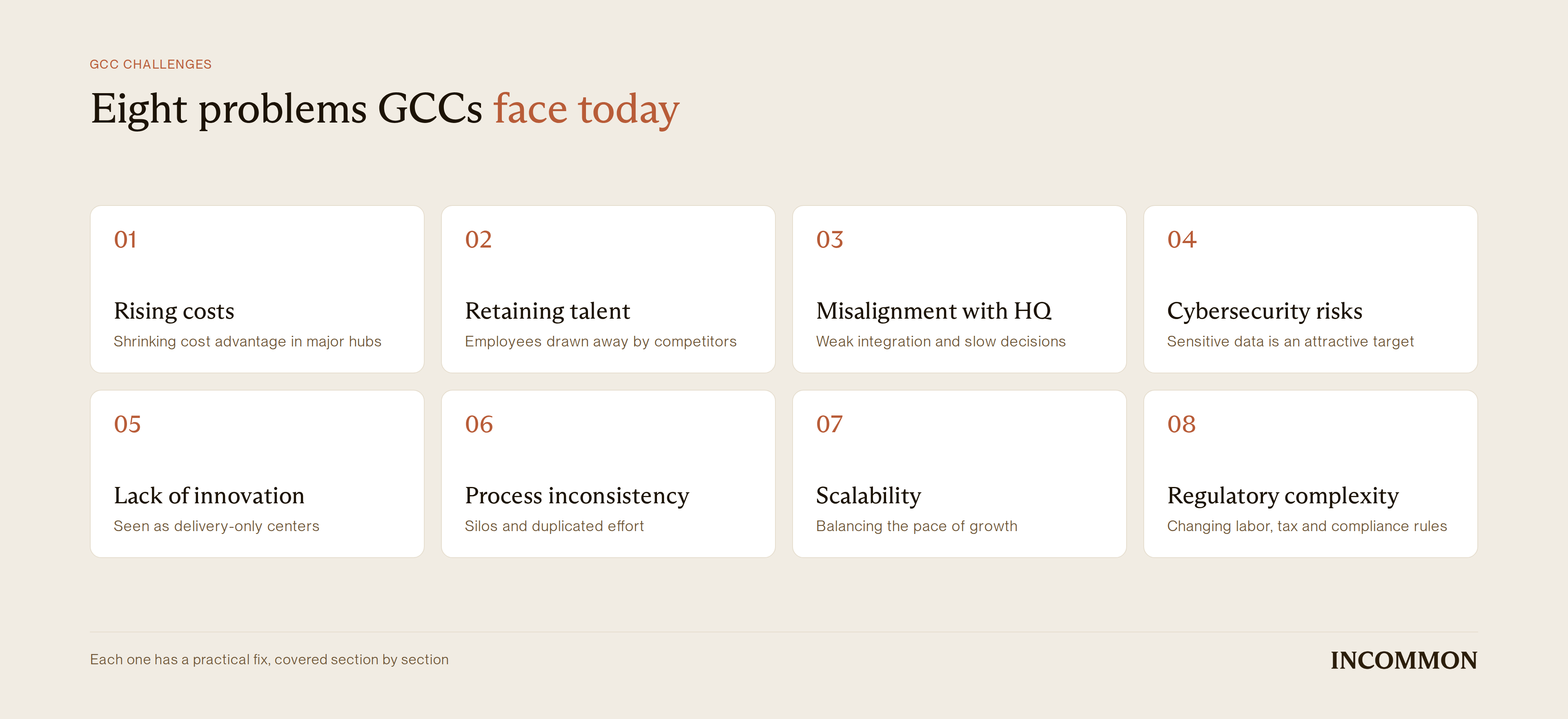
1. Rising Costs and Shrinking Cost Advantages
The Problem
The original value proposition of GCCs was rooted in lower operating expenses. But wages in key cities, infrastructure requirements, and reduced tax incentives have eroded this advantage.
The Solution
- Shift the narrative: measure GCCs by value delivered, not just costs saved
- Explore opportunities in secondary locations where operating expenses remain competitive
- Use automation and digital systems to reduce dependence on manual work
- Continuously review tax and regulatory obligations
2. Retaining Top Talent in a Competitive Market
The Problem
GCCs compete for the same talent pool as global technology firms, startups, and multinational headquarters. Skilled employees are quick to leave for higher pay or more interesting projects.
The Solution
- Build career growth paths that give employees long-term reasons to stay
- Provide flexible work arrangements to attract and retain diverse talent
- Offer clear upskilling opportunities so employees see future prospects within the GCC
- Strengthen identity and culture so the GCC is not seen as just a delivery unit
3. Cultural and Operational Misalignment with Headquarters
The Problem
Many GCCs operate in silos, disconnected from headquarters. Time zones, unclear expectations, and mismatched work styles cause slow decision-making and inefficiencies.
The Solution
- Launch structured collaboration between GCC leadership and global teams
- Ensure GCCs are included in high-impact projects, not just repetitive tasks
- Introduce leadership exchange programs for stronger mutual understanding
- Pair headquarters leaders with GCC employees through mentorship models
4. Cybersecurity and Data Protection Risks
The Problem
With access to sensitive company and customer data, GCCs are natural targets for cyberattacks. Weak protocols or careless employee behavior can result in breaches and compliance failures.
The Solution
- Deploy strict "zero-trust" security models that verify every access point
- Train employees regularly on security awareness and data handling
- Audit compliance against major international standards
- Use intelligent security tools to identify unusual activity early
5. Lack of Innovation and Strategic Ownership
The Problem
Some GCCs remain stuck in delivery mode, executing instructions rather than influencing business direction. This perception risks limiting their value.
The Solution
- Establish innovation labs that encourage testing and experimentation
- Provide GCC leaders with active participation in global strategy
- Create opportunities for teams to work on research and technology projects
- Recognize contributions that go beyond delivery, tying rewards to innovation
6. Inconsistent Process Standardization
The Problem
GCCs working across multiple regions often operate without uniform standards. This leads to duplication of effort, inconsistent quality, and inefficiencies.
The Solution
- Develop process documentation that is universally accessible
- Set up governance teams to maintain global standards
- Apply automation to enforce consistency across workflows
- Conduct periodic reviews to confirm alignment with business objectives
7. Managing Cost-Effective Scalability
The Problem
Scaling too quickly creates inefficiencies; scaling too slowly results in missed opportunities. Many GCCs struggle to balance these forces.
The Solution
- Rely on data to plan workforce and infrastructure expansion
- Use hybrid work to minimize reliance on large physical spaces
- Build partnerships with local education and training institutions
- Adopt modular scaling, adding functions in manageable increments
8. Regulatory and Compliance Complexities
The Problem
Countries frequently update labor, tax, and compliance rules. GCCs that fail to adapt risk penalties, reputational damage, and operational disruptions.
The Solution
- Hire legal and compliance experts with strong knowledge of local regulations
- Automate compliance monitoring to detect risks in real time
- Maintain close ties with government and industry bodies for early updates
- Develop contingency plans for unexpected legal changes
Most of these challenges are easier to handle with a partner who has met them before.
Everything you need to build and run your India GCC.
Entity, hiring, workspace and ongoing operations under one agreement.
Table: GCC Challenges and Solutions
| Challenge | Problem Summary | Practical Solutions |
|---|---|---|
| Rising Costs | Shrinking cost advantage in major hubs | Shift to value focus; explore Tier-2/3 cities; automation |
| Retaining Talent | Employees attracted by competitors | Career growth paths; flexible work; upskilling |
| Misalignment with HQ | Weak integration, communication delays | Structured collaboration; exchange programs |
| Cybersecurity Risks | Sensitive data vulnerable to attacks | Zero-trust frameworks; employee training |
| Lack of Innovation | Seen as delivery-only centers | Innovation labs; leadership inclusion |
| Process Inconsistency | Silos and duplicated efforts | Standardized workflows; governance teams |
| Scalability Issues | Difficulty balancing growth pace | Data-driven planning; modular scaling |
| Regulatory Complexities | Changing local laws and compliance risks | Legal expertise; automated compliance tools |
Conclusion
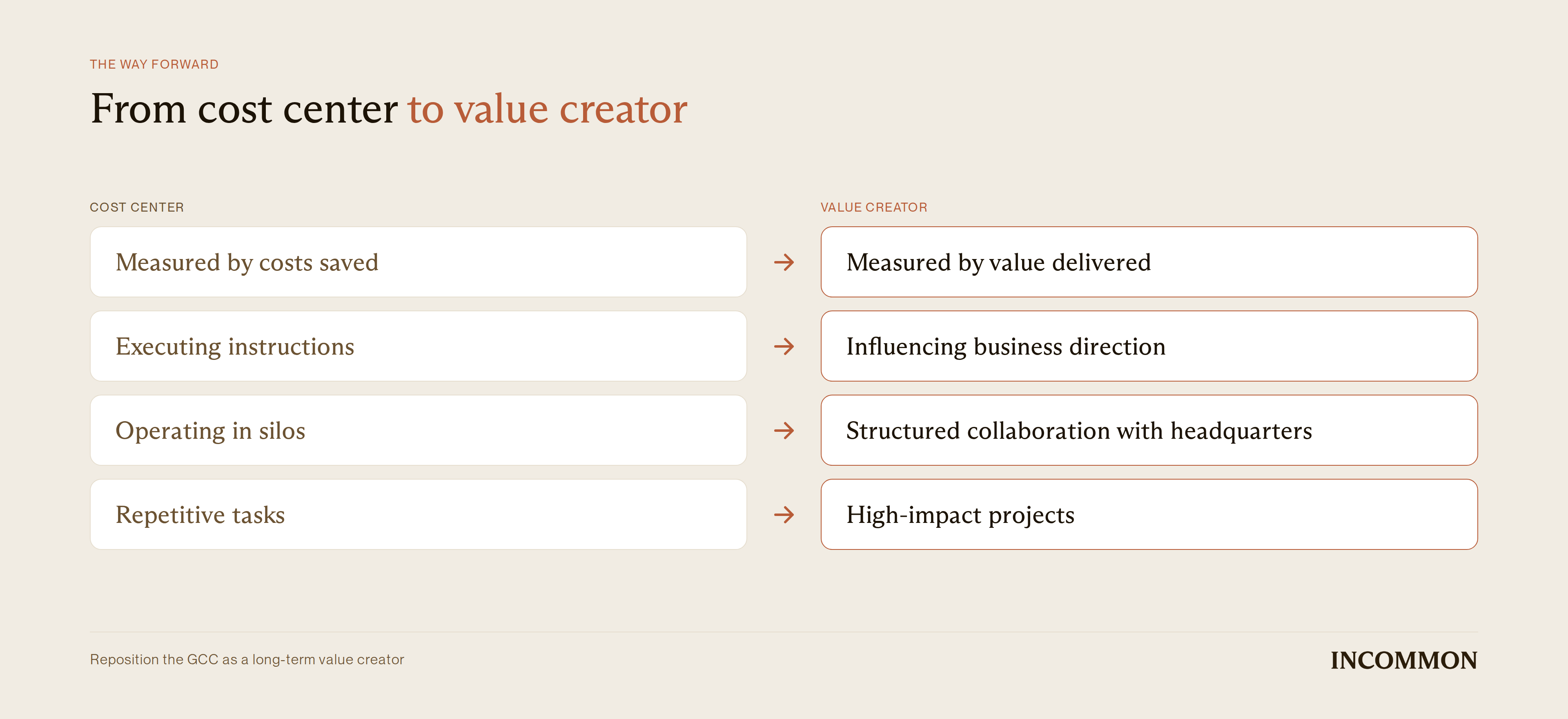
GCCs are under pressure to deliver efficiency and strategic value, but challenges such as rising costs, talent retention struggles, cybersecurity risks, and compliance pressures can limit their success.
The way forward is to reposition GCCs as long-term value creators rather than short-term cost centers. By addressing misalignment, standardizing processes, strengthening security, and driving innovation, organizations can ensure their GCCs continue to play a decisive role in shaping business outcomes.
Frequently asked questions
Why are GCCs facing rising costs?
Operating expenses in major cities have increased due to higher wages, infrastructure requirements, and reduced government incentives.
What is the biggest workforce challenge in GCCs?
Retention. Skilled employees have many alternatives, making it difficult to keep talent for the long term.
How can GCCs align better with headquarters?
By building structured collaboration models, including leadership exchanges, and involving GCCs in strategic projects.
Why is cybersecurity such a major risk?
Because GCCs manage sensitive business and customer data, making them attractive targets for attackers.
How can GCCs move beyond being seen as service centers?
By creating innovation labs, influencing global strategy, and being recognized for value creation beyond delivery.
What is the best way to ensure process consistency?
Clear documentation, global governance teams, automation, and periodic reviews.
How can GCCs scale sustainably?
Through data-driven planning, hybrid work models, partnerships with local talent pools, and modular growth strategies.
How should GCCs handle changing regulations?
With strong legal expertise, automated compliance systems, and proactive engagement with policymakers.
Written by
CEO, InCommon
Piyush Kedia is the CEO of InCommon, a talent infrastructure company that helps US and global enterprises set up and scale Global Capability Centers (GCCs) in India. He works with founders, CTOs, and heads of talent to design smaller, AI native GCC teams that focus on judgment work, not just headcount, so India offices stay senior, stable, and production ready. Before InCommon, Piyush built Blue Vector into a 50 person creative agency serving brands such as Trump Towers, Audi, and Porsche, giving him a front row view of how high performing teams are hired, managed, and grown.