Performance reviews for offshore teams, how to maintain consistency

See how Findigs, Accompany Health, Veramatic and Podifi built their teams.
Real teams, real results, from faster hiring to lasting retention.
Quick look:
| Consistent performance reviews keep an offshore team engaged, aligned with company goals, and clear on how to grow. Set expectations and KPIs from day one, adjust feedback for cultural differences, use shared tools, and put every review in writing. Run the same templates, schedule, and manager training across onshore and offshore teams, judge outcomes rather than effort, and make each review a two-way conversation. Plan for time zones, limited day-to-day visibility, and isolation. |
|---|
A performance review is often thought of as a report card, but it's a little more complex than that.
It covers more than a rating of someone's technical knowledge. It is also a way to judge how they communicate, how they work with others, and whether they could lead.
Running reviews for an offshore team adds a few roadblocks. How do you ensure consistency when your team spans countries, cultures, and time zones?
Performance reviews are critical for growth, accountability, and motivation. When done right, they help offshore teams feel valued and aligned with company goals. So, let's dive into how you can make performance reviews work well for your offshore team.
Why offshore performance reviews matter
Performance reviews are an essential component of managing offshore teams. They show your offshore team that their contributions matter. Here's why they're so essential:
- Improves engagement: Offshore employees often miss out on casual recognition due to distance. Regular reviews provide structured feedback and appreciation
- Aligns goals: Reviews help offshore team members understand how their work contributes to the bigger picture
- Identifies growth opportunities: Offshore employees need clarity on their career progression. Reviews are the perfect time to address this
Now that we've set the stage, let's explore how to maintain consistency in these reviews.
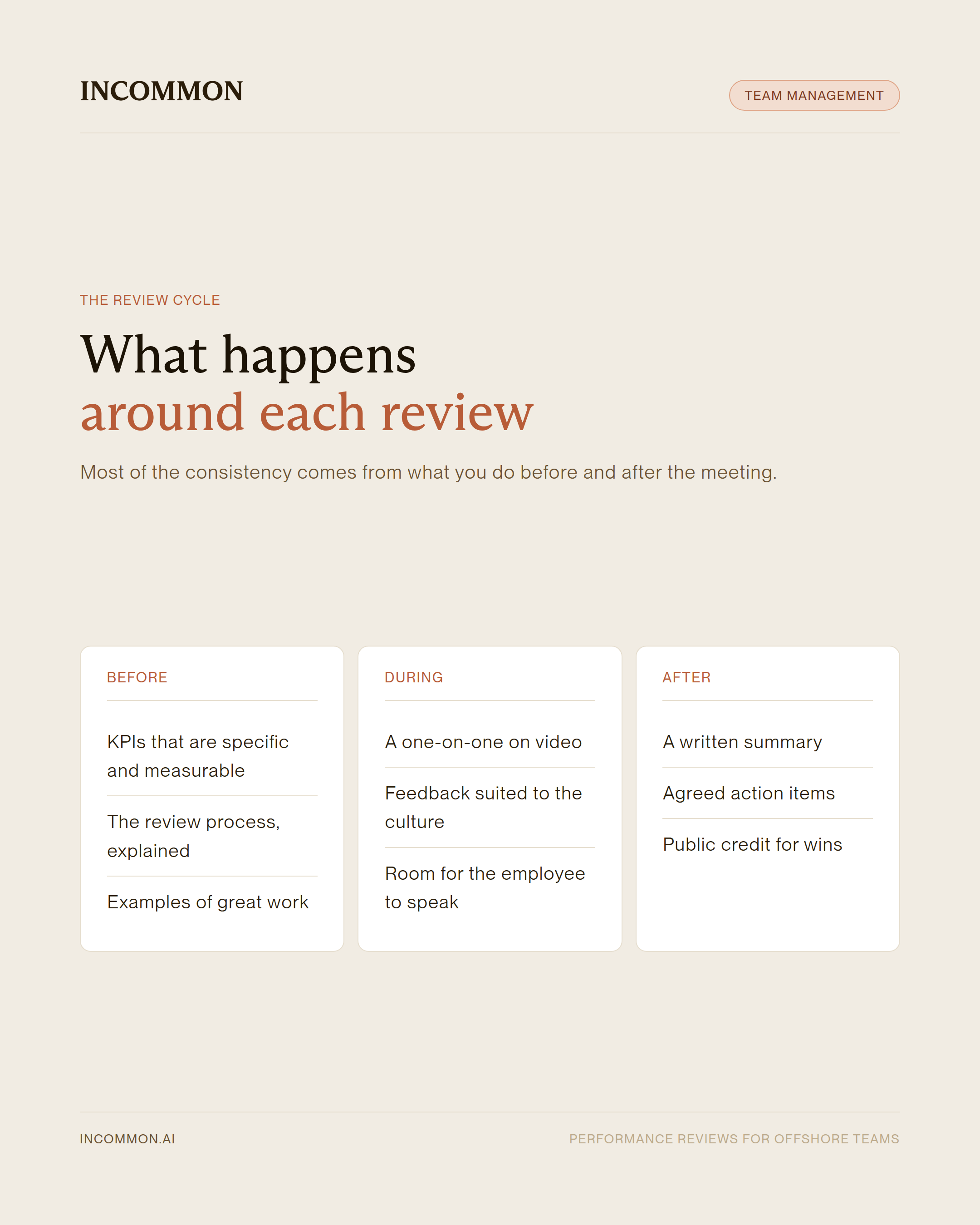
1. Set clear expectations from day one
Before jumping into reviews, set the ground rules. Offshore employees need clarity on what's expected from them:
- Define KPIs and metrics: Ensure key performance indicators (KPIs) are specific and measurable. For example, instead of "improve efficiency," use "reduce project turnaround time by 10%"
- Explain the review process: Offshore team members should know how often reviews happen and what will be evaluated
Pro tip: Share examples of excellent performance so offshore employees know what "great" looks like in your organization.
2. Tailor feedback for cultural sensitivities
Cultural differences matter a lot. Feedback that works in one country might be perceived as harsh or vague in another:
- Understand communication styles: Direct feedback might work well for some cultures, while others prefer a more diplomatic approach
- Balance positives and negatives: Start with strengths before discussing areas for improvement. This helps maintain a constructive tone
Pro tip: Do your homework on cultural nuances. It will show your offshore team that you value their background.
3. Use technology to bridge the gap
Consistency starts with having the right tools in place. Thankfully, tech makes it easier to keep offshore reviews on track:
- Use performance management platforms: Lattice, 15Five, or BambooHR can standardize reviews, making them more objective and trackable
- Schedule virtual one-on-ones: Platforms like Zoom or Microsoft Teams ensure face-to-face interactions, even if they're virtual
- Track progress in real time: Use collaboration tools like Asana or Trello to monitor project milestones and achievements
Pro tip: Record meetings (with permission) for reference and clarity, especially if language barriers exist.
4. Keep communication crystal clear
When reviewing offshore teams, clarity is your best friend. Misunderstandings can derail even the most well-intentioned feedback:
- Provide written summaries: After a review, share a summary of key points and action items via email or your performance management tool
- Avoid jargon: Stick to simple, straightforward language to ensure everyone's on the same page
- Ask for feedback on your feedback: Offshore employees might have insights on how to make reviews more effective
Pro tip: If language is a barrier, consider providing materials in the employee's preferred language or using professional translators.
5. Standardize the review process across teams
A consistent process ensures fairness and helps offshore employees trust the system:
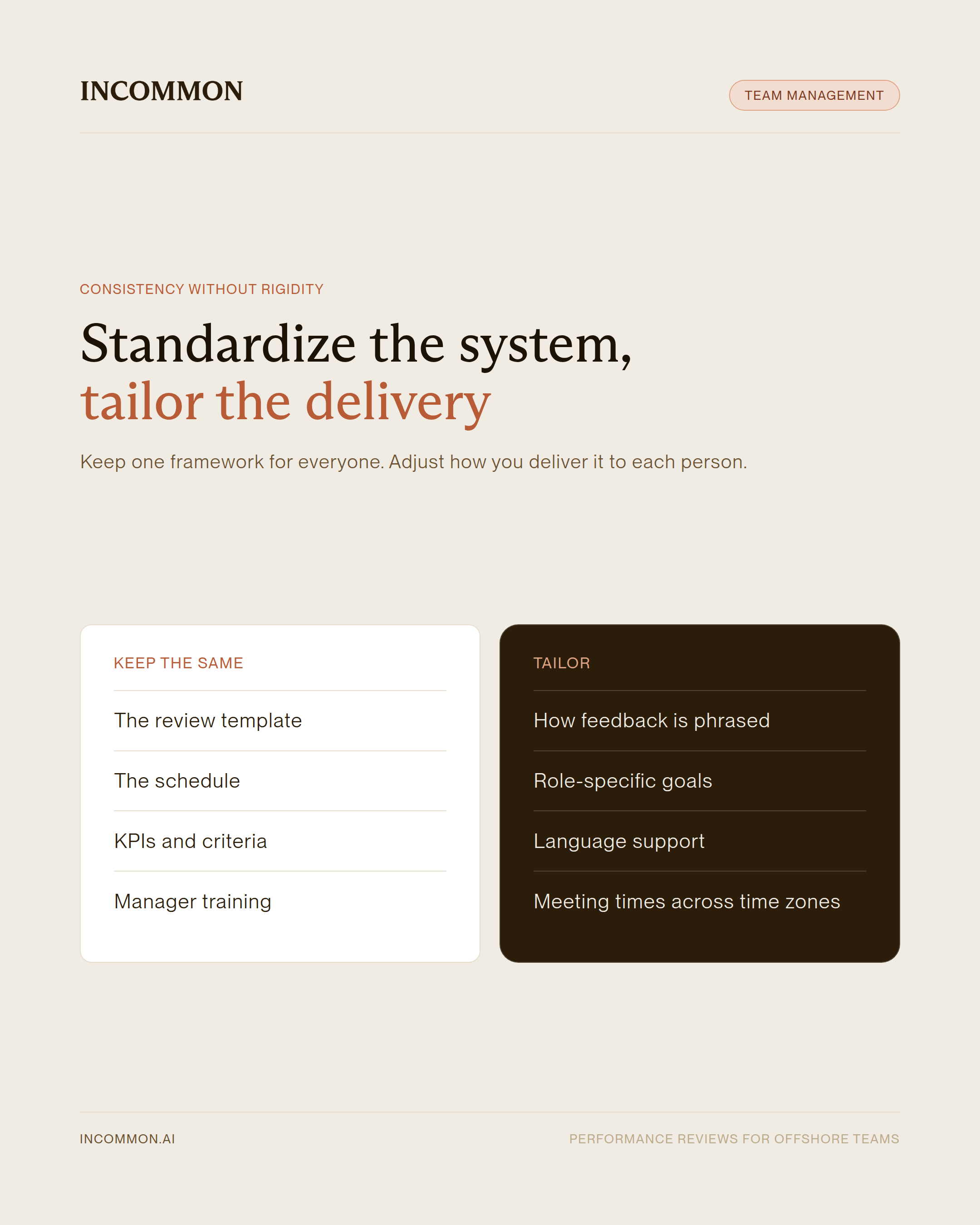
- Use uniform templates: Create a review template with the same sections for goals, achievements, challenges, and areas of improvement
- Stick to a schedule: Whether reviews are quarterly, biannual, or annual, consistency in timing builds trust
- Train managers: Ensure that every manager conducting reviews, whether for onshore or offshore teams, follows the same guidelines
Pro tip: Consistency doesn't mean rigidity. Tailor some aspects to suit individual roles while sticking to a standard framework.
6. Focus on outcomes, not just effort
With offshore teams, it can be tempting to base reviews on how hard someone is working. But results should almost always take center stage:
- Measure deliverables: Focus on what the offshore team member has accomplished rather than hours logged
- Acknowledge initiative: Celebrate proactive problem-solving and creative solutions, as these add long-term value
- Track progress toward goals: Link reviews to previously set KPIs to assess growth objectively
Pro tip: Highlight how the outcomes impact the company's goals. Offshore employees often appreciate seeing the bigger picture.
7. Make reviews a two-way street
A performance review should be a conversation:
- Encourage offshore employees to share: Ask what's working for them and what's not
- Listen actively: Show genuine interest in their challenges, whether it's related to tools, time zones, or team dynamics
- Act on their input: If they suggest improvements, take those suggestions seriously and implement them where feasible
Pro tip: This approach not only improves morale but also helps uncover inefficiencies you might not have noticed.
8. Recognize contributions publicly
Offshore employees can sometimes feel invisible. Public recognition can change that:
- Highlight achievements in team meetings: Celebrate their wins during virtual team huddles
- Send out email shoutouts: Share their contributions with the wider team via email or internal newsletters
- Use peer recognition platforms: Tools like Bonusly let team members recognize each other's efforts, fostering appreciation across the board
Pro tip: Recognition boosts confidence and reinforces positive behaviors, leading to even better performance.
Consistent management is a large part of why the teams we built have stayed.
See how Findigs, Accompany Health, Veramatic and Podifi built their teams.
Real teams, real results, from faster hiring to lasting retention.
Common challenges and how to handle them
Even with the best intentions, performance reviews for offshore teams can hit roadblocks. Here's how to handle common challenges:
1. Time zone differences
Scheduling reviews across time zones can be a logistical nightmare:
- Solution: Use scheduling tools like Calendly to find overlap hours. Rotate meeting times to avoid burdening the same team members every time
2. Lack of real-time observations
It's harder to gauge offshore employees' day-to-day performance:
- Solution: Focus on measurable outcomes and encourage regular check-ins with their direct managers
3. Cultural misunderstandings
Feedback might not always be received as intended:
- Solution: Train reviewers on cultural sensitivity and include local team leads in the review process
4. Isolation and low engagement
Offshore employees may feel disconnected from the rest of the team:
- Solution: Schedule regular team-building activities, both virtual and in-person when possible, to boost morale and connection
5. Inconsistent feedback
Reviews can sometimes differ widely between onshore and offshore teams:
- Solution: Standardize your review process to ensure all employees are evaluated by the same criteria
Final thoughts
Reviewing an offshore team stretches traditional HR practices, and it is also a chance to rethink what reviews can achieve.
Good reviews bridge gaps, strengthen relationships, and drive results. It's not difficult to set up a review system that benefits both your company and your offshore team.
At the end of the day, performance reviews should help people grow, and that takes empathy, clear communication, and integrity.
Frequently asked questions
Why are performance reviews important for offshore teams?
Offshore employees miss much of the casual recognition that comes from sharing an office. Regular reviews give them structured feedback, show how their work fits company goals, and make career progression clear.
How do you keep performance reviews consistent across onshore and offshore teams?
Use the same review template, the same schedule, and the same manager guidelines for both teams, and measure everyone against the same KPIs.
How should feedback be adjusted for cultural differences?
Learn how each team prefers to receive feedback. Some cultures expect direct feedback and others a more diplomatic approach, so start with strengths before discussing areas to improve.
Which tools help run offshore performance reviews?
Performance management platforms such as Lattice, 15Five, or BambooHR standardize reviews, video calls on Zoom or Microsoft Teams keep them face to face, and tools like Asana or Trello track milestones.
Should offshore reviews focus on hours or results?
Focus on results. Measure deliverables and progress against agreed KPIs rather than hours logged, and recognize initiative and problem-solving.
How do you schedule reviews across time zones?
Use a scheduling tool to find overlapping hours and rotate meeting times so the same people are not always taking calls early or late.
Written by
CEO, InCommon
Piyush Kedia is the CEO of InCommon, a talent infrastructure company that helps US and global enterprises set up and scale Global Capability Centers (GCCs) in India. He works with founders, CTOs, and heads of talent to design smaller, AI native GCC teams that focus on judgment work, not just headcount, so India offices stay senior, stable, and production ready. Before InCommon, Piyush built Blue Vector into a 50 person creative agency serving brands such as Trump Towers, Audi, and Porsche, giving him a front row view of how high performing teams are hired, managed, and grown.