Protecting your IP when outsourcing AI development: legal and technical safeguards

See how Findigs, Accompany Health, Veramatic and Podifi built their teams.
Real teams, real results, from faster hiring to lasting retention.
Quick look:
| Outsourcing AI development puts your algorithms, models, code, and data in other people's hands, so IP protection has to be set up before the work starts. On the legal side, that means contracts that assign ownership to you, NDAs, IP ownership clauses, and indemnity clauses. On the technical side, it means encryption, access control, secure development environments, audits, and version control. The team's location matters too, because IP law and enforcement differ from country to country. |
|---|
Intellectual property (IP) is often a company's most valuable asset.
IP consists of the legal rights and protections assigned to creations of the mind, such as inventions, designs, and proprietary software. When it comes to AI, this could include algorithms, data models, and other technical solutions developed for specific use cases.
When a company outsources AI development to an outside team, protecting that intellectual property becomes critical. Outsourcing helps a company scale, with access to global talent and more flexibility. But it also introduces risks, particularly regarding IP theft, unauthorized use of proprietary information, and loss of control over sensitive data.
This article explains why IP protection matters so much when outsourcing AI development, and sets out the legal and technical safeguards that protect it.
Why IP protection matters when outsourcing
Without proper safeguards, AI outsourcing can leave intellectual property in a vulnerable state:
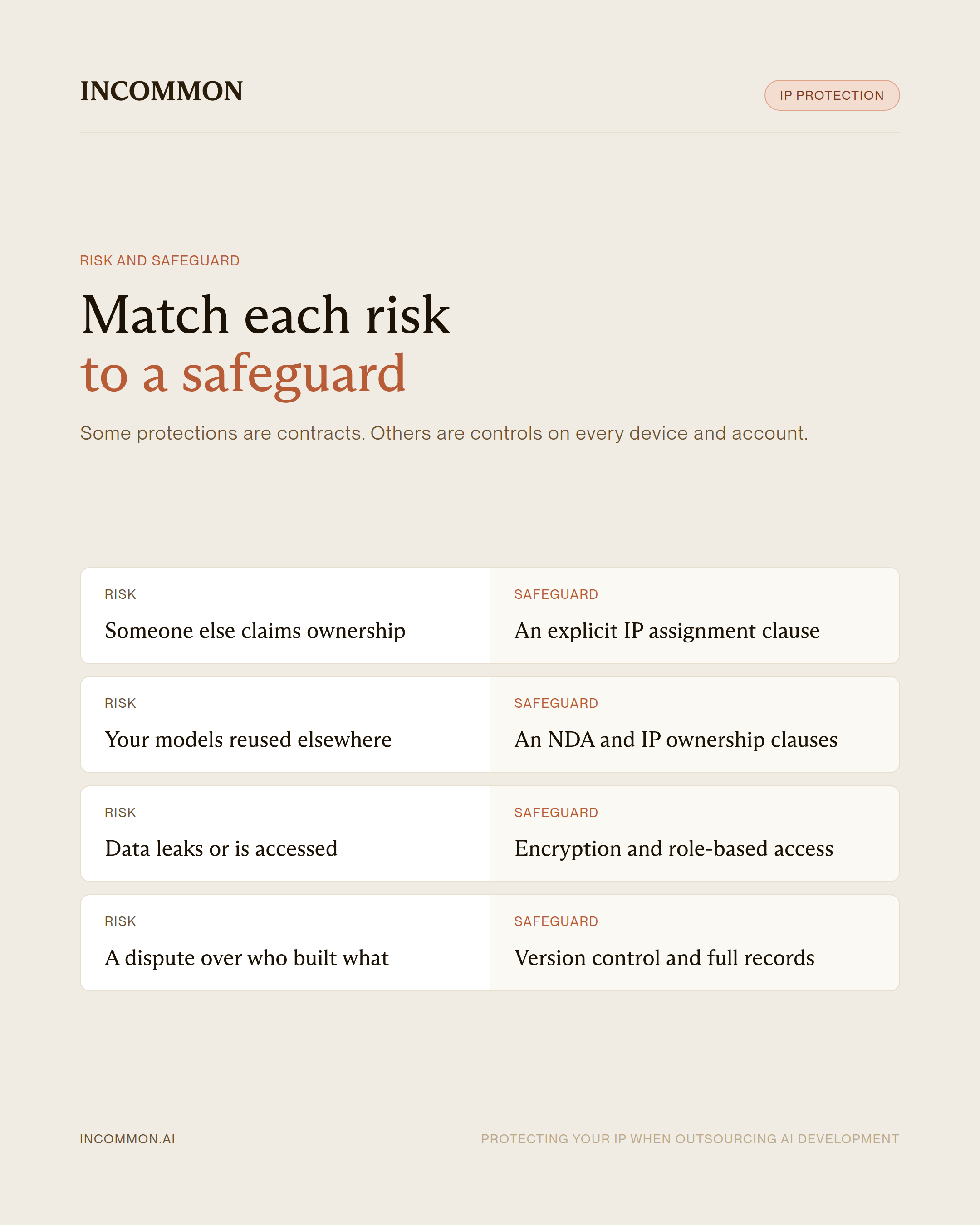
- Loss of ownership: Without proper contractual protections, outsourced companies may claim ownership over AI systems, algorithms, or code developed for your project
- Unauthorized use of AI: External teams may reuse your proprietary AI models or technologies in other projects without your permission
- Data security risks: AI development often relies on data, and sharing this data with external teams increases the risk of leakage or unauthorized access
- Potential for IP theft: Without stringent safeguards, your competitors or other parties may gain access to your AI technologies and use them without proper authorization
Protecting your IP is not only about legal compliance. Ensuring that your innovations and proprietary technologies remain secure and within your control is essential.
Legal safeguards for AI IP
Legal safeguards have to be put in place before outsourcing AI development. Here are some of the key legal measures to ensure your IP remains protected:
1. Well-defined contracts
Your outsourcing agreement or contract should explicitly outline ownership of the AI technology being developed. This includes:
- Defining IP ownership: Clarify that all IP rights to any AI-related work produced during the collaboration will belong to your company
- Scope of work: Specify the exact work being done by the outsourced team to avoid confusion over who owns which part of the final AI product
- Work-for-hire and assignment clauses: Include these clauses so the work produced by the external team belongs to you. Work for hire is a US legal concept, so for teams abroad, an explicit assignment of IP rights to your company is the safer route
2. Non-disclosure agreements (NDAs)
NDAs help protect confidential information by legally preventing the outsourced team from disclosing or using your intellectual property without permission. Key clauses to include in your NDA:
- Confidentiality: Ensure that the external team cannot share or use your IP or data outside of the project scope
- Non-compete clauses: Prevent the outsourced team from working with competitors using similar technologies for a specified period. Restrictions that apply after the contract ends are hard to enforce in some countries, including India, so rely mainly on confidentiality terms
- Time limits: Specify how long the NDA will remain in effect after the project ends
3. IP ownership clauses
It's essential to have IP ownership clauses in your outsourcing contract that define the following:
- Who owns the rights to the final product or technology developed
- How existing technologies, such as pre-existing AI models, will be handled
- If joint development occurs, clear terms should specify who owns which parts of the new IP
4. Indemnity clauses
Indemnity clauses protect your company from legal liability, for example, if the outsourced team infringes on third-party IP during development. Including these clauses helps transfer the financial and legal responsibility to the external team in case of an IP infringement.
Technical safeguards for AI IP
Beyond legal safeguards, technical measures are equally important in protecting your AI intellectual property when outsourcing development. Here are some key technical practices to keep your AI assets secure:
1. Data encryption
One of the most effective ways to protect sensitive data is through encryption. All data, both at rest and in transit, should be encrypted to prevent unauthorized access. This includes encryption for source code, datasets, and models shared with the external team.
2. Access control
Implement strict access control measures to ensure that only authorized personnel from the outsourcing team can access your proprietary AI models, code, or data. Use multi-factor authentication (MFA) and role-based access controls to limit access to sensitive information.
3. Secure development environments
Provide the outsourced team with a secure development environment where they can work on your AI projects without compromising security. Use virtual private networks (VPNs), isolated servers, or cloud environments with restricted access to ensure that your IP stays secure throughout the development process.
4. Auditing and monitoring
Set up regular audits and monitoring of the outsourced team's work to ensure compliance with your IP protection protocols. This helps track who accesses your data and when, and provides a record of any suspicious activities.
5. Version control and documentation
Maintain clear and thorough documentation of every step of the AI development process. Use version control systems to track changes to the source code and models, so that you have a clear record of all work done by the outsourced team. This documentation can serve as proof of your IP ownership in case of a dispute.
Other important considerations
When outsourcing AI development, the type of outsourcing (onshore, nearshore, or offshore) can also impact how you approach IP protection. Each of these models presents different challenges:
- Onshore outsourcing: Hiring developers within your country offers better control over legal frameworks and IP enforcement
- Nearshore outsourcing: Working with nearby countries can offer similar legal environments and easier communication, making it somewhat less risky than offshore
- Offshore outsourcing: Hiring from distant countries can widen your talent pool but requires extra diligence due to different legal jurisdictions and enforcement challenges
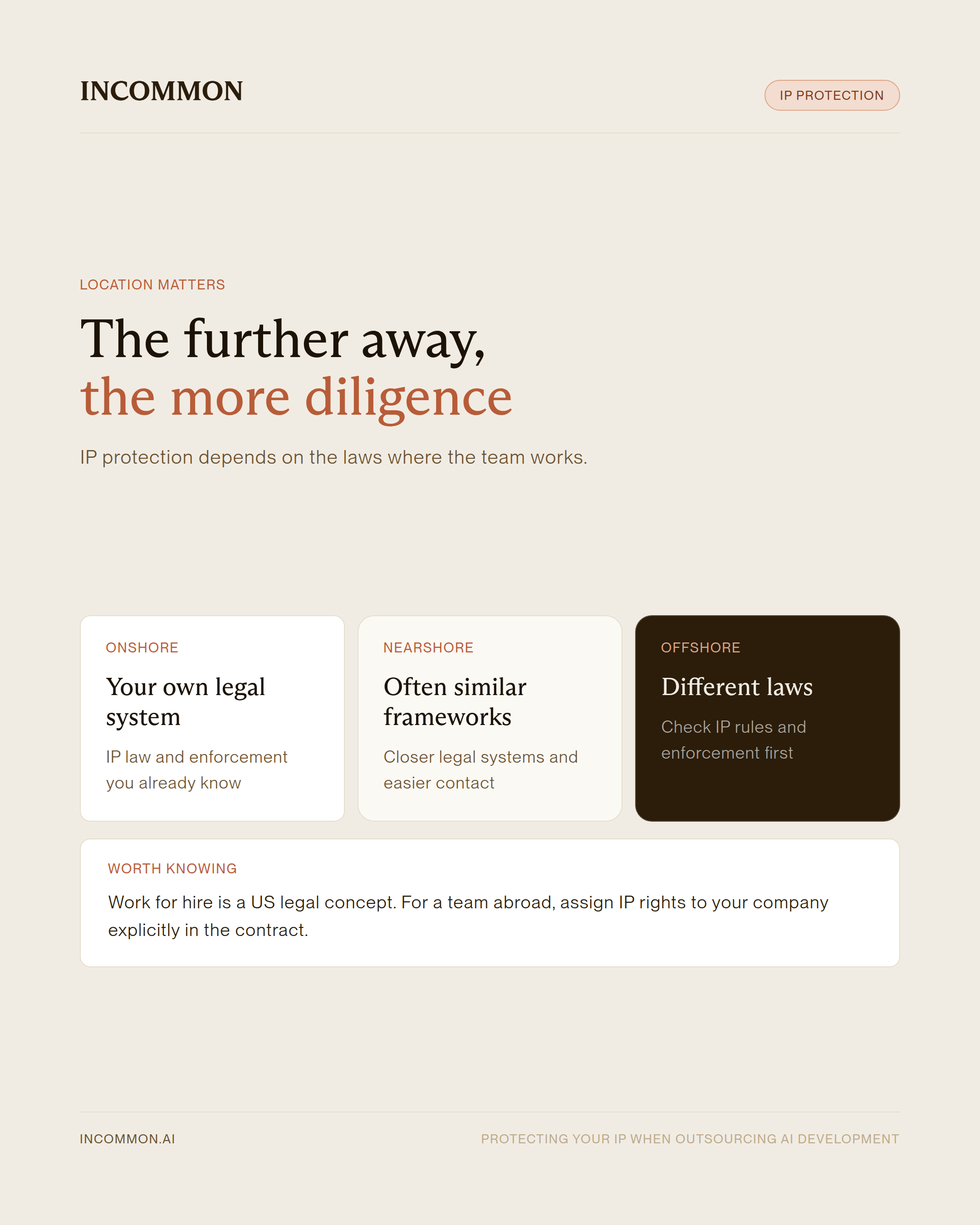
Understand these differences before planning your outsourcing strategy. If you employ the team through your own India entity instead of outsourcing, the picture changes again, and our GCC compliance guide covers IP and confidentiality for that route.
Best practices for protecting AI IP
Legal safeguards such as well-defined contracts, NDAs, and IP ownership clauses, combined with technical safeguards like data encryption and secure development environments, help to keep your proprietary AI technologies safe. While outsourcing has numerous benefits, the risks of losing control over your intellectual property should not be ignored.
Taking these steps early helps keep your innovations yours, even as you use external talent to bring your AI projects to life:
- Choose reputable partners: Only work with providers who have a track record and strong security protocols
- Conduct due diligence: Research the legal frameworks in the outsourced team's country, particularly regarding IP rights
- Use secure communication channels: All communication regarding your AI project should be conducted through secure, encrypted platforms
- Create backups: Regularly back up your AI models, code, and datasets so you always control the latest versions
Contracts decide who owns the work, and controls decide who can reach it. Put both in place before the first line of code is written, and review them whenever the team or the vendor changes.
If you are unsure which route protects your IP best, we are happy to help.
Frequently asked questions
Why is IP protection important when outsourcing AI development?
Without safeguards, an outside team could claim ownership of the code or models, reuse your technology in other projects, or expose the data you share. Protection keeps your AI work in your control.
What legal safeguards protect AI IP when outsourcing?
Use contracts that assign all IP to your company, NDAs with clear confidentiality terms, IP ownership clauses that cover pre-existing and jointly developed work, and indemnity clauses for third-party infringement.
Is a work-for-hire clause enough for a team abroad?
Work for hire is a US legal concept and may not carry over to other countries. For teams abroad, include an explicit assignment of IP rights to your company in the contract.
What technical safeguards protect AI IP?
Encrypt data at rest and in transit, limit access with multi-factor authentication and role-based controls, give the team a secure development environment, audit access regularly, and keep full version control records.
Are non-compete clauses enforceable for outsourced teams?
Restrictions that apply after a contract ends are hard to enforce in some countries, including India. Confidentiality terms and IP assignment are more reliable protections.
Does the outsourcing location affect IP protection?
Yes. Onshore teams sit under your own legal system, nearshore teams often share similar frameworks, and offshore teams need extra diligence because IP law and enforcement differ by country.
Written by
CEO, InCommon
Piyush Kedia is the CEO of InCommon, a talent infrastructure company that helps US and global enterprises set up and scale Global Capability Centers (GCCs) in India. He works with founders, CTOs, and heads of talent to design smaller, AI native GCC teams that focus on judgment work, not just headcount, so India offices stay senior, stable, and production ready. Before InCommon, Piyush built Blue Vector into a 50 person creative agency serving brands such as Trump Towers, Audi, and Porsche, giving him a front row view of how high performing teams are hired, managed, and grown.