Legal & Compliance Considerations for Setting Up a GCC in India
See how Findigs, Accompany Health, Veramatic and Podifi built their teams.
Real teams, real results, from faster hiring to lasting retention.
Quick look:
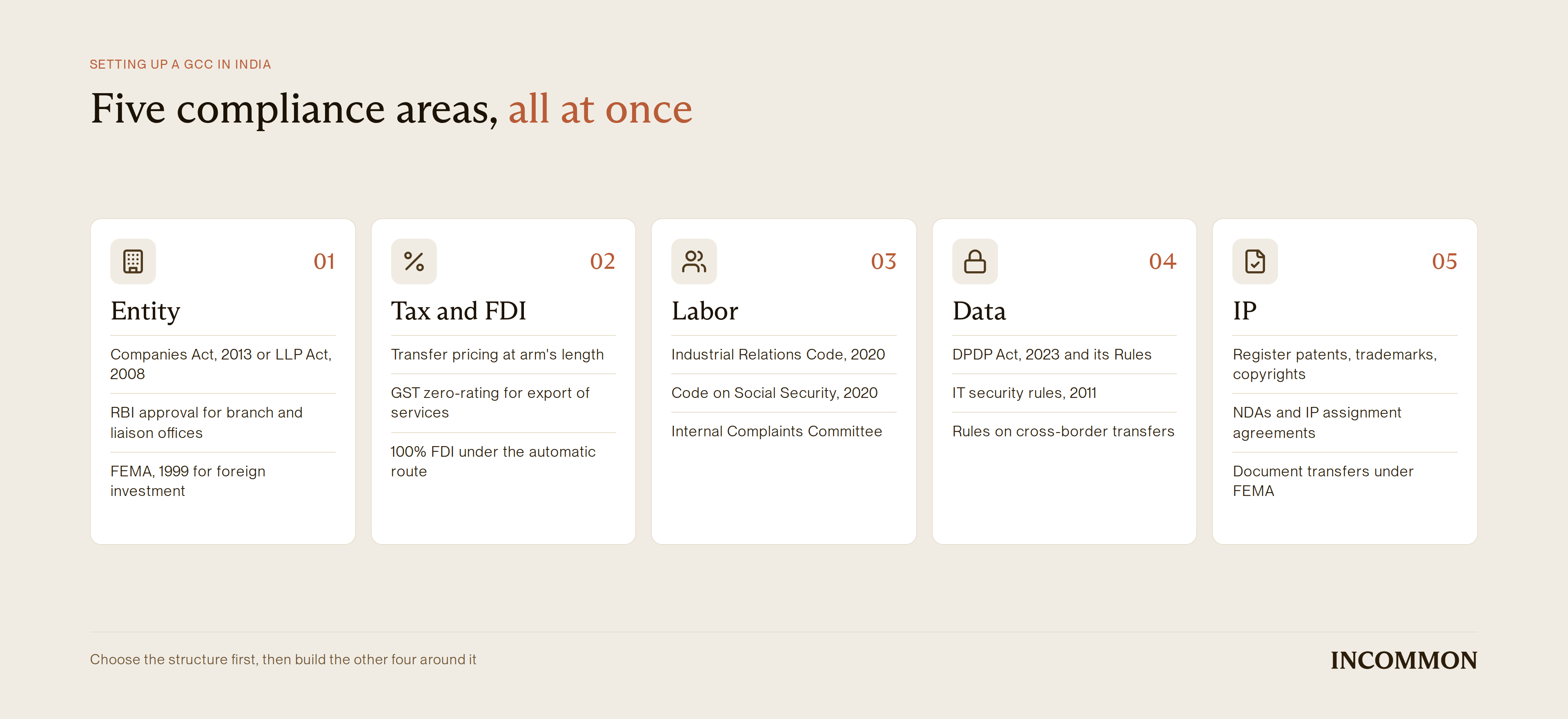
| Setting up a GCC in India touches five compliance areas at once: entity formation (subsidiary, LLP, branch, or liaison office), tax and FEMA/FDI rules, labor law (employment contracts, EPF/ESI, working hours, and the Industrial Relations Code), data protection under the DPDP Act and IT security rules, and IP registration and assignment. Missing any one of these can mean penalties, compliance headaches, or an operational shutdown. Choose the right structure first, then build tax, labor, data, and IP compliance around it before hiring begins. |
|---|
India has always been a hotspot for global corporations looking to tap into a massive talent pool, cut costs, and scale operations efficiently.
But there's a maze of legal and compliance requirements to work around. From business registration and tax laws to employment regulations and data security, the whole process of setting up a GCC has to stay on the right side of the law.
Missing key legal steps could lead to penalties, compliance headaches, and even operational shutdowns. You absolutely need to know and ensure that your GCC in India is legally solid, tax-efficient, and future-proof.
This article takes a comprehensive look at the legal, regulatory, and compliance requirements that companies must consider before launching a GCC in India.
What is a GCC?
A Global Capability Center (GCC) is an in-house unit established by a multinational corporation (MNC) to perform key business functions such as IT support, finance, HR, research & development, and analytics. Unlike traditional outsourcing models, GCCs provide companies with greater control, efficiency, and integration across business operations. Many global organizations have chosen India as a preferred destination due to its abundant talent pool, cost-effectiveness, and favorable government policies.
1. Legal structure and entity formation
1.1 Choosing the right business structure
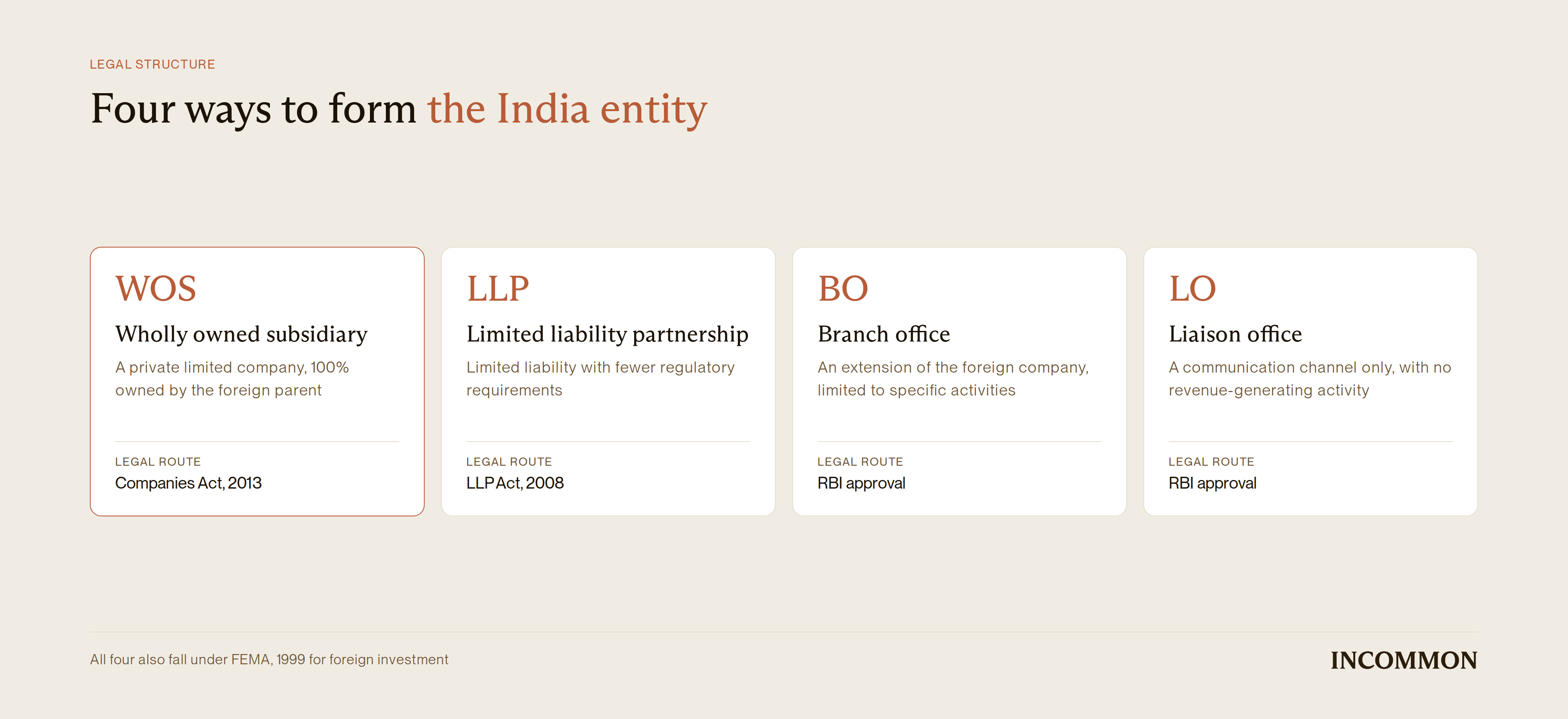
Foreign companies looking to set up a GCC in India must register a legal entity. The most common options include:
- Wholly Owned Subsidiary (WOS) – A private limited company where the foreign company owns 100% shares
- Limited Liability Partnership (LLP) – A hybrid structure with limited liability but fewer regulatory requirements
- Branch Office (BO) – A foreign company's extension, limited to specific business activities
- Liaison Office (LO) – Serves as a communication channel between the parent company and India, but cannot engage in revenue-generating activities
1.2 Registration and compliance requirements
Regardless of the chosen structure, companies must complete:
- Registration under the Companies Act, 2013 (for a WOS) or the Limited Liability Partnership Act, 2008 (for an LLP)
- Approval from the Reserve Bank of India (RBI) for BOs and LOs
- Compliance with Foreign Exchange Management Act (FEMA), 1999 to regulate foreign investments
2. Taxation and financial compliance
2.1 Corporate taxation in India
GCCs in India are subject to:
- Corporate Tax Rate – 22% (effective 25.17% including surcharge and cess) for domestic companies opting for reduced tax rates
- Transfer Pricing Regulations – Transactions with the parent company must be at arm's length to prevent profit shifting
- Withholding Tax – Payments to foreign entities are subject to withholding tax, depending on applicable Double Taxation Avoidance Agreements (DTAA).
2.2 Goods and Services Tax (GST) compliance
- GCCs providing IT and business support services are categorized as "Export of Services" and are zero-rated under GST.
- Input Tax Credit (ITC) is available for GST paid on procurement of goods and services
- Monthly and annual GST filings are mandatory
2.3 FEMA and foreign direct investment (FDI) regulations
- 100% FDI is permitted under the automatic route for IT and software-related GCCs
- Capital and profit repatriation is governed by FEMA regulations and RBI guidelines
3. Labor laws and employment regulations
3.1 Employment contracts and policies
- GCCs must ensure legally compliant employment contracts, specifying salary structure, benefits, termination clauses, and non-compete agreements
- Employee Provident Fund (EPF) and Employee State Insurance (ESI) contributions are mandatory for eligible employees
- Work-from-home & hybrid models should align with company policies and Indian labor laws
3.2 Working hours and overtime regulations
- Standard working hours: 48 hours per week, with a maximum of 9 hours per day.
- Overtime pay is required for work exceeding the prescribed limits under the Occupational Safety, Health and Working Conditions Code, 2020 or the applicable state Shops and Establishments Act.
3.3 Compliance with industrial and workplace laws
- The Industrial Relations Code, 2020 governs termination and retrenchment policies
- The Sexual Harassment of Women at Workplace (Prevention, Prohibition and Redressal) Act, 2013 requires GCCs to have an Internal Complaints Committee (ICC).
- Gratuity obligations are governed by the Code on Social Security, 2020, and leave encashment by the applicable state Shops and Establishments Act and company policy
4. Data protection and cybersecurity compliance
4.1 Compliance with India's data protection laws
- GCCs handling customer data, financial information, and employee records must adhere to:
- The Information Technology (Reasonable Security Practices and Procedures and Sensitive Personal Data or Information) Rules, 2011
- The Digital Personal Data Protection Act, 2023 (DPDP Act) and its Rules, notified in November 2025 and phased in over 18 months
- Cross-border data transfers must comply with RBI and Ministry of Electronics & IT (MeitY) regulations
4.2 Cybersecurity measures
- GCCs must implement ISO 27001-certified security policies
- Strict data encryption, firewall, and access controls should be in place
- Incident response protocols to handle cyber breaches must be documented and regularly tested
5. Intellectual property (IP) and confidentiality
5.1 Protecting company IP in India
- Companies should register patents, trademarks, and copyrights under Indian law
- Employees and vendors should sign Non-Disclosure Agreements (NDAs) and Intellectual Property Assignment Agreements.
5.2 Handling IP transfers and licensing
- Licensing agreements must comply with Indian contract laws
- Transfer of technology & IP between the GCC and the parent entity should be documented under FEMA and RBI guidelines.
If you would like the entity and compliance work handled for you, this is how we help.
Everything you need to build and run your India GCC.
Entity, hiring, workspace and ongoing operations under one agreement.
Conclusion
Setting up a GCC in India is a golden opportunity, but only if you play by the rules. The key takeaways include:
- Choose the right business structure that aligns with your operational needs
- Ensure tax and financial compliance to avoid legal hassles
- Adhere to labor laws and employment policies to maintain a stable workforce
- Implement strong data protection and cybersecurity measures to safeguard sensitive information
- Protect your intellectual property to maintain business integrity
In short, success lies in being proactive, consulting legal experts, and staying updated on India's regulatory landscape.