How to Set Up a GCC in India: The Complete Build Sequence

See how Findigs, Accompany Health, Veramatic and Podifi built their teams.
Real teams, real results, from faster hiring to lasting retention.
| Quick look: Set the mandate, decision rights, and India leader before filing anything. Then run entity formation, payroll, hiring, workspace, and security in parallel. A wholly owned subsidiary typically takes about 12 weeks to incorporate, while signature to a seated team can take closer to five months. Much of that later timeline is candidate notice periods rather than setup work. An employer of record route skips the incorporation wait, which is how Podifi went live with 9 engineers in 6 weeks. |
|---|
What is a GCC?
A Global Capability Center is a team a company owns and runs directly in another country, doing real strategic, engineering, or operational work for the parent business, not vendor-run support work.
Setting up a global capability center in India is more of a sequencing problem than a registration problem. The filings are well documented and rarely where things go wrong. What separates a fast launch from a slow one is knowing which work can start today and which work is waiting on somebody else.
Across the India teams InCommon has built, people have gone live in as little as four weeks and never longer than four months. That's proof the model works at the size this guide is actually written for: a 5- to 40-person team, not an enterprise captive designed for a company fifty times that size.
This guide is for technology leaders building an India team they intend to keep.
How do you set up a GCC in India?
Set the mandate, choose the employment model, build the operating case, and assign decision rights before filing. Those four choices determine the city, entity, first hires, and controls.
The mandate comes first. "Engineering capacity" doesn't tell a candidate or a hiring manager anything useful. Decide what India will actually own in year one: a product, a platform, a process, or a specific customer outcome. Define what stays with the parent team, and settle how priorities will change and who gets to change them.
The employment model follows. A wholly owned subsidiary suits a company that wants direct employment and a lasting India operation. InCommon can also support the first hires through an employer of record while incorporation runs, or while the company tests the market. A managed GCC can reduce the early operating load. A build-operate-transfer model adds a planned handover.
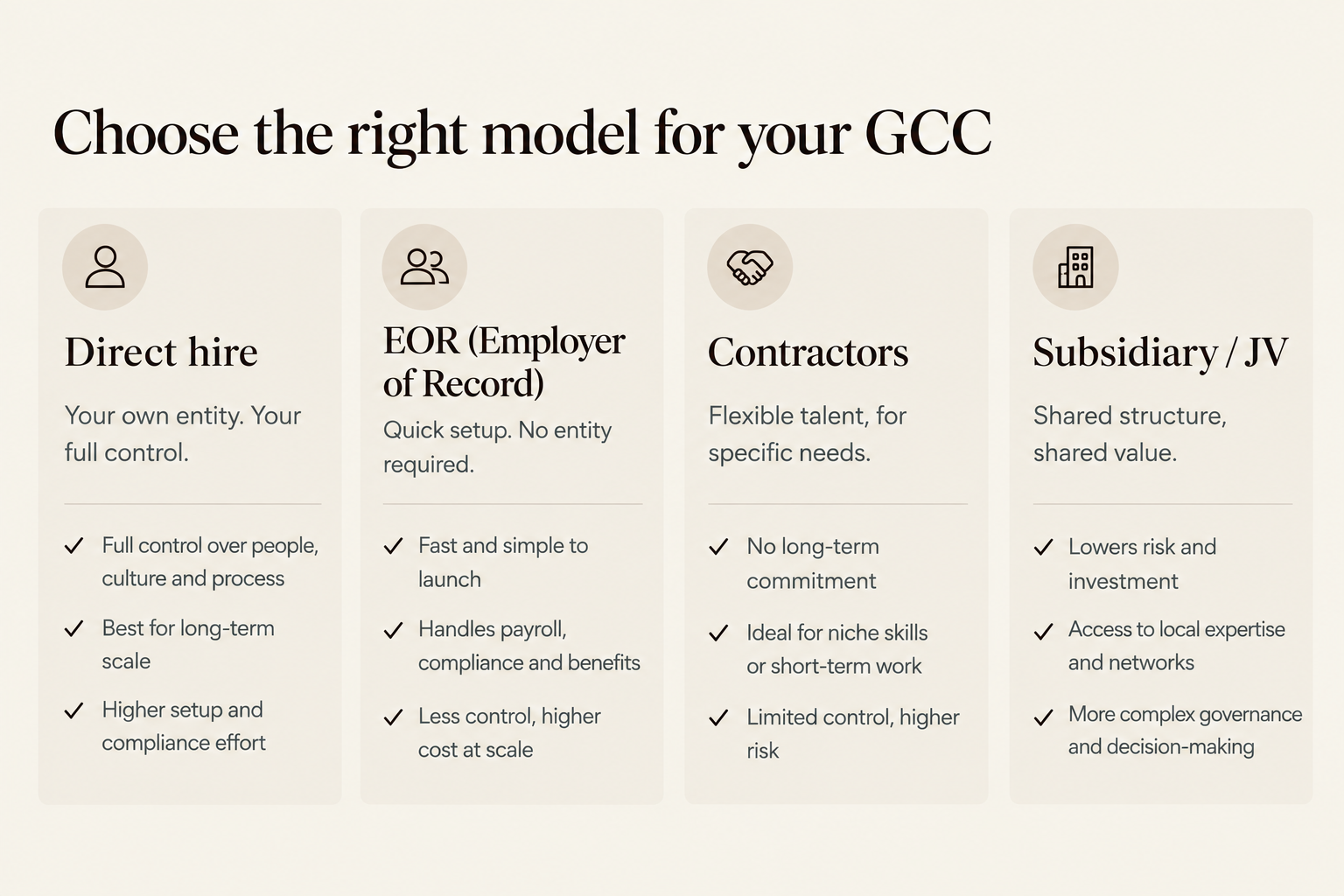
Each route changes control, cost, data access, and transition work. Ask who employs the team, who holds the contracts, and what must move later. There is no honest team-size rule that settles the choice for every company.
Here's what that looks like in practice, and where it doesn't apply:
Podifi is a working example of the EOR route: InCommon put 9 engineers live in six weeks, employed through employer of record with no wait for incorporation. Six weeks isn't a standard entity timeline. It's what's possible when the entity is taken out of the critical path entirely.
The same route isn't right for every company, and InCommon isn't right for every route. If a company already has its candidates and needs employment only, a straightforward payroll-and-compliance partner may be the right answer. If the plan is a multi-thousand-person captive with a fully built governance structure, an enterprise capability-centre firm built for that scale is the better fit.
The operating case comes next. Build it from the full cost of the team.
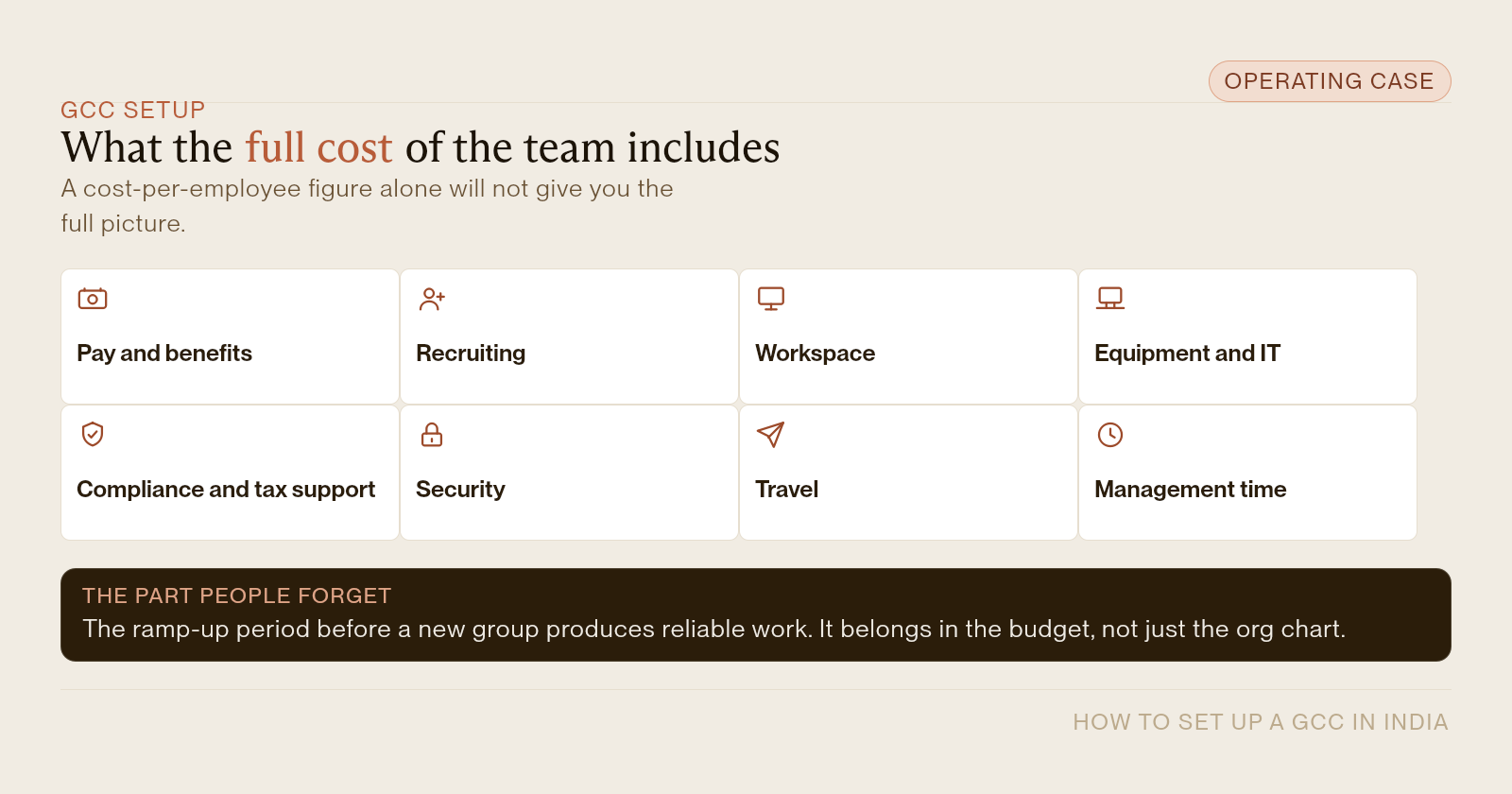
The cost of a GCC depends on the team being built, including its size, seniority and functional mix. Beyond salaries, the total cost includes entity setup, workspace, technology, compliance and hiring. That is why a cost-per-employee figure on its own does not give a complete picture of what it takes to build and operate the center.
Decision rights close the gap. Name the parent-company sponsor and the India leader. Decide who can approve offers, pay bands, vendors, access exceptions, and scope changes. A team cannot own delivery if routine choices wait overnight for permission.
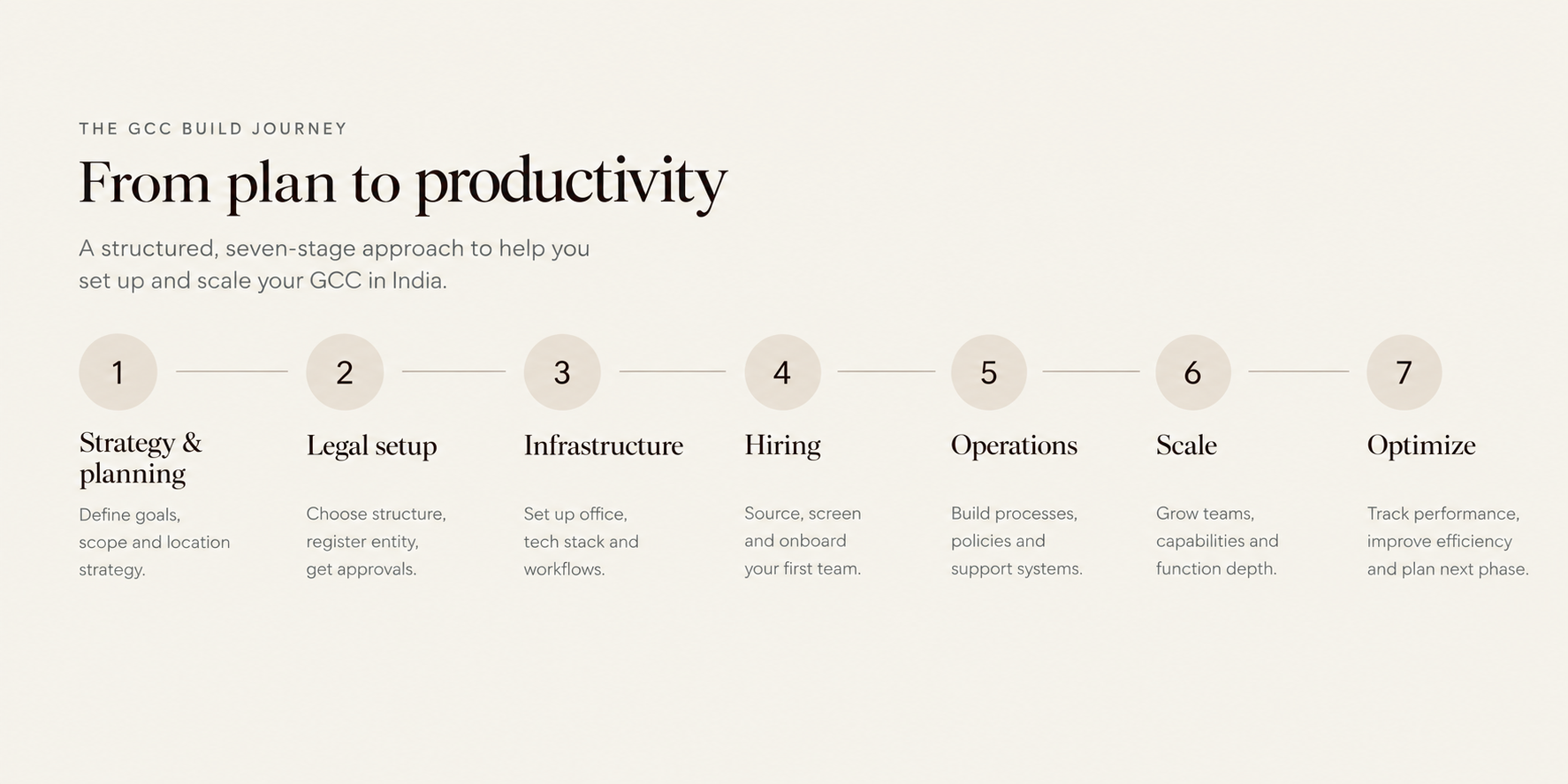
The seven stages of setting up a GCC
Setting up a GCC involves seven stages. The first six overlap, while the seventh begins after the initial team can deliver without constant intervention.
Choosing the right city for your GCC
The right city has enough of the roles and leaders your mandate needs. Compare role depth, senior talent, retention, workplace needs, and state obligations before comparing salaries.
- Bengaluru has the broadest market for product engineering, AI, cloud, and startup experience
- Pune works well for engineering, enterprise software, and industrial technology
- Hyderabad has depth in cloud, data, life sciences, and financial services
- Chennai suits software and engineering-led work
- NCR has enterprise operations and consulting talent
- Mumbai remains relevant for finance, risk, and treasury
Those are starting points, not rankings, and there is no universally "best" GCC city in India. Choose based on your first 5 to 10 roles, not the average salary market: the specific skills those roles need, the managers actually available locally, the hiring competition you'll be up against, retention patterns, and workplace or compliance requirements. Check whether senior candidates will work from the location you choose.
Remote hiring complicates the city choice further. A Bengaluru entity with employees in Pune or Gurgaon may take on state-specific obligations. Include those locations in the payroll and compliance plan before making offers.
Hire the managing director first
The managing director is the first and most consequential appointment in the whole process. This person sets the local bar, closes senior candidates, and turns parent-company intent into daily decisions.
Treat the search as succession work, not database matching. InCommon sources these candidates from people currently running India centers rather than from a database. The final interview is run by someone who has held the role.
Give the managing director authority in writing. This should cover hiring, offer limits, local vendors, delivery calls, and escalation. A senior title without decision rights only creates a coordinator, not a leader.
This person should be involved in city and team design from the start, rather than handed a fixed office, an inherited org chart, and a hiring target after those decisions are already made. Let them shape the team they will be accountable for.
How do you incorporate an Indian entity?
A wholly owned Indian private limited company is a common structure for long-term GCCs. Confirm the foreign investment route, activity, ownership, and sector requirements with Indian counsel before choosing that structure.
The parent company first approves the investment and the proposed subsidiary. It then prepares constitutional records, board resolutions, and authorized representative documents. Foreign documents may require notarization, apostille, or another form of attestation. The exact treatment depends on where the documents were signed.
The Indian company also needs a registered office and directors. At least one director must meet India’s statutory residency rule. The incorporation file may also require digital signatures and director identification details.
New companies file through SPICe+, the Ministry of Corporate Affairs incorporation process. Part A handles name reservation. Part B handles incorporation and related applications. The filing may include e-MoA, e-AoA, and AGILE-PRO-S.
SPICe+ combines several applications, but each output still needs operating work:
| SPICe+ starts or issues | What remains |
|---|---|
| Incorporation and certificate | Bank activation, capital, and approval limits |
| PAN and TAN | Accounting, tax, and recurring filings |
| EPFO and ESIC registrations | Applicability review and payroll configuration |
| Bank account application | KYC, signatories, and working access |
| GSTIN, if requested | GST analysis, registration choice, and invoicing rules |
Treat the parent documents and office proof as critical-path items. Errors there create rework across linked forms. They can also delay banking after the company exists.
A 12-week incorporation estimate is a planning assumption, not a promise. Document attestation, name queries, director records, office proof, and bank checks can move the date.
What makes the entity ready to transact?
The entity is ready when it can receive capital, pay people, sign contracts, and invoice correctly. Incorporation alone does not create those abilities.
Open the bank account and set signatory limits as soon as the records allow. Coordinate foreign capital with the authorized dealer bank, since the reporting deadlines that follow depend on the investment and share-allotment sequence. Put the actual dates into one calendar with a named owner.
Finish the intercompany agreement before the first invoice. It should describe the services, ownership, pricing method, and responsibilities of each company. The transfer-pricing analysis has to reflect what the India team actually does, not a generic template: a product team with real authority should not be described as routine support on paper.
Before the first invoice goes out, confirm:
- Bank account active
- Capital received
- Intercompany agreement signed
- Transfer-pricing position reviewed
- GST position confirmed
- Invoice flow tested
- Compliance owner assigned
GST needs its own decision. A new GCC does not become liable for GST because it incorporated. Under section 22 of the CGST Act, the ordinary threshold for service suppliers is generally INR 20 lakh. Exceptions, place of supply, and the state footprint can change the result.
Ask how the India company will invoice the parent. Review input tax credits, imported services, and the state of registration. Do this before the first transaction, not after finance closes the month.
Organize the compliance calendar by event. Use incorporation, capital receipt, first payroll, first invoice, month-end, and financial year-end. External advisers may prepare filings, but an employee should still own each deadline.
How does payroll and compliance work in India?
Payroll starts with the employee’s work location, pay structure, benefits, and tax treatment. The setup must also reflect state rules and each statutory scheme that applies.
Choose the payroll provider, HR system, benefits, and employment counsel before the first direct hire starts. Configure salary tax withholding, approvals, payslips, expenses, leave, employee records, and exits. Test one payroll cycle before the first full run.
Employment agreements should cover:
- Confidentiality
- Inventions and IP assignment
- Data handling
- Acceptable use
- Return of company property
Counsel should review the IP chain from the employee to the Indian entity. If needed, the chain should continue to the parent company.
These obligations vary by state as well. Professional tax, Shops and Establishments rules, holidays, leave, and working conditions differ across India, and an employee’s location can create obligations even when the main office sits elsewhere.
Registration and liability are two different questions, and it’s easy to conflate them. SPICe+ automatically creates EPFO and ESIC registration numbers for a new company, but that doesn’t mean every contribution is due from day one.
According to EPFO employer guidance, the provident fund law generally covers notified establishments with 20 or more employees. Voluntary coverage and other cases also exist. Confirm the company’s position with payroll and labor counsel.
Create a monthly close that compares the employee list, payroll register, bank payment, tax deposit, and statutory contributions. That check catches mismatches while they can still be fixed.
How do you hire the first team?
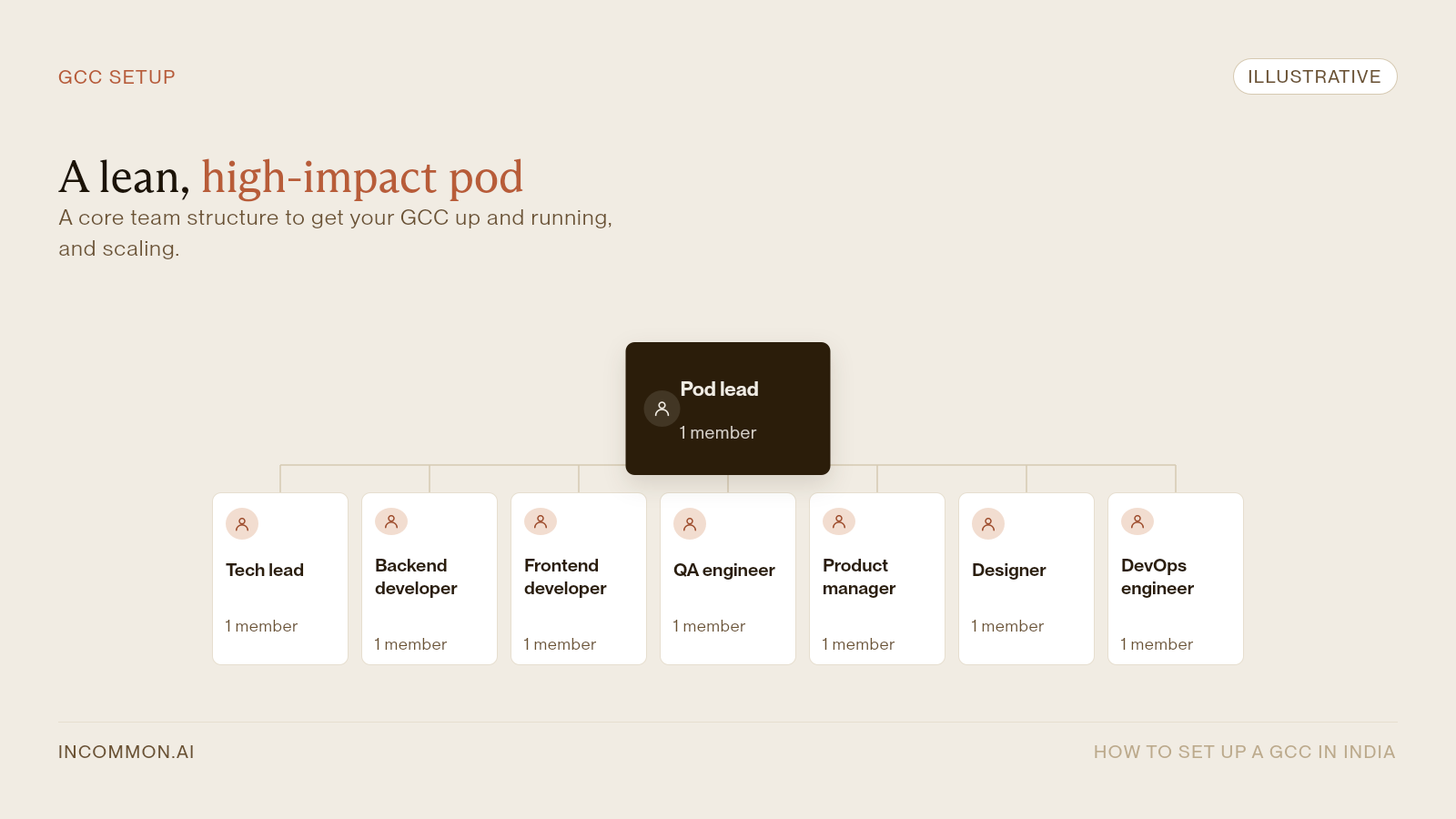
Hire one senior-led, cross-functional delivery pod of eight people around a defined outcome. Three or four pods form a center of about 30 to 35 people.
A pod is the smallest group that can deliver without borrowing every key skill from the parent team. Its composition follows the work. A product pod may include engineering leadership, senior engineers, product context, quality, and platform support.
One illustrative shape, not a template to copy directly since the actual mix should follow your mandate.
InCommon builds the hiring process through four stages
| Stage | What it answers |
|---|---|
| 1. Sourcing | Where does the search reach qualified candidates, beyond whoever applies? |
| 2. Screening | Which candidates actually match the role's requirements and standard? |
| 3. Interviewing | What evidence shows the candidate can do the work? |
| 4. Offer | Will this person accept, and succeed in this company, team, and stage? |
Sourcing comes before screening. Write the scorecard around output, judgment, and ownership, then look beyond whoever applies. InCommon's talent pool runs to roughly 700 people, and every one of them has already had a real conversation with the team, they are not just a database match. That's what separates an actual talent pool from a purchased contact list.
Screening checks whether a candidate actually matches the role's requirements and standard, not a list of tools copied from another company's job description.
Interviewing comes from work, not polish. The final assessment involves someone who has done the role. The offer stage tests whether this person will accept, and succeed in this company, team, and stage.
Here's how that funnel performs in practice. Across InCommon searches, 33% of candidates sent are hired. Every candidate also carries a six-month replacement guarantee.
Accompany Health shows how that method works in practice, at full scale. InCommon put a 22-person team live in 10 weeks, with 100% retention across the team.
This was a case where the mandate, interview access, and decisions were all in place from day one, and ten weeks is what that made possible. It also shows why getting the first pod right matters more than opening a large number of roles at once.
Keep the team connected to the people who own the work. Give it the same product context, tooling, and review standards. The reporting line is what makes it a GCC rather than outsourced delivery. The practical test: the team reports into your engineering leadership, the entity belongs to you from day one, and InCommon staffs and supports it while you direct the work.
While the pod is being hired, security and workspace need to be ready in parallel:
- Devices and identity set up before candidates finish notice
- Least-privilege access and data classification defined
- Vendor controls, onboarding, and exit processes in place
- Incident escalation path documented
- A secure workplace sized to the first team, not to growth you haven't proven yet
Governance for a 30-person GCC
A 30-person GCC needs clear decisions and a short operating rhythm. It does not need layers of committees or an enterprise governance program.
Write down what the India lead can decide. Cover offers, compensation limits, vendors, access exceptions, architecture calls, and delivery priorities. Name the few decisions that stay with the parent company.
Use one weekly meeting for priorities, blockers, and decisions that need both locations. Keep a written decision log so decisions don't get stuck waiting on a call that only fits one team's time zone. The India team should run its daily work locally.
Review a small scorecard each month. Include hiring progress, offer acceptance, start dates, delivery commitments, early exits, and unresolved risks. Add financial and compliance issues only when someone needs to decide or act.
- At 30 days, check access, payroll, leadership, and open roles
- At 60 days, check delivery quality and joining risks
- At 90 days, decide whether the pod can take more ownership
When should a GCC expand its mandate?
Expand after the first pod delivers reliably and the India leader has management capacity. Add ownership before adding volume, then check whether speed or quality improves.
A second pod should have its own outcome and leader. It should not become a pool of people shared across every parent-team request.
Revisit the plan after six to twelve months and check:
- City
- Remote footprint
- Manager bench
- Workplace
- Costs
- Control gaps
- Which decisions can now move to India
Growth should follow evidence. A larger team with the same narrow mandate adds coordination work. A wider mandate with no local authority creates delay.
Running the entity, hiring, and setup work in parallel is where a partner helps most.
Everything you need to build and run your India GCC.
Entity, hiring, workspace and ongoing operations under one agreement.
Common causes of GCC setup delays
Most avoidable delays come down to unclear ownership, late decisions, and work done in the wrong order. One thing on this list can't be engineered away: the notice period, it is a feature of India's talent market, not a flaw in the process.
Sequencing mistakes cause the most damage. Filing before the mandate is clear can lock a company into the wrong city or structure. Confusing a registration with an actual liability creates payroll and tax errors down the line. Delaying the intercompany agreement or the IP chain puts the first invoice and the first line of code at risk.
Hiring mistakes are just as costly. Hiring a managing director late removes local judgment from the city and team decisions that come before it. Hiring junior roles before the senior pod lead is in place creates an onboarding burden with nobody there to carry it. Slow parent-company interviews lose candidates to other employers who are moving faster.
A few choices quietly add cost later, even when they don't cause a delay today. Picking a city on salary alone ignores the supply of leaders and the cost of replacing them. Signing a large office commitment turns a forecast into a fixed bill. Expecting a fully synchronous US working day makes the India team wait on decisions that could otherwise move without them.
Here's a simple test: can this task run before incorporation finishes?
Before incorporation, usually yes:
- Leadership search
- Role design
- Sourcing
- Workplace planning
- Security design
- Operating rules
After incorporation, no:
- Bank activation
- Direct payroll
- Certain transaction-specific activities
Where to start
Start with a one-page mandate. Name the work, the India leader, the first eight-person pod, and the decisions that move with it. Then choose the employment route and launch the parallel work.
InCommon tracks this because a fast hire that doesn't stay isn't actually fast. Across InCommon case studies that publish retention data, reported retention ranges from 90 to 100 percent.
Frequently asked questions
How long does it take to set up a GCC in India?
Plan on about 12 weeks to incorporate a wholly owned subsidiary and roughly five months from signature to a seated team. The later part is often candidate notice period, so leadership search and hiring should start while entity work continues.
Do you need an entity, or can you start with an employer of record?
You can start through an employer of record when the first hires need to join before the Indian entity is ready. Podifi used this route, with 9 engineers live in six weeks and no incorporation wait in the critical path.
What is the difference between a GCC and an EOR in India?
A GCC is the broader model: a team you own and run in India across hiring, entity, payroll, and operations. An employer of record is one employment route inside that model, useful when hires need to start before an entity is ready or while you're still testing the market. Most long-term GCCs eventually move to their own entity; EOR is usually a bridge, not the end state.
Which city is best for setting up a GCC in India?
There is no universal best city. The right choice depends on the specific roles you're hiring for first, the depth of senior talent available, how much hiring competition you'll face, retention patterns, and workplace or compliance requirements in that state, not just average salary levels.
What does a GCC in India cost to run?
Model the cost across compensation, recruiting, workplace, equipment, compliance, security, management time, and the ramp-up period before a new team is fully productive. There's no single "cost per employee" figure that holds without knowing the mandate and team composition. A useful model shows the first-year build cost and the steady operating cost, not a generic savings percentage.
Is a GCC the same as outsourcing?
No. The practical test is the reporting line. A GCC team works inside the company’s priorities, tools, review standards, and management structure, while an outsourced team works through a vendor relationship.
What does SPICe+ cover for a new GCC?
SPICe+ handles Indian company incorporation and linked applications for PAN, TAN, EPFO, ESIC, and a bank account. GSTIN can be requested, but the company still needs GST analysis, bank activation, payroll setup, and recurring compliance.
Written by
CEO, InCommon
Piyush Kedia is the CEO of InCommon, a talent infrastructure company that helps US and global enterprises set up and scale Global Capability Centers (GCCs) in India. He works with founders, CTOs, and heads of talent to design smaller, AI native GCC teams that focus on judgment work, not just headcount, so India offices stay senior, stable, and production ready. Before InCommon, Piyush built Blue Vector into a 50 person creative agency serving brands such as Trump Towers, Audi, and Porsche, giving him a front row view of how high performing teams are hired, managed, and grown.