GCC vs Outsourcing: Which One a Growing Company Should Choose

See how Findigs, Accompany Health, Veramatic and Podifi built their teams.
Real teams, real results, from faster hiring to lasting retention.
Quick look:
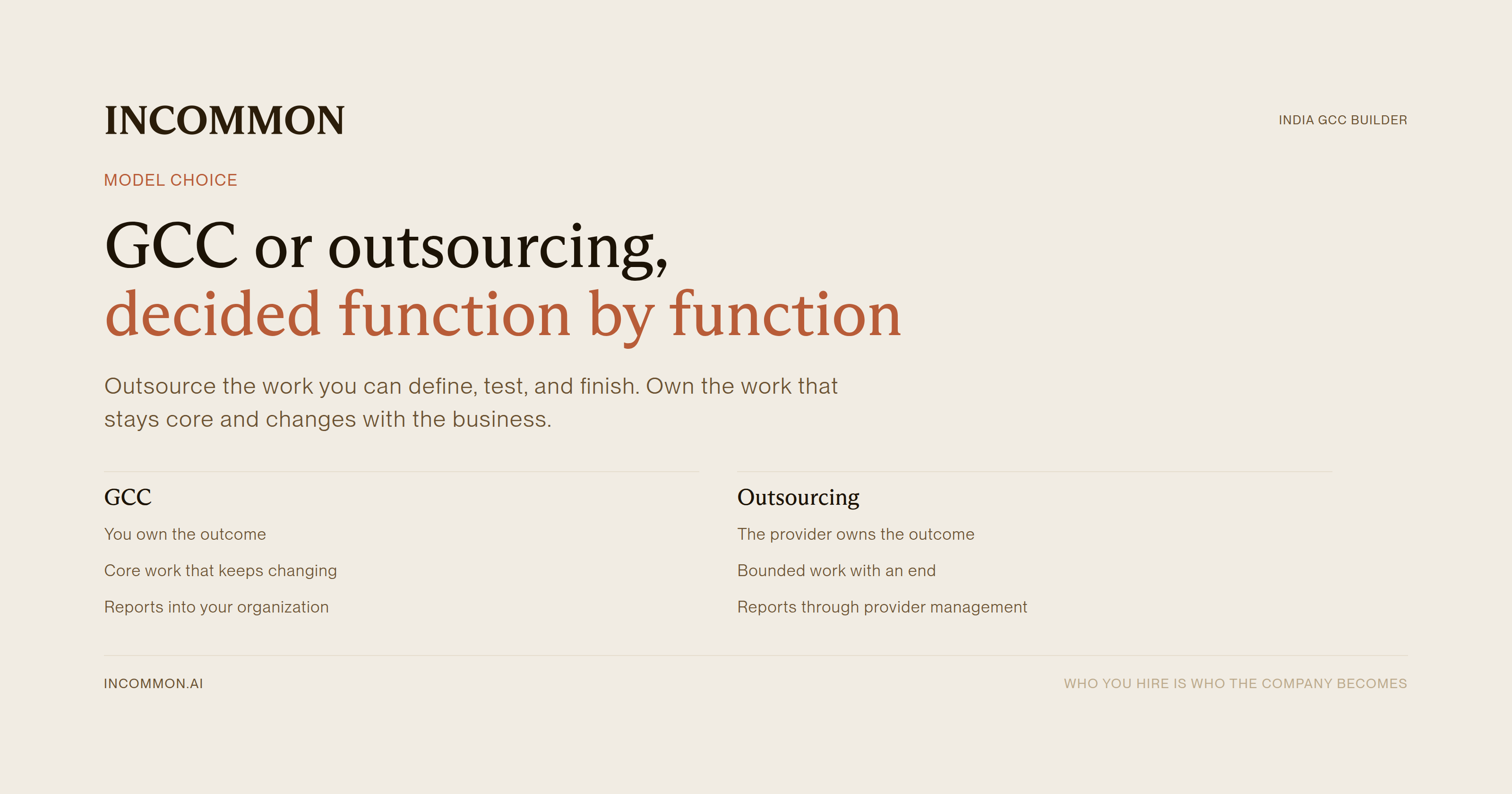
| GCC versus outsourcing comes down to who owns the work once it starts, not where the team is based. Outsource work you can define, test, and finish. Choose a GCC for work that stays core, changes with the business, and needs direct product context and leadership. The teams can look identical, so test the reporting line: who sets priorities, reviews performance, and answers when the outcome misses. Most growing companies need both, decided function by function. |
|---|
A GCC and an outsourced team can look nearly identical. They may sit in the same city, use the same systems, join the same product meetings, and even carry the same company name.
What separates them is who sets priorities, reviews performance, and answers when the outcome misses. If those decisions run through a provider, it is outsourced delivery. If they run through the parent organization, it operates as a GCC.
For CTOs, VP Engineering leaders, and founders, the practical question is direct: are you buying defined work, or building a capability your company will direct over time?
The difference is operating ownership
A global capability center is a company-directed team in another talent market. Its leaders report into the parent organization, which sets the mandate and remains accountable for results.
That definition depends on the operating relationship. It does not depend on the office, logo, or employment contract. A captive center is an older name for the same broad idea.
The term sometimes refers more narrowly to a wholly owned subsidiary. In practice, a captive center vs outsourcing comparison still comes back to who directs the team and owns its results.
Branding does not create ownership
A team may use your company email addresses, work from a dedicated room, and spend all its time on your account. Those features make the team feel internal without giving your leaders control over how it operates. Your logo proves little.
If a provider assigns the people, interprets your priorities, reviews performance and decides who gets replaced, you are outsourcing. Full-time dedication does not change that. A dedicated team is still the provider's team if the provider decides who is on it.
Legal structure is separate
Operating ownership and legal structure answer different questions. Operating ownership identifies who directs the work and carries accountability. Legal structure identifies who employs the team, signs local contracts, and meets statutory obligations.
A wholly owned subsidiary allows the parent to employ people and sign contracts directly in India, but it is only one route into a GCC. Other routes include employer of record, managed operations, and build-operate-transfer.
Each route changes how employment and administration are handled. It does not, by itself, determine who owns delivery.
A company begins hiring through an employer of record and still operates the team as a GCC. The parent must set the mandate, manage performance, and connect the team to its own organization.
A provider supports payroll and recruiting. It also supports compliance or workspace around that team without taking over delivery accountability.
GCC vs outsourcing comparison
Once legal structure is separated from operating ownership, the comparison becomes clearer:
| Question | GCC | Outsourcing |
|---|---|---|
| Who owns the outcome? | The parent organization | The outsourcing provider under contract |
| Best-fit work | Core, changing, enduring work | Bounded, temporary, or test-stage work |
| Who sets priorities? | Parent product or functional leaders | Provider within the agreed scope |
| Where does the team report? | Into the parent organization | Through provider management |
| Who manages people? | Parent leaders, with provider support if needed | Provider leaders |
| How does scope change? | Through internal planning | Through contract governance |
| What happens at exit? | The company retains the team and its knowledge | Transition follows contract terms |
The same confusion shows up with IT services firms. Infosys and TCS will sell you an outsourced contract, and either will also help you set up, run or transfer a GCC. So the name on the invoice settles nothing.
What settles it is who runs the work after kickoff. That means who sets priorities, who reviews performance, who moves people, and who answers when the outcome misses.
Choose by work type
Ownership becomes easier to assign when you start with the work. One company outsources a finite project while building a GCC for a function it expects to keep.
Even teams in the same city need different models because their work has different boundaries, timelines, and requirements for business context. Ownership decides the model.
Outsource bounded work
Outsourcing fits work you can describe before it begins and assess when it ends. A defined application migration, a testing program with an end date, or a specialist audit each has a finish line both sides understand.
That finish line shapes the contract. Agree on outputs and acceptance criteria before delivery begins.
Set dependencies, change control, and transition duties before delivery begins. If the acceptance criteria are not clear in a short paragraph, the work is less bounded than the contract suggests.
Speed strengthens the case for outsourcing. A qualified provider often already has the people, methods, and infrastructure needed to start. That matters when the assignment will end after a release, migration, or test.
The company still needs an internal owner. That person answers questions and controls access. The internal owner makes timely decisions and accepts completed work.
The provider manages delivery. The internal owner prevents a defined assignment from turning into an open-ended dependency.
Own enduring capability
A GCC fits work you expect to keep and keep changing. Product engineering, a data platform, internal security, a product domain someone has to own: none of these has a finish line.
They resist fixed scope for the same reason. Priorities move with customers, incidents and architecture, so the team needs enough context to decide before anyone writes the task down.
The reporting line gives the team that context and authority. A US or European product leader sets direction directly with the India leader.
The India leader then challenges priorities, stops low-value work, and makes trade-offs within the mandate. The team works inside the company rather than alongside it.
Our India office model supports employment and administration while the parent directs the work. That division keeps local operations covered without separating the team from the leaders accountable for its results.
A GCC does not automatically protect IP, improve retention, or solve compliance. Those outcomes depend on contracts and employment terms. They also depend on access controls, leadership, and local execution.
For example, InCommon hired 60 underwriters for Findigs in 4 months, and 90% remain in place. The hiring bar and local leadership produced that result, not the organization chart alone.
Use a pod carefully
A pod is an 8-person, senior-led, cross-functional team organized around a defined outcome. 3 or 4 pods make a center of 30 to 35. Both models use this shape. What separates them is who picks the pod members and who the pod leader answers to.
An outsourced pod suits a bounded outcome when the provider controls staffing and delivery. A GCC pod uses the same team shape while owning an enduring product area. In that case, the pod leader reports into the parent's product or engineering organization and works within its planning and performance systems.
Test the reporting line
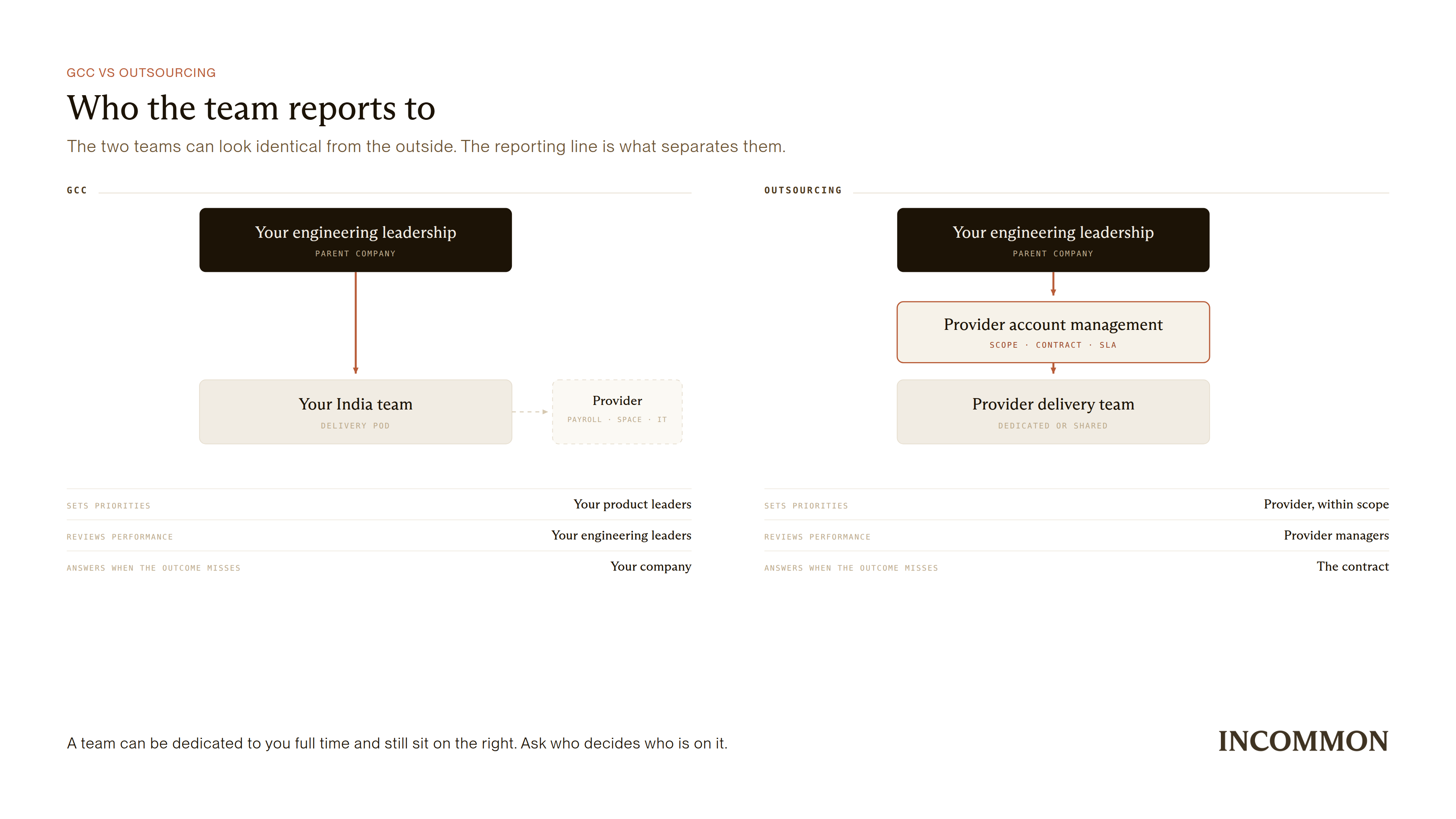
The reporting line exposes the model faster than branding or contract labels. It also reveals common GCC failure modes. To map it, document who makes each of these decisions:
- Who sets weekly priorities when two stakeholders disagree?
- Who reviews the India leader's performance?
- Who approves a senior hire or changes a role?
- Who owns a production incident?
- Who stops low-value work?
- Who remains accountable when the outcome misses?
In outsourced delivery, the provider organizes the team and delivers the agreed service through its own managers. The parent makes requests, supplies decisions, and enforces its contract rights. The provider's managers still run delivery.
In a GCC, leaders inside the parent organization set the mandate and remain accountable for results. A provider supports payroll, workspace, or local compliance. Those administrative responsibilities surround the team rather than separating it from its business leaders.
Frequent access to stakeholders blurs this distinction. An outsourced engineer attends product calls every day while reviews, priorities, and people decisions still pass through the provider.
Contact improves collaboration. It does not transfer authority.
The diagnostic is straightforward. If the parent requests work but the provider decides how the team operates, the model is outsourcing. If parent leaders direct the work and carry performance accountability, the team operates as a GCC.
Choose function by function
The in-house vs outsourced offshore team decision does not need one answer for every type of work. A company places core product engineering in a GCC and outsources a bounded ERP migration. It buys periodic penetration testing from a specialist.
Each choice follows the needs of the function rather than a company-wide preference for one structure. Problems begin when both models occupy the same responsibility without a clear boundary. A parent product manager, GCC leader, and provider manager all try to redirect the same engineers.
The team then has multiple sources of authority. That slows delivery and turns routine decisions into escalations.
Prevent that overlap by naming one operating owner for each function. Record what that person decides, what remains with headquarters, and what any provider controls. Shared work still succeeds, but accountability cannot be shared vaguely.
The function is the practical unit of choice. Outsourcing buys defined delivery, while a GCC keeps enduring responsibility inside the company. Country, office, and provider choices follow that decision.
If you want to see how different operating choices work in practice, browse our case studies.
Price the real model
After choosing the operating model, price the function you intend to run. There is no universal headcount at which a GCC becomes cheaper. There is no standard month when it reaches breakeven.
Role mix and seniority change the result. Location, provider pricing, and duration change it too.
For outsourcing, include:
- service fees
- internal contract management
- likely scope changes
- security requirements
- transition assistance
- knowledge transfer
Then test what happens if the work expands, pauses, or moves to another provider. These scenarios expose costs that the base contract may not show.
For a GCC, include:
- recruiting
- local leadership
- payroll and statutory administration
- finance and compliance
- workspace
- equipment
- IT controls
- provider fees where used
Add the time headquarters leaders will spend integrating and managing the team. Direct control requires internal capacity.
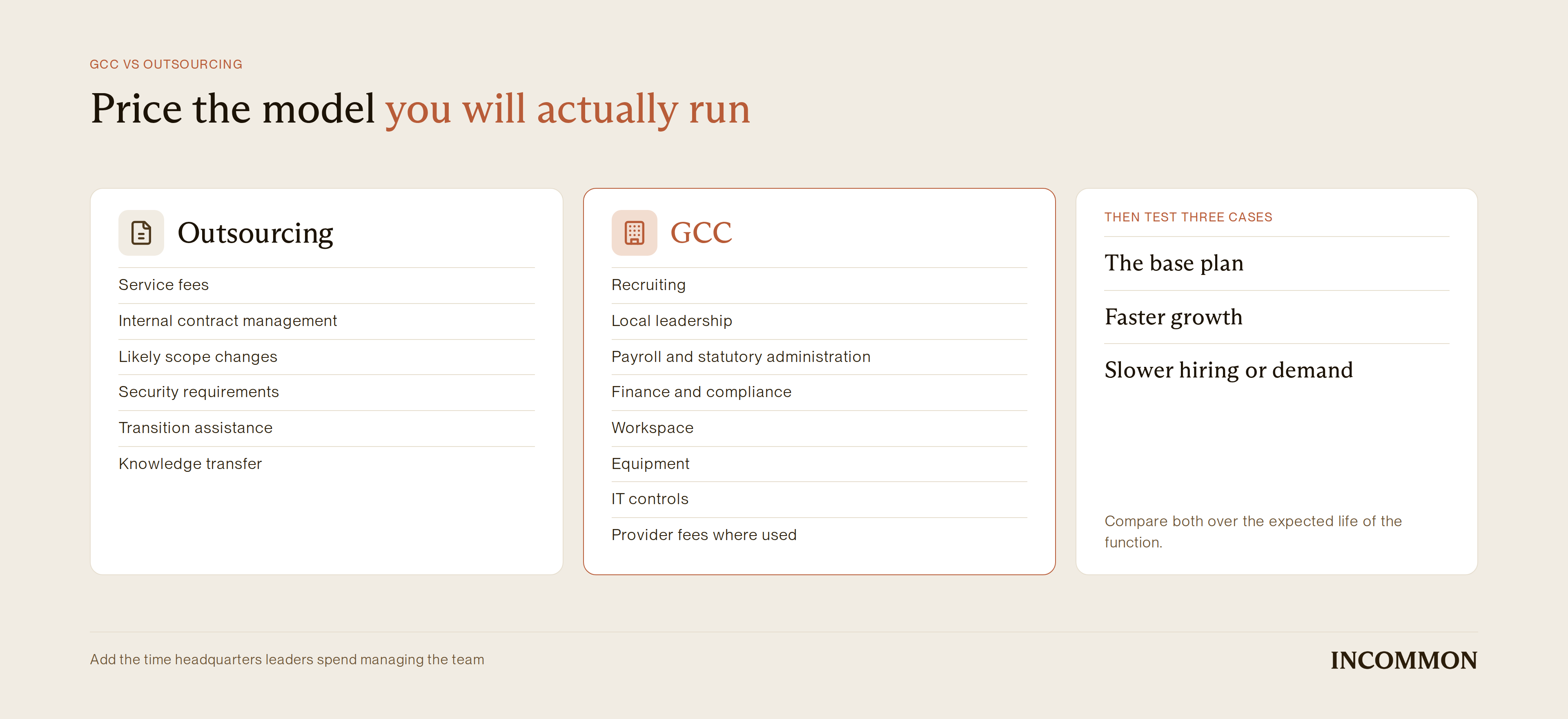
Compare both models over the expected life of the function. Run at least three cases: the base plan, faster growth, and slower hiring or demand.
A low-priced contract becomes expensive if it separates a core function from the leaders directing it. A GCC creates unnecessary overhead if the work ends before the team has time to mature.
The useful financial question is specific: what will it cost the company to own this outcome at the level the business requires?
Choose your entry route
With the operating model clear, choose the legal and administrative route that supports it. An employer of record enables early hiring before the company has a local entity. Managed operations cover local infrastructure and administration.
For Podifi, we put 9 engineers live in 6 weeks through employer of record without waiting for incorporation. The parent set the mandate and directed the work from day one. The employment route determined who signed the contracts, not who owned delivery.
A build-operate-transfer route adds a planned move from provider-supported operations to a parent-owned structure. A wholly owned subsidiary creates the legal base for direct local operation, although incorporation timelines vary. Our complete setup sequence shows which setup workstreams can run in parallel.
Whichever route you choose, document the mandate and reporting line. Document people decision rights and transition conditions too. Also record who employs each person, who directs daily work, and who owns the entity.
Keeping those answers separate prevents administrative support from drifting into delivery authority. Tax, employment, and data requirements vary by jurisdiction and structure. IP and regulatory requirements vary too.
Get current advice from qualified specialists. Then assign every obligation to a named owner and due date.
The right entry route supports the intended operating relationship without creating duties the company cannot manage. Ease or perceived seriousness must not drive the choice.
Run the decision process
Start with a 24-month mandate for each function. Describe the outcome, the business context the team will need, and how much the work will change. This separates fixed assignments from capabilities the company expects to keep developing.
Next, assign decision rights for priorities and performance. Assign them for hiring, role changes, and incidents too. Draw the reporting line and test whether the leaders on it have the capacity to manage the team.
If the line runs through a provider, treat the model as outsourcing. If it enters the parent organization, confirm that parent leaders have the capacity to carry GCC accountability.
Only then compare entry routes and transition conditions. A pilot needs a decision date. A transfer model needs acceptance terms.
An outsourcing contract needs usable documentation and exit support. A GCC needs leadership and governance before hiring scales. Use the following questions to test the choice:
| Decision question | Signal |
|---|---|
| Is the work bounded and testable? | Outsourcing |
| Will priorities change with product strategy? | GCC |
| Does the company need to retain the team and knowledge? | GCC |
| Is provider-managed delivery acceptable? | Outsourcing |
| Are parent leaders ready to manage the team directly? | GCC readiness |
| Is the function temporary or specialist? | Outsourcing |
Do not total arbitrary points. Discuss the conflicting answers. They show which responsibilities, boundaries, or management gaps must be resolved before either model will work.
If the answers point toward owning the team, this is where we come in.
Everything you need to build and run your India GCC.
Entity, hiring, workspace and ongoing operations under one agreement.
Make the choice explicit
For each function, state who owns the outcome, who directs the team, and who makes people decisions. That record matters more than the location, office branding, or amount of dedicated capacity.
Outsource work with a clear finish line when provider-managed delivery gives the business the speed or specialist capability it needs. Own enduring work the parent intends to direct, develop, and retain. Both models serve the same company as long as each function has one accountable owner.
We help companies map functions, reporting lines, entry routes, and operating responsibilities before hiring plans lock them into the wrong structure.
Frequently asked questions
What is the main difference between a GCC and outsourcing?
The difference is operating ownership. In a GCC, the parent organization directs the work, owns performance accountability, and connects the team through its reporting line. In outsourcing, a provider manages the team and remains accountable for contracted delivery.
Is a GCC always a wholly owned subsidiary?
No. A wholly owned subsidiary is one legal route, but a GCC can begin through an employer-of-record or managed setup. The parent must still direct the work, own accountability, and integrate the team into its organization.
Can a company use both a GCC and outsourcing?
Yes. Choose the model by function. Core product engineering may belong in a GCC, while a bounded migration or specialist audit may suit outsourcing. Each function needs a clear operating owner and defined boundaries between internal and provider responsibilities.
How does a captive center differ from outsourcing?
A captive center generally refers to a company-controlled India capability, often through a wholly owned subsidiary. Outsourcing purchases delivery from a provider. The practical test is whether the parent or provider controls priorities, performance, and people decisions.
Is a dedicated India team a GCC?
Not necessarily. A dedicated team can use your tools, branding, and workspace while remaining outsourced. If performance, priorities, and people decisions run through the provider, it is outsourced delivery. A GCC reports into the parent organization.
Written by
CEO, InCommon
Piyush Kedia is the CEO of InCommon, a talent infrastructure company that helps US and global enterprises set up and scale Global Capability Centers (GCCs) in India. He works with founders, CTOs, and heads of talent to design smaller, AI native GCC teams that focus on judgment work, not just headcount, so India offices stay senior, stable, and production ready. Before InCommon, Piyush built Blue Vector into a 50 person creative agency serving brands such as Trump Towers, Audi, and Porsche, giving him a front row view of how high performing teams are hired, managed, and grown.