What an India employee really costs, provident fund, gratuity and the rest

See how Findigs, Accompany Health, Veramatic and Podifi built their teams.
Real teams, real results, from faster hiring to lasting retention.
Quick look:
| The cost of hiring an engineer in India is salary plus a short list of statutory lines. The employer pays 12% of wages into their provident fund, on a ₹25,000 monthly ceiling or on full wages, depending on company policy. Gratuity accrues at about 4.8% of wages from the first month. State insurance rarely applies to engineers, and professional tax comes out of the employee's pay. Most Indian offers quote all of this inside one annual figure, the CTC. |
|---|
A US finance team asks what an India engineer costs, and the first answer is usually a salary. The offer letter shows a larger number, the CTC, and the payroll run shows a third. The gap between them is a handful of statutory lines, each set by formula. Once you know the formulas, the three numbers reconcile.
This piece is for CFOs and founders pricing their first India hires, through a subsidiary or an employer of record. The full line list for a center, from incorporation to transfer pricing, is in our center-level cost breakdown.
What an employee costs beyond salary
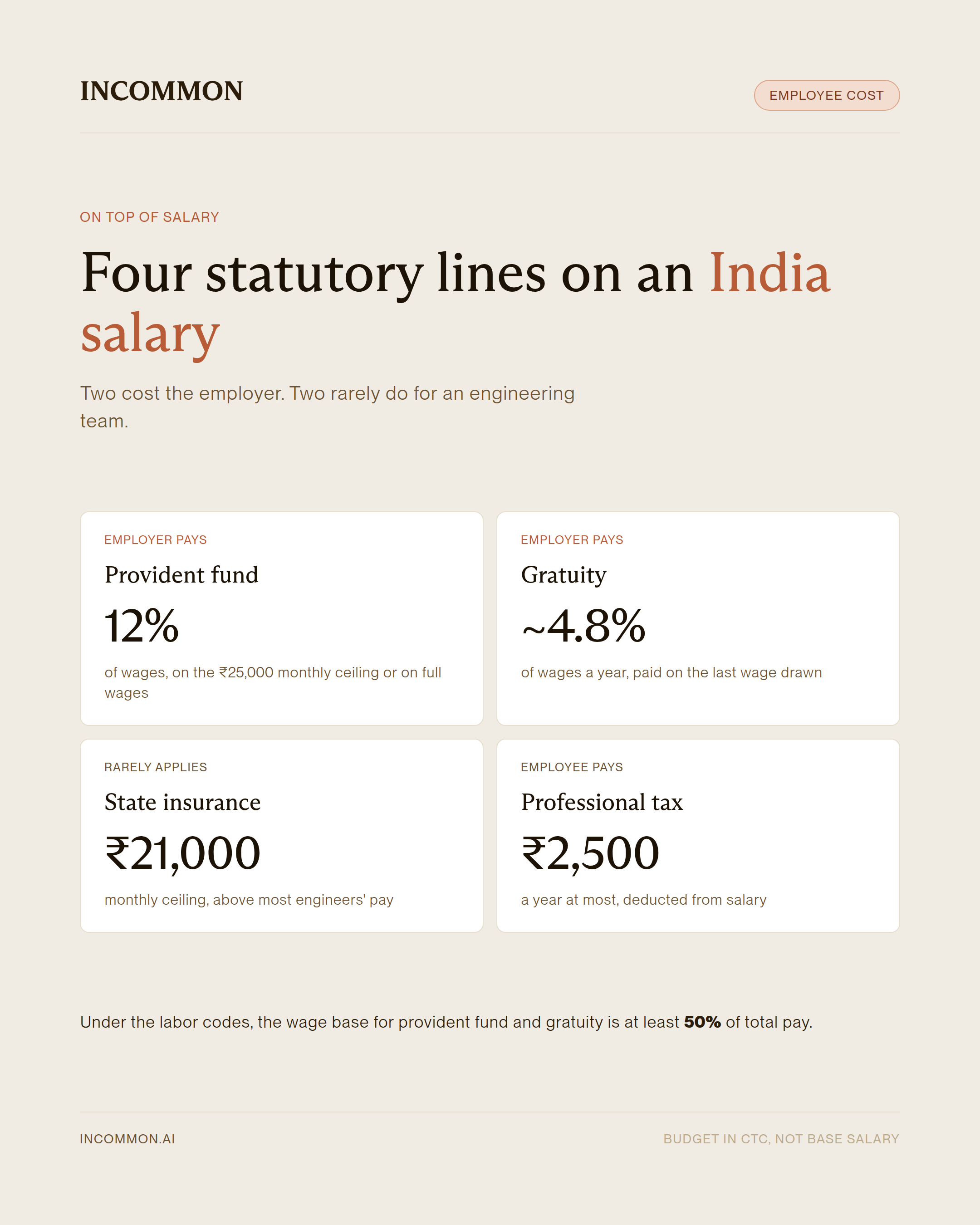
Four statutory lines attach to an Indian salary. Provident fund and gratuity cost the employer. State insurance usually misses engineers entirely, and professional tax is deducted from the employee.
All four now run under the labor codes, which came into force on 21 November 2025. The codes replaced 29 older laws, including the Payment of Gratuity Act, 1972. The contribution rates carried over, but the definition of wages they apply to did not.
Under the codes, allowances left out of wages cannot exceed half of total pay, and anything above that half is added back. So the wage base for provident fund and gratuity is at least 50% of what the employee earns, whatever the salary slip calls each component. The rest of the employer's duties are covered in our labor law guide.
How an India CTC is built
CTC stands for cost to company, and it is an annual figure that bundles fixed pay, allowances, and the employer's provident fund share. Many offers also fold in gratuity and variable pay.
Candidates compare offers on CTC.
A US budget that takes the CTC and then adds provident fund as a separate employer line counts that contribution twice. Budget and offer in the same unit. Write down which statutory lines each CTC includes, and keep that list identical for every hire.
The split inside the CTC is where structure comes in. Packages built around a low basic and large allowances no longer shrink the wage base, because of the 50% rule. A package designed today should assume at least half of it counts as wages.
The split also dictates take-home pay, depending on the employee's tax regime. The new regime is the default and drops most exemptions, including the one for house rent allowance (HRA), so a package heavy on allowances lowers tax only for employees who choose the old regime. Employees can switch regimes each year, so allowances can help a candidate's take-home pay but do not lower your cost.
Pay is in rupees, so a budget set in dollars moves with the exchange rate. Leave room for currency movement when you fix the annual dollar figure.
What provident fund costs the employer
The employer contributes 12% of wages to the Employees' Provident Fund, and the employee contributes another 12%. The EPFO administers both.
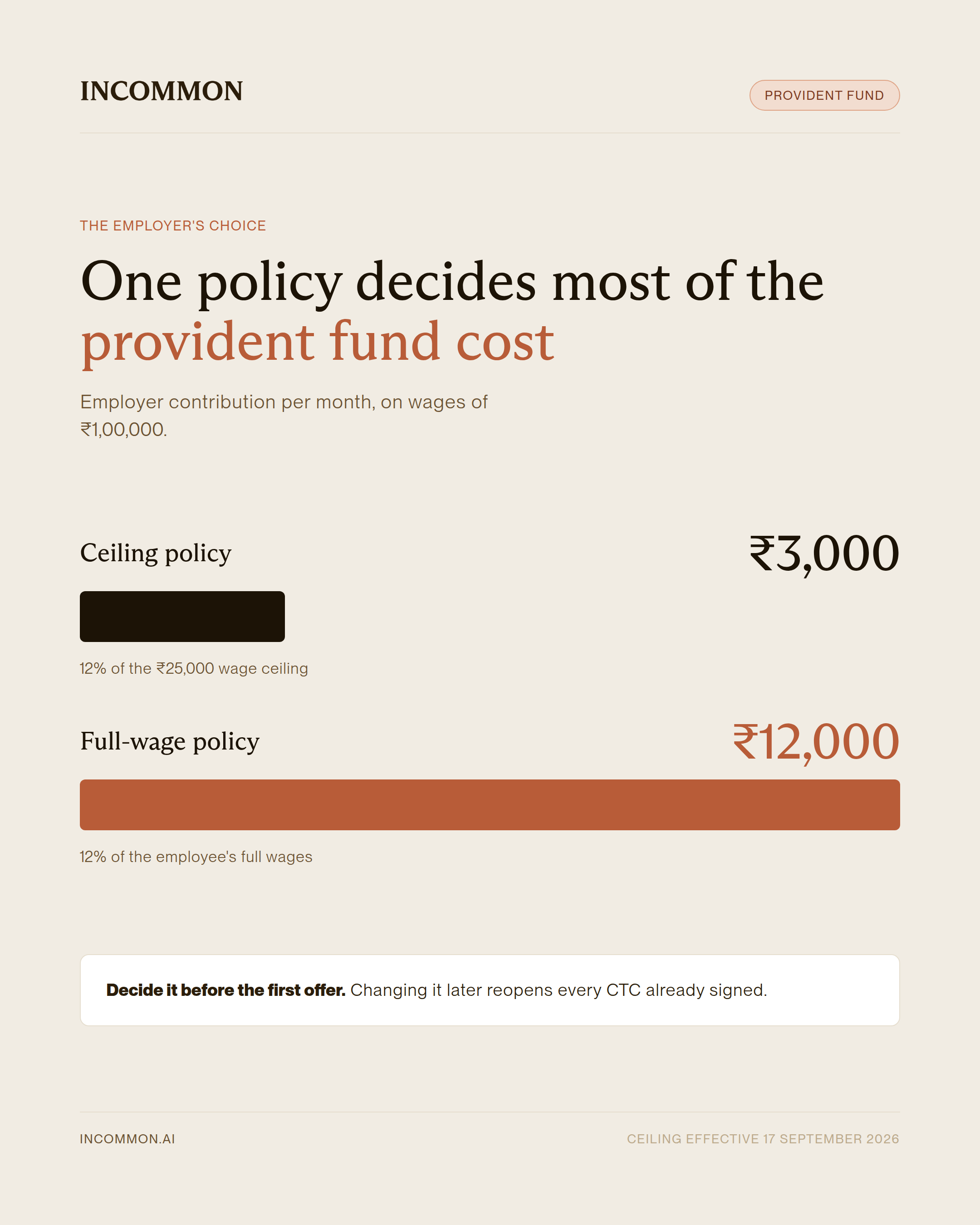
The wage ceiling for mandatory contribution rose to ₹25,000 a month on 17th September 2026, its first change since 2014. Above the ceiling, the employer has a choice. It can contribute 12% of the ceiling, which is ₹3,000 a month, or 12% of the employee's full wages.
For an engineer, that choice decides most of the provident fund cost. On wages of ₹1,00,000 a month, the ceiling route costs ₹3,000 and the full-wage route costs ₹12,000.
Part of the employer's share goes to the pension scheme instead of the provident fund account. For members covered by that scheme, 8.33% of wages up to the ceiling is diverted, now about ₹2,083 a month. The employer's total stays at 12%, with small insurance and administration charges on top.
Decide the provident fund policy before the first offer. Changing it later reopens every CTC already signed.
An employer of record runs the same contributions under its own registration. When that route makes sense is covered in EOR or your own entity.
How gratuity accrues
Gratuity is a lump sum paid when an employee leaves, retires, or dies after qualifying service. It moved from the Payment of Gratuity Act to the Code on Social Security, 2020, and the formula came across unchanged.
The payout is 15 days of wages for each completed year of service, with a month counted as 26 working days. That works out to about 4.8% of annual wages for every year worked.
A permanent employee qualifies after five years of continuous service. A fixed-term employee qualifies after one, according to the labor ministry's FAQs on the codes.
Gratuity follows the last wage drawn. So each increment revalues every year already served, and a liability that looked small in year one grows with each pay review.
The accrual rarely becomes cash in the first two years. It is still a cost from day one, and an auditor will expect the provision on the balance sheet. The first payouts tend to land around year five, as our five-year cost view shows.
Leave that turns into cash
Earned leave is a statutory entitlement under each state's Shops and Establishments Act, and in some states it becomes cash. Maharashtra's Act credits 1 day of earned leave for every 20 days worked, once an employee has worked 240 days in a year. Leave accumulates up to 45 days, and the employer must pay for leave still due when an employee leaves.
So unused leave is a liability. It is valued at the current wage, grows with every increment like gratuity, and needs a provision on the balance sheet.
Set the carry-forward and encashment rules before the first offer. Our guide to India holidays and leave covers the calendar side.
State insurance and professional tax
ESI, the employees' state insurance scheme, covers employees earning up to ₹21,000 a month. The ministry's FAQs confirm that the ceiling still applies under the codes. Almost every engineer earns above it, so ESI rarely reaches a technical team.
Professional tax is a state levy on employment. The employer deducts it from salary and pays it to the state. Article 276 of the Constitution caps it at ₹2,500 per person per year, and rates and slabs vary by state. Some states levy none.
Benefits outside the statute
Several lines in a CTC are not statutory at all. Health insurance is the main one. ESI does not reach most engineers, so medical cover for a technical team is company policy, usually a group health plan.
Cover for spouses, children, and parents is widely valued in India, and the plan's scope affects the premium. Decide it alongside the provident fund policy, because both change every CTC you issue.
Variable pay is the other policy line. Many CTCs include a target bonus, and candidates compare the full figure. Budget variable pay at target, since that is the number the candidate accepted.
One engineer, worked through
The table takes an illustrative engineer on ₹2,00,000 a month in pay before employer contributions, with wages at the 50% floor:
| Line | Ceiling policy | Full-wage policy |
|---|---|---|
| Monthly pay before employer contributions | ₹2,00,000 | ₹2,00,000 |
| Wages for statutory purposes | ₹1,00,000 | ₹1,00,000 |
| Employer provident fund, 12% | ₹3,000 | ₹12,000 |
| Gratuity accrual, about 4.8% of wages | ₹4,808 | ₹4,808 |
| State insurance | Not applicable | Not applicable |
| Professional tax | Deducted from the employee | Deducted from the employee |
| Employer statutory cost per month | ₹7,808 | ₹16,808 |
| Share of monthly pay | About 3.9% | About 8.4% |
Provident fund policy affects the total the most.
Both columns exclude the small insurance and administration charges. When a subsidiary bills its parent, every rupee in the table also carries the transfer pricing markup, a mechanism explained in captive center vs GCC.
Costs outside payroll
The statutory lines are only part of what a hire costs. Several more costs land outside payroll, and a budget built from the CTC alone misses them:
- Recruitment: a one-time cost per hire, whether it is a partner's fee or your own team's time on sourcing, screening, and interviews, plus background checks
- Equipment and software: a laptop, a monitor, licenses for every tool the team uses, and the IT work to set them up and secure them
- Onboarding: the weeks before a new engineer works at full pace, and the time your existing team spends getting them there
- Manager time: regular one-on-ones, reviews, and feedback, often run across a time-zone gap that pushes some of it into early or late hours
A team that works from an office adds workspace on top. Our guide to GCC partner pricing covers which of these costs a partner passes through and which it folds into its fee.
None of these lines appear on a payslip, so they are easy to leave out of a per-head budget. Add each one as its own line, priced once per hire or per month, depending on how it falls.
What changes the number after hiring
Salaries move every year. Aon projects increments of 9.3% for global capability centers in India in 2026. Provident fund on full wages and the gratuity balance both rise with them.
The table follows the engineer from the worked example through two increments at a constant 9.3%. Gratuity is the balance accrued by the end of each year, on that year's wage:
| Line | Year one | Year three |
|---|---|---|
| Monthly wages for statutory purposes | ₹1,00,000 | ₹1,19,465 |
| Employer provident fund, ceiling policy | ₹3,000 | ₹3,000 |
| Employer provident fund, full-wage policy | ₹12,000 | ₹14,336 |
| Gratuity balance accrued | ₹57,692 | ₹2,06,766 |
At the year-one wage, three years of service would accrue ₹1,73,077. The year-three wage adds about ₹33,690, because every year served is revalued at the new wage. The ceiling policy stays flat.
A hire who leaves costs more than any statutory line. Replacing one engineer means paying for the search again and carrying an empty seat through the replacement's notice period. Turnover is also one of the early signals of why capability centers fail.
That is why retention belongs in the cost model, especially for PE-backed builds where the real question is not just how fast a team launches, but how well it holds. For Veramatic, a PE-backed company, the result was 21 people live in four weeks, with 92% retention across the build. Findigs had 60 underwriters hired in four months, with 90% still in place.
As part of our India office setup, we run payroll, provident fund, and gratuity provisioning for client teams after they join. We also back every candidate with a six-month replacement guarantee.
For private equity portfolios, retention is the figure we lead with because it is the clearest proof that the operating model is working.
To work through these numbers for your own team, get in touch.
Final thoughts
Price an India engineer from the CTC, and settle the provident fund policy before the first offer goes out. Carry gratuity from month one, and model increments into year two.
The statutory lines are small and predictable. Retention decides whether the total stays that way.
Frequently asked questions
What does an India employee cost on top of salary?
The employer pays 12% of wages into provident fund, on the ₹25,000 monthly ceiling or on full wages depending on company policy, and accrues gratuity at about 4.8% of wages. State insurance applies only to employees earning up to ₹21,000 a month, and professional tax is deducted from the employee. For an engineer, the statutory load usually comes to a single-digit percentage of pay, with the provident fund policy deciding most of it.
What does provident fund cost an employer in India?
12% of wages, matched by 12% from the employee. The mandatory wage ceiling rose to ₹25,000 a month on 17 September 2026, so an employer restricting contributions to the ceiling pays ₹3,000 a month. An employer contributing on full wages pays 12% of the employee's actual wages, which under the labor codes are at least half of total pay.
How does gratuity work in India and what does it accrue at?
Gratuity pays 15 days of wages for each completed year of service, with a month counted as 26 working days, which is about 4.8% of annual wages per year worked. Permanent employees qualify after five years and fixed-term employees after one. It is calculated on the last wage drawn, so each increment revalues the whole accrued balance.
What is CTC in an Indian offer?
CTC, or cost to company, is the annual figure Indian offers are quoted in. It bundles fixed pay, allowances and the employer's provident fund share, and many offers also include gratuity and variable pay. Budget in the same unit and record which statutory lines each CTC includes.
Does ESI apply to software engineers in India?
Rarely. Employees' state insurance covers employees earning up to ₹21,000 a month, a ceiling that still applies under the labor codes. Almost every engineer earns above it.
Who pays professional tax in India?
The employee. The employer deducts professional tax from salary and pays it to the state. The Constitution caps it at ₹2,500 a person per year, and rates vary by state, with some states levying none.
Written by
CEO, InCommon
Piyush Kedia is the CEO of InCommon, a talent infrastructure company that helps US and global enterprises set up and scale Global Capability Centers (GCCs) in India. He works with founders, CTOs, and heads of talent to design smaller, AI native GCC teams that focus on judgment work, not just headcount, so India offices stay senior, stable, and production ready. Before InCommon, Piyush built Blue Vector into a 50 person creative agency serving brands such as Trump Towers, Audi, and Porsche, giving him a front row view of how high performing teams are hired, managed, and grown.