Understanding Indian Labor Laws for Offshore Teams: How an EOR Simplifies Compliance

See how Findigs, Accompany Health, Veramatic and Podifi built their teams.
Real teams, real results, from faster hiring to lasting retention.
Quick look:
| Hiring offshore in India means complying with wage, safety, and benefits laws that vary by state and change often, including the four labor codes that replaced 29 central labor laws in November 2025. Non-compliance risks fines, disputes, and reputational damage. An EOR acts as the local legal employer: it drafts compliant contracts, runs payroll and statutory deductions, administers benefits, and tracks regulatory changes on your behalf, so you can manage the work without carrying the compliance burden directly. |
|---|
India is a hotbed of talent.
Its skilled workforce draws businesses from across the globe. However, hiring in India has an add-on responsibility: understanding and adhering to offshore labor laws that are often complex and dynamic.
This is where an Employer of Record (EOR) steps in to make life easier.
For businesses managing offshore teams in India, an EOR ensures you're playing by the rules while focusing on what you do best: building and scaling your team.
Let's break down Indian labor laws and explore how an EOR can take the stress out of compliance.
Why understanding offshore labor laws in India matters
Labor laws in India protect employees' rights and ensure businesses operate ethically. For companies hiring offshore teams, compliance is critical to avoid hefty fines, legal disputes, and reputational damage.
Here's why you need to pay attention:
- Legal Protection: Staying compliant shields your company from penalties
- Employee Trust: Following the law fosters a better relationship with your offshore team
- Smooth Operations: When your processes align with local regulations, you avoid unexpected hiccups
The basics of Indian labor law
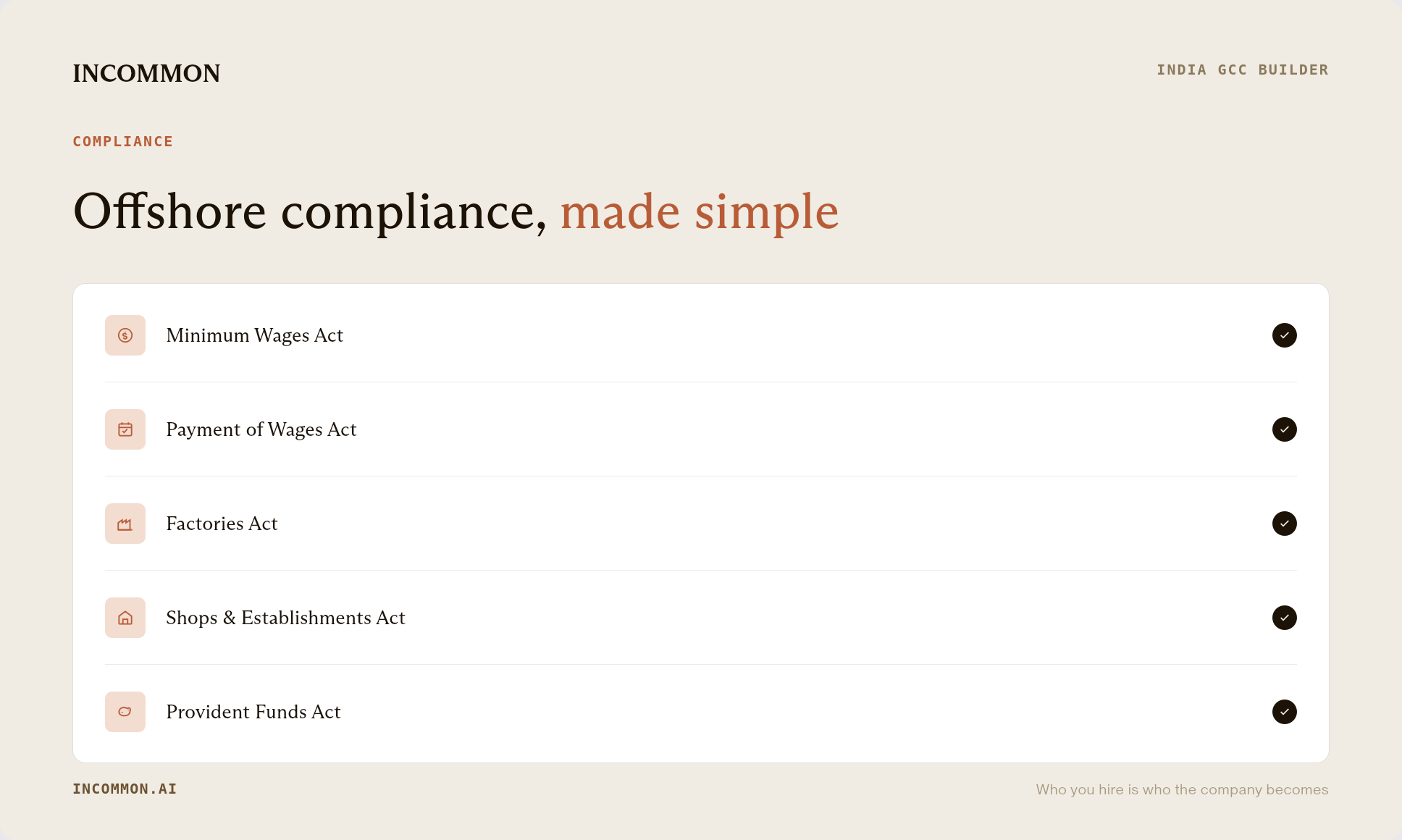
On 21 November 2025, India replaced 29 central labor laws with four labor codes. Central and state rules under the codes have been rolling out since, so check the rules for each state where your team works. Here are the laws you should know:
1. The Code on Wages, 2019
This code replaces the Minimum Wages Act, the Payment of Wages Act, the Payment of Bonus Act, and the Equal Remuneration Act.
- States still set minimum wages, and none can fall below a national floor wage
- Monthly salaries must be paid by the seventh day of the following month
- If allowances and other excluded pay add up to more than half of total pay, the excess counts as wages for contributions and gratuity
2. The Code on Social Security, 2020
This code replaces nine laws, including the Employees' Provident Funds Act, the Employees' State Insurance Act, the Payment of Gratuity Act, and the Maternity Benefit Act.
- Employers and employees each contribute 12% of wages to the Provident Fund (PF)
- Gratuity, maternity benefits, and Employee State Insurance (ESI) are now covered by this one code
3. The OSH Code, 2020
The Occupational Safety, Health and Working Conditions Code replaces 13 laws, including the Factories Act. It governs working hours, health, and safety for companies with physical operations in India.
4. The Industrial Relations Code, 2020
This code replaces the Industrial Disputes Act, the Trade Unions Act, and the Industrial Employment (Standing Orders) Act. It covers terminations, layoffs, and how disputes are resolved.
5. State Shops and Establishments Acts
The codes did not replace these state laws. They regulate working hours, holidays, and registration for offices and service businesses, and each state has its own version.
How offshore labor laws impact international employers
Hiring offshore isn't as simple as issuing a contract and sending paychecks. Here's how labor laws affect international employers:
- Tax Compliance: Employers may need to pay taxes on employee income and other statutory contributions
- Contractual Obligations: Employment contracts must comply with Indian labor laws, not just the employer's country of origin
- Employee Benefits: Offshore employees in India are entitled to statutory benefits like PF, gratuity, and paid leave
- Severance and Termination: Labor laws dictate how layoffs and severance packages should be handled
The role of an EOR in simplifying offshore labor laws
An Employer of Record (EOR) acts as a local employer on your behalf. They take care of compliance, payroll, and benefits while you manage the day-to-day work.
- Local Expertise: EORs have in-depth knowledge of Indian labor laws and keep track of updates
- Streamlined Processes: They handle payroll, taxes, and statutory contributions, ensuring accuracy
- Risk Mitigation: By working with an EOR, you reduce the risk of non-compliance and penalties
How an EOR simplifies offshore labor laws
An EOR simplifies compliance with Indian labor laws in several ways:
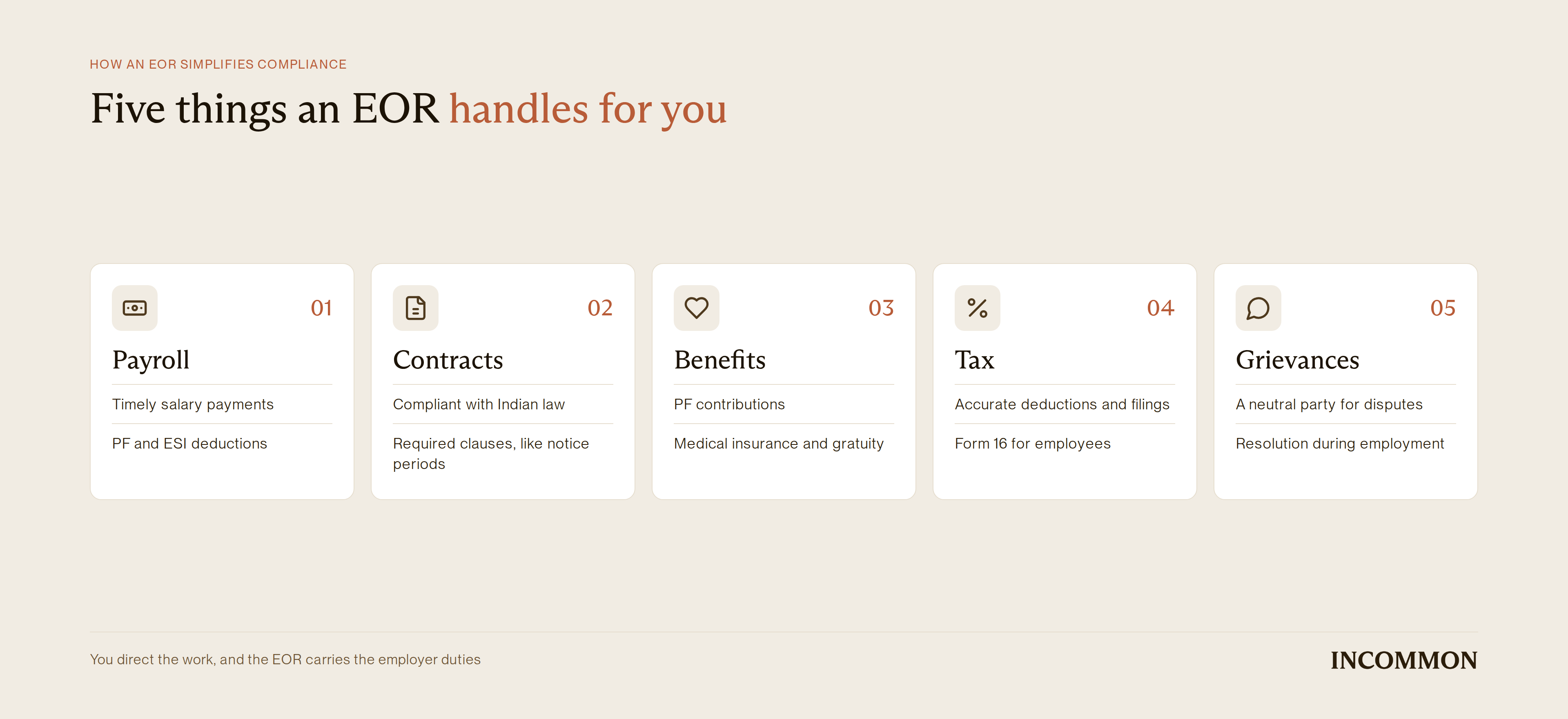
1. Payroll management
Processing payroll in India involves compliance with tax laws and contributions.
- An EOR ensures timely salary payments
- They handle statutory deductions like PF and Employee State Insurance (ESI)
2. Employment contracts
Drafting compliant contracts is tricky. An EOR handles:
- Contract creation, ensuring alignment with Indian laws
- Inclusion of legally required clauses, such as termination notice periods
3. Benefits administration
Employee benefits are legally mandated and culturally significant in India.
- EORs manage benefits like PF contributions, medical insurance, and gratuity payments
4. Tax compliance
India's tax system is complex, with both direct and indirect taxes.
- An EOR ensures accurate tax deductions and filings
- They also give employees their annual tax certificate
5. Grievance handling
Disputes or misunderstandings can arise during employment.
- An EOR serves as a neutral party to address and resolve employee grievances
Common challenges in Indian offshore labor laws
Labor law compliance isn't without its hurdles. Here's what you might face:
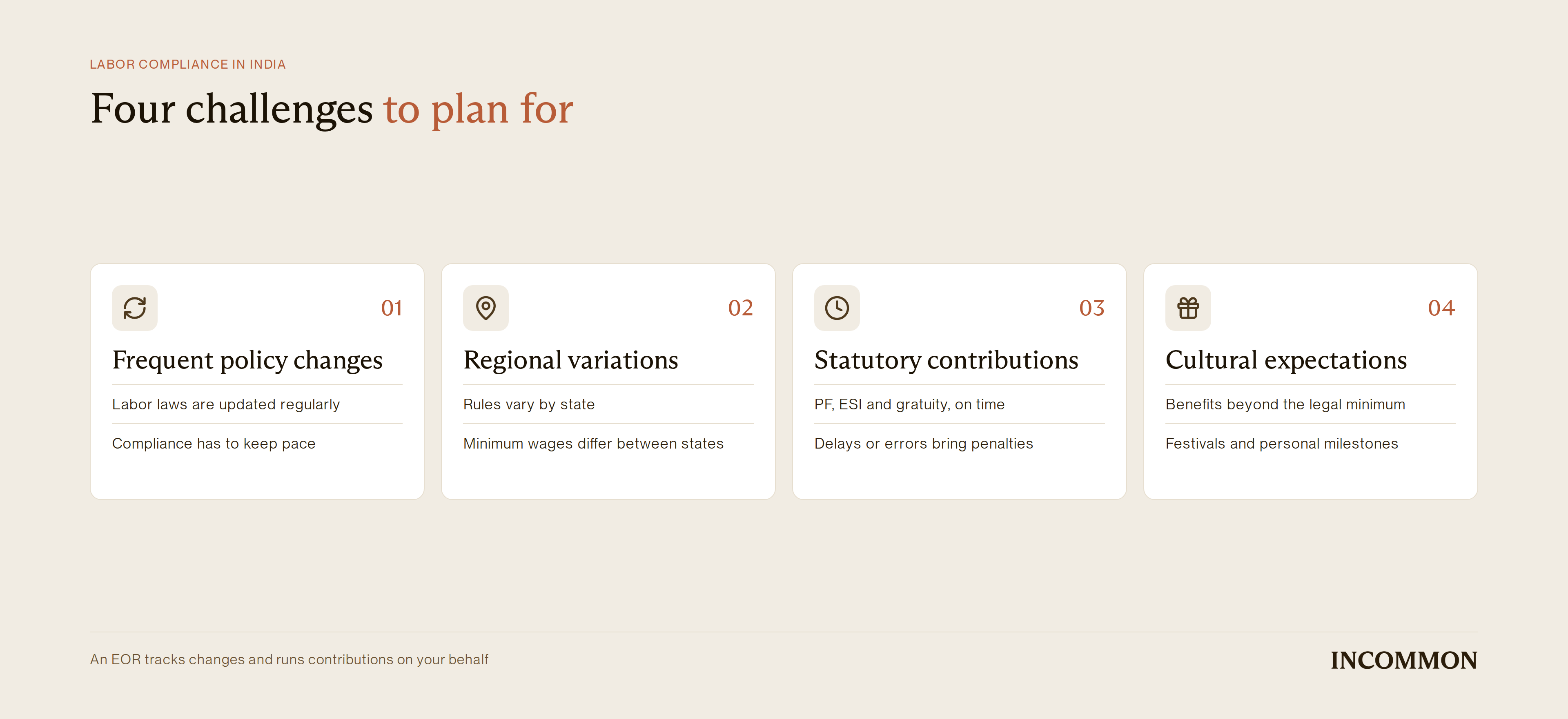
1. Frequent policy changes
India's labor laws are updated regularly, which can be hard to keep up with.
- An EOR stays informed about changes and ensures compliance
2. Regional variations
Labor laws often vary by state, creating additional complexity.
- For instance, minimum wages differ between Karnataka and Maharashtra
3. Statutory contributions
Ensuring timely contributions to PF, ESI, and gratuity funds requires precision.
- Delays or inaccuracies can result in penalties
4. Cultural expectations
Beyond legal requirements, employees in India expect certain benefits during festivals or personal milestones.
- An EOR helps balance legal obligations with cultural considerations
Benefits of partnering with an EOR for Indian offshore teams
Working with an EOR simplifies compliance and offers additional benefits:
- Time-Saving: You focus on building your team while the EOR handles red tape
- Cost Efficiency: Avoid fines and legal fees caused by non-compliance
- Employee Satisfaction: Offshore employees receive accurate pay and benefits on time
Tips for choosing the right EOR for offshore labor laws
Not all EORs are created equal. Here's how to find the right one for your offshore team:
1. Look for real expertise
Choose an EOR with a deep understanding of Indian labor laws and regional nuances.
2. Check for customization options
Ensure the EOR can tailor services to suit your business needs and team size.
3. Prioritize transparency
Your EOR should provide clear, itemized billing and regular updates on compliance matters.
If you want that kind of support for your India team, we can help.
Everything you need to build and run your India GCC.
Entity, hiring, workspace and ongoing operations under one agreement.
Offshore labor laws made simple with an EOR
Indian labor laws might seem like a maze, but they're designed to protect employees and promote fair practices.
For businesses managing offshore teams, staying compliant is non-negotiable and an EOR makes it easier.
With an EOR handling compliance, payroll, and benefits, you can build a productive offshore team without worrying about labor law headaches.
Because in the end, a happy, compliant team is the key to long-term success.
Written by
CEO, InCommon
Piyush Kedia is the CEO of InCommon, a talent infrastructure company that helps US and global enterprises set up and scale Global Capability Centers (GCCs) in India. He works with founders, CTOs, and heads of talent to design smaller, AI native GCC teams that focus on judgment work, not just headcount, so India offices stay senior, stable, and production ready. Before InCommon, Piyush built Blue Vector into a 50 person creative agency serving brands such as Trump Towers, Audi, and Porsche, giving him a front row view of how high performing teams are hired, managed, and grown.