EOR, Payroll, or Both: How to Make the Right Choice for Your Startup

See how Findigs, Accompany Health, Veramatic and Podifi built their teams.
Real teams, real results, from faster hiring to lasting retention.
Quick look:
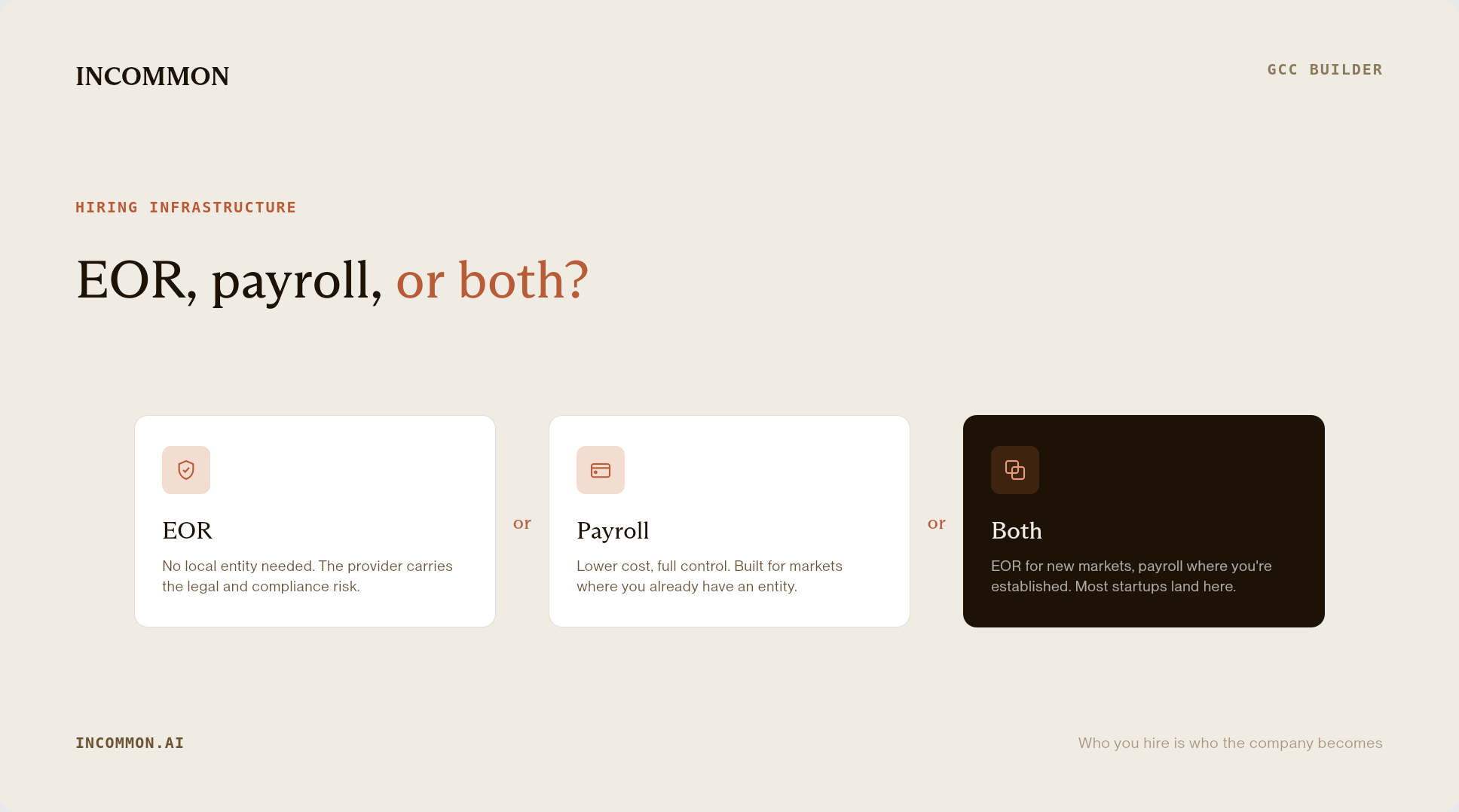
| An EOR employs your team directly, handling onboarding, tax compliance, and benefits so you can hire without a local entity. Payroll services manage wages, deductions, and disbursement, but only work where you already have a legal entity, and they carry none of the employer liability. Use EOR to enter a new market or cover short-term roles. Use payroll once you have an established entity and in-house HR. Many startups combine both as they expand across multiple markets or scale beyond their first hires. |
|---|
Discover the ideal solution for your startup with our comprehensive guide on EOR and payroll services.
Understanding EOR and Payroll
Managing the right employment infrastructure is the most important aspect of a startup looking to scale.
Whether expanding domestically or entering global markets, companies face a choice between using an Employer of Record (EOR), a payroll service, or a combination of both. Each option has unique advantages, responsibilities, and costs, which make a strategic approach essential.
An EOR (Employer of Record) is a third-party entity that manages all legal employment responsibilities for employees, including onboarding, tax compliance, and benefits, allowing companies to hire internationally without setting up a legal entity. Payroll services, on the other hand, are more focused on managing employee wages, tax deductions, and salary distributions without assuming the same legal obligations of an EOR.
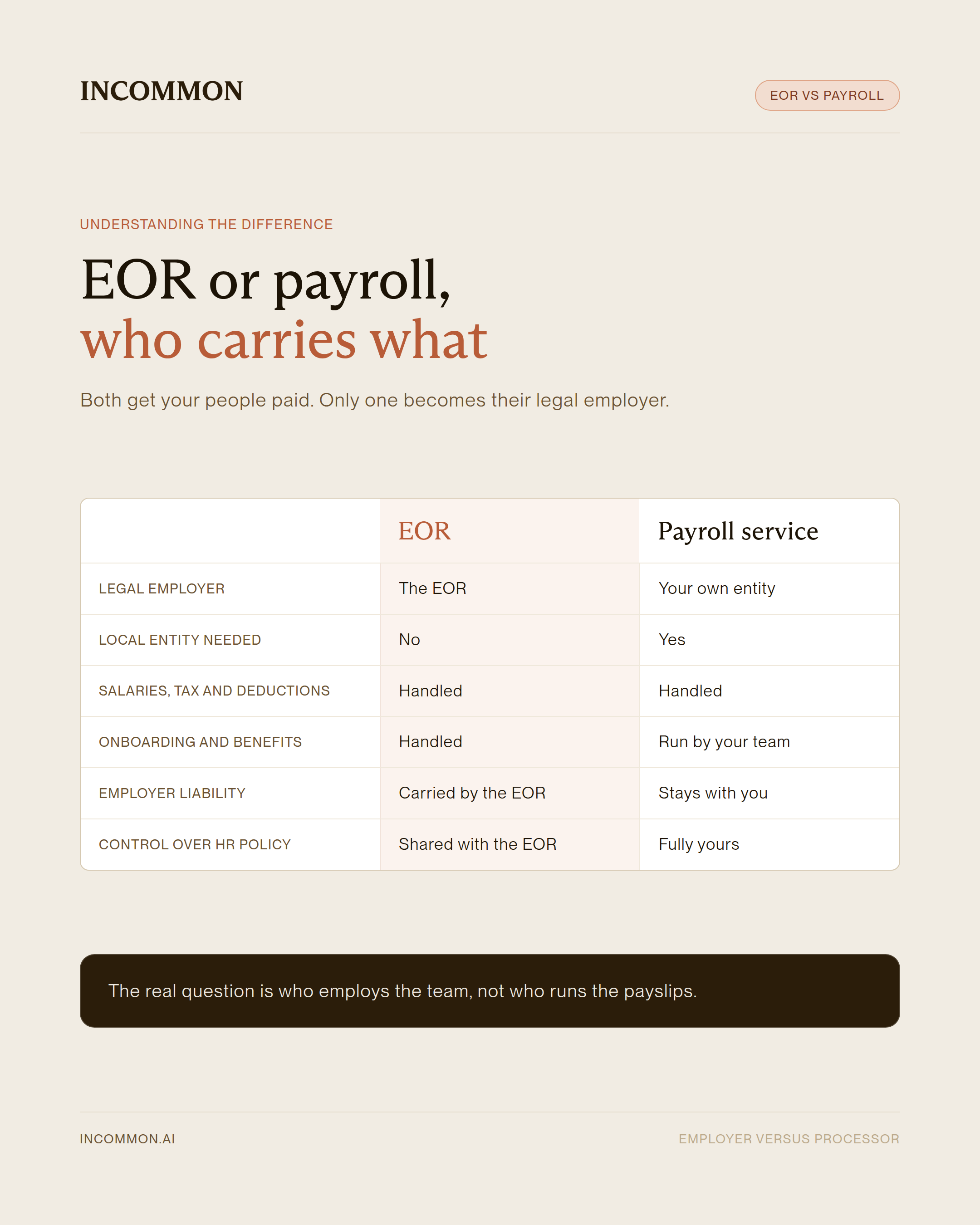
This guide explores the pros and cons of EOR and payroll services and offers guidance on when each, or a combination, might be the best choice for startups.
Advantages and Disadvantages of EOR and Payroll Services
EOR Advantages
- Simplified Compliance: EORs handle complex employment laws, particularly in foreign jurisdictions, ensuring full legal compliance without requiring the startup to establish a local entity
- Comprehensive HR Support: EOR providers manage employee onboarding, benefits, and payroll, freeing up startups to focus on their core operations
- Reduced Liability: With EORs, the third-party provider assumes employer liability, mitigating risk for the startup
EOR Disadvantages
- Higher Costs: EOR services might come at a premium due to their comprehensive nature
- Less Control Over HR Practices: Since EORs manage employee policies, companies may experience less flexibility in certain administrative aspects
Payroll Services Advantages
- Cost-Efficiency: Payroll services are generally more affordable, especially for startups only needing basic payroll functions
- Control Over HR Policies: Payroll services allow startups to maintain control over their HR policies, employee engagement, and workplace culture
Payroll Services Disadvantages
- Limited Compliance Assistance: Payroll providers focus on payroll tax filings and payments but do not assume legal responsibility for employees
- Restricted to Established Entities: Payroll services are most effective for companies with legal entities in the respective countries
When to Use Both EOR and Payroll Services Together
Some startups may benefit from a dual approach, where EOR and payroll services are combined for flexibility and cost efficiency.
This setup is most effective when:
- Expanding Gradually: Startups looking to enter multiple countries gradually may initially use an EOR, then switch to payroll services once they have legal entities in each location
- Scaling Beyond Initial Hires: Once a company grows beyond a few hires in a region, moving to a payroll service can reduce costs while allowing an EOR to oversee compliance
- Seasonal or Contract-Based Work: Companies with varying employment needs may benefit from an EOR for short-term staff and payroll for long-term employees, enabling adaptability
When should you opt for an EOR-only approach?
In some cases, using only an EOR is ideal due to the complexity of managing international hires and local regulations.
Here are situations where only an EOR may suffice:
- Hiring in New Foreign Markets: Entering markets where the company has no legal entity
- Compliance with Foreign Labor Laws: Ensuring full compliance with employment laws in unfamiliar territories
- Short-Term or Project-Based Roles: Hiring contractors or employees for specific, short-term projects
- Startups with Limited HR Resources: When a company lacks the HR capacity to manage compliance and payroll
- Risk Mitigation in Unstable Markets: When hiring in countries with fluctuating regulations or high compliance risks
When should you opt for a payroll-only approach?
For startups with established legal entities and a more permanent workforce, payroll services can provide efficient support.
Here are cases where only payroll might be necessary:
- Domestic Payroll Management: Handling payments, taxes, and deductions within a home country
- Permanent Full-Time Staff in Established Markets: Paying employees in regions where the company has already set up local entities
- Company-Specific Benefits: Startups that want complete control over benefits, policies, and employee engagement
- In-House HR Expertise: When the company has HR experts to handle compliance and payroll policies
- Stable Market Presence: Managing payroll in a country where the company has an established and stable market presence
What running payroll in India involves
The payroll-only route means your own Indian entity runs payroll every month, directly or through a provider. The work is the same either way:
- Withholding income tax from each salary and depositing it with the government on schedule
- Remitting provident fund contributions and, where they apply, ESI and state professional tax
- Collecting each employee's PAN and bank details before the first pay run
- Issuing a clear payslip every month and keeping payroll records ready for inspection
- Filing the periodic tax returns and giving each employee an annual tax certificate
The rules also change. The new labor codes took effect in November 2025 and a new income tax law in April 2026, so check that your provider has updated its calculations, and audit payroll at least once a year. Our guide to what an India employee costs covers the statutory rates.
When are both EOR and Payroll required?
In certain scenarios, the combination of EOR and payroll is the optimal approach for startups to maximize flexibility while maintaining legal compliance.
Here’s when you might use both:
- Expanding Across Multiple Markets: Utilizing an EOR for new regions while using payroll for established ones
- Complex Global Payroll Needs: When operating in regions with varied regulatory requirements that demand both payroll and compliance support
- Hybrid Teams: Having permanent, payroll-based staff in some areas and EOR-based employees in newer locations
- Seasonal Workforce Increases: Adding seasonal or temporary hires to a core team, managed by the EOR
- Localized Employee Benefits with Global Oversight: Offering region-specific benefits through EOR, while payroll focuses on central administrative function
Whichever mix you choose, we can set it up and run it for you.
Everything you need to build and run your India GCC.
Entity, hiring, workspace and ongoing operations under one agreement.
Making the Right Choice for Your Startup
Ultimately, this decision has to be taken with caution.
Choosing between an EOR, payroll service, or a combination depends on your startup’s growth stage, geographic reach, and the resources available.
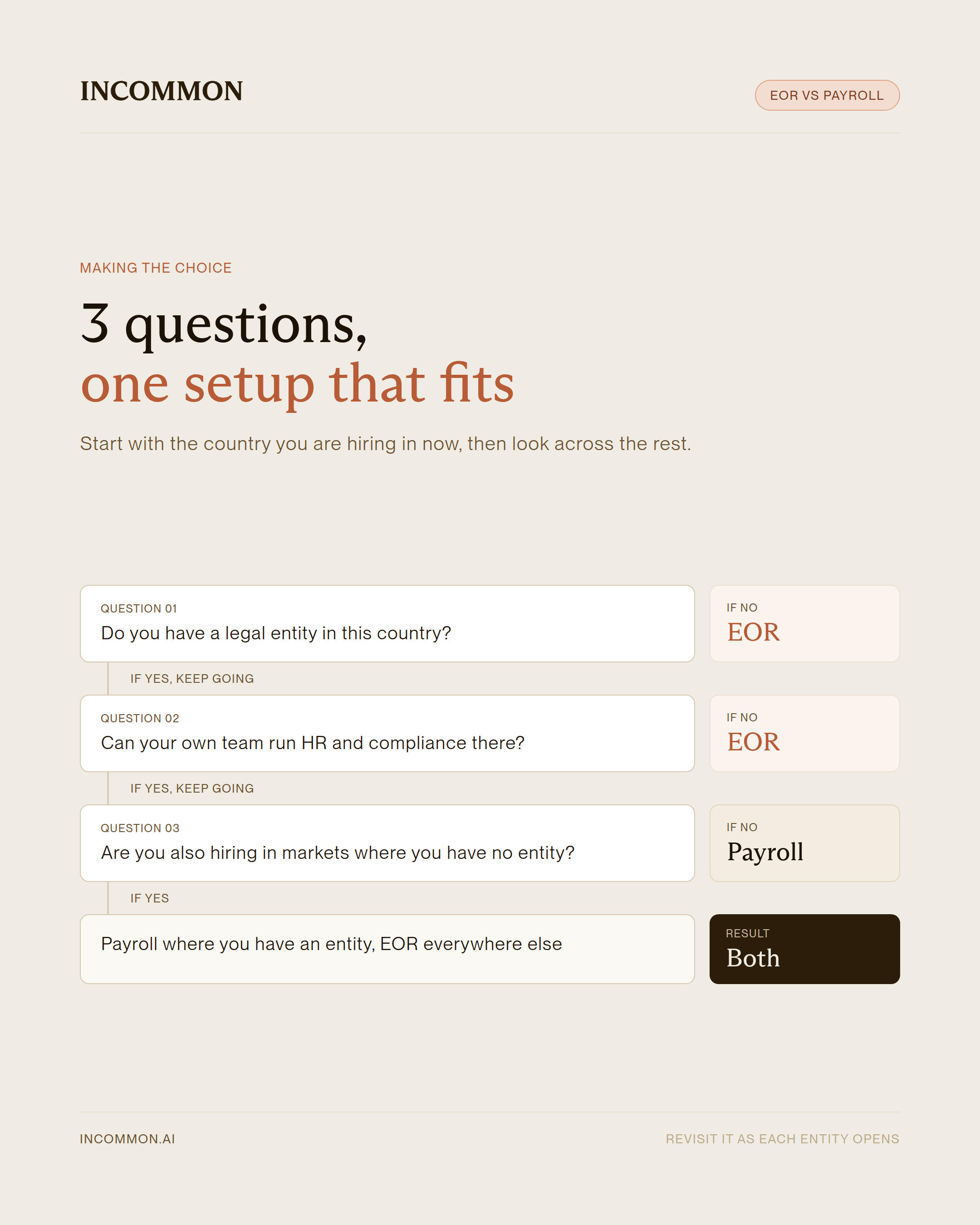
A smaller, emerging startup entering foreign markets without legal entities may lean toward an EOR. A company with established local entities may find that payroll is more cost-effective and manageable.
Each startup must weigh the pros and cons of each approach, considering factors such as cost, compliance, and operational needs. Startups need a thoughtful strategy. Startups need to build efficient teams, maintain compliance, and support growth wherever their talent may be located.
Weigh the pros and cons of these approaches before you decide on an approach, and it will save your startup a world of worry.
Frequently asked questions
What is the difference between an EOR and a payroll service?
An Employer of Record legally employs workers on your behalf and handles onboarding, compliance, taxes, and benefits. A payroll service processes salaries, deductions, and filings for workers employed by your own legal entity.
When should a startup use an EOR?
A startup should use an EOR when hiring in a country where it does not yet have a legal entity, when speed matters, or when it needs help managing local compliance and employment risk.
When is payroll enough for a startup?
Payroll is usually enough when the startup already has a legal entity in the country, has internal HR or finance support, and wants to retain direct control over employee policies and operations.
Can a startup use both EOR and payroll at the same time?
Yes. Many startups use an EOR in new markets for speed and compliance, while using payroll for employees in countries where they already have established entities.
Written by
CEO, InCommon
Piyush Kedia is the CEO of InCommon, a talent infrastructure company that helps US and global enterprises set up and scale Global Capability Centers (GCCs) in India. He works with founders, CTOs, and heads of talent to design smaller, AI native GCC teams that focus on judgment work, not just headcount, so India offices stay senior, stable, and production ready. Before InCommon, Piyush built Blue Vector into a 50 person creative agency serving brands such as Trump Towers, Audi, and Porsche, giving him a front row view of how high performing teams are hired, managed, and grown.