EOR vs Your Own India Entity: Which You Need and When

See how Findigs, Accompany Health, Veramatic and Podifi built their teams.
Real teams, real results, from faster hiring to lasting retention.
Quick look:
| An employer of record in India puts employment, payroll, and applicable statutory administration with a local legal employer while you direct the work. Use it for named hires, a small or temporary team, a market test, or hiring during incorporation. Form your own entity for direct employment, local contracts, equity, and lasting scale. EOR costs rise per person. An entity brings fixed setup costs and direct legal responsibility. Neither route removes tax, employment, or IP risk. |
|---|
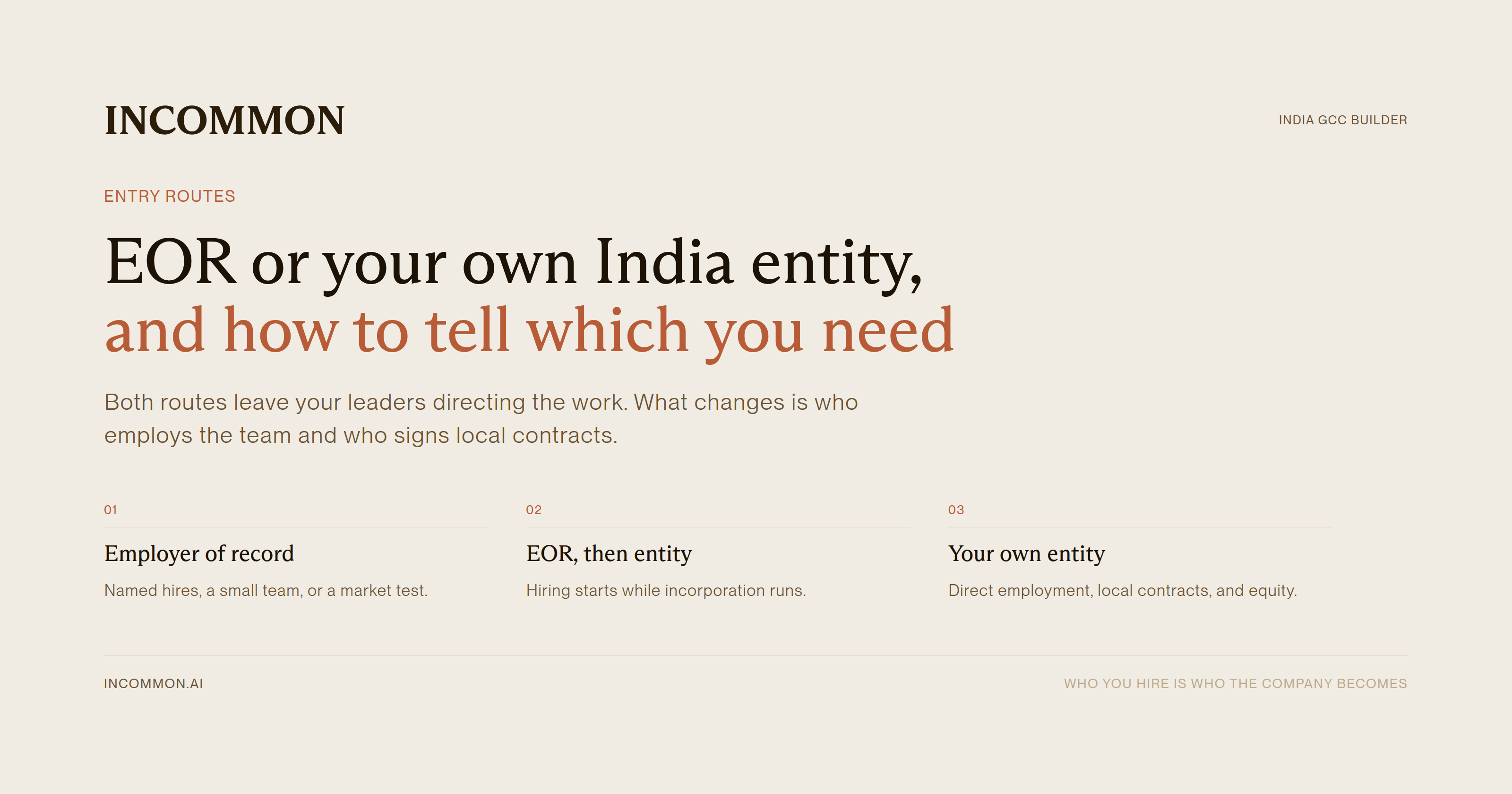
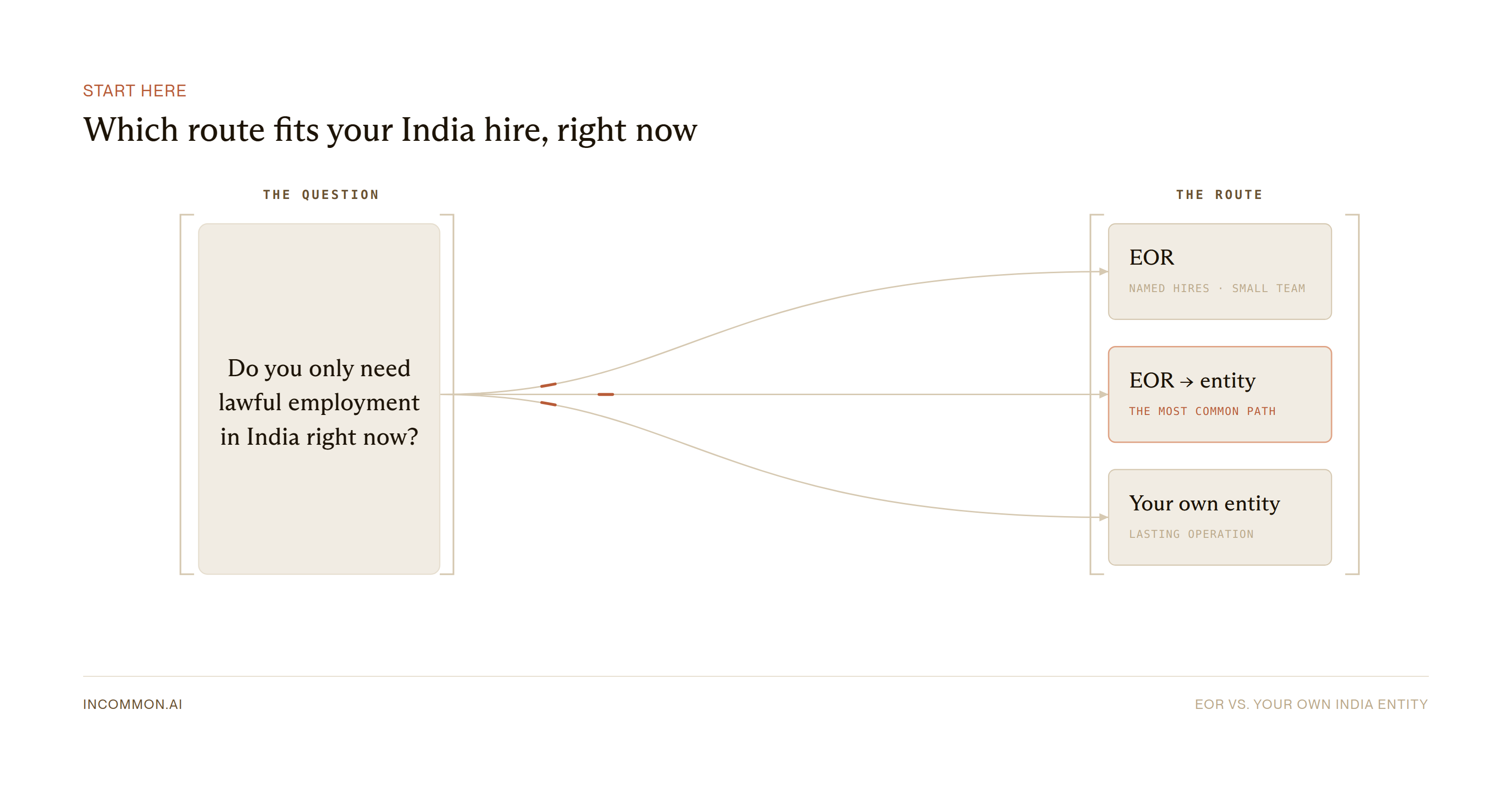
Most companies that ask the EOR question end up using both. An employer of record carries the first hires while incorporation runs, and the entity takes over once India is permanent. What matters is knowing which one you are in today, and what will trigger the change.
What is an EOR in India?
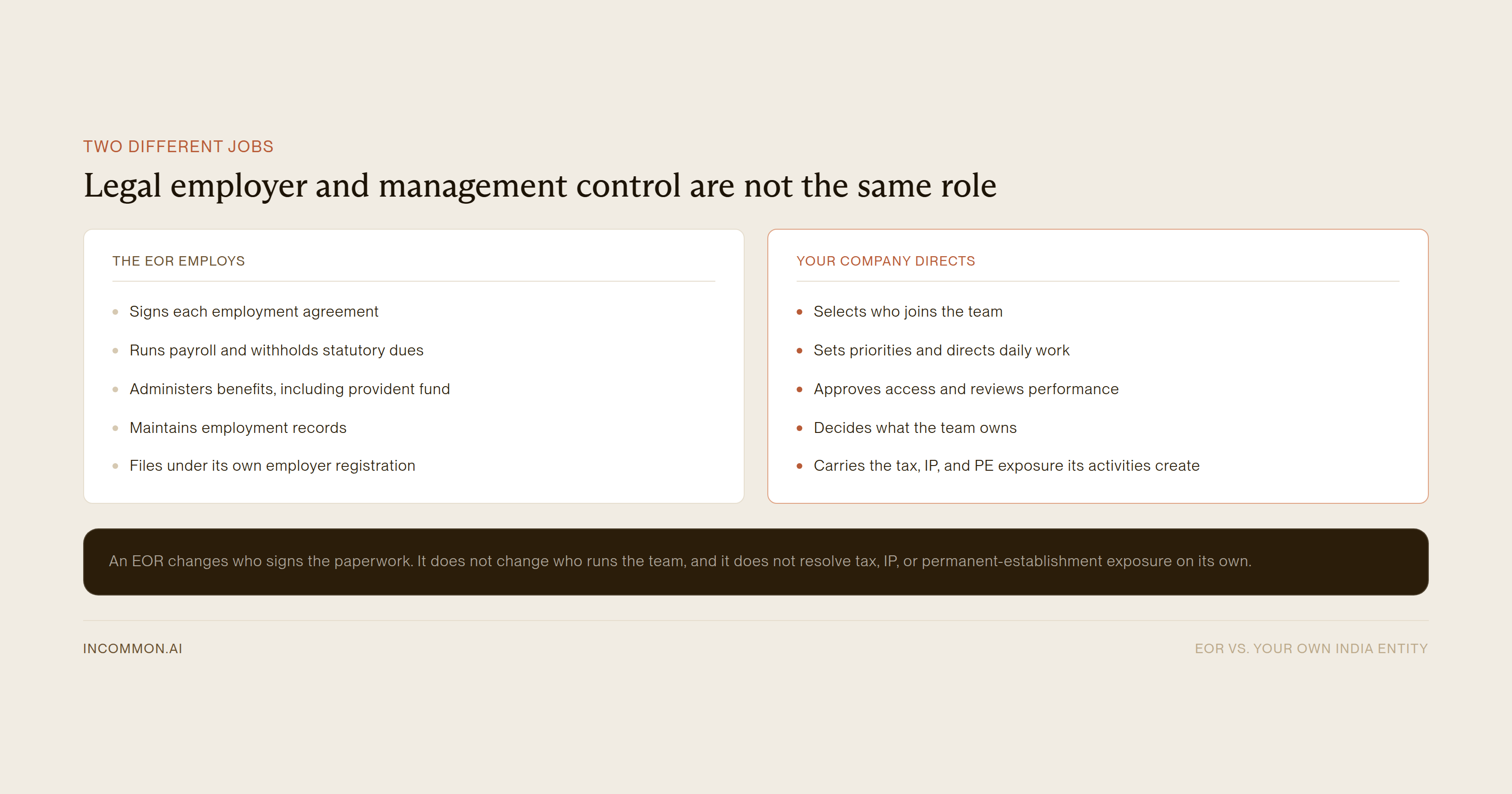
An employer of record, or EOR, is a third party that legally employs your India-based team under its local entity. You select the people and direct their work.
The EOR signs each employment agreement, places employees on payroll, withholds required amounts, maintains records, and administers applicable benefits. It also handles employment filings under its employer registration.
Your commercial agreement governs the relationship between both companies, while each employment agreement governs the provider's relationship with an employee, and the contracts must align.
The Employees' Provident Fund Scheme operates under the Employees' Provident Funds and Miscellaneous Provisions Act, 1952, and sets requirements for covered establishments, contributions, records, and administration where coverage applies.
Your leaders set priorities, approve access, review performance, and decide what the India team owns, so the operating model stays yours.
A global capability center can use EOR employment while reporting into the parent company's leadership. The setup sequence still starts with mandate, decision rights, and leadership rather than registration paperwork.
What an EOR does not give you
An EOR does not create a company that you own in India. The provider remains the legal employer, even when your managers direct daily work.
You also lack your own local contracting vehicle. Customer agreements, local vendor contracts, invoicing, banking, and regulated activities need separate analysis and another suitable structure.
You can employ a whole team through a provider and still have no bank account, no corporate approvals, and no right to sign a local contract.
The EOR's standard employment architecture might limit how closely a local package mirrors programs offered through your parent company, so equity and benefits also need careful design.
A per-person fee is light at the start, then increases with every hire instead of spreading fixed entity costs across a larger team, so cost acts differently too.
An EOR is a way to employ people. It is not a company you own.
The GCC versus outsourcing distinction still depends on mandate, reporting lines, access, and decision rights. Weak management control is also one of the common causes of GCC setup delays, whatever employment route you choose.
When an EOR is the right answer
If you have named candidates and need lawful employment only, a pure employment product is likely the right fit. Check tax, IP, security, and regulated-activity requirements before signing.
There are multiple market options a buyer might evaluate for that requirement. The right selection depends on the actual contracting and employment terms.
Inspect who employs the team, then inspect statutory remittance evidence, exit terms, data duties, IP assignment, liability limits, and the process for moving employees later.
If you never form an entity, you never gain direct employment, your own local contracting vehicle, or full control over local benefit architecture. That is the trade-off.
A small or temporary team can also justify EOR because it avoids creating a subsidiary before the company knows whether the work, location, and hiring plan justify one.
A market test works only if the hires have real work, clear managers, and access to the systems needed to perform. EOR is useful for that kind of test.
EOR is also one of our engagement models for opening a team because it keeps incorporation off the critical path while operating questions continue in parallel.
When you need your own entity
A wholly owned subsidiary is an Indian company owned by the foreign parent. It becomes the direct employer and carries its own contracts, accounts, registrations, and recurring obligations.
A lasting operating location in India points to a wholly owned subsidiary. Local contracting still depends on the entity's objects, registrations, licenses, tax position, and regulatory requirements.
Direct employment gives you more control over equity architecture, benefits design, and employment terms, although each choice still needs local review.
The subsidiary becomes part of your corporate system, and finance, HR, security, and leadership each need a named owner for decisions that no provider will absorb.
Scale changes the economics because entity costs include incorporation, banking, payroll, accounting, filings, governance, and local administration, but they do not rise as one fee per employee.
Plan incorporation rather than deferring it forever. Our current planning assumption is about 12 weeks, though documents and approvals affect incorporation timing.
Banking and operating readiness follow their own dependencies. Our GCC setup and operations support in India covers entity setup and the operating work around it.
EOR or your own India entity?
Both routes let your leaders direct priorities and performance. The difference is who employs the team, holds local obligations, signs local contracts, and owns the transition work.
Start with the intended footprint. A short hiring deadline supports EOR, while a need for direct local ownership supports an entity.
Use this comparison before discussing providers. It separates time-to-hire pressure from the longer-term operating choice that your leadership must make:
| Factor | EOR | Your own entity |
|---|---|---|
| Management control | Your leaders direct the work | Your leaders direct the work |
| Legal employer | EOR provider | Your Indian subsidiary |
| Cost shape | Per-person fee | Setup and recurring fixed costs |
| Time to first hire | Employment can start without incorporation | Direct hiring follows operational readiness |
| Local contracting | Limited to the provider's role | Entity signs eligible local contracts |
| Equity | Depends on structure and provider process | Designed through company and local advice |
| Exit | End or transfer the employment arrangement | Wind down, sell, or continue the entity |
The table is only a starting point. Apply the seven table factors to the next 12 months, then test the answer again at your planned scale.
What each route costs
Model EOR and entity as two different cost structures rather than comparing one headline number.
With EOR, many costs move with headcount and duration of employment. Salary, statutory dues, benefits, equipment, workspace, recruiting, and transition work should each sit in separate lines so your team can see what changes as hiring scales.
When an entity is likely, include the transfer as part of the EOR case. Contract exits, employee changes, benefit reconciliation, payroll migration, and internal time all belong in the model.
An entity, however, begins with a different ledger. Incorporation, banking, accounting, payroll configuration, tax work, statutory administration, and governance create costs before the team grows.
Its fixed costs spread further. Divide those setup and recurring fixed costs across the planned team, then repeat the calculation at each growth stage.
Compare complete operating cases. For a few hires, EOR often protects cash and time; for a durable larger team, entity economics deserve a direct model.
Permanent establishment and other risks
Using an EOR does not settle permanent establishment exposure. Permanent establishment is a tax concept that determines when a foreign enterprise has enough presence for local taxing rights.
The analysis is fact-dependent. An EOR neither automatically creates permanent establishment nor prevents it, because the operating facts still determine the position.
For US companies, Article 5 of the technical explanation of the US-India tax treaty addresses fixed places of business, services in India, and dependent-agent activity. Domestic Indian tax law, treaty eligibility, the treaty text, and operating facts determine the analysis.
Review what the India team does, where it works, and who binds the foreign company. Contract authority, service duration, workspace arrangements, and the business carried on in India all affect the position.
Employment compliance has its own evidence trail. Ask for payroll records and proof that applicable provident fund contributions and other statutory dues were remitted correctly.
Labels offer little protection. Contractor language does not settle status when supervision, integration, exclusivity, and the working relationship point in another direction.
Risk does not move as one package. The EOR carries employer duties under its contracts, while your company retains exposure created by its activities and decisions.
IP needs an unbroken chain. The employment agreement should assign relevant rights to the legal employer, and the provider agreement should transfer those rights as intended.
Confirm your position once with tax and employment counsel. Legal-employer convenience never replaces tax analysis.
How to choose an EOR in India
The best EOR in India is the one whose legal and operating answers survive diligence. A logo grid tells you less than the contract.
Run these tests before signing:
- Identify the Indian contracting entity and confirm whether it directly employs the team or resells another provider's service
- Read the notice, termination, severance, and dispute procedures against the employment agreement, then assign approval responsibility inside your company
- Require evidence for payroll, tax withholding, provident fund, and every other applicable statutory remittance
- Map what happens to tenure, benefits, records, and accrued balances when employees transfer to your future entity
- Review IP assignment, confidentiality, data access, security duties, insurance, liability, and the order of precedence across agreements
Price comes after structure. A lower fee has little value when the contracting chain, employment evidence, or transfer process creates work your team did not budget for.
Documents beat assurances. The provider should answer with evidence and named owners, because vague transition terms become expensive when employees are waiting.
Using an EOR as an entry route
An entry route is different from a temporary patch. It starts employment now while the company decides which responsibilities will move into its own entity later.
Keep the operating work moving. While employment is live, define the mandate, leadership, reporting line, security access, onboarding plan, and owner for each decision.
For Podifi, we put 9 engineers live in 6 weeks, without waiting for incorporation. We employed the team through an employer of record while their leaders chose the lead and directed the work.
The workstreams run together. Leaders can select people, approve access, and set management routines while entity documents, banking, payroll, and operating controls progress separately.
A transition plan should exist before the first offer. Set the decision date, employee communication owner, document list, benefits mapping, and continuity checks at the outset.
Choose employment around the next 12 months, then design the team around the work it must own.
Moving from EOR to your own entity
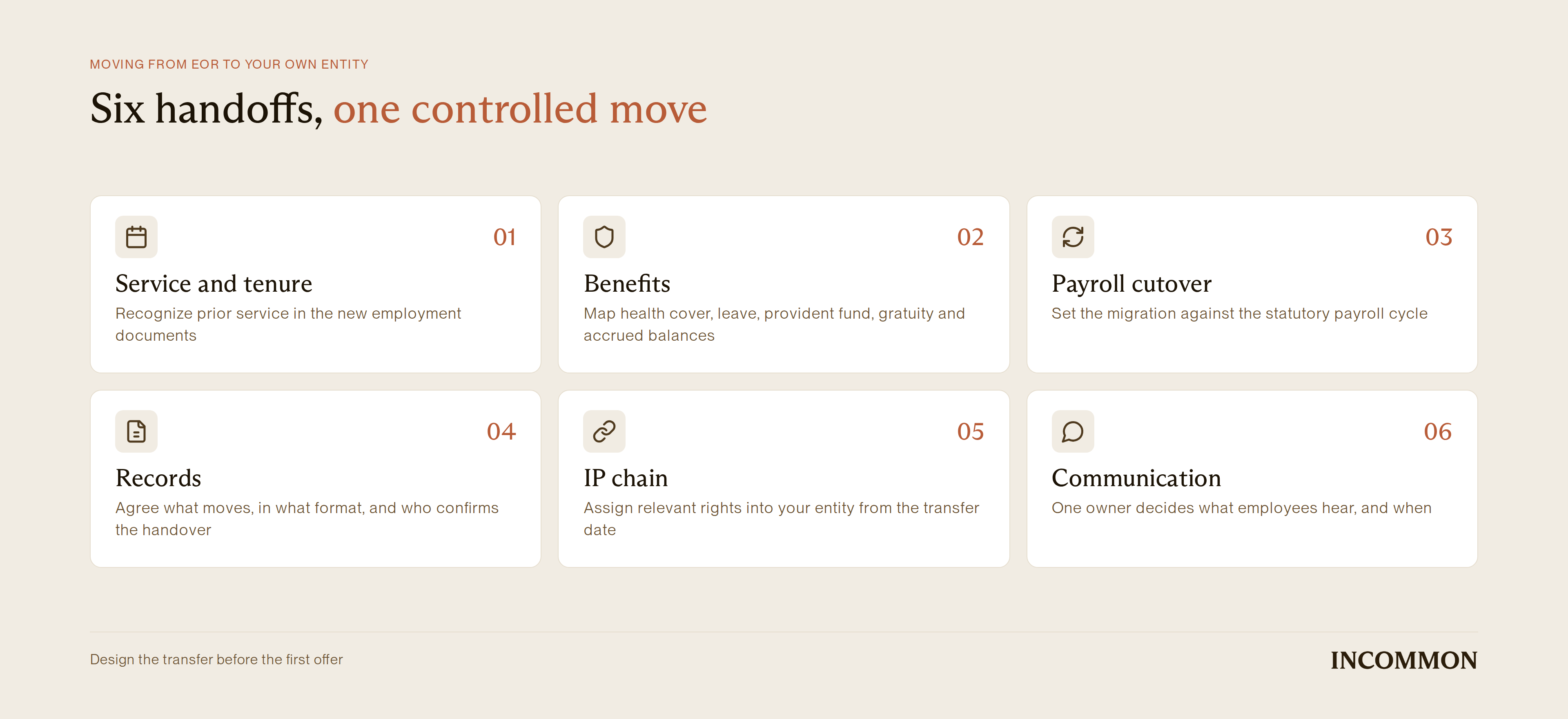
Start with continuity of service and tenure. Decide how new employment documents will recognize prior service, then make that treatment consistent across offers, policies, and employee communications.
Benefits come next. Map health coverage, leave, provident fund records, gratuity treatment, reimbursements, and every accrued balance before either payroll relationship changes.
Protect the payroll cutover. Set the migration against the statutory payroll cycle, confirm the last provider payroll, and identify who reconciles deductions, contributions, and final balances.
Records must follow. Agree which employment, payroll, tax, benefit, and statutory records move to your entity, in what format, and who confirms that the handover is complete.
Then test the IP chain. Existing assignments should run through the provider's contractual chain, while new employment documents assign relevant rights into your entity from the transfer date.
Communication needs one owner. Decide who tells employees, what can be shared before documents are ready, and when managers receive the same answers.
Sequence is important here. Employees should understand what changes, what remains continuous, and which action they must take before either employer starts the formal process.
The transfer is easier to run when it was designed before the first offer. Early planning turns six separate handoffs into one controlled employment change.
If you want the entity and the transfer planned from the start, we can run both.
Everything you need to build and run your India GCC.
Entity, hiring, workspace and ongoing operations under one agreement.
Final thoughts
The employment route is only one layer of the India decision. The work still needs a mandate, a leader, clear reporting lines, secure access, and an accountable owner.
EOR gives you sequencing flexibility. A subsidiary gives you direct local ownership and a platform for a permanent operation.
Choose with the next transition in view. The strongest plan explains who employs today, what triggers incorporation, and how people move without breaking payroll, benefits, or IP continuity.
Frequently asked questions
What EOR services are available in India for a US company?
The EOR services India operations need often cover legal employment, agreements, payroll, benefits administration, tax withholding, statutory filings, and exit support. Some providers also offer recruiting, equipment, workspace, security coordination, and a planned transfer into your entity. Confirm who delivers each service and which duties remain yours.
What is the best EOR in India?
The best EOR in India is the one whose contract, employment chain, statutory evidence, data controls, and transfer process fit your operating facts. Do not choose from a logo list or headline fee. Apply the diligence tests above and require documents, named owners, and clear exit terms.
Who is the legal employer under an EOR?
The provider's Indian entity is the legal employer and signs the employment agreement with each employee. Your company selects the people, directs their work, controls access, and manages performance under the commercial arrangement. Check whether your contracting provider employs directly or uses another company in the chain.
Does using an EOR create permanent establishment?
An EOR neither automatically creates permanent establishment nor prevents it. The analysis is fact-dependent and considers the team's activities, authority, work location, service duration, and the applicable tax rules. Legal employment through a provider does not replace an assessment of how your business operates in India.
Does an EOR handle provident fund?
The legal employer should administer applicable provident fund enrollment, deductions, employer contributions, records, and remittances. Coverage depends on the establishment and employee facts, so the contract alone is not enough. Ask for payroll records and proof that each applicable remittance reached the correct account.
How long does it take to hire the first person each way?
EOR removes incorporation from the sequence, so timing depends on contracts, screening, notice periods, and onboarding readiness. Direct employment starts after the subsidiary can operate payroll, not merely after receiving an incorporation certificate. Compare dependencies instead of treating either route as a guaranteed number of days.
Can you move from an EOR to your own entity later?
Yes, but the move requires coordinated employment documents, tenure treatment, benefits mapping, payroll cutover, records handover, accrued balances, and IP continuity. The transfer section above sequences those workstreams without promising a standard duration. Design the process before the first offer, while commercial leverage and employee expectations remain clear.
Is there a minimum team size for forming an entity?
There is no universal team-size threshold for forming an entity. The decision turns on permanence, local contracting, direct employment, benefit and equity design, regulated activities, operating capacity, and cost shape. Model fixed entity costs across your planned team, then weigh ownership needs against the speed of EOR employment.
Written by
CEO, InCommon
Piyush Kedia is the CEO of InCommon, a talent infrastructure company that helps US and global enterprises set up and scale Global Capability Centers (GCCs) in India. He works with founders, CTOs, and heads of talent to design smaller, AI native GCC teams that focus on judgment work, not just headcount, so India offices stay senior, stable, and production ready. Before InCommon, Piyush built Blue Vector into a 50 person creative agency serving brands such as Trump Towers, Audi, and Porsche, giving him a front row view of how high performing teams are hired, managed, and grown.