GCC setup in India, what it costs in years one, three and five

See how Findigs, Accompany Health, Veramatic and Podifi built their teams.
Real teams, real results, from faster hiring to lasting retention.
Quick look:
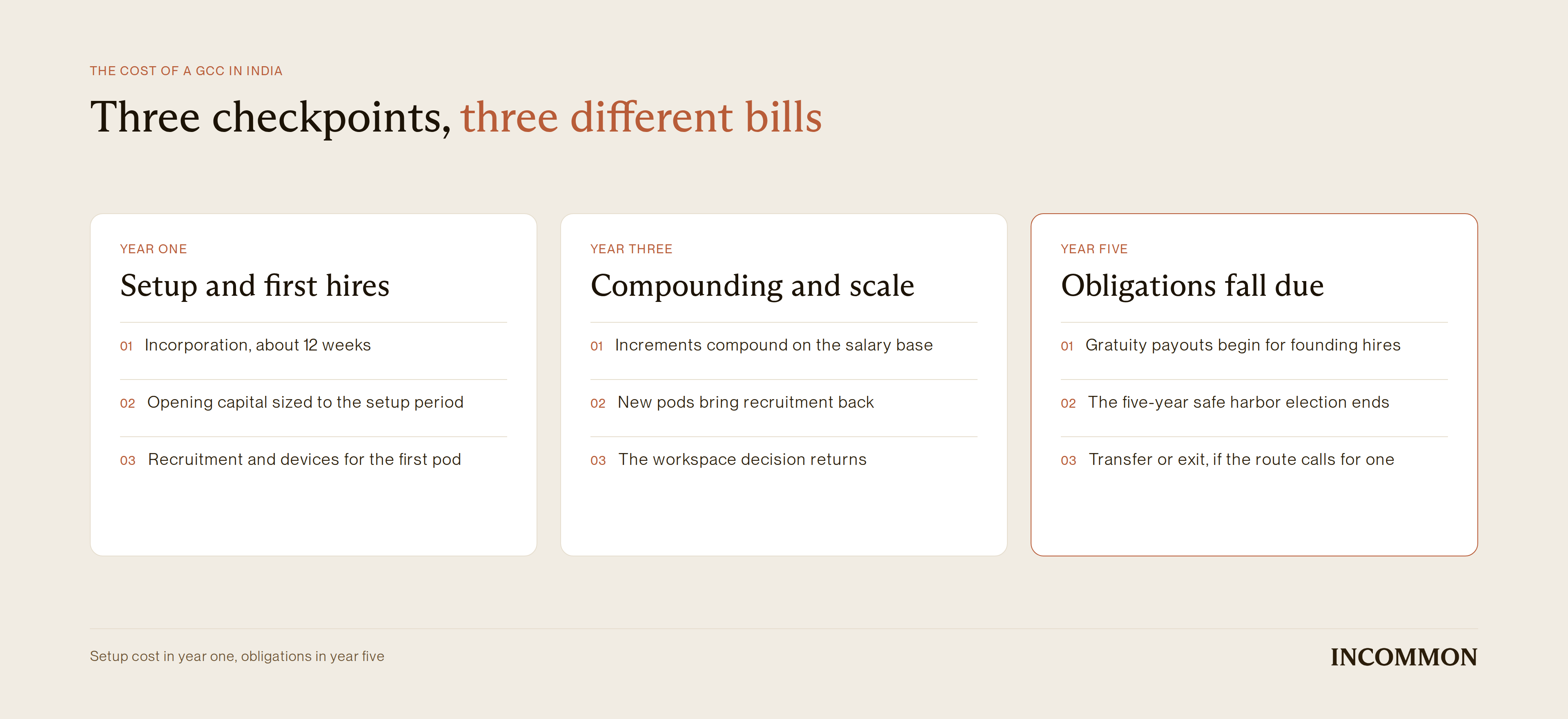
| The cost of GCC setup in India is front-loaded in year one and reshaped after it. Year one carries incorporation, opening capital, and the founding team. By year three, increments get compounded, the center adds pods, and the workspace decision returns. Year five brings the first gratuity payouts for founding hires and the end of a five-year safe harbor election. A budget that stops at month 24 can miss both. |
|---|
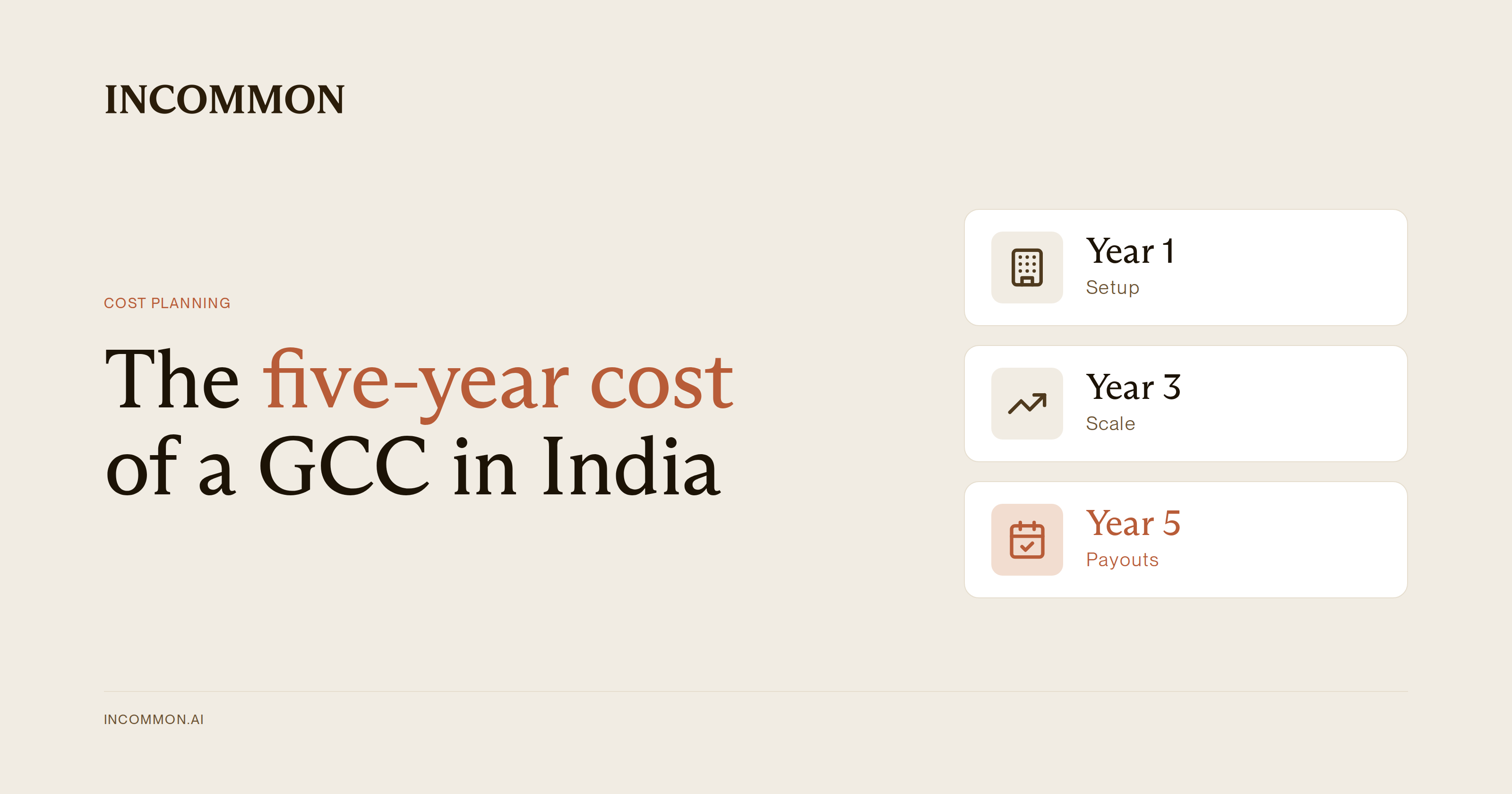
A GCC cost model for India usually stops at month 24. Year one pays for setup, year three pays for scale, and year five pays for obligations that year one created. A board that approves India is approving all five years, whether or not the model shows them.
This piece is for CFOs and operating partners who plan to set up a GCC in India and need the five-year view. The year-one and year-two costs have their own line-by-line breakdown.
Why model years one, three and five?
Each checkpoint marks a change in what drives the cost. Between them, the drivers still stay steady. That is why modeling every year in between adds rows to the spreadsheet without changing the decision the board is being asked to make.
Years two and four are transitions. Year two finishes what year one started, and year four carries year three's run-rate forward until the year-five obligations arrive. Three checkpoints show the shape that a board approves.
Year one, setup and the founding team
Year one is where the cost of setting up a GCC in India shows up, because the one-time GCC setup costs all land here. Incorporation takes about 12 weeks as a planning figure, and the setup sequence runs in a fixed order behind it.
The filing is modest. The required opening capital is not.
India removed the minimum paid-up capital for private companies in 2015, but your subsidiary pays salaries and desks for months before it invoices the parent. Shares must be allotted within 60 days of the money arriving, then reported to the central bank within 30 days. An underfunded entity repeats the whole cycle.
People are the largest line, and the managing director comes first because that person hires the first ten. Our repeatable unit is a pod of 8 people, senior-led and cross-functional. A first pod means eight searches, eight sets of devices, and eight notice periods.
The route can move part of year one later, because an employer of record can employ the team before your entity exists. Podifi got 9 engineers live in 6 weeks, employed through employer of record with no wait for incorporation. The entity costs still arrive, just in a later year.
Two recurring lines start in year one and never stop. Provident fund is 12% of wages, calculated on wages up to a ceiling of Rs 25,000 a month from 17 September 2026. Transfer pricing starts with the first invoice, so India taxes a margin on the center's costs before the team is complete.
Capitalize year one for the full setup period, plus the months a late hire adds.
Year three, compounding and scale
By year three, the one-time costs are gone, and the GCC cost in India is a run-rate. Those ongoing GCC operating costs are larger than year one probably suggested.
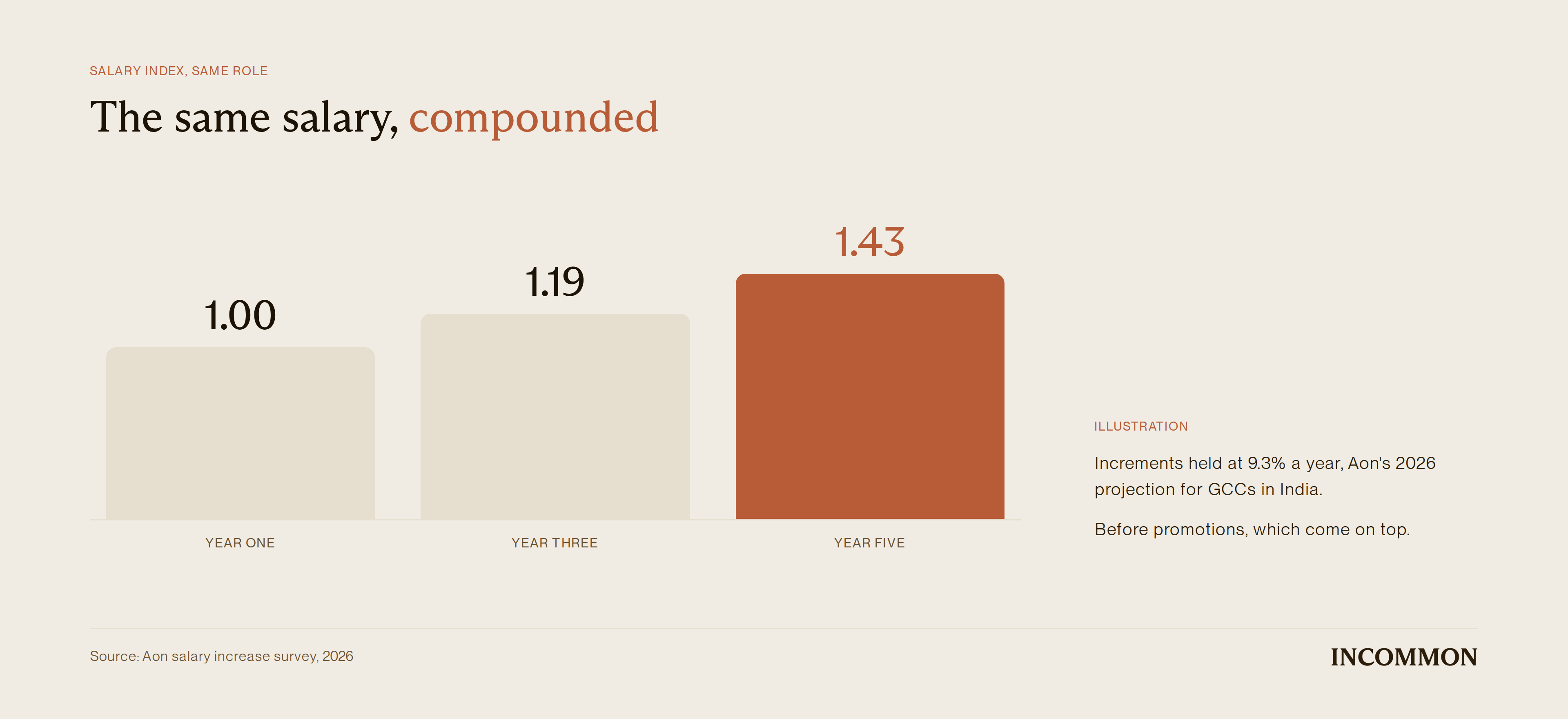
Aon projects salary increases of 9.3% for global capability centers in India in 2026. Held at that rate for illustration, a year-one salary is about 19% higher by year three, before any promotion. And promotions come on top.
Founding engineers become leads, and leads become managers. The same people cost more because they are doing more, which is the point of hiring them.
Reaching a center of 30 to 35 people, or 3 or 4 pods, puts new pods into years two and three. So recruitment and devices come back into the budget with every pod, and the one-time lines never fully retire.
A team that started through an employer of record converts to its own entity. The choice of EOR or your own entity then becomes a dated project, and a second city means registrations in a new state. Both bring a one-time cost back after setup has closed.
Managed desks suit a team still finding its size. A lease brings a three to five year commitment and a fit-out project, so it makes sense only once the team's size has settled. Year three is the earliest point at which the hiring plan can justify a lease.
Retention decides how much of this is waste. A founding hire who leaves in year three takes two years of context and puts recruitment back on the bill. For Accompany Health, the result was 22 people, 10 weeks to a live team, 100% retention across the build.
Year five, gratuity, tax and ownership
Gratuity accrues from the first month at 15 days of wages per completed year. A regular employee becomes eligible only after five years of continuous service.
From year five, the provision becomes cash. Every founding hire who leaves or retires triggers a payout on last-drawn wages. Fixed-term employees are different, because the Code on Social Security pays them pro rata after one year.
Sizing it is simple math. At 15 days of wages per year on a statutory 26-day month, five years of service comes to about 2.9 months of last-drawn wages. Across a founding team whose salaries have compounded since year one, that provision stops being a rounding line.
The IT services safe harbor sets the transfer pricing markup at 15.5% of operating cost. A company can keep that election for five years at a stretch. A center elected in year one faces the choice again in year five, on a cost base that has grown every year since.
The renewal also tests the center's profile, because a center that has moved from support work to product decisions may no longer qualify. The captive center vs GCC question turns into a tax question here.
Five years of markup also leave retained profit in India. Bringing it home is a dividend, taxed on the way out, so the year-five plan needs a view on repatriation as well as renewal.
Under the build-operate-transfer model, the transfer at an agreed point is a cost of its own. For private equity portfolios, year five can fall inside the exit window, and an owned center is part of what the buyer acquires. Veramatic, PE-backed itself, went to 21 people live in four weeks, with 92% retention across the build.
Three year-one decisions that set year five
Much of the year-five bill is fixed by choices made before the center runs. Three of them are better settled in year one.
Contract type decides when gratuity is paid.
Fixed-term contracts bring it forward to one year, paid pro rata. A center staffed on renewals pays out earlier and more often.
Electing the safe harbor fixes the markup. Doing it in year one sets 15.5% for five years, while declining means a benchmarking study every year and the risk of a dispute.
Workspace commitments set the year-three options. Managed desks leave the lease decision open. A lease signed in year one fixes the space for three to five years, before the team's size is known.
How the three checkpoints are compared
The table sets the three checkpoints against the lines that change most between them:
| Line | Year one | Year three | Year five |
|---|---|---|---|
| One-time costs | Incorporation, capital, first recruitment | New pods only | Transfer or exit costs, if any |
| Salary base | Founding team, part year | Compounded, with promotions | Compounded further |
| Team size | First pod | 3 or 4 pods | Stable or growing |
| Workspace | Managed desks and a deposit | Lease decision | The terms you chose in year three |
| Gratuity | Provision starts | Provision grows | Payouts begin |
| Transfer pricing | Election made | Election running | Election up for renewal |
| Retained profit | Markup begins | Grows in India | Repatriation decision |
Year one front-loads the cost. Years three and five carry the obligations year one created, and those obligations grow for as long as the center runs.
What a five-year budget needs to show
A five-year budget that a board can defend shows four things that a one-year budget cannot. It shows increments compounding on the whole salary base, and a gratuity provision that turns into payouts from year five. It also shows the safe harbor renewal and the first repatriation as dated events, not speculations.
Put the year-five lines in the first board paper. Shown early, they cost nothing.
If you are preparing that board paper now, this is how we help with the build behind it.
Everything you need to build and run your India GCC.
Entity, hiring, workspace and ongoing operations under one agreement.
Final thoughts
The cost of a GCC in India is set in year one and paid across five.
The founding team's salaries compound, their gratuity vests, and the tax election made at setup comes due. Model the checkpoints now, and year five arrives as a line the board already approved.
At InCommon, we run the entity, hiring, and operations for teams planning that far ahead, through our India office setup.
Frequently asked questions
What are the one-time GCC setup costs in India?
The one-time GCC setup costs land in year one: incorporation and registrations, the opening capital, recruitment for the founding team, devices, and a workspace deposit. Incorporation takes about 12 weeks as a planning figure. Salaries start before setup finishes, because hiring runs while the entity forms.
How do ongoing GCC operating costs change by year three?
By year three the one-time costs are gone, but the run-rate is larger. Increments compound, promotions shift the salary mix, and new pods bring recruitment and devices back into the budget. Aon projects 9.3% salary increases for GCCs in India in 2026, and held at that rate for illustration, a year-one salary is about 19% higher by year three.
When does gratuity become a real cost for a GCC in India?
Gratuity accrues from the first month at 15 days of wages per completed year, but regular employees become eligible only after five years of continuous service. At that point, five years of service comes to about 2.9 months of last-drawn wages. Fixed-term employees are paid pro rata after one year under the Code on Social Security.
Does the transfer pricing safe harbor last for the life of a GCC?
The IT services safe harbor sets the transfer pricing markup at 15.5% of operating cost, and a company can keep that election for five years at a stretch. A center that elects in its first year faces the choice again in year five, on a larger cost base.
When should a GCC in India move from managed desks to a lease?
Managed desks suit a team still finding its size. A lease brings a three to five year commitment and a fit-out project, so it makes sense only once the team's size has settled, which is year three at the earliest.
Why model the cost of setting up a GCC in India at years one, three and five?
Each checkpoint marks a change in what drives the cost. Year one pays for setup, year three for scale, and year five for obligations that year one created. Between them the drivers hold steady, so modeling every year adds detail without changing the decision.
Written by
CEO, InCommon
Piyush Kedia is the CEO of InCommon, a talent infrastructure company that helps US and global enterprises set up and scale Global Capability Centers (GCCs) in India. He works with founders, CTOs, and heads of talent to design smaller, AI native GCC teams that focus on judgment work, not just headcount, so India offices stay senior, stable, and production ready. Before InCommon, Piyush built Blue Vector into a 50 person creative agency serving brands such as Trump Towers, Audi, and Porsche, giving him a front row view of how high performing teams are hired, managed, and grown.