GCC partner pricing and contracts, how the fees work and what to sign

See how Findigs, Accompany Health, Veramatic and Podifi built their teams.
Real teams, real results, from faster hiring to lasting retention.
Quick look:
| GCC partner pricing usually combines a few fee lines: a one-time fee per hire, a monthly fee per employee for employment and operations, setup costs for the entity, and pass-through costs such as salaries, statutory contributions and workspace. The model matters as much as the totals, because it shows what the partner is paid to care about. In the contract, check the term, lock-in, IP assignment, replacement terms, and the cost of moving the team onto your own entity. |
|---|
GCC partner pricing follows three models: per hire, per employee per month, or a margin on the center's running costs. A typical proposal combines two of the three and passes salaries through at cost.
Read the structure first and the totals second. Then read the contract for how the arrangement ends.
This guide is made for founders, CFOs, and operations leaders comparing partner proposals for a team in India. It covers how the fees work and which clauses deserve a second read. It quotes no market rates, because rates vary too much by role, city, and seniority to help.
The three ways partners charge
A GCC partner is the firm that sets up and runs your India center. Its fees fall into three shapes:
- Per hire: a one-time fee for each person hired, usually a percentage of annual base salary
- Per employee per month: a flat monthly fee for each person on the team, covering employment, payroll, and compliance
- Margin on running costs: a mark-up on everything the center costs to run, from salaries to workspace and devices
At InCommon, we charge a one-time fee per hire and a monthly fee per employee on employer of record. Our published terms are no hidden costs, no lock-in period, and no capital expenditure.
A per-hire fee on its own suits a company that already runs an India entity and only needs recruitment. Everyone else needs the operation priced too.
What the fee model tells you
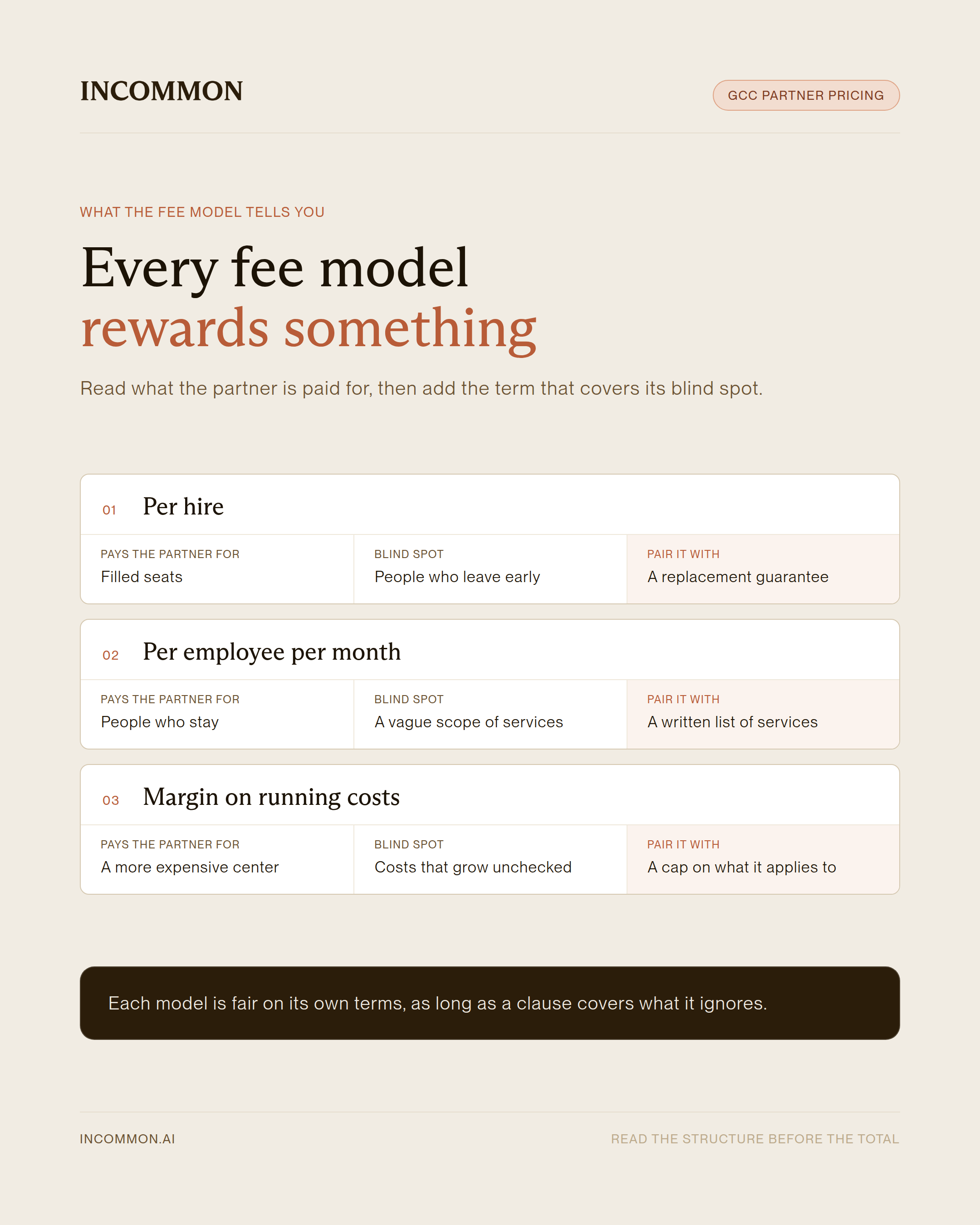
Each model pays the partner for something different. So the structure tells you what the partner is rewarded for, long before you see a total.
A partner paid per hire earns when seats get filled, and nothing extra when people stay. Pair that model with a replacement guarantee, or early departures become your cost alone.
A partner paid per employee per month earns while people stay. Retention and revenue point the same way.
A margin on running costs grows as the center grows more expensive. Ask what is capped. Without a cap, a pricier lease or a larger device budget raises the partner's fee along with your bill.
None of these is the wrong way to go. Each one delivers something different, so pair the model with terms that cover its blind spot.
What the monthly fee should cover
A monthly fee is only comparable once you know its scope. For a full GCC partner, the global capability center services behind the team typically include payroll, benefits administration, monthly accounting and statutory compliance.
It should also cover audit support, annual filings, the transfer pricing study, facility management, and ongoing recruitment.
Ask for the list in writing. Anything missing from it becomes a separate invoice, or a gap that your own team fills at month-end.
IT is the line most often left vague. Device provisioning, single sign-on, the asset register, and backup are either inside the fee or billed per request, and the difference adds up quickly.
Why quotes differ so widely
Two quotes for the same team can be very far apart, and the cheaper one usually leaves something out. The missing line is most often recruitment depth or the operation after launch.
Employer of record platforms price the employment line alone. They employ whoever you hand them, so the search, the vetting, and the India leader are still your problems to deal with. That is a fair product for one or two hires, and the wrong comparison for a large team.
A quote can also look low because it prices a smaller team or a later start. Check the plan behind the number before the number itself.
What passes through at cost
Some costs belong to you, whatever the partner charges for them.
Salaries, statutory contributions, workspace, devices, insurance and benefits all fall in this group. Background checks and job advertising land on either side, depending on the partner.
Ask for these at cost, itemized every month, with any mark-up written into the contract. The contributions on top of salary are larger than first-time employers expect, and our breakdown of what an India employee costs walks through each line.
Pay close attention to workspace costs. Since managed offices charge per desk, holding seats for future hires means paying for empty space for months.
Setup costs and the entity
Your own entity carries a one-time cost before anyone joins. Incorporation, registrations, and a bank account come first, followed by the capital you put in at incorporation.
This capital decision gets less attention than it deserves. It sets how long the entity runs before the parent has to fund it again. Our guide to what GCC setup costs shows how the totals move over five years.
You can also start before the entity exists. With an employer of record, Podifi had 9 engineers live in 6 weeks, employed through an employer of record with no wait for incorporation. The EOR versus entity comparison covers when each route fits.
Once the entity charges the parent for its work, transfer pricing applies. Our default is a cost-plus mark-up on operating expense, agreed up front. Settle it before the first invoice.
Fee lines at a glance
The table lists the fee lines a typical proposal contains, how each is usually charged, and the question that tests it:
| Fee line | How it is usually charged | What to ask |
|---|---|---|
| Recruitment | One-time, per hire | Is a replacement included, and for how long? |
| Employment | Monthly, per employee | What exactly does the monthly fee cover? |
| Entity setup | One-time, or folded into monthly fees | Who owns the entity, and from which day? |
| Operations | Monthly, or a margin on running costs | Which services fall outside the fee? |
| Workspace and devices | Pass-through | Is there a mark-up, and is it itemized? |
| Moving to your entity | Sometimes a one-time fee | What does conversion cost, and who runs it? |
Each answer belongs in the proposal itself. A verbal answer on any of these lines is worth nothing at renewal.
Contract terms to read twice
The fee schedule gets the attention, but the clauses decide what the arrangement costs you over three years. Read these before you sign:
- Term and lock-in: A long lock-in is the partner pricing in its own churn risk. Ask what the minimum term protects, and for whom
- Exclusivity: Common and often fair, because one partner cannot own outcomes it shares with three others. Tie it to service levels, so it lapses if they slip
- IP assignment: Every employment agreement should assign code and inventions to your company. Agree the clause with counsel before the first offer
- Replacement terms: How long the replacement guarantee runs and what it covers
- Service levels: Time to a shortlist, time to fill each role, and payroll accuracy, each with a remedy if missed
- Termination: The notice to end the contract, and what happens to the team on the day it ends
- Conversion: What it costs to move people from the partner's payroll onto your own entity, including how accrued leave and gratuity balances move
That last clause gets skipped most often. The cheapest moment to negotiate your exit is before you sign. If your route is build-operate-transfer, the transfer price is the same conversation, and our BOT model guide explains the phases.
Data protection belongs in the contract too, and our GCC compliance guide covers what the DPDP Act asks of an India team. We manage compliance and coordinate with your counsel. Your own lawyer still reviews the agreement.
How to compare two proposals
Proposals rarely line up, because each partner prices in its own form. Put them on one sheet before you compare totals.
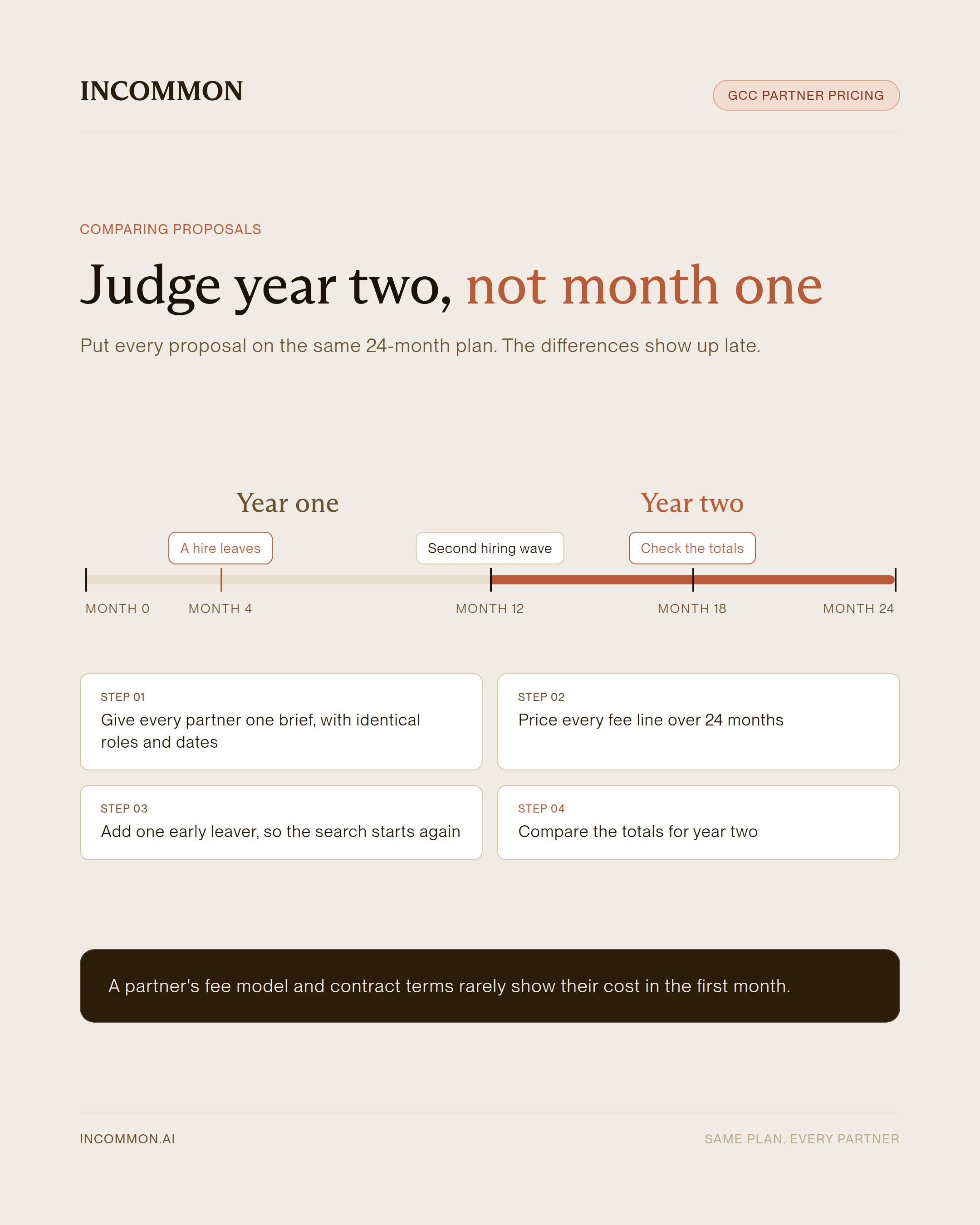
Send every partner the same brief: roles, levels, city, start months, and the team size by quarter.
Then model 24 months under each proposal. Include every fee line, the pass-throughs, and one early leaver in year one. A leaver in month four is the expensive outcome, because the search, the notice period, and the ramp all have to start again.
Retention changes the comparison more than any fee line. Findigs had 60 underwriters hired in four months, with 90% still in place. The GCC failure modes that cost the most seldom show up on the first invoice.
Judge the second year, not the first month. That is when the fee model and the contract terms finally show what the arrangement really costs. Then decide.
If you are weighing proposals now, we are happy to talk through how ours is put together.
Final thoughts
A low monthly fee and a clean contract rarely arrive together by accident. Ask each partner to price the same team plan, then read the exit clauses before you even open the fee schedule.
The right partner is usually the one whose numbers still hold up during the later months. Put one leaver and a second hiring wave into that plan before you decide.
Frequently asked questions
What is the pricing model for a GCC partner?
GCC partner pricing follows three models: a one-time fee per hire, a monthly fee per employee, or a margin on the center's running costs. A typical proposal combines two of the three and passes salaries through at cost.
What does a GCC partner's monthly fee usually cover?
For a full GCC partner, it typically covers payroll, benefits administration, monthly accounting, statutory compliance, audit support, annual filings, the transfer pricing study, facility management and ongoing recruitment. IT services are the line most often left vague, so get the scope in writing.
What is the difference between the total cost of a GCC and the partner's fee?
The partner's fee is one part of the total. The full cost also includes salaries, statutory contributions, workspace, devices, insurance and benefits, plus entity setup and the capital you put in at incorporation.
Why do GCC partner quotes vary so much?
The cheaper quote usually leaves something out, most often recruitment depth or the operation after launch. Employer of record platforms price the employment line alone, and some quotes look low because they price a smaller team or a later start.
What should be included in a GCC partner contract?
The term and any lock-in, exclusivity tied to service levels, IP assignment, replacement terms, service levels with remedies, termination, and the cost of moving people onto your own entity.
How do exit terms work in a GCC partner contract?
The contract should set the notice to end it, what happens to the team on the day it ends, and what it costs to move people onto your own entity, including how accrued leave and gratuity balances move. For build-operate-transfer, the transfer price belongs in the contract from the start. The cheapest moment to negotiate any of this is before you sign.
How do you compare two GCC partner proposals?
Send every partner the same brief with roles, levels, city, start months and team size by quarter. Model 24 months under each proposal, include one early leaver in year one, and judge the second year rather than the first month.
Written by
CEO, InCommon
Piyush Kedia is the CEO of InCommon, a talent infrastructure company that helps US and global enterprises set up and scale Global Capability Centers (GCCs) in India. He works with founders, CTOs, and heads of talent to design smaller, AI native GCC teams that focus on judgment work, not just headcount, so India offices stay senior, stable, and production ready. Before InCommon, Piyush built Blue Vector into a 50 person creative agency serving brands such as Trump Towers, Audi, and Porsche, giving him a front row view of how high performing teams are hired, managed, and grown.