What is the Build-Operate-Transfer (BOT) Model? A Detailed Guide

See how Findigs, Accompany Health, Veramatic and Podifi built their teams.
Real teams, real results, from faster hiring to lasting retention.
Quick look:
| The Build-Operate-Transfer (BOT) model is a three-step business expansion strategy. A third-party partner sets up and manages an offshore center (Build and Operate) before handing full ownership and control to the company (Transfer). It reduces risk, speeds up market entry, and ensures long-term ownership. |
|---|
Discover the Build-Operate-Transfer (BOT) model and how it helps businesses establish global operations. Learn its phases, benefits, challenges, and best practices in this detailed guide.
What is the BOT model?
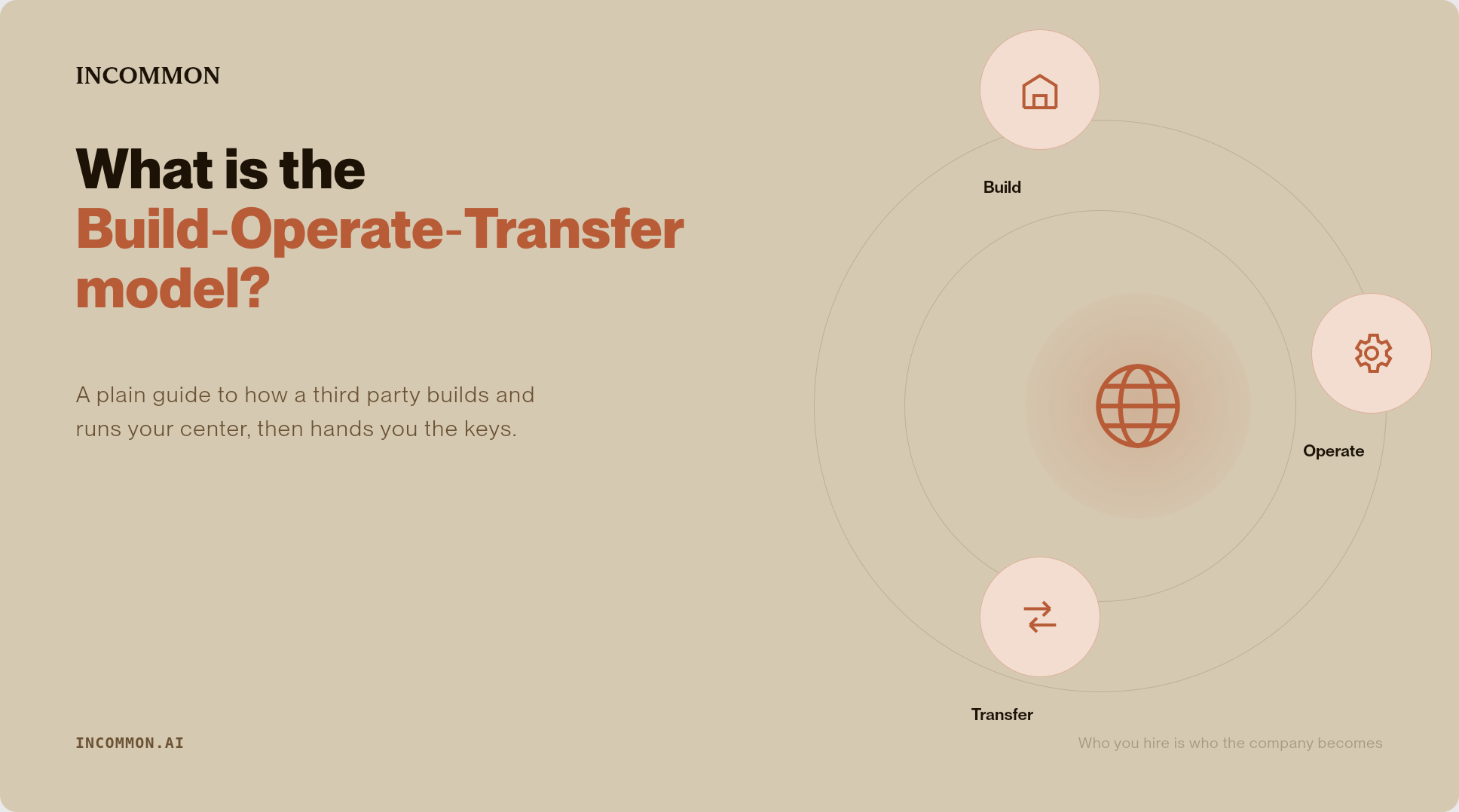
The BOT model is a proven framework for companies that want to expand globally without immediately taking on full ownership. It breaks down the setup into three structured phases:
- Build
- Operate
- Transfer
This structure allows businesses to test new markets, lean on local expertise, and reduce upfront risk. It also creates a smooth path toward full ownership once the center is stable and mature.
How does the BOT model work?
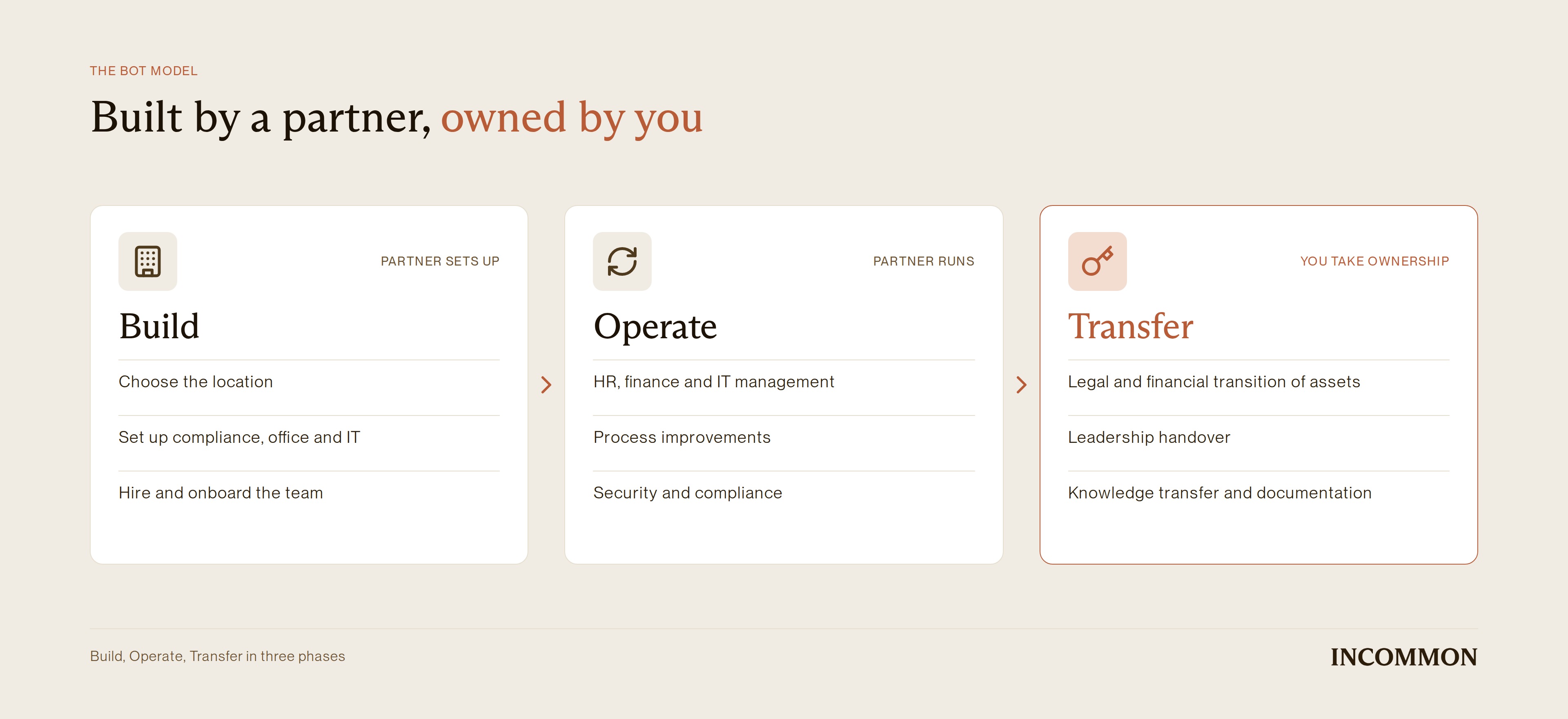
1. Build phase: laying the foundation
In this phase, a third-party provider sets up the offshore operation. This usually involves:
- Choosing the right location based on talent and infrastructure
- Establishing legal and regulatory compliance
- Setting up office space, networks, and IT systems
- Hiring and onboarding employees
- Building workflows, processes, and management structures
2. Operate phase: running and scaling the center
Once the foundation is ready, the provider manages day-to-day operations. This includes:
- HR, finance, and IT management
- Process optimization and efficiency improvements
- Coordination between offshore teams and headquarters
- Employee training and leadership development
- Data security and compliance management
3. Transfer phase: handing over ownership
After the center is stable and aligned, it is transferred to the parent company. Key steps include:
- Legal and financial transition of assets
- Leadership and management handover
- Knowledge transfer and documentation
- Full integration with global operations
What you own after the transfer
A transfer is complete when the center runs as yours, with nothing still held in the partner's name. Check for these at handover:
- The entity: The shares in the local company, or the team moved onto an entity you already own
- The people: Every employment contract, with a clear record of how service history and accrued benefits carry over
- The premises: Office leases, utilities and local registrations in your entity's name
- IP and data: Code, documents and data assigned to your company, with access no longer routed through the partner
- Contracts and systems: Vendor agreements, software licenses and IT accounts moved across
- The leadership team: Managers who now report into your organization
Anything still in the partner's name after the transfer date keeps you dependent on them. Listing these items in the BOT contract from the start turns the handover into a checklist rather than a negotiation.
Why companies choose the BOT model
- Lower entry risk: Test a new market without heavy upfront investment
- Speed: Faster setup compared to starting from scratch
- Local expertise: Use partner knowledge for compliance and hiring
- Flexibility: Scale operations gradually
- Risk control: Reduce compliance and operational risks in the early stage
- Long-term growth: Structured path to full ownership
Industries that benefit
The BOT model is especially effective in industries that need specialized skills and structured operations:
- Technology and software development
- Banking, financial services, and insurance
- Healthcare and pharmaceuticals
- Manufacturing and engineering
- Customer support and shared services
Challenges and considerations
While the model is attractive, businesses must plan for potential hurdles:
- Choosing the right service provider
- Aligning offshore and global cultures
- Managing risks during the transfer phase
- Navigating complex compliance rules
- Planning for long-term financial impact
BOT vs other expansion models
| Model | Pros | Cons |
|---|---|---|
| BOT | Balanced risk and control, structured transfer | Dependent on provider quality |
| Captive center | Full control, branding, ownership from start | High upfront cost, long setup time |
| Outsourcing | Fast, cost-efficient | Limited control, dependency risks |
| Joint venture | Shared risk, local expertise | Shared profits, alignment challenges |
BOT vs a GCC you own
BOT is often weighed against a global capability center (GCC), a center in another country that you own and run as part of your company.
BOT is one route to it, where a partner sets up and runs the center first, then hands it over. So the real choice is when ownership starts, and who runs the center until then.
These two approaches differ in five main places:
- Speed: BOT usually gets a team running sooner, because the partner's entity, office, and hiring are already in place
- Control: With your own GCC, the team reports to your leadership from the first hire. Under BOT, the partner runs the operation until the transfer
- Cost shape: Owning means setup costs up front and no handover fee. BOT spreads the early cost but adds the partner's margin during the operate phase and a transfer fee at the end
- The handover: BOT ends with a transition, and everything the center depends on has to move across. Owning from day one has nothing to transfer
- IP: In your own GCC, work belongs to your entity from the start. Under BOT, the contract has to assign it clearly before the transfer
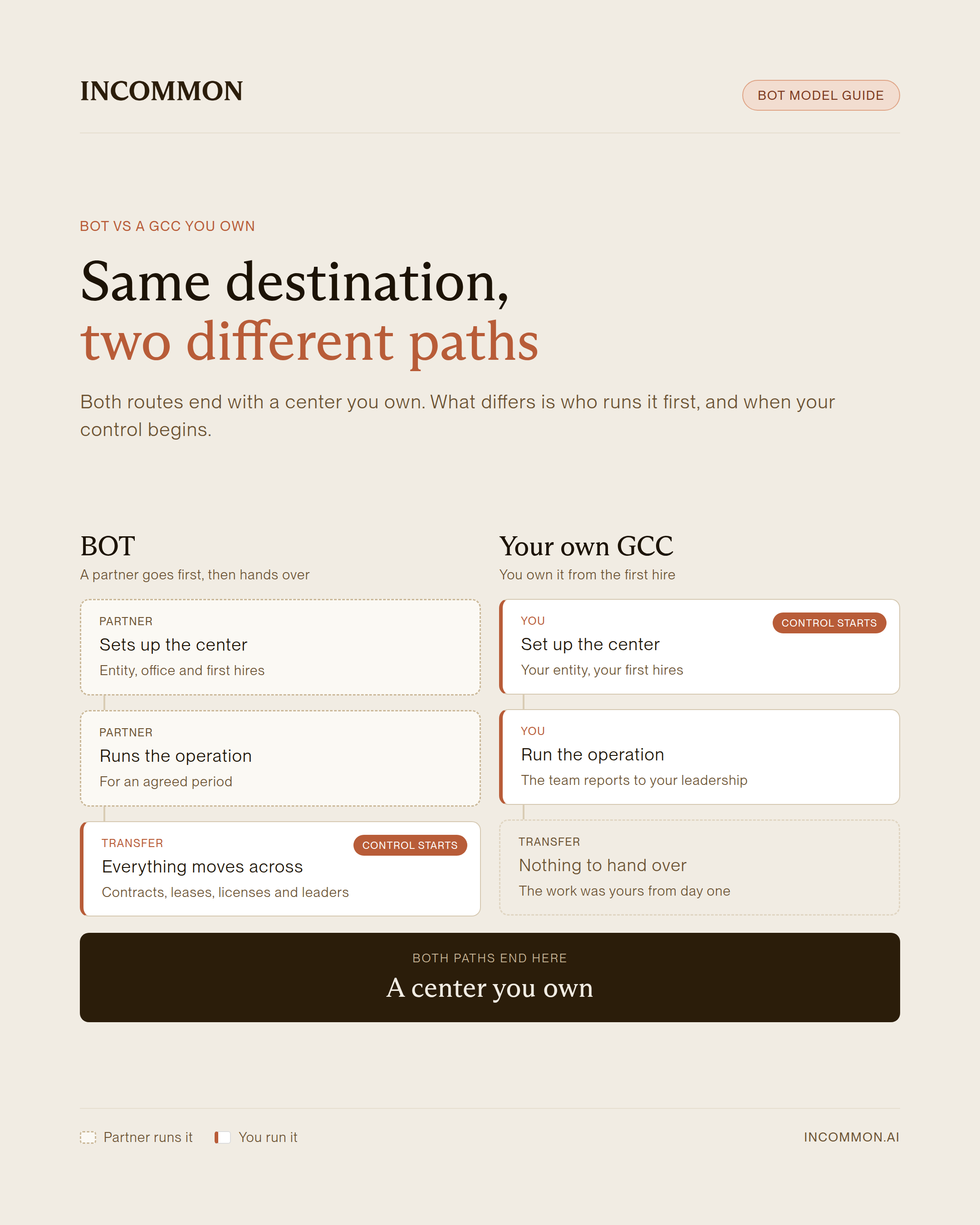
After a successful transfer, both routes end in the same place: a center that you own. The difference is the path, and how much has to move when the partner steps back.
The verdict: BOT fits better when speed comes first and you have no appetite to run operations early. For a growth-stage company hiring engineers to keep, owning the GCC from day one is the better option, because control, culture and IP all start with the first hire.
If owning the team from day one is the route for you, this is how we set it up.
Everything you need to build and run your India GCC.
Entity, hiring, workspace and ongoing operations under one agreement.
Is the BOT model right for your business?
BOT works best for companies that want:
- An offshore presence with lower risk
- Local expertise in setup and operations
- Long-term ownership
- A phased, structured expansion path
It may not suit businesses looking only for short-term, low-cost outsourcing.
Final thoughts
The Build-Operate-Transfer model offers companies a safe and structured way to expand globally. By splitting expansion into three phases, businesses can reduce early risk, use local expertise, and secure long-term control.
Companies that carefully plan their provider choice, manage cultural alignment, and prepare for smooth transfer often see BOT as a powerful strategy for global growth.
Frequently asked questions
How long does a BOT setup usually take?
Between two and five years, depending on business needs and complexity.
Who manages operations during the Operate phase?
A third-party partner runs the center while aligning with the parent company's strategy.
Can the Transfer phase fail?
Yes, if knowledge transfer, legal compliance, or leadership handover are poorly managed.
How is BOT different from outsourcing?
Outsourcing keeps control with a vendor. BOT shifts control to the company once operations are stable.
Which industries gain the most from BOT?
Tech, finance, healthcare, and customer support benefit most because they need skilled teams and structured operations.
What is the difference between BOT and a GCC?
A GCC is a center you own and run from the first hire. Under BOT, a partner sets up and runs the center first, then transfers it to you. Both end with a center you own, but BOT usually gets a team running sooner, while owning from day one gives you control, culture and IP from the start.
When should a company choose BOT over its own GCC?
Choose BOT when speed comes first and you have no appetite to run operations early. For a growth-stage company hiring engineers it plans to keep, owning the GCC from day one is usually the better default.
Written by
CEO, InCommon
Piyush Kedia is the CEO of InCommon, a talent infrastructure company that helps US and global enterprises set up and scale Global Capability Centers (GCCs) in India. He works with founders, CTOs, and heads of talent to design smaller, AI native GCC teams that focus on judgment work, not just headcount, so India offices stay senior, stable, and production ready. Before InCommon, Piyush built Blue Vector into a 50 person creative agency serving brands such as Trump Towers, Audi, and Porsche, giving him a front row view of how high performing teams are hired, managed, and grown.