What Is a Global Capability Center? Definition, Models and How One Works

See how Findigs, Accompany Health, Veramatic and Podifi built their teams.
Real teams, real results, from faster hiring to lasting retention.
Quick look:
| A global capability center is a dedicated team in another country that the parent company owns and directs. It has a defined mandate, such as product engineering or operations, and reports into the parent's leadership. A GCC may operate through a wholly owned subsidiary, an employer of record, a managed GCC, or a build-operate-transfer arrangement. A GCC in India is simply this structure located in India. |
|---|
A global capability center is a dedicated overseas team that your company owns and directs against a defined mandate. The team works inside your operating model, and its leaders report into yours. It can cover product engineering, operations, or another function your leadership has chosen to keep close.
This guide is for US or European leaders at a Series A to C or PE-backed company with 50 to 500 people. You have product-market fit, no India presence, and need a dedicated team rather than individual hires. If you already know the people you want to hire, this is more machinery than you need. A payroll and compliance provider will employ them lawfully and stop there.
What Is a Global Capability Center?
GCC stands for global capability center. It describes an overseas entity or team that belongs to the parent company and performs a defined part of its work.
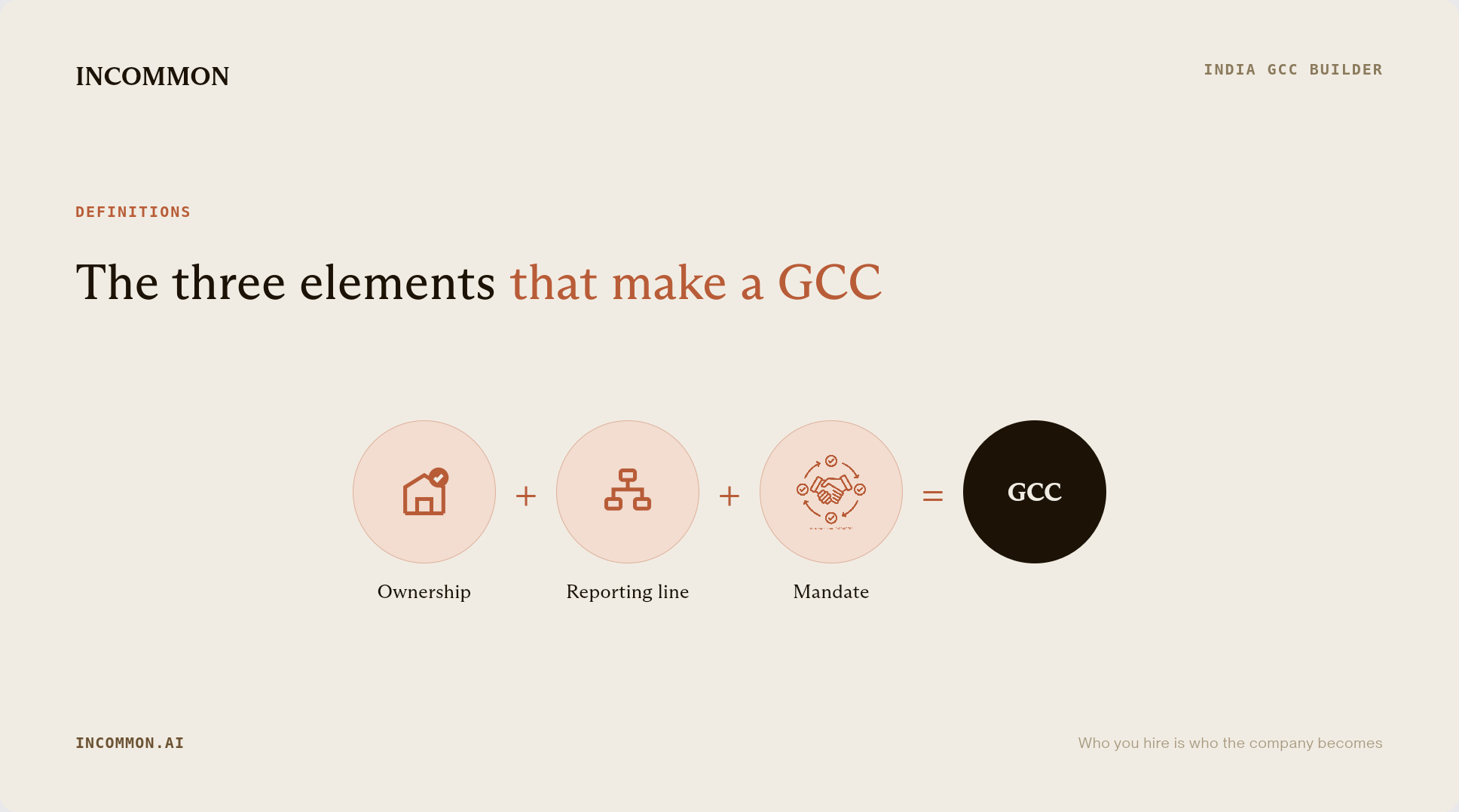
Three facts make it a GCC:
- The parent owns the entity or holds the employment arrangement. The team is part of the parent’s operating model, not a supplier’s delivery organization
- The local team reports into the parent’s leadership. It has a mandate that says what it owns, such as a product area, platform, or operational function
- The team works on the parent’s priorities under the parent’s direction. It is not a vendor-run support contract, where a supplier manages people and commits to contracted delivery
The arrangement gives the parent a team it can direct over time. It does not turn a set of external deliverables into an internal function. That distinction matters most when the work touches product decisions, customer data, or a core operating capability.
One should settle the mandate before anyone discusses titles or office space. It tells the first leader which decisions sit with the center and which remain with the parent. It also makes later hiring decisions easier to judge.
How a Global Capability Center Works
The parent company sets the mandate, funds the team, and keeps accountability for outcomes. The India entity employs people when you use a wholly owned subsidiary. An employer of record employs them when you start without one.
The practical test is clear:
- Your engineering, product, or functional leaders set priorities, hold budget authority, and make executive decisions. The team remains connected to the decisions that affect its work
- The team reports into your leadership, while the entity belongs to you from day one where you use a wholly owned subsidiary. A partner can staff and support the center without directing the work
- The local leader has a clear route for resolving trade-offs. Named counterparts in the parent, access to necessary systems, and a regular leadership cadence keep ordinary working relationships intact
Start with a team shape tied to one piece of work. A useful first unit is a senior-led, cross-functional pod of 8 people. Three or four pods make a center of 30 to 35 people.
What Is a GCC in India?
A GCC in India works by the same definition. The difference is the local employment, entity, workspace, tax, and data-handling decisions required to run the team in India.
Bengaluru is India's broadest market for product engineering, AI, cloud, and startup experience. The city will not fit every team. Start with the experience the work requires, then assess where that experience is concentrated.
For instance with Accompany Health, city choice also reflected proximity to medical device, diagnostics, and payer technology centers. Its IIT, IISc, and IIIT feeder pipeline supported the search for engineers with experience in regulated health data.
The conversation often starts with one of these triggers:
- a funding round,
- a PE acquisition,
- a cost requirement, or
- data residency needs
None of them settles the operating decision. Your company still needs a dedicated team with durable work to own.
Nasscom's GCC Value Orbit: From Delivery Engine to Enterprise Nerve Centre counted 2,117 GCCs in India in FY2026. The India GCC Landscape Report: The 5 Year Journey projected 2,100 to 2,200 centers by 2030. The category reached its own 2030 ceiling 4 years early, which is worth knowing if the term still sounds new to you.
The Four GCC Operating Models
The legal route changes what you control on day one and who employs the team. It also changes the operating work that remains before the team is ready.
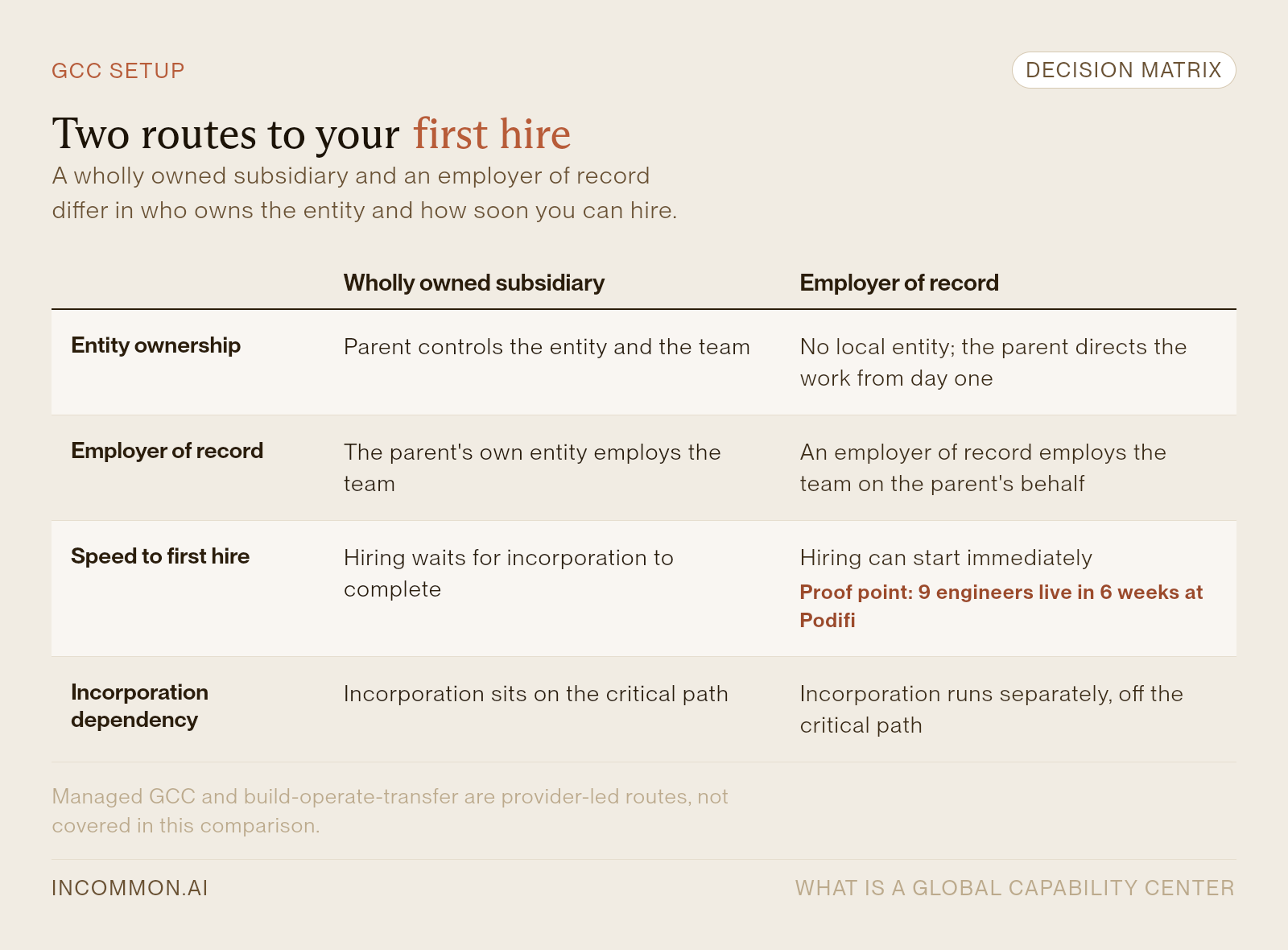
An employer of record is how a GCC starts when the entity is not ready. The parent still sets the mandate and directs the work. What changes is who signs the employment contract:
| Model | Control | Employment | Operating route |
|---|---|---|---|
| Wholly owned subsidiary | Parent controls the entity and team | Parent entity employs the team | The company establishes its own local entity |
| Employer of record | Parent directs the work | Employer of record employs the team | The company starts hiring before its entity is ready |
A wholly owned subsidiary gives the parent direct entity ownership and suits companies ready to establish and run their own local entity. An employer of record removes incorporation from the critical path while the parent continues to direct the work. Managed GCC is a provider-led arrangement for companies that want help running a dedicated team, while build-operate-transfer is provider-led at first and intended to move into parent ownership.
The model names alone do not decide which route fits the work.
InCommon put 9 engineers live in 6 weeks at Podifi, employed through employer of record with no wait for incorporation. Six weeks is not a standard entity timeline. It is what happens when incorporation sits outside the critical path.
The Podifi case study gives the full build context.
GCC, Captive Center or Offshore Development Center
The vocabulary causes avoidable confusion, especially in board discussions. Use ownership and reporting lines to identify the arrangement.
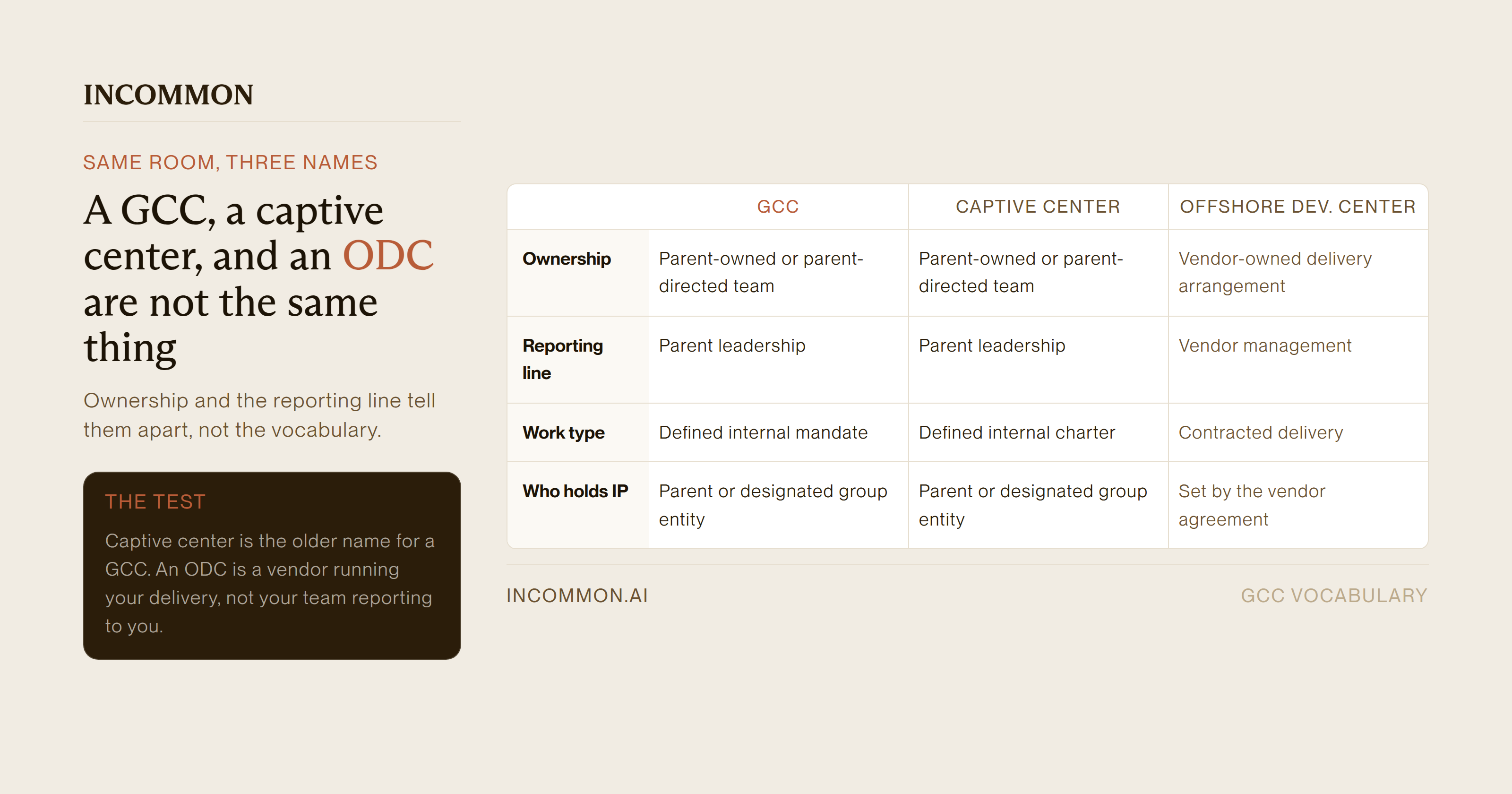
Captive center is the older term for the same broad idea, and it now reads dated. Offshore development center describes vendor-run delivery, which is a different arrangement. The label signals who manages the team and who owns the work.
What the First Team Looks Like
The managing director is the first consequential hire. That person turns the charter into an operating rhythm, represents the team to the parent, and shapes every decision that follows.
I would take longer on that hire than on any early specialist role:
- Source candidates from people running India centers now
- Have the final interview run by someone who has held the job
- Test for the authority and judgment needed to carry the ambiguity of a new center; a polished resume will not show it
After that, staff the first pod around the work. The 8-person pod should be senior-led and cross-functional, with roles chosen for the charter rather than an abstract organization chart.
How Long a GCC Takes to Stand Up
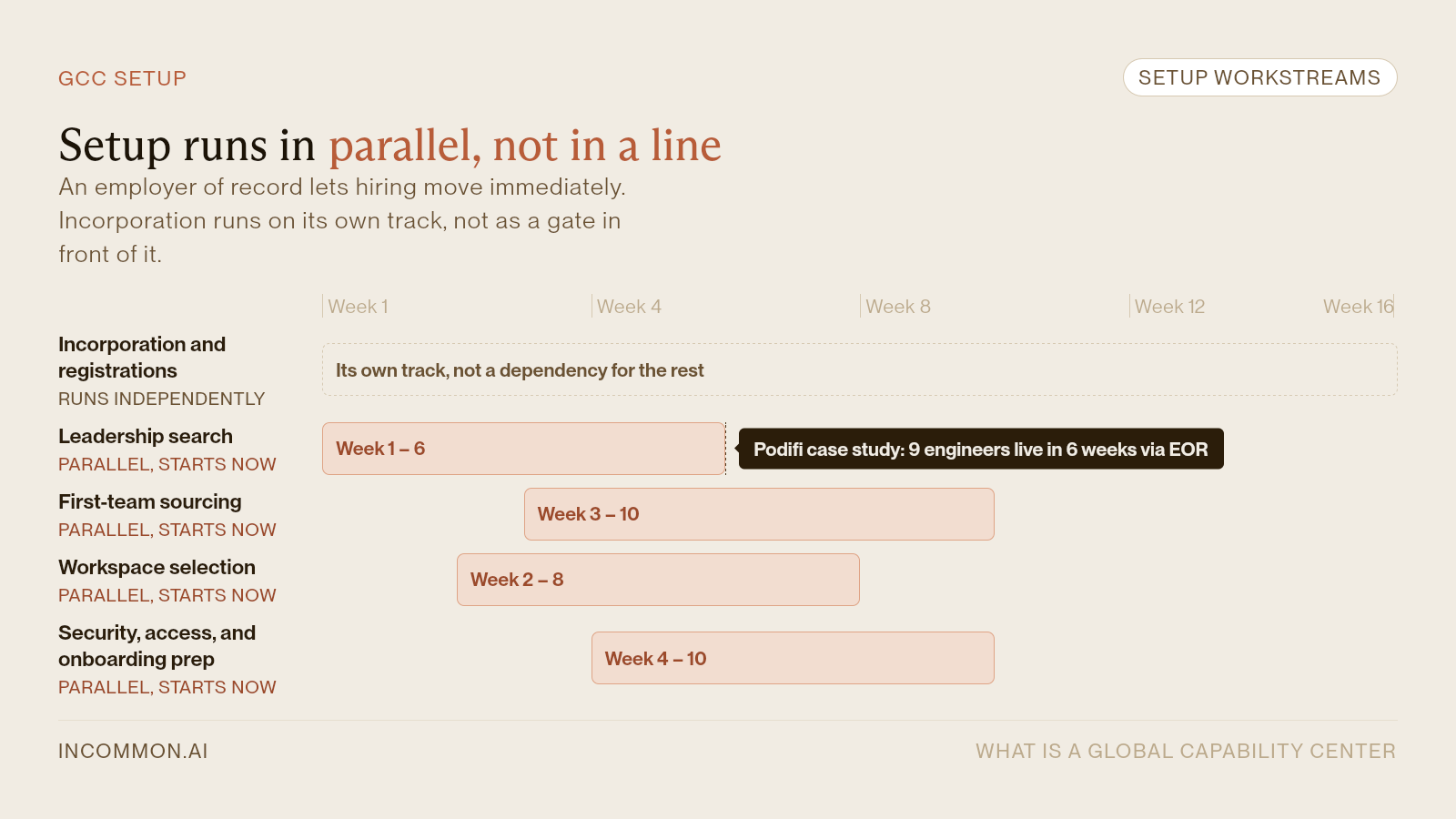
Treat setup as parallel work, not a single clock. Incorporation can run alongside the leadership search, sourcing, workspace selection, and security design. Some tasks wait for the entity, while others can move first.
The workstreams typically include:
- incorporation and local registrations,
- leadership search and hiring,
- sourcing for the first team,
- workspace selection, and
- security design, systems access, and onboarding preparation
Employer of record takes incorporation off the critical path because it employs the team. It does not remove the need to define the work, select leaders, or prepare access and onboarding.
Published examples range from 4 weeks to 4 months for a live team. Accompany Health had 22 people live in 10 weeks, with 100% retention across the build. See the Accompany Health case study for the build context.
I would plan around dependencies instead of promising a date at the outset. Readiness depends on leadership, team fit, workspace, systems access, and the operating decisions behind them.
What It Costs to Run
The cost of a global capability center is the cost of a working team, not a salary figure multiplied by people. A good build should account for:
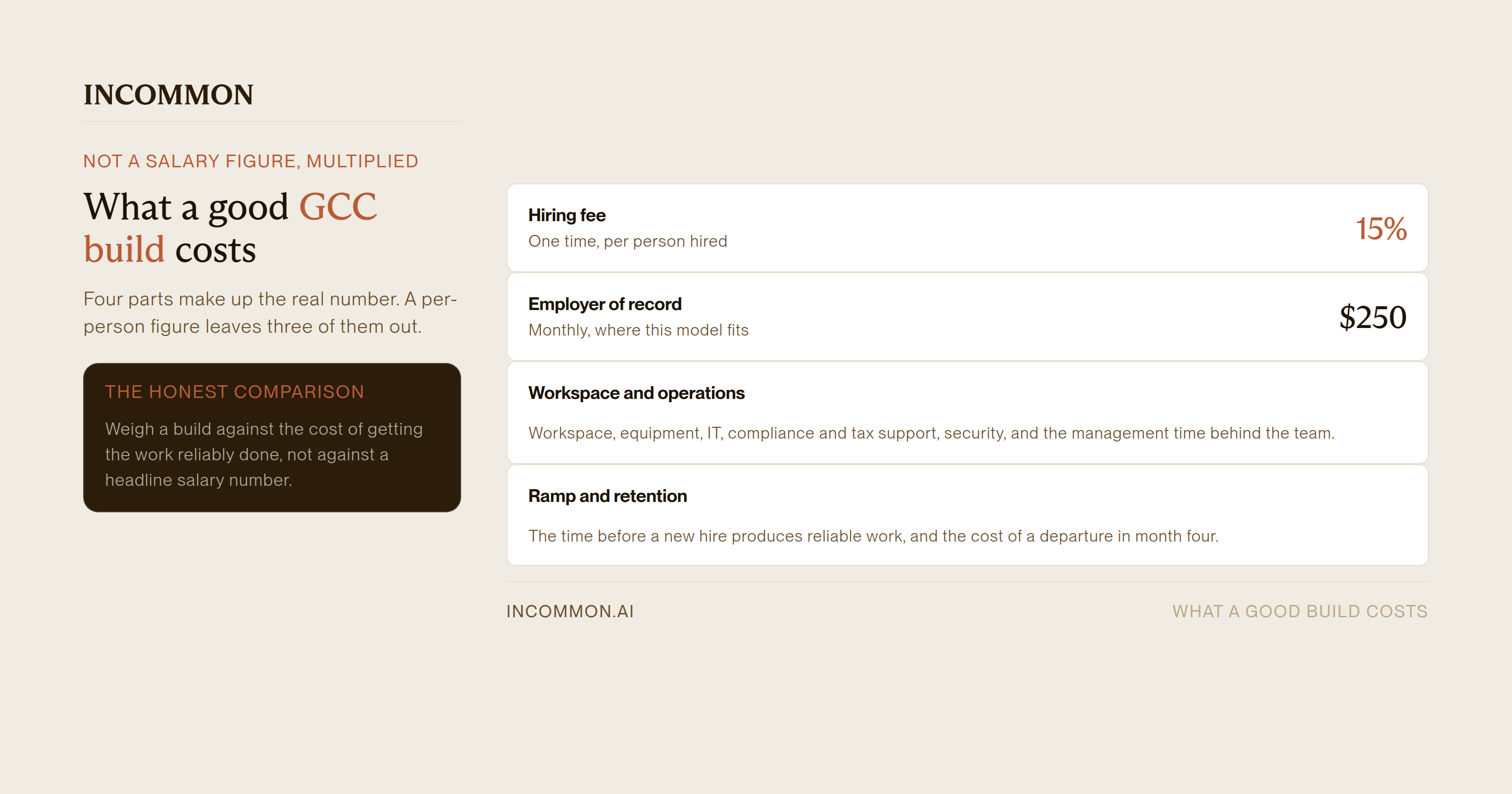
- Pay and benefits, plus the one-time hiring fee, which InCommon prices at 15% of annual base salary
- Employer of record employment, priced at $250 per employee per month, where that model fits
- Workspace, equipment, IT, compliance and tax support, security, management time, and the ramp before a new group produces reliable work
Those figures describe parts of a good build, not a complete per-person cost. They sit beside the systems, leadership time, and operating support that make a dedicated team usable on day one. The commercial model should also make clear who carries each expense and when it starts.
Retention belongs in the model too:
- A departure in month 4 creates another search, another ramp, and more management time
- Compare a build against the cost of getting the work reliably done, rather than against a headline salary number
Who Should Build One and Who Should Not
A GCC suits a US or European company with product-market fit, 50 to 500 people, and a durable need for a dedicated India team. The question is whether you have work substantial enough for a team to own.
Use the operating need to qualify the route:
- Build a GCC when you need a dedicated team to own durable work and your leaders intend to retain responsibility for it
- Use a payroll and compliance provider when you already have candidates and need nothing beyond compliant employment
- Choose a different operating route when you are planning a multi-thousand-person captive with a full governance structure and deeper internal capability
Do not force either situation into a GCC plan. The right answer follows the work, intended scale, and responsibility your leaders want to hold.
The approach is talent-first, meaning the build is organized around the hires rather than around the entity. Every candidate carries a 6-month replacement guarantee. 33% of the candidates InCommon sends are hired.
If you are weighing a GCC of your own, this is how we build one.
Everything you need to build and run your India GCC.
Entity, hiring, workspace and ongoing operations under one agreement.
Final Thoughts
A global capability center is an owned or parent-directed team with a clear charter and direct leadership connection. The model changes how you employ people and handle early operating work. The core test stays the same: your company needs a durable team to own real work.
Frequently asked questions
What does GCC stand for in business?
GCC stands for Global Capability Center. In business, it means a dedicated overseas team that the parent company owns or directs against a defined mandate.
What is the difference between a GCC and outsourcing?
A GCC is part of the parent company’s operating model. Outsourcing places delivery with a third-party vendor that employs and manages the team under a service agreement.
How many people does a GCC need?
There is no fixed minimum. A useful first unit is an eight-person, senior-led, cross-functional pod, and three or four pods make a 30 to 35 person center.
Is a GCC the same as a captive center?
Captive center is an older term for the same broad arrangement. Both describe a team that belongs to and works for the parent company, rather than a vendor-run delivery team.
What does a GCC cost to set up?
A complete cost view includes pay and benefits, recruiting, workspace, equipment and IT, compliance and tax support, security, management time, and the ramp to reliable work. A per-person figure leaves out material parts of the operating cost.
How long does incorporation take?
Incorporation has its own sequence and should run in parallel with leadership search, sourcing, workspace selection, and security design. Its duration depends on the entity structure and the required registrations, so do not use it as the only setup clock.
Can a company start a GCC without an entity?
Yes. An employer of record can employ the initial team while the parent directs the work, which removes incorporation from the critical path. The company can then decide whether and when to incorporate its own entity.
Written by
CEO, InCommon
Piyush Kedia is the CEO of InCommon, a talent infrastructure company that helps US and global enterprises set up and scale Global Capability Centers (GCCs) in India. He works with founders, CTOs, and heads of talent to design smaller, AI native GCC teams that focus on judgment work, not just headcount, so India offices stay senior, stable, and production ready. Before InCommon, Piyush built Blue Vector into a 50 person creative agency serving brands such as Trump Towers, Audi, and Porsche, giving him a front row view of how high performing teams are hired, managed, and grown.