The ultimate interview playbook: key questions to ask before hiring offshore developers

See how Findigs, Accompany Health, Veramatic and Podifi built their teams.
Real teams, real results, from faster hiring to lasting retention.
Quick look:
| A strong interview for offshore developers tests more than code. Set clear objectives, mix scenario-based, coding and behavioral questions, and use the same question set for every candidate so comparisons stay fair. Judge how candidates communicate and reason, not just their final answers. Below are eight core questions, each with a follow-up, plus the soft skills worth assessing. |
|---|
Introduction
When you hire offshore developers, you know what you need: the best skills, reliability, and a good cultural fit. You know you will meet a lot of exceptionally skilled candidates.
But how do you choose the right one?
The answer lies in asking the right questions.
Interviews are the ultimate screening tools. They help assess technical proficiency, problem-solving skills, adaptability, and communication abilities. When hiring offshore developers, interview questions must be laser-focused, cutting through the fluff to reveal real expertise and work ethic.
Let's explore why asking the right questions is essential, what makes an interview truly effective, and, most importantly, the questions you should be asking.
The role of proper interview questions in hiring offshore developers
Interviewing offshore developers isn't just about testing technical skills. It's about ensuring that they fit into your workflow, understand your business needs, and communicate effectively across time zones. A well-structured interview does more than filter candidates. It saves you from future headaches caused by poor hires.
Key reasons why well-crafted questions matter:
- Skill verification: Candidates may list impressive technologies on their resumes, but the right questions test how well they actually use them
- Cultural fit: Offshore developers work remotely, so assessing their ability to integrate into your company's culture is crucial
- Problem-solving insight: Great developers don't just code. They solve problems. Interviews help gauge how they approach challenges
- Communication check: Strong technical skills mean little if a candidate can't clearly express ideas and collaborate with teams
What makes a good interview?
A great interview isn't just a rapid-fire quiz of technical questions. It's structured, balanced, and insightful, designed to get a 360-degree view of a candidate's abilities.
Elements of a strong interview:
- Clear objectives: Know exactly what you're assessing: technical skills, problem-solving, or teamwork
- Scenario-based questions: Real-world challenges reveal much more than textbook answers
- Interactive coding challenges: Watching how a candidate writes and explains code in real-time is invaluable
- Behavioral questions: Past behavior is often the best predictor of future performance
- Consistent evaluation: A standardized question set ensures fair and objective comparisons
Key interview questions for offshore developers
Now, let's get to the heart of it: the questions that will help you identify the best offshore developers. Here are eight essential ones:
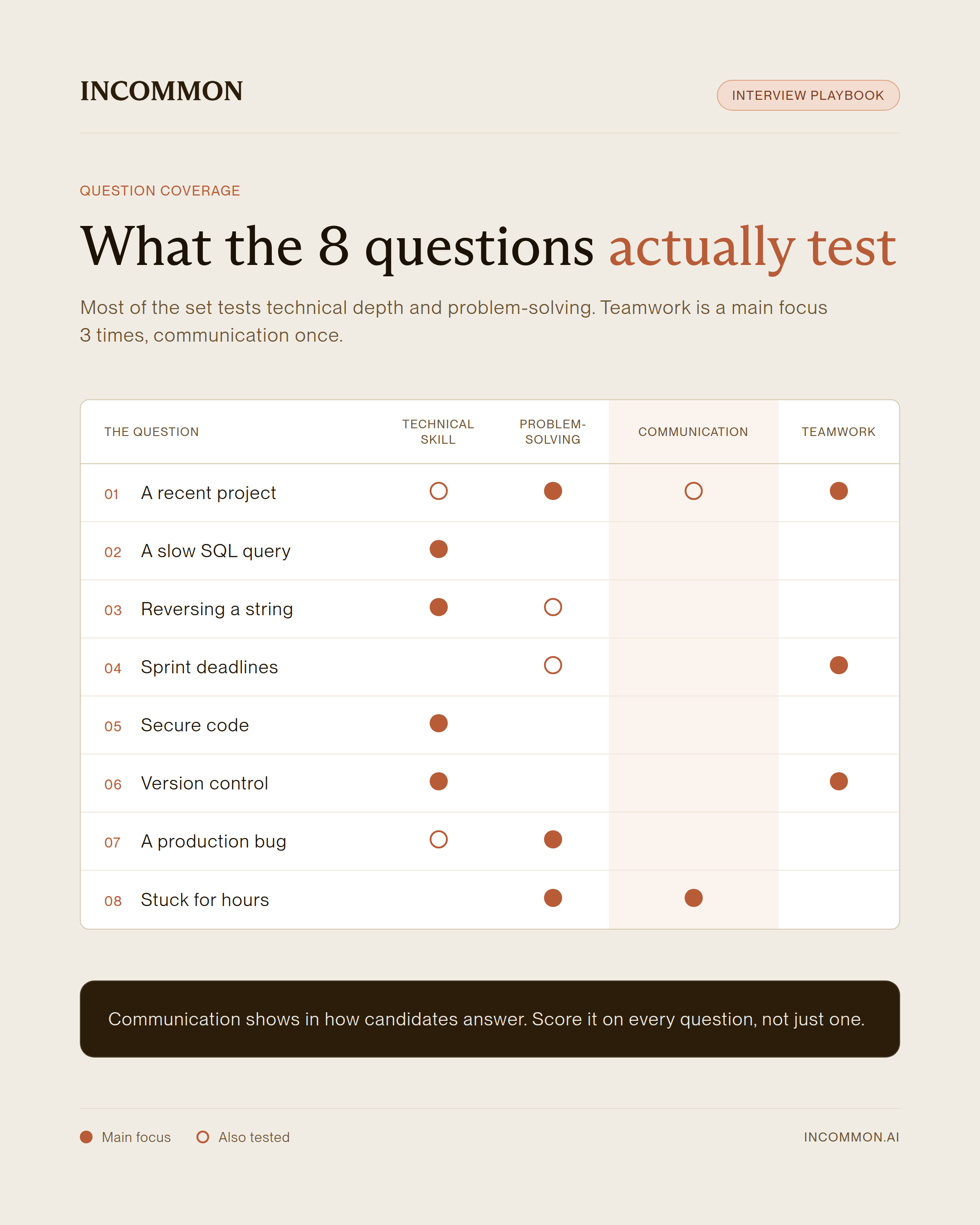
1. Can you walk us through a recent project you worked on?
- Purpose: This reveals a candidate's hands-on experience, problem-solving skills, and role in team projects
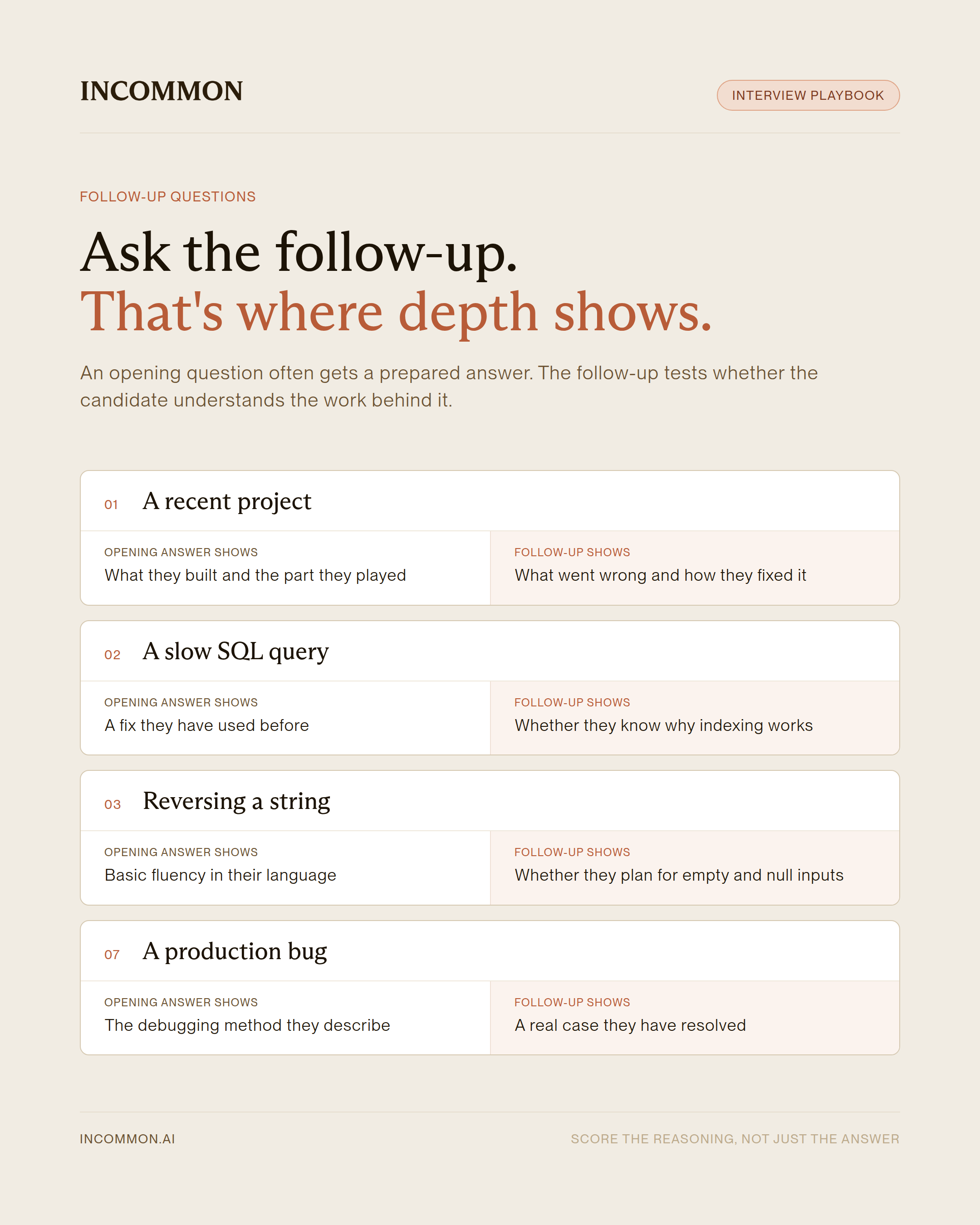
- Follow-up: What challenges did you face, and how did you resolve them?
2. How would you optimize a slow-running SQL query?
- Purpose: Tests database knowledge and the ability to write efficient queries
- Follow-up: Can you explain indexing and when to use it?
3. Can you write a simple function to reverse a string in your preferred language?
- Purpose: Checks basic coding proficiency and thought process
- Follow-up: How would you handle edge cases like empty strings or null values?
4. Have you ever worked in an Agile environment? If so, how did you manage sprint deadlines?
- Purpose: Assesses experience with Agile methodologies and ability to meet deadlines
- Follow-up: How do you handle last-minute requirement changes?
5. How do you ensure the security of the code you write?
- Purpose: Evaluates awareness of secure coding practices
- Follow-up: Can you give an example of a security vulnerability you've fixed in the past?
6. What tools and workflows do you use for version control and collaboration?
- Purpose: Confirms familiarity with Git, CI/CD pipelines, and teamwork practices
- Follow-up: How do you handle merge conflicts in a collaborative coding environment?
7. How do you approach debugging a complex issue in production?
- Purpose: Tests problem-solving abilities under pressure
- Follow-up: Can you recall a specific instance where you resolved a critical bug?
8. What do you do if you're stuck on a coding problem for hours?
- Purpose: Evaluates self-sufficiency, resourcefulness, and ability to seek help when needed
- Follow-up: How do you balance independent problem-solving with asking for support?
Questions for ML engineering roles
For machine learning roles, add questions that test whether a candidate can run a model in production, not just train one.
How do you deploy and monitor models?
- Purpose: Shows whether the candidate has handled versioning, scaling, and monitoring after launch
- Follow-up: What did you do when a model's accuracy dropped after release?
How do you handle messy training data?
- Purpose: Tests practical data preprocessing and feature engineering
- Follow-up: How do you check that cleaning the data did not introduce bias?
Which metrics would you use, and why?
- Purpose: Checks that the candidate matches metrics such as precision and recall to the problem at hand
- Follow-up: How would you explain the trade-off between them to a product manager?
Our guide to assessing AI skills covers take-home projects and other ways to test these skills.
Why asking the right questions is so important
A well-planned interview can mean the difference between hiring a standout developer and onboarding someone who struggles to deliver. Asking precise questions ensures that:
- You avoid hiring mismatched candidates who may have great resumes but lack real skills
- You save time by filtering out unqualified candidates early
- You ensure long-term compatibility, reducing turnover and rehiring costs
It's not just about verifying skills. It's about setting expectations, clarifying responsibilities, and finding developers who will grow with your company.
How to approach the questions and the soft skills needed
Technical skills are only half the equation. The way you ask these questions and interpret responses matters.
How to get the best answers:
- Encourage open discussion: Instead of grilling candidates, create a relaxed environment where they feel comfortable showcasing their expertise
- Assess communication skills: A great developer should explain their thought process clearly
- Observe problem-solving approaches: Focus on their logic, not just the final answer
- Gauge teamwork attitude: Notice how they discuss past collaborations and challenges
Soft skills to look for:
- Adaptability: Can they adjust to different working styles and time zones?
- Curiosity: Do they ask intelligent questions and show a passion for learning?
- Ownership: Do they take responsibility for past projects and decisions?
- Collaboration: Do they value teamwork and constructive feedback?
To see the results of hiring this way, explore the teams we have built.
See how Findigs, Accompany Health, Veramatic and Podifi built their teams.
Real teams, real results, from faster hiring to lasting retention.
Conclusion
Interviewing offshore developers is an art and a science. It requires the right blend of technical scrutiny and interpersonal evaluation.
Final thoughts:
- Well-crafted interview questions separate true talent from resume fluff
- A structured interview approach saves hiring costs and ensures better team integration
- Technical expertise is important, but soft skills and adaptability matter just as much
Hiring offshore developers shouldn't feel like a gamble. With the right questions and a thoughtful approach, you can build a solid remote team that delivers high-quality software without the headaches. Choose wisely, and your offshore development team will be one of your company's biggest assets.
Frequently asked questions
What questions should you ask when interviewing offshore developers?
Ask them to walk through a recent project, explain how they would optimize a slow SQL query, write a simple function such as reversing a string, describe how they managed Agile sprint deadlines, explain how they keep code secure, describe their version control workflow, explain how they debug production issues, and say what they do when stuck on a problem for hours.
What makes a good interview for offshore developers?
A good interview is structured and balanced. It has clear objectives, scenario-based questions, interactive coding challenges, behavioral questions, and a standard question set so every candidate is compared fairly.
Why do interview questions matter when hiring offshore developers?
Well-crafted questions verify that candidates can actually use the skills on their resumes, show how they approach problems, and test whether they communicate clearly and fit your workflow across time zones.
Which soft skills should you look for in offshore developers?
Look for adaptability to different working styles and time zones, curiosity, ownership of past projects and decisions, and a collaborative attitude toward teamwork and constructive feedback.
How do you get the best answers in a developer interview?
Create a relaxed setting instead of grilling candidates, ask them to explain their thought process, focus on their logic rather than only the final answer, and notice how they talk about past collaborations and challenges.
Why use follow-up questions in a developer interview?
Follow-ups go past rehearsed answers. Asking what challenges a candidate faced, how they would handle edge cases, or how they resolved a specific bug shows the depth of their experience and how they think.
Written by
CEO, InCommon
Piyush Kedia is the CEO of InCommon, a talent infrastructure company that helps US and global enterprises set up and scale Global Capability Centers (GCCs) in India. He works with founders, CTOs, and heads of talent to design smaller, AI native GCC teams that focus on judgment work, not just headcount, so India offices stay senior, stable, and production ready. Before InCommon, Piyush built Blue Vector into a 50 person creative agency serving brands such as Trump Towers, Audi, and Porsche, giving him a front row view of how high performing teams are hired, managed, and grown.