How to conduct an AI skills assessment for software developers

See how Findigs, Accompany Health, Veramatic and Podifi built their teams.
Real teams, real results, from faster hiring to lasting retention.
Quick look:
| An AI skills assessment tests whether a developer can build working AI systems, beyond listing AI on a resume. It covers eight areas: AI fundamentals, programming, algorithms, frameworks, data handling, model evaluation, software engineering practice, and how the developer works with AI coding tools. The strongest assessments combine technical interviews, coding tasks, take-home projects, and code reviews, instead of relying on theory or resumes alone. |
|---|
AI-driven software building is here, and it's shaping industries and redefining how software is understood. With companies racing to integrate AI-driven solutions, hiring the right AI talent has become a high-stakes game. However, not every developer who lists AI skills on their resume is equipped to build functional, efficient, and scalable AI systems.
A strong AI skills assessment is your best defense against hiring mistakes. It helps you separate real expertise from buzzword-heavy resumes.
This guide breaks down everything you need to conduct a meaningful AI skills assessment. From coding tests to real-world problem-solving tasks, we'll cover the best ways to evaluate AI skills effectively and ensure you bring in candidates who can truly deliver.
Why AI skills assessments matter
Hiring the right AI talent can determine the success of your projects. An effective skills assessment helps in:
- Identifying candidates with hands-on AI experience
- Evaluating problem-solving abilities in AI-driven environments
- Ensuring familiarity with industry-standard tools and frameworks
- Measuring a candidate's ability to work with real-world AI applications
- Avoiding costly hiring mistakes by selecting the right talent from the start
Key areas to assess
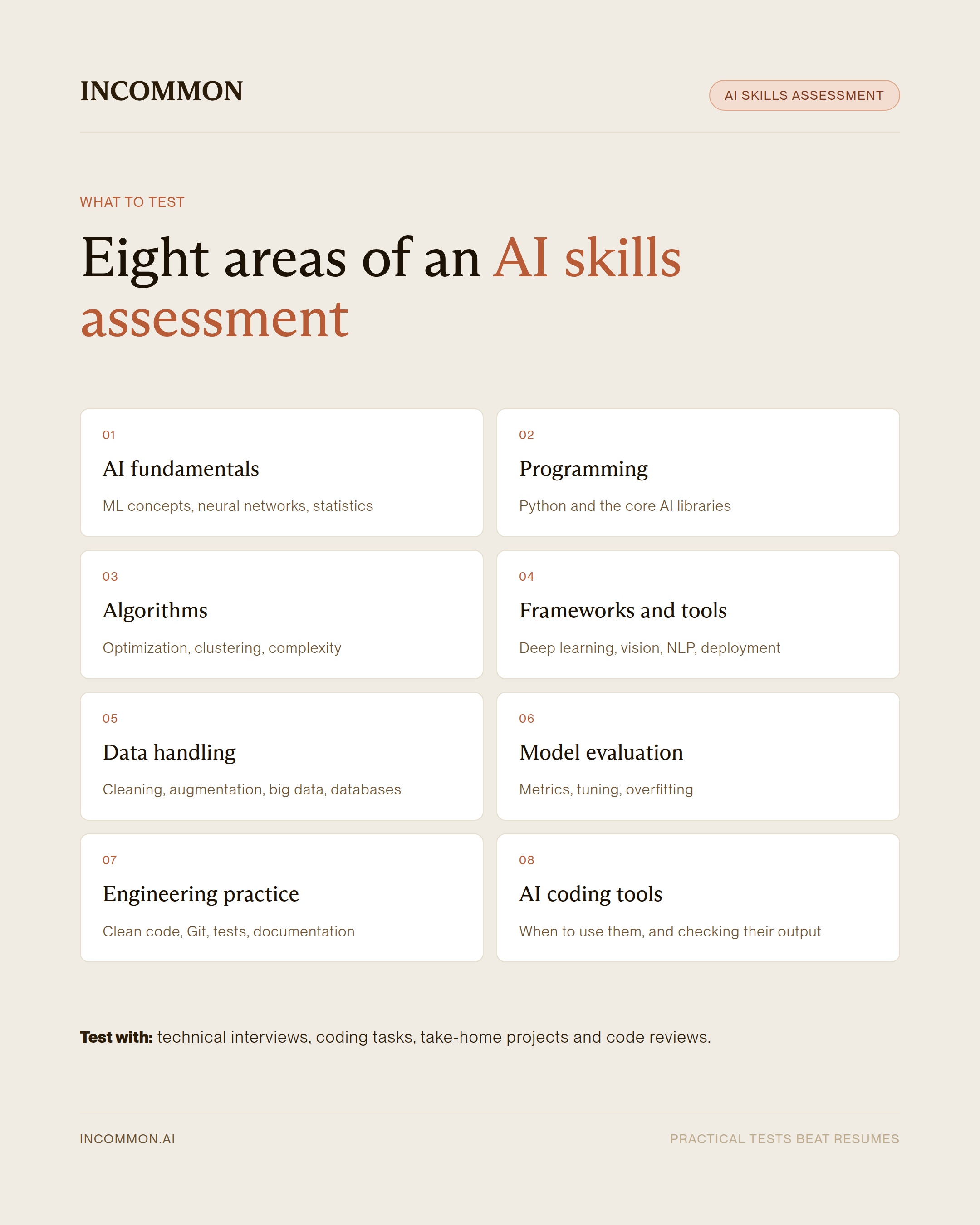
A comprehensive AI skills assessment should evaluate multiple aspects of a candidate's expertise. These include:
1. Understanding of AI fundamentals
A strong foundation in AI is necessary for software developers. Key areas to test include:
- Machine learning concepts: supervised, unsupervised, and reinforcement learning
- Neural networks and deep learning basics
- Statistical methods and probability
- Data preprocessing and feature engineering
2. Programming proficiency
AI developers need strong programming skills to implement models and algorithms efficiently. Assess their proficiency in:
- Python, the most commonly used AI programming language
- Libraries such as TensorFlow, PyTorch, and Scikit-learn
- Data manipulation using Pandas and NumPy
- Writing efficient and scalable code for AI applications
3. Algorithmic problem-solving
AI software developers must understand algorithms and how to optimize them. Assess their ability to:
- Implement search algorithms (e.g., A*, Dijkstra's algorithm)
- Solve optimization problems using gradient descent
- Work with clustering, classification, and regression techniques
- Analyze time complexity and optimize AI-driven processes
4. Experience with AI frameworks and tools
A candidate's familiarity with industry-standard tools and frameworks is essential. Check their experience with:
- TensorFlow and PyTorch for deep learning models
- OpenCV for computer vision tasks
- NLP libraries like SpaCy and NLTK
- Model deployment tools like ONNX and TensorRT
- Running and monitoring models in production on cloud platforms
5. Data handling and engineering skills
AI developers work extensively with data. Assess their skills in:
- Extracting and cleaning raw datasets
- Data augmentation techniques
- Working with big data technologies like Apache Spark
- Using SQL and NoSQL databases for AI applications
6. Model evaluation and performance tuning
The ability to assess AI model performance is crucial. Evaluate their understanding of:
- Metrics like precision, recall, F1-score, and AUC-ROC
- Hyperparameter tuning with GridSearchCV and RandomizedSearchCV
- Overfitting and underfitting issues
- Strategies to improve model accuracy and efficiency
7. Software development best practices
AI skills alone are not enough. Developers should also follow software engineering principles, such as:
- Writing clean and maintainable code
- Version control using Git
- Testing AI models with unit tests
- Code documentation and readability
8. Working with AI coding tools
Many developers now write code alongside AI assistants and large language models. Assess how they use them:
- When they reach for an AI tool, and when they choose not to
- How they check AI-generated code for bugs, security gaps, and poor logic
- Whether they can explain and defend code they did not write line by line
Methods to assess AI skills
1. Technical interviews
A structured technical interview can reveal a candidate's expertise. Include:
- Conceptual AI questions to assess theoretical understanding
- Coding challenges related to AI algorithms
- Scenario-based questions to test problem-solving skills
- A review of AI-generated code, to see what the candidate catches and fixes
When the candidate is in India and the interviewers are in the US, plan the live part around the time difference. Send a short note beforehand with the format, length, and tools, and check the setup at the start of the call. Ask the candidate to think aloud, and score how they approach the problem more than how fast they finish. If no time works for both sides, give a recorded task and review it with the candidate live afterward.
2. Coding assignments
Give candidates a hands-on coding task to evaluate their real-world implementation skills. Examples include:
- Building a simple machine learning model
- Implementing a neural network for image classification
- Cleaning and preprocessing a raw dataset
- Writing an AI-powered chatbot using NLP
3. Take-home projects
For a deeper assessment, provide a take-home project that simulates real AI work. Tasks could include:
- Developing a recommendation system using collaborative filtering
- Training a sentiment analysis model for text data
- Deploying a trained AI model using Flask or FastAPI
4. AI hackathons and challenges
Live AI challenges are an excellent way to assess how candidates perform under pressure. Platforms like Kaggle, HackerRank, and CodinGame offer AI-specific coding challenges.
5. Peer code reviews
Reviewing a candidate's past AI projects or open-source contributions can give insight into their coding style and problem-solving approach. Look for:
- Code efficiency and readability
- Proper use of AI libraries and frameworks
- Logical flow and implementation of AI algorithms
6. AI-specific knowledge tests
An AI-focused written or multiple-choice test can measure theoretical knowledge. Topics to include:
- Machine learning model selection
- Neural network architectures
- AI ethics and bias in models
- Data augmentation techniques
7. Behavioral and soft skills assessment
AI developers must also work well in teams and communicate effectively. Assess:
- Their ability to explain AI concepts to non-technical stakeholders
- Team collaboration and problem-solving mindset
- Critical thinking in AI-related scenarios
How to score the results
Each method above produces evidence, and the scoring decides what that evidence means. Agree on a written rubric before the first candidate starts, setting out the criteria and what a strong, average, and weak answer looks like for each. Give every candidate the same task and score them against the same rubric, so the comparison stays fair even when different people run the interviews.
Then add one round of feedback. Comment on the candidate's submission and ask them to revise one part of it. How they respond shows how they will work with your team after they join, which a first attempt cannot show.
To see what structured assessment produces, look at the teams we have built.
See how Findigs, Accompany Health, Veramatic and Podifi built their teams.
Real teams, real results, from faster hiring to lasting retention.
Conclusion
Assessing AI skills isn't as simple as asking a few technical questions. AI is an evolving field that requires a blend of theoretical knowledge, hands-on coding ability, problem-solving skills, and an understanding of industry-standard tools and frameworks.
Remember to avoid these pitfalls when assessing AI candidates:
- Focusing only on theoretical knowledge: Real-world AI work requires practical skills
- Ignoring software engineering principles: AI is part of a larger software system
- Overlooking problem-solving skills: A candidate's ability to troubleshoot issues is key
- Relying solely on resumes: Practical assessments provide better insights
The strongest assessments test the work the engineer will actually do. Pair a practical task with a conversation about how the candidate reached their answer, and you will learn far more than a resume can tell you.
Frequently asked questions
What is an AI skills assessment for software developers?
An AI skills assessment tests whether a software developer can build working AI systems, beyond listing AI on a resume. It checks fundamentals, programming, algorithms, frameworks, data handling, model evaluation, engineering practice, and how the developer works with AI coding tools.
What skills should an AI skills assessment cover?
Cover eight areas: AI fundamentals, programming proficiency, algorithmic problem-solving, AI frameworks and tools, data handling, model evaluation and tuning, software development best practices, and working with AI coding tools.
How do you assess AI skills when hiring a developer?
Combine methods. Use structured technical interviews, hands-on coding assignments, take-home projects that simulate real AI work, reviews of past projects or open-source contributions, knowledge tests, and a behavioral assessment of communication and teamwork.
How do you assess a developer's use of AI coding tools?
Assess when they reach for an AI tool and when they choose not to, how they check AI-generated code for bugs, security gaps and poor logic, and whether they can explain code they did not write line by line. A review of AI-generated code in the technical interview shows what the candidate catches and fixes.
What makes a good take-home project for AI developers?
A take-home project should simulate real AI work, such as building a recommendation system with collaborative filtering, training a sentiment analysis model, or deploying a trained model using Flask or FastAPI.
What mistakes should you avoid in an AI skills assessment?
Avoid focusing only on theoretical knowledge, ignoring software engineering principles, overlooking problem-solving skills, and relying solely on resumes. Practical assessments give better insight into what a candidate can deliver.
Written by
CEO, InCommon
Piyush Kedia is the CEO of InCommon, a talent infrastructure company that helps US and global enterprises set up and scale Global Capability Centers (GCCs) in India. He works with founders, CTOs, and heads of talent to design smaller, AI native GCC teams that focus on judgment work, not just headcount, so India offices stay senior, stable, and production ready. Before InCommon, Piyush built Blue Vector into a 50 person creative agency serving brands such as Trump Towers, Audi, and Porsche, giving him a front row view of how high performing teams are hired, managed, and grown.