How long does it take to set up a GCC in India?
See how Findigs, Accompany Health, Veramatic and Podifi built their teams.
Real teams, real results, from faster hiring to lasting retention.
Quick look:
| A GCC setup timeline in India runs on two clocks. Incorporating your own subsidiary takes about 12 weeks, as a planning figure. A live team depends on hiring, and across four published teams it took between 4 weeks and 4 months. Hiring sets the pace, starting with the managing director. With an employer of record, the team does not have to wait for the entity at all. |
|---|
You have chosen India, the spend is approved, and the board wants a date. That date depends far more on people than on paperwork. Incorporation follows a fixed sequence, set out in our GCC setup roadmap, while hiring moves on candidates' calendars.
This piece is for founders, COOs and operating partners at growth-stage companies planning their first global capability center in India. It covers timing only.
How long does each part take?
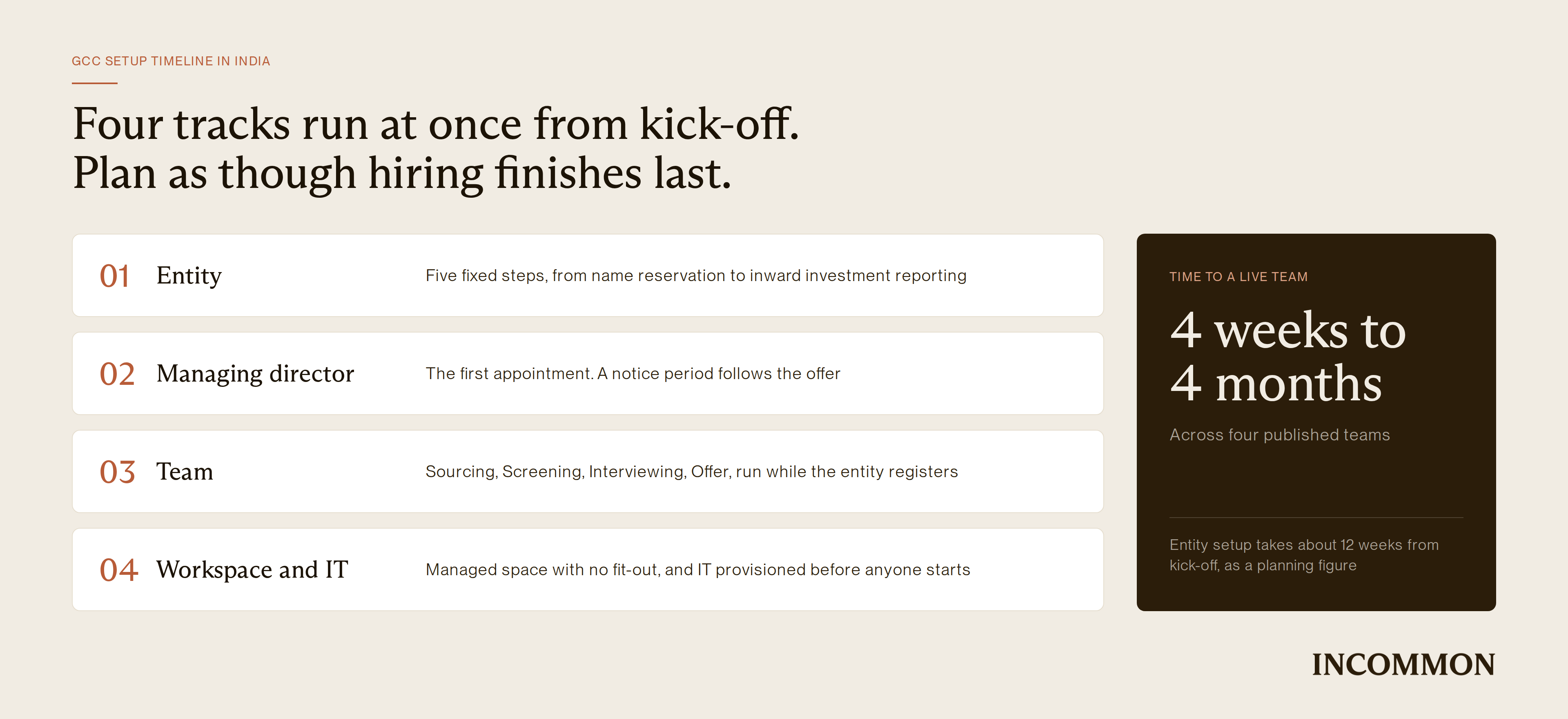
Opening a GCC in India means running four tracks at once, one each for the entity, the managing director, the team, and the workspace. At InCommon, we run all four under one agreement through our India office setup.
The clock starts at kick-off, after the service agreement is signed and a planning stage is done. Planning settles team structure, salary benchmarks, location, workspace and IT requirements, and your company culture. Several of those choices overlap with what you need to decide before establishing a GCC.
From kick-off, the entity follows a fixed sequence with a planning figure of about 12 weeks. The other three tracks depend on people, and people keep their own calendars. So any GCC implementation timeline is really a hiring timeline with an entity alongside it.
Plan as though hiring finishes last.
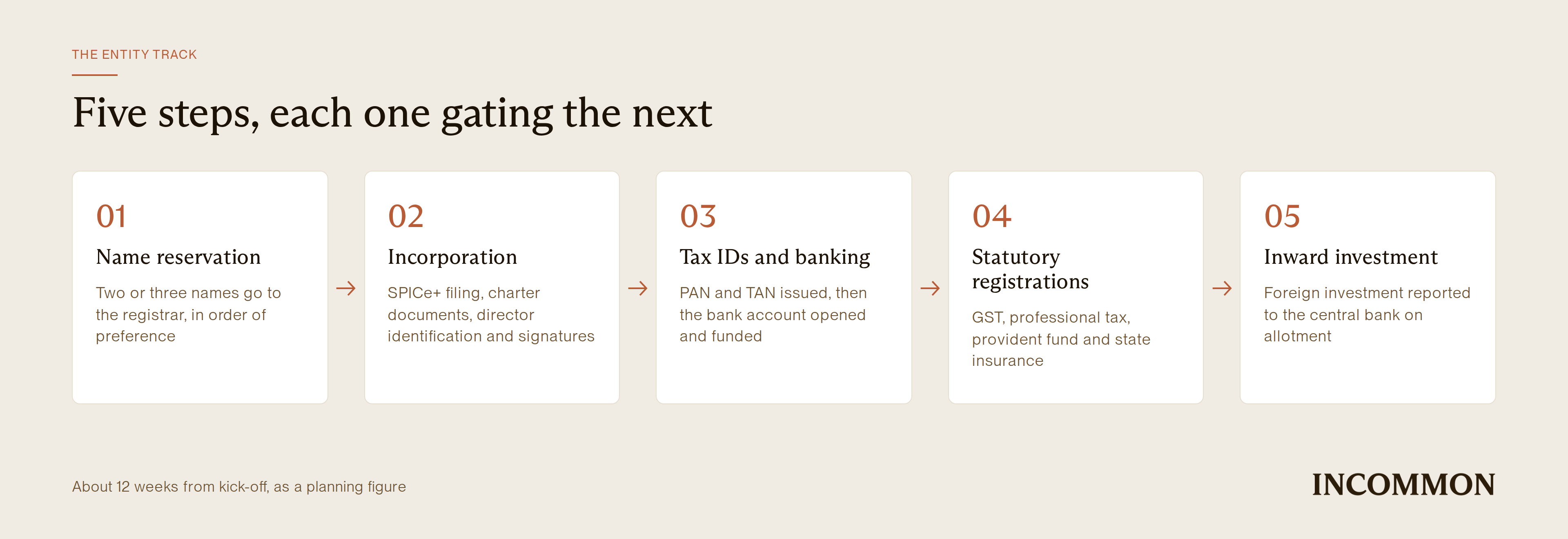
The entity track in five steps
Incorporation follows five steps, and each one gates the next. Two or three candidate names go to the registrar first, in order of preference, so one rejected name does not stall the filing.
The SPICe+ filing then carries the charter documents, director identification and signatures. Once the company exists, PAN and TAN are issued, and the bank account is opened and funded. Statutory registrations follow for GST, professional tax, provident fund and state insurance.
The last step reports the foreign investment to the central bank on allotment of shares.
The paperwork is the predictable part. What stretches this track is usually a decision still open on your side, and three of them belong at the start.
A private limited company is the standard vehicle. Transfer pricing is a cost-plus mark-up on operating expense, agreed up front. Capitalization sets how much to fund at incorporation, and the runway that buys.
We keep standing relationships with the registrars and banks that gate each step, and we work from process templates. A compliance team stays with the entity once setup finishes, because the compliance obligations for a GCC recur every year.
The managing director comes first
The managing director is the first and most consequential appointment in the center. Everyone hired afterward is measured against the standard set by the first ten, and this person hires those ten.
They start from nothing. There is no HR function, no process and no local employer brand until they create one.
They also carry head office trust, because you will see the center mostly through them. A center left on maintenance work declines, so they have to win better work from head office as well as hire for it.
We source these candidates from people currently running India centers. The GCC Leaders' Breakfast, a closed-door table of current India center heads, meets every six to eight weeks, city by city. In some cases, a leader from that room goes on to run a client's India operation.
Someone who has held the role runs the final interview, and you make the appointment. Once your choice accepts, they serve a notice period at their current employer, with its length set by that contract.
This is the one appointment worth letting the timeline slip for. A strong managing director who joins late costs you weeks. A weak one who joins on time costs you the first ten hires.
Hiring the team alongside the entity
Sourcing, screening and interviewing can all happen while the entity is still being registered. Offers go out once there is an employer to issue them, either your subsidiary or an employer of record (EOR).
The bar has to be agreed before sourcing starts, because every later stage checks against it. Accompany Health made regulated health data experience a screen before any sourcing began. That one decision took a whole category of candidates out of the search before anyone spent time on them.
Our hiring moves through four stages, Sourcing, Screening, Interviewing and Offer.
Sourcing is fast when relationships already exist. By the time a role opens, we have usually known the right person for years, so the shortlist takes days. Every new search is briefed to an invite-only referral network, whose members are paid for referrals they would work with again.
Screening goes through someone who has done the job, in a 45-minute interview with a domain expert who puts their name to the shortlist. The result shows in send-to-hire, where 33% of the candidates we send are hired.
Each hire serves a notice period too. An offer made a week earlier starts that clock a week earlier, so the Offer stage deserves as much care as the first three.
Workspace, IT and payroll on day one
The workspace is the easy track. Taking desks through WeWork or Indiqube removes both the fit-out project and the three-to-five-year lease that come with leased space. Candidates judge an employer by its office, so the space does some of the recruiting as well.
IT is provisioned before anyone starts, from laptops and endpoint management to VPN and single sign-on. Payroll and benefits administration are set up before the first salary run, and onboarding follows a written procedure. What we learned about each hire in the search comes to you with them.
When the team starts before incorporation
An EOR changes the order of the tracks. Your team is employed through the EOR, which means hiring does not wait for an Indian entity of your own.
Podifi needed engineers in India against a data residency deadline. We hired the lead first, and the result was 9 engineers live in 6 weeks, employed through employer of record with no wait for incorporation. The deadline chose the route.
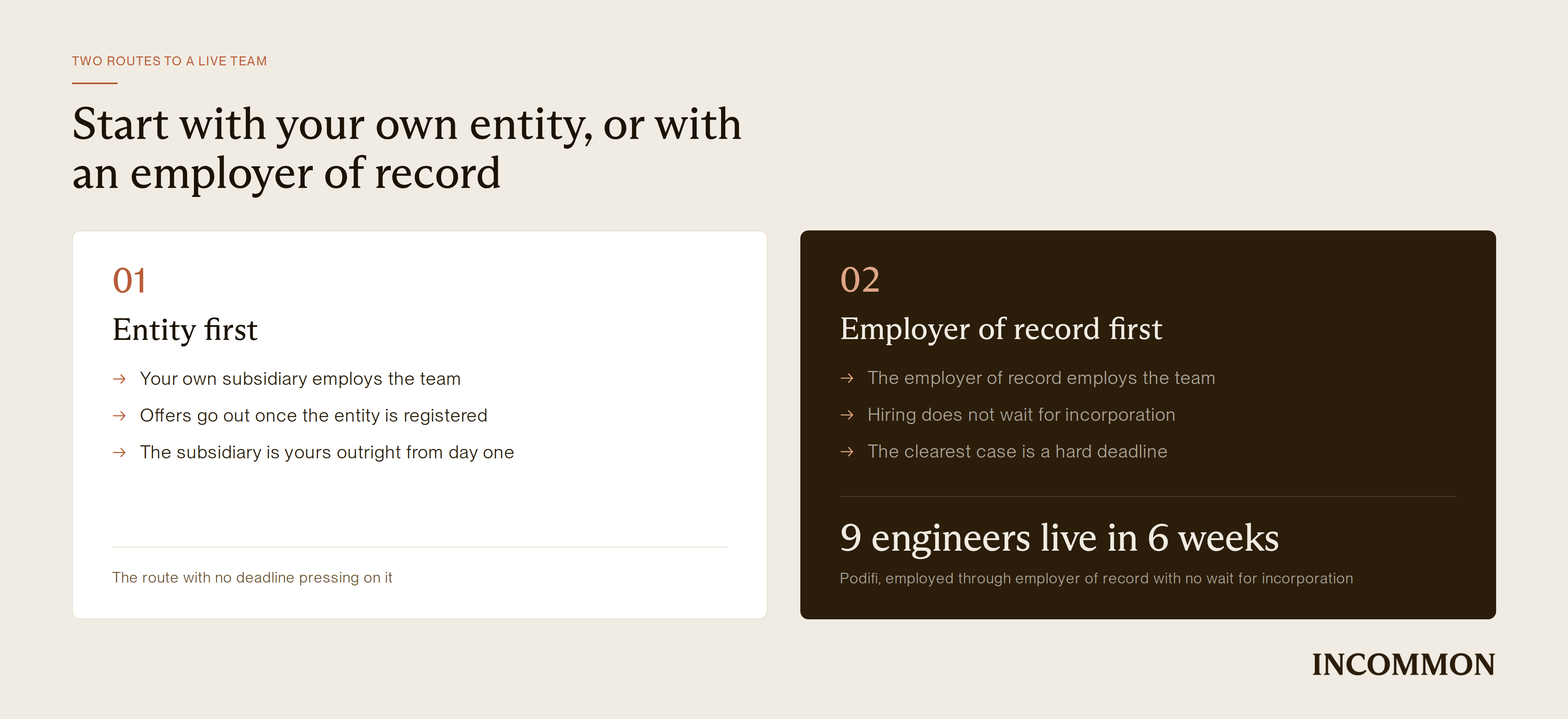
With your own entity, the subsidiary belongs to you outright from day one. With an EOR, your people are working before any entity exists. So a hard deadline is the clearest reason to start on the second route.
How long four teams actually took
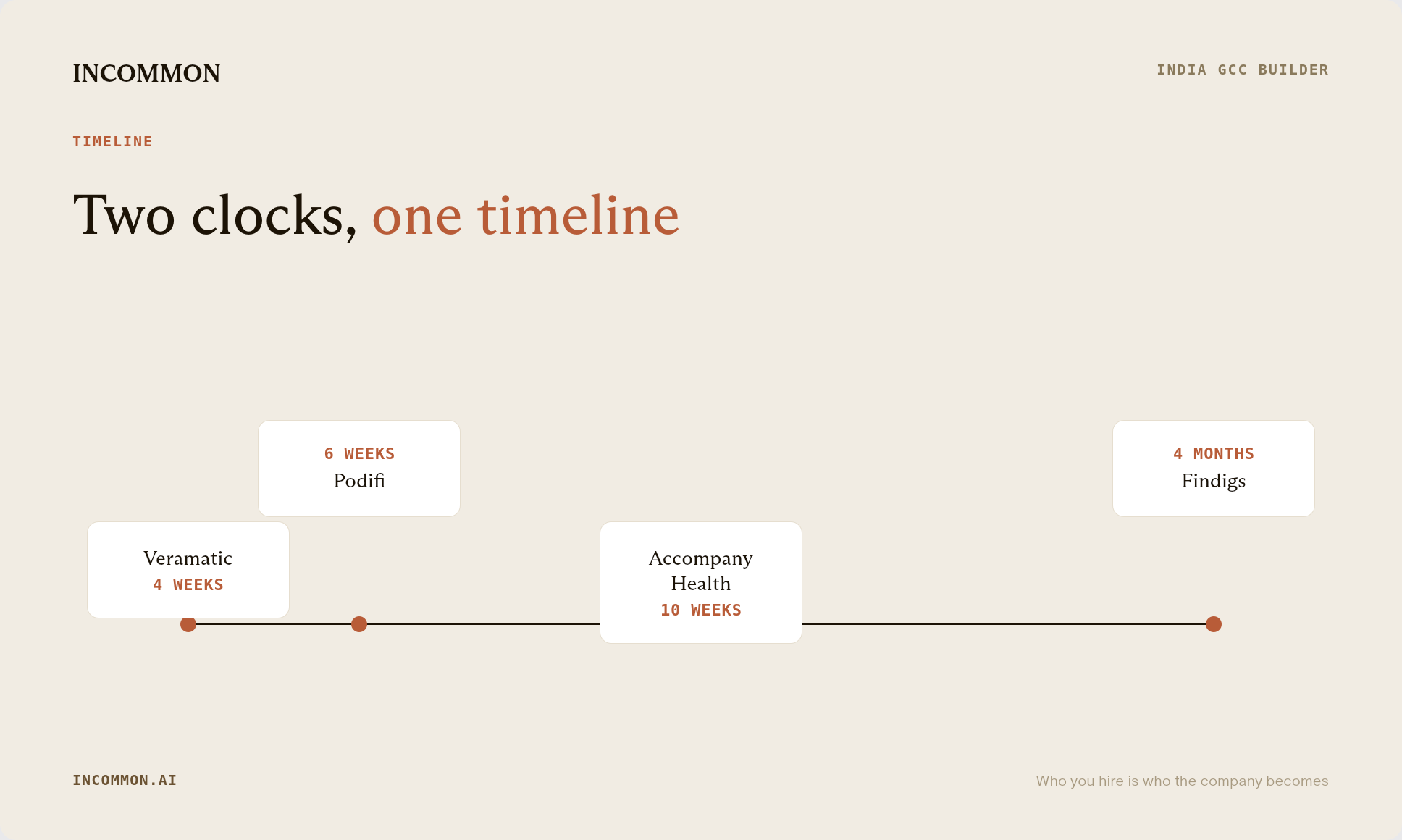
Across four published teams, time to a live team ran from 4 weeks to 4 months. The table sets each result beside the constraint that made the search hard:
| Client | Company | Hard part | Result |
|---|---|---|---|
| Veramatic | PE-backed SaaS | An automotive domain nobody arrives knowing | 21 people live in four weeks, 92% retention across the build |
| Podifi | SaaS and IT services | A data residency deadline | 9 engineers live in 6 weeks, employed through employer of record with no wait for incorporation |
| Accompany Health | Series B healthtech | Regulated health data experience as a screen | 22 people, 10 weeks to a live team, 100% retention across the build |
| Findigs | Series C fintech | 60 hires, all against an existing standard | 60 underwriters hired in four months, with 90% still in place |
Plan to the top of that range. Findigs hired 60 people and took four months, while each of the three teams that went live in weeks had fewer than 25.
Our repeatable unit is a pod of 8 people, senior-led and cross-functional. A center of 30 to 35 takes 3 or 4 pods, closer in size to Findigs than to Veramatic. Team size is the variable you can see in advance, so set the date against it.
A date the board has to move once costs more trust than a later date held from the start.
Each of those builds is written up in more detail.
See how Findigs, Accompany Health, Veramatic and Podifi built their teams.
Real teams, real results, from faster hiring to lasting retention.
Timelines inside a PE hold period
An operating partner has two worries about an India center. The team slips past the hold period, or the cost case never shows up. A hold period runs in years, while a live team takes weeks or months.
The start date is rarely the risk. The risk is a team that has to be rehired in year two, halfway through the plan.
For Veramatic, a PE-backed company, the result was 21 people live in four weeks, 92% retention across the build. Veramatic set its bar around a trait rather than a title, the instinct to distrust your own output.
Retention carries the cost case too, because a hire who leaves in month four is the expensive outcome. It is the figure we lead with for private equity portfolios, and we give a six-month replacement guarantee on every candidate.
Final thoughts
Set the date from team size and route, at the top of the range. That leaves room for the one slip worth taking, which is a managing director appointment held to the standard you would hold at home. An EOR start is there when a deadline leaves no room.
Frequently asked questions
How long does it take to set up a GCC in India?
A practical planning figure is about 12 weeks for incorporation, but a live team timeline depends more on hiring than paperwork. Across the examples in the article, teams went live in as little as 4 weeks and up to 4 months.
What usually takes longer: incorporation or hiring?
Hiring usually sets the pace. Entity setup follows a fixed sequence, while leadership hiring, team interviews, and candidate notice periods can extend the overall timeline.
Can an employer of record speed up a GCC launch in India?
Yes. An employer of record lets hiring begin and employees start work before your own Indian entity is fully incorporated, which is useful when timelines are driven by a hard business deadline.
When should the managing director be hired?
The managing director should be prioritized first. This hire shapes the early team, establishes local operating standards, and often has the biggest impact on how quickly the GCC becomes effective.