How a US company registers a subsidiary in India, WOS, branch or LLP

See how Findigs, Accompany Health, Veramatic and Podifi built their teams.
Real teams, real results, from faster hiring to lasting retention.
Quick look:
| Company registration in India for a foreign company runs through one of three vehicles. A wholly owned subsidiary is a private limited company, incorporated with the Ministry of Corporate Affairs through the SPICe+ form. A branch office is the parent itself, approved through an Indian bank under FEMA and RBI rules. An LLP is a partnership with limited liability, open to foreign investment in software. For a US software company hiring a team, the subsidiary is usually the right choice. |
|---|
A US company can register in India in three legal forms, and each answers to a different authority. The form decides who in India carries the liability, how profit is taxed, and how easily the team grows. Choose it for the center you will run in year three.
This guide is for founders, CFOs and general counsel at US software companies choosing a vehicle for their first India team. How long registration takes is covered in our GCC setup timeline.
How a foreign company registers in India
India gives foreign companies three ways to set up a legal presence. Each has its own statute and gatekeeper.
A wholly owned subsidiary is incorporated under the Companies Act, 2013, with the Ministry of Corporate Affairs (MCA). An LLP registers under the Limited Liability Partnership Act, 2008, with the same ministry. A branch office is approved under the Foreign Exchange Management Act (FEMA), through an authorized bank that reports to the Reserve Bank of India (RBI).
The first two create a new Indian entity that your parent owns. The branch creates nothing new, because it is the US company itself, operating in India under its own name.
A liaison office also exists, but it can only represent the parent. It cannot earn revenue, so it cannot run engineering work. Whether you need any entity yet is a separate question, and our comparison of the four ways to hire answers it.
The wholly owned subsidiary route
A wholly owned subsidiary is a private limited company whose shares your US parent owns. A private company needs at least two shareholders. So the parent owns nearly all the shares, and a nominee or a second group company owns the rest.
It also needs at least two directors. Section 149(3) of the Companies Act requires one of them to have stayed in India for 182 days or more in the financial year. India removed the minimum paid-up capital for private companies in 2015, but the company still needs funding for the months before it invoices anyone.
Software and IT services take foreign investment under the automatic route. So no government approval is needed before you incorporate.
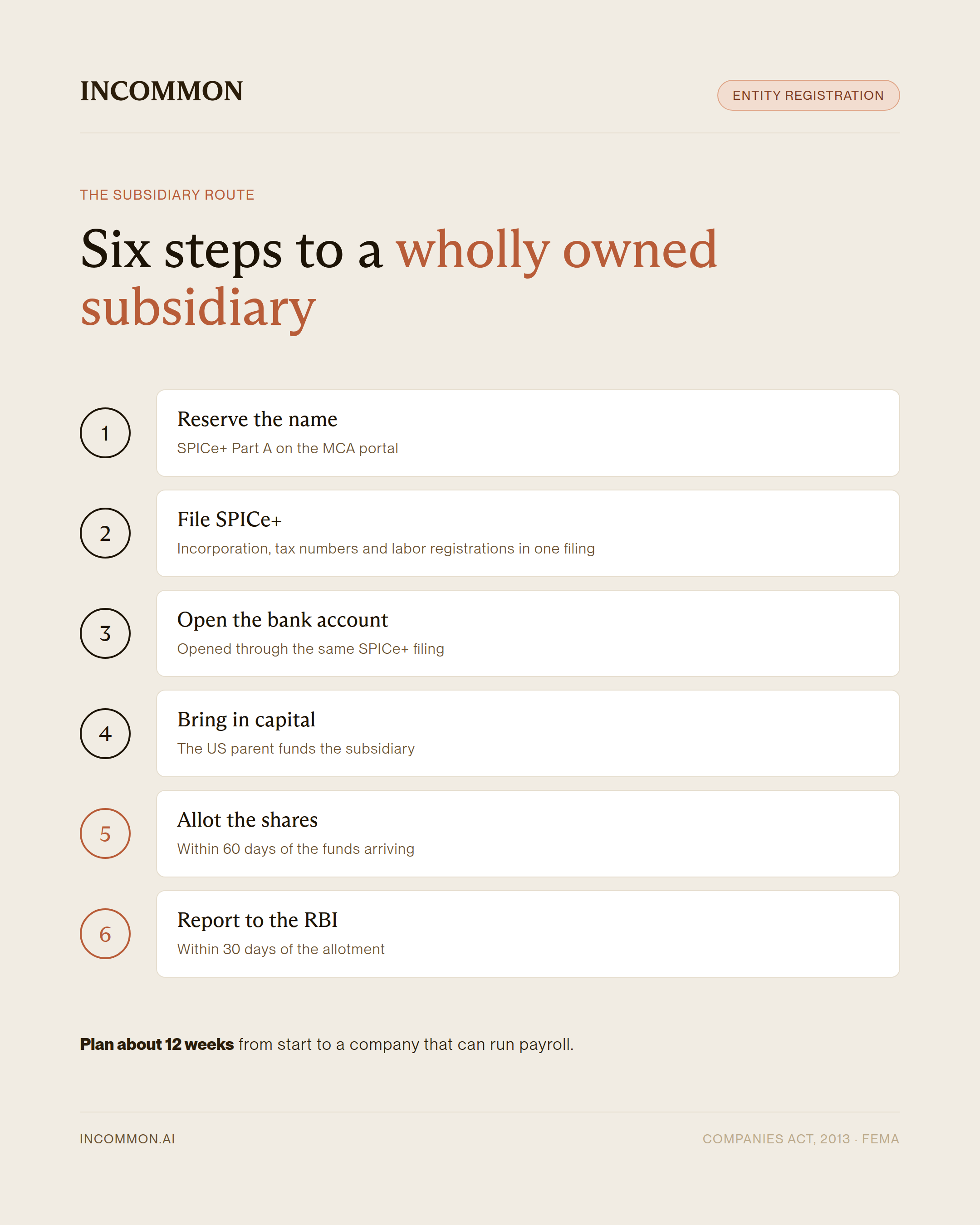
SPICe+ on the MCA portal is a single filing. It carries the incorporation, the tax numbers and the labor registrations together, and it opens the company's bank account.
The slow part is usually the paperwork from the US side. When a subscriber is a company based outside India, the charter documents go in as physical copies. Those copies need signing and notarizing in the US before anything is filed.
After incorporation, the money moves under FEMA. Shares must be allotted within 60 days of the funds arriving, and the allotment reported to the RBI within 30 days. Plan about 12 weeks from start to a company that can run payroll, and follow the setup sequence behind it.
The subsidiary then bills your parent its costs plus a margin, and India taxes that margin. The arrangement is the same one described in captive center vs GCC.
The branch office route
A branch office is your US company registered to do business in India. It is not a separate legal person, so its contracts, tax and liabilities belong to the parent.
The application goes to an authorized bank on Form FNC, under the RBI master direction. The bank approves most cases itself, and the RBI steps in only for listed sectors and countries. The parent needs a profit in each of the five preceding financial years and a net worth of at least USD 100,000.
Software development is on the permitted list. A branch can provide IT services and develop software in India. It sends profit to the parent after Indian tax, with an auditor's certificate for each remittance.
Once it opens, the branch registers with the registrar of companies and files an annual activity certificate with its bank and the tax department.
A branch is taxed as a foreign company, at a 35% base rate under the Income-tax Act, 2025. A domestic company, which includes your subsidiary, can opt for 22%.
A branch also brings your US balance sheet into India. For a team you plan to grow, that trade rarely pays.
The LLP route
An LLP is a partnership whose partners have limited liability. Foreign investment is allowed under the automatic route, but only in sectors open to 100% automatic investment with no conditions attached, and software qualifies.
It needs at least two designated partners. One must stay in India for 120 days in the financial year, lighter than the 182 days a company director needs.
An LLP pays a 30% base rate with no concessional option, so the lighter residency test is an expensive saving. It can convert to a company later under the automatic route, but the conversion is a second project.
The three routes compared
The table compares the three vehicles on the questions a CFO asks first:
| Wholly owned subsidiary | Branch office | LLP | |
|---|---|---|---|
| Governing law | Companies Act, 2013 | FEMA branch office regulations | LLP Act, 2008 |
| Who approves | MCA, through SPICe+ | Authorized bank, RBI in listed cases | MCA |
| Legal person | Separate Indian company | The US parent itself | Separate Indian LLP |
| Resident in India | 1 director, 182 days | A person authorized to accept notices | 1 designated partner, 120 days |
| Parent eligibility | Sector open to automatic FDI | 5 profitable years, USD 100,000 net worth | Sector open to 100% automatic FDI |
| Base tax rate | 22%, if opted | 35% | 30% |
| Profit to the parent | Dividend | Remittance after tax | Partner's profit share |
The subsidiary carries the lowest tax rate and keeps India's liabilities inside India. A branch saves only the incorporation.
Which vehicle fits a software team
For a US software company planning a team of any size, the wholly owned subsidiary is the default. The branch and the LLP each need a specific reason.
Our repeatable unit is a pod of 8 people, senior-led and cross-functional, and 3 or 4 pods make a center of 30 to 35. A center that size has its own payroll, contracts and board, which is what a company is for.
Registration speed should not decide the vehicle, because the entity rarely sets the pace. Hiring does. An employer of record can employ the team before any entity exists. Podifi got 9 engineers live in 6 weeks, employed through employer of record with no wait for incorporation.
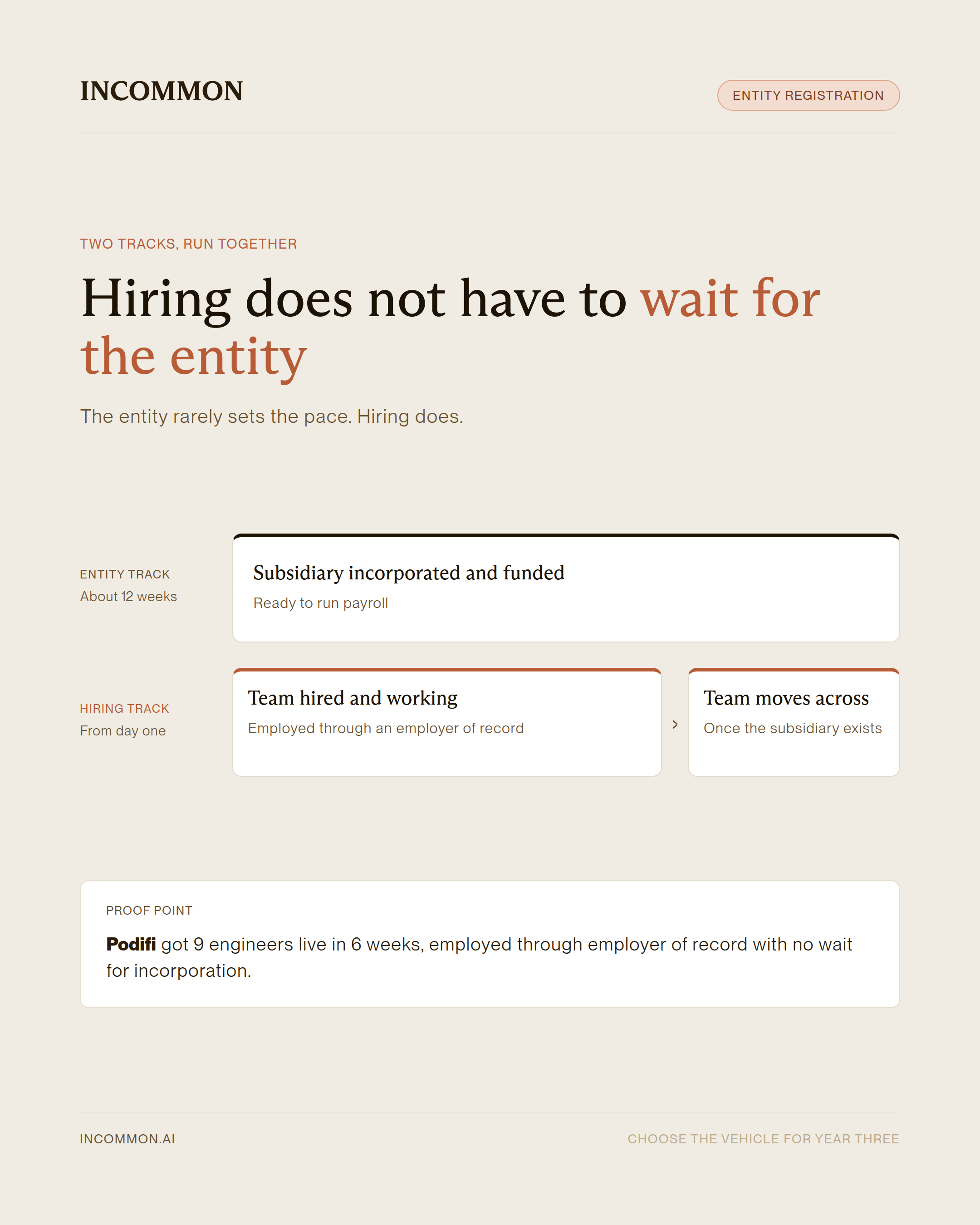
The team moves to the subsidiary once it exists, which is when the choice of EOR or your own entity becomes a dated project. For Accompany Health, the result was 22 people, 10 weeks to a live team, 100% retention across the build.
At InCommon we register the subsidiary as part of our India office setup, and our compliance team stays with the entity after setup. We coordinate with Indian counsel on the structure, and you should confirm it with yours before filing. The capital you put in at incorporation belongs in your year-one and year-two costs.
If you would like the incorporation handled alongside hiring, this is how we work.
Everything you need to build and run your India GCC.
Entity, hiring, workspace and ongoing operations under one agreement.
Final thoughts
Register for the company you will run in year three. For most US software teams that means a wholly owned subsidiary, filed through SPICe+ and funded under FEMA.
If the first hires cannot wait for the entity, start them through an employer of record while the filing runs.
Frequently asked questions
How does a foreign company register a subsidiary in India?
A foreign company incorporates a private limited company under the Companies Act, 2013, through the SPICe+ form on the MCA portal. SPICe+ covers incorporation, tax numbers, labor registrations and the bank account. The company needs two directors, one resident in India for 182 days in the financial year, and at least two shareholders. After funding, shares are allotted within 60 days and reported to the RBI within 30 days.
Wholly owned subsidiary, branch office or LLP, which suits a US software company in India?
For most US software companies, a wholly owned subsidiary. It is a separate Indian company, it can opt for a 22% base tax rate, and it keeps liabilities inside India. A branch is the US parent itself and pays a 35% base rate. An LLP pays a 30% base rate with no concessional option.
What is SPICe+ registration?
SPICe+ is the Ministry of Corporate Affairs web form for incorporating a company in India. Part A reserves the name, and Part B covers incorporation, director identification numbers, PAN and TAN, provident fund and state insurance registration, and opening the company's bank account, with GST if applied for.
Does a branch office in India need RBI approval?
A branch office applies on Form FNC through an authorized bank, which approves most cases under the RBI master direction. The RBI's prior approval is needed only for listed sectors, such as defense and telecom, and applicants from certain countries. The parent needs profits in each of the five preceding years and a net worth of at least USD 100,000.
Can a foreign company own 100% of an Indian company?
Yes, in sectors open to 100% foreign investment under the automatic route, which includes software and IT services. A private company needs at least two shareholders, so the parent owns nearly all the shares and a nominee or second group company owns the rest.
Can a US company hire in India before its subsidiary is registered?
Yes. An employer of record can employ the team before any entity exists, and the team moves to the subsidiary once it is incorporated. Podifi got 9 engineers live in 6 weeks, employed through employer of record with no wait for incorporation.
Written by
CEO, InCommon
Piyush Kedia is the CEO of InCommon, a talent infrastructure company that helps US and global enterprises set up and scale Global Capability Centers (GCCs) in India. He works with founders, CTOs, and heads of talent to design smaller, AI native GCC teams that focus on judgment work, not just headcount, so India offices stay senior, stable, and production ready. Before InCommon, Piyush built Blue Vector into a 50 person creative agency serving brands such as Trump Towers, Audi, and Porsche, giving him a front row view of how high performing teams are hired, managed, and grown.