How a US Company Legally Hires in India: Four Routes Compared

See how Findigs, Accompany Health, Veramatic and Podifi built their teams.
Real teams, real results, from faster hiring to lasting retention.
Quick look:
| US companies can hire in India through a contractor, an employer of record (EOR), a managed team, or a wholly owned subsidiary. The right route depends on two practical tests. One is who employs the person, and the other is who directs the work each day. Use a contractor for finite independent work, an EOR for early direct hires without an Indian company, a managed team for provider-led delivery, and a wholly owned subsidiary for a lasting, company-owned operation in India. |
|---|
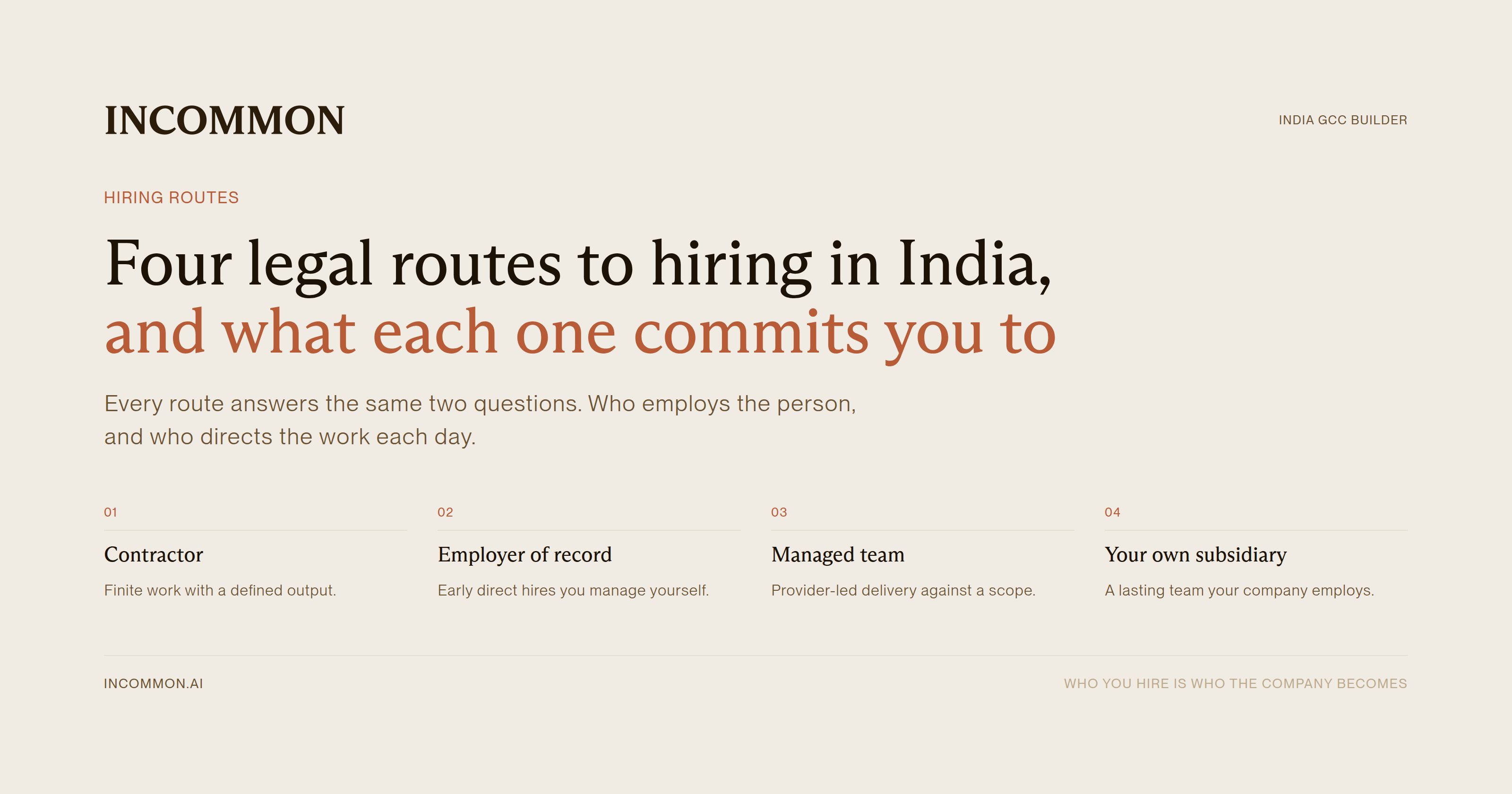
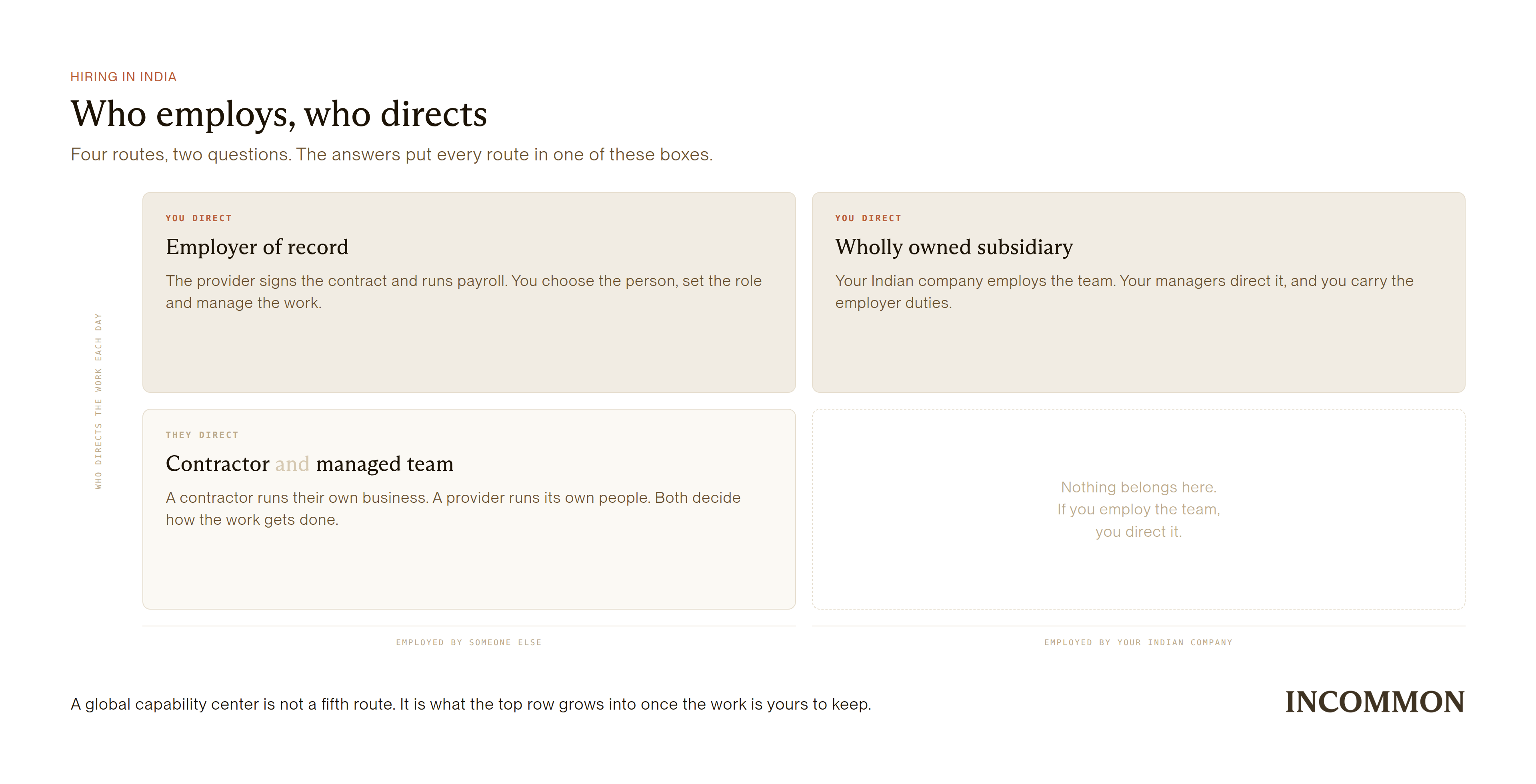
US companies can hire in India through a contractor, an employer of record (EOR), a managed team, or a wholly owned subsidiary. The right route depends on two practical tests. One is who employs the person, and the other is who directs the work each day.
This guide is for a US company making its first India hire and deciding which legal structure to use.
How do you hire in India?
Employment means signing the contract, running payroll, and meeting employer duties. Direction means setting goals, reviewing work, and managing each day. A contractor works under a services agreement and controls the work, while an EOR employs the person and your company directs them.
A managed team provider employs and directs its people in return for an agreed service or output. An Indian subsidiary is a company in India owned by your US parent, so it employs the team while you direct the work.
You can still have India tax or employment questions without an Indian company. A global capability center is a company-owned hub that an EOR or subsidiary team can grow into.
Hiring a contractor in India
Contractors work best for finite work where you need a result, and not a role embedded in your team. For one specialist on a three-month project, a clear services agreement can be enough. It should define the output, the acceptance process, and who owns the IP at the end.
Misclassification is the main risk here. The daily relationship starts to look like employment despite the contract label, and there is no single test and no time limit.
What counts is supervision, team integration, and how long the work lasts. If your manager sets hours, assigns daily tasks, and treats the person like part of the team, the India risk rises quickly.
Spell out deliverables, payment dates, review points, and the contractor's freedom to serve other clients. Managers should review results rather than direct every hour.
With a freelancer you have not worked with before, start with a small paid test project, then pay by milestone. A freelance setup stops fitting when the work turns into ongoing maintenance, needs several skill sets, or needs someone who stays. That is the point to move the role to an EOR or a managed team.
Hiring through an employer of record
If you need a direct employee in India before you have an Indian company, an EOR is the usual route. The EOR is the legal employer. It signs the employment contract, runs local payroll, and handles employer-side filings and statutory benefits.
Your company still chooses the person and sets the role, goals, manager, feedback, and priorities. The role remains part of your company, and your managers direct the work each day.
That makes an EOR a good fit for early hires when speed matters. Before onboarding, review the employment terms, the IP assignment, and where employee records are held. Confirm who handles leave, employee questions, and an eventual exit before the first offer goes out.
The local employer changes, but the management load does not. Your managers still need a clear reporting line, sensible onboarding, regular feedback, and a role that fits your company. For the longer decision between an EOR and an Indian subsidiary, see our GCC setup guide.
Using a managed team
A managed team fits when you want a provider to own delivery, staffing, and day-to-day management. The provider employs the people and directs their work. Your company buys the output.
This route works for changing workloads or defined services that do not need deep integration with your company. It fits a service lane better than an internal role with a named manager.
Agree on acceptance standards, output ownership and who leads each side. Our GCC definition guide explains the difference between provider-led delivery and company-owned capability.
Setting up an Indian subsidiary
An Indian subsidiary makes sense once India is a lasting, company-owned part of your operating plan. It is a company in India owned by your US parent. The subsidiary employs the team, and your company directs the work.
Incorporation involves company filings, a registered address, and tax and bank accounts. The bank account is the slow part.
A private company needs at least two directors, and Section 149 of the Companies Act, 2013 adds a residency test. At least one director must have stayed in India for at least 182 days during the financial year.
Plan for about 12 weeks before the first payroll, although documents and bank checks can change the schedule. A subsidiary carries local payroll, contracts, filings, and employer decisions, so it suits a team that will stay and grow rather than a small experiment.
Someone local has to own finance, payroll approvals, and statutory filings because incorporation only gets you to the starting line. Name that person before you incorporate, not after.
The four routes compared
The table runs the same two tests across all four routes. It then shows first-hire speed, cost shape, and daily control of the work:
| Route | Who employs? | Who directs work? | First-hire pace | Cost shape | Good fit | Key limit |
|---|---|---|---|---|---|---|
| Contractor | Contractor's business | Contractor | Fast | Project fee | Finite specialist work | The relationship must stay independent |
| EOR | EOR provider | Your company | Fast | Per-person monthly fee | Early direct hires | The EOR holds the contract |
| Managed team | Provider | Provider | Fast | Service fee | Defined delivery | You do not direct each day |
| Indian subsidiary | Your subsidiary | Your company | About 12 weeks | Setup and ongoing local costs | Lasting team | You run local employer duties |
Fast setup does not remove India payroll, benefits, tax, or record-keeping work. If your managers direct the role each day, choose the route that supports that control on paper and in practice.
Use the table to narrow the choice. Then test the facts for each hire.
Which route should you choose?
Choose the lightest route that matches the real work, the control you need, and the team's expected life. A contractor suits one specialist with a finite project.
Provider-led delivery points to a managed team. If you will manage two or three direct hires yourself, use an EOR.
Choose an Indian subsidiary when the team will become a durable company function, not just because you want to make a first offer. Contractor paperwork never covers a permanent role.
Teams can move from an EOR to a subsidiary later, subject to contracts, employee consent, and local requirements. Our India office service covers people, payroll, workspace, and day-one operations around a growing team.
If the subsidiary route fits your plans, this is what it looks like with us.
Everything you need to build and run your India GCC.
Entity, hiring, workspace and ongoing operations under one agreement.
What each route costs
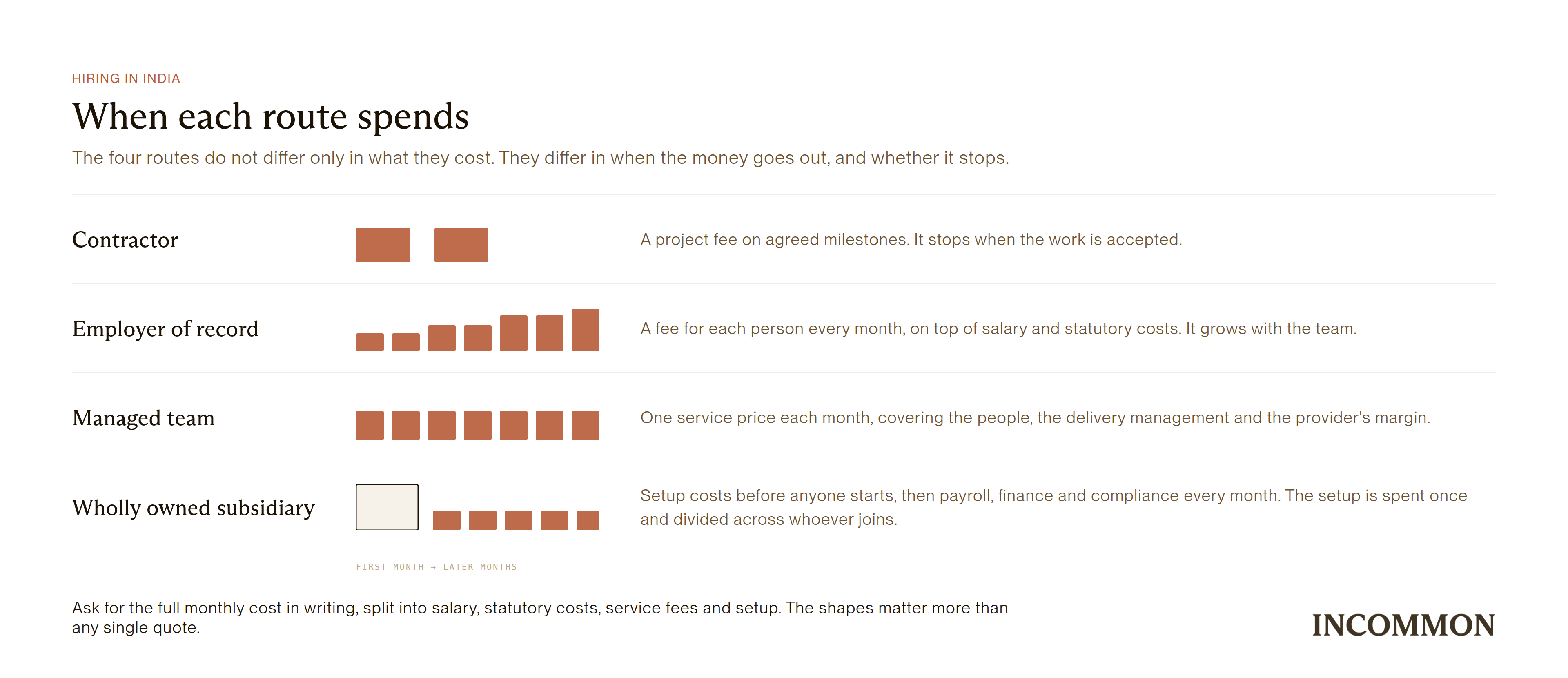
Compare cost shapes before quotes. The cheapest monthly option often carries duties your team does not want.
A contractor costs the agreed project fee and agreement review. An EOR costs salary, required employment costs, and a service fee on top.
A managed team combines people, delivery management, and the provider's margin in a service price. An Indian subsidiary has upfront setup costs plus local payroll, compliance, and often workspace support.
Ask for the full monthly cost in writing, with salary, statutory costs and service fees separated out on the quote. Prices vary by role, state and scope.
Where routes go wrong
In India, trouble usually starts when the contract says contractor while your managers run the role like an employee job. A written contractor label does not settle the question. What decides it is whether the person works as an independent business or as part of yours.
Provident fund is India's mandatory retirement savings scheme, and where it applies, both the employer and the employee contribute every month. The Employees' Provident Funds and Miscellaneous Provisions Act, 1952 governs that obligation, so coverage turns on the employer and worker facts.
Permanent establishment is a taxable business presence in India, and it is a separate question from company registration. Article 5 of the US-India tax treaty covers fixed places of business, service activity and agents with contract authority. Having no subsidiary does not mean no India tax exposure.
The answer depends on what your India activity looks like, the role, and the degree of control. That is why the structure needs confirming with Indian employment and tax counsel before you make the offer.
IP gets lost in the chain. When a provider employs the person, check that the provider contract and the worker agreement both assign the work to your company.
Notice periods need local treatment, because the contract and Indian rules shape the exit and US at-will practice does not apply. Check who owns the employee file and how final payments are handled. Contracts, invoices, reporting lines and the work itself should tell the same story.
From first hire to a team
An EOR or Indian subsidiary can grow into a global capability center when your company owns the long-term mandate. A global capability center is a hub the company owns, holding work the company intends to keep.
A managed team stays provider-led. Growing it does not change the arrangement.
At InCommon we put 9 engineers live for Podifi in 6 weeks, through employer-of-record employment with no wait for incorporation. Your own timeline depends on the roles and the market.
A larger team changes the shape of the first quarter. Accompany Health reached 22 people and a live team in 10 weeks, with 100 percent retention across the build.
Final thoughts
Choose the route that fits the role you are hiring in India, the control you need, and how long the team should stay.
Frequently asked questions
What is the best way to hire employees in India as a US company?
For hiring in India for a US company, an EOR is often the clearest route for early direct hires without an Indian entity. A wholly owned subsidiary fits a team that will become a lasting company operation.
How do you legally hire someone in India from the US?
Choose a route that matches the work. Use a genuine contractor for finite independent work, an EOR for direct employment, or your subsidiary for long-term employment.
How to hire in India as a US company without an entity?
Use an EOR when you need to employ someone in India as part of your company without first establishing an Indian entity. The EOR is the local legal employer while you direct the person's work.
Can a US company employ someone in India directly without an entity?
An EOR provides a local legal employer for the person while your US company directs their work. The EOR signs the employment contract and manages local payroll.
Is it legal to pay an Indian contractor in dollars?
Contract currency does not decide whether a worker is a contractor. The agreement and daily working facts need to match an independent services relationship.
What is a provident fund and who pays it?
Provident fund is India's mandatory retirement savings scheme. Where it applies, the employer and employee both make monthly contributions under the governing law.
How long does it take to hire the first person each way?
A contractor, EOR, or managed team can start quickly once contracts are ready. Plan about 12 weeks for a subsidiary before first payroll, subject to documents and banking.
What happens if a contractor is found to be an employee?
The relationship may face employment-related duties that were not handled as employment. The deciding facts include supervision, integration, exclusivity, tools, duration, and applicable law.
Written by
CEO, InCommon
Piyush Kedia is the CEO of InCommon, a talent infrastructure company that helps US and global enterprises set up and scale Global Capability Centers (GCCs) in India. He works with founders, CTOs, and heads of talent to design smaller, AI native GCC teams that focus on judgment work, not just headcount, so India offices stay senior, stable, and production ready. Before InCommon, Piyush built Blue Vector into a 50 person creative agency serving brands such as Trump Towers, Audi, and Porsche, giving him a front row view of how high performing teams are hired, managed, and grown.