Who Builds GCCs in India? The Provider Landscape, Mapped

See how Findigs, Accompany Health, Veramatic and Podifi built their teams.
Real teams, real results, from faster hiring to lasting retention.
Quick look:
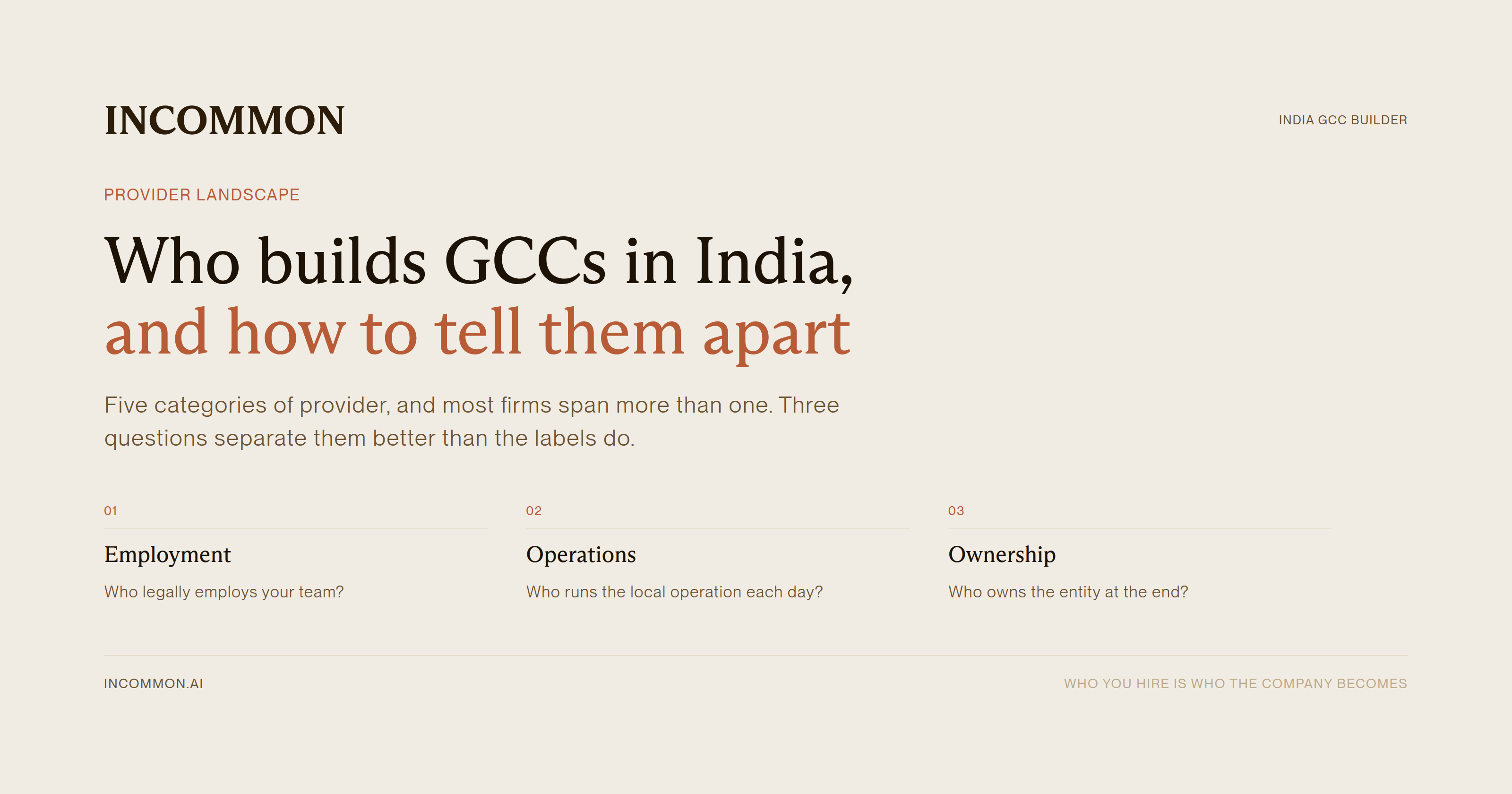
| Five kinds of companies set up GCCs in India. They are strategy and transformation advisers, specialist GCC operators, build-operate-transfer providers, employment and EOR platforms, and technology and workplace partners. Most GCC consulting firms span more than one, so the label tells you less than it seems to. Three questions separate them. Who employs your team, who runs the local operation, and who owns the entity at the end? Shortlist two providers in each relevant category and put those questions to all of them. |
|---|
Three providers can all say they set up GCCs in India and mean three different things. The difference is in who employs, who runs the local operation, and who owns what at the end.
For leaders comparing GCC consulting firms, the useful first step is to write down the intended end state before reviewing provider logos. That clarifies whether you need advisory, an operator, a transfer model, or an employment route.
nasscom counts 2,117 GCCs in FY26, inside the range projected for 2030. The category got there four years early, which is not the same as hitting a ceiling. nasscom's GCC Value Orbit analysis and its India GCC Landscape Report provide the category context.
That expansion gives buyers more plausible ways to start an India team. Provider labels have become less reliable shorthand for what is actually delivered.
Separate the decision about the team's mandate from the decision about its employment route. Then identify the party that will own the operational work when the first hire needs help.
Which companies set up GCCs in India?
Companies that set up GCCs in India fall into five groups. Strategy and transformation advisers frame the business case and governance, and specialist GCC operators turn that plan into a working team and local operation.
Build-operate-transfer providers run a center before a planned ownership handover. Employment and EOR platforms employ people and administer payroll, while technology and workplace partners supply the systems and the space. The categories overlap, but they are not interchangeable.
A GCC builders list is only useful when it separates these jobs. So limit the first shortlist to two providers in each relevant category.
Put the same operating questions to all of them. Ask who is accountable when a hire leaves in month three, and how that answer appears in the contract.
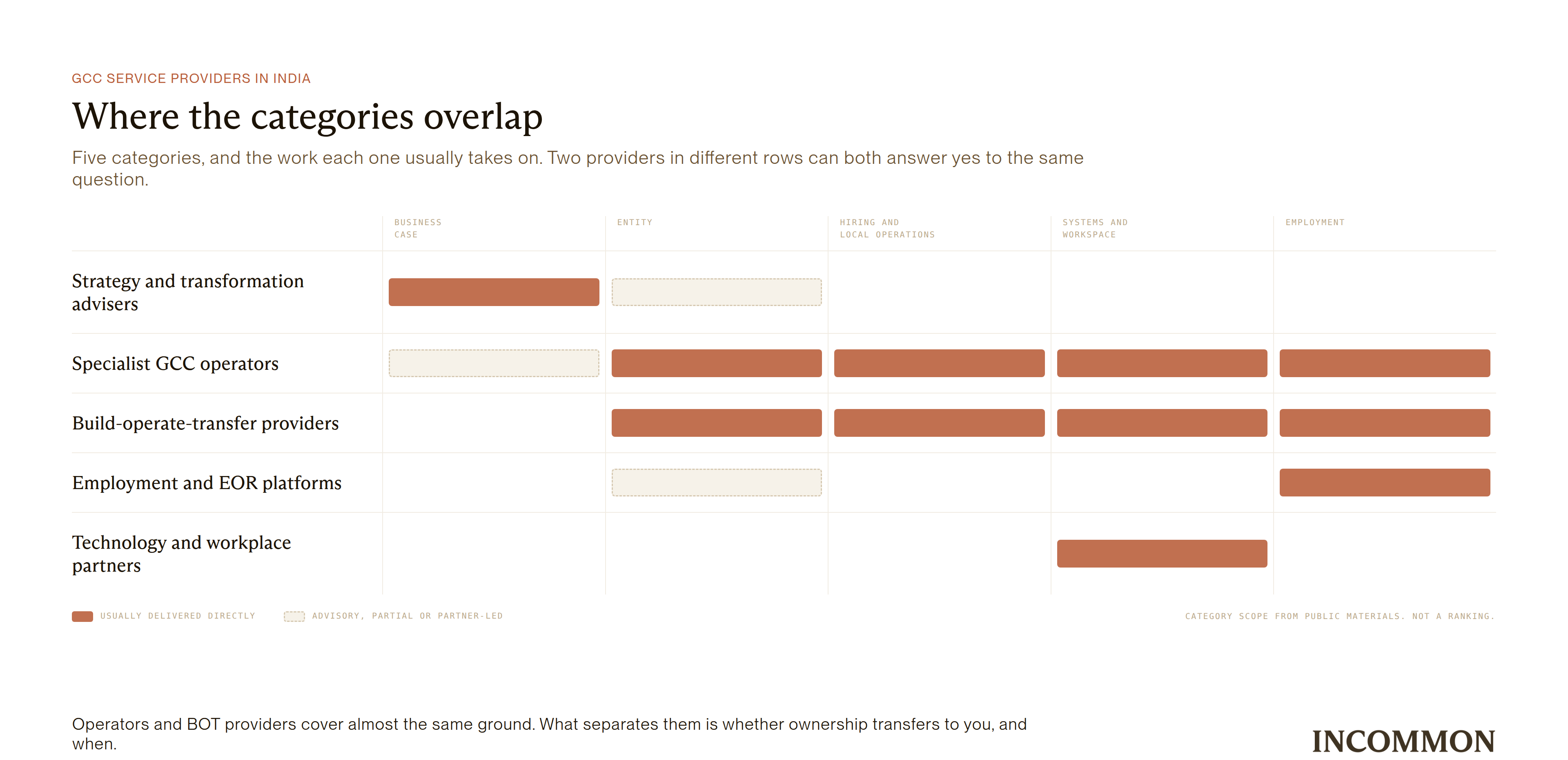
Use the table as a map. A category may be strong for the decision you face today and still be the wrong fit for the next stage. The "What to validate" column names the questions someone has to answer in writing:
| Category | Good fit when | Where it stops | What to validate |
|---|---|---|---|
| Strategy and transformation advisers | The mandate needs enterprise operating-model, risk or transformation input | At the point where recommendations become hands-on work | How advice turns into execution, and who owns the move into local operations |
| Specialist GCC operators | You are setting up a dedicated India team and want a path to long-term ownership | At the boundary between direct delivery and partner-led work | Direct delivery scope, the commercial model, and named operating owners |
| Build-operate-transfer providers | You want a structured route to eventual ownership with an operating bridge first | At handover, which is the part that needs to be written down | Transfer mechanics, operating-period terms, and what moves at handover |
| Employment and EOR platforms | Compliant employment is the immediate constraint, in India or across several countries | At employment, which is not the same as operating a center | The Indian employing entity, the support model, and conversion to your own entity |
| Technology and workplace partners | Identity, devices, access, or office space need a specialist | At the edges of the operating plan, unless someone integrates them | Who owns device delivery, access control, and issues that cross payroll, IT, and workspace |
Start with the operating model
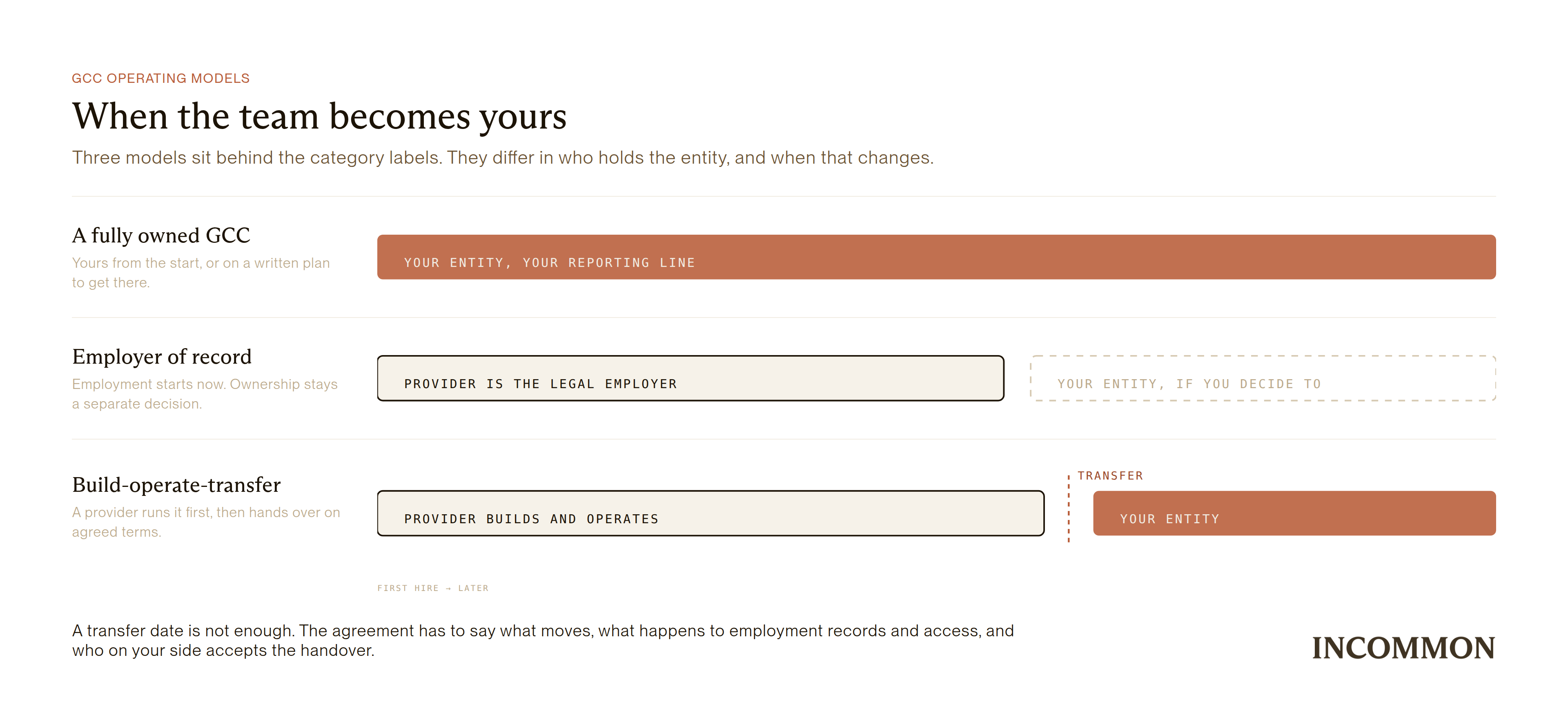
The category labels come down to three operating models.
They are a fully owned center, an employer of record arrangement, and a build-operate-transfer agreement.
The category tells you who you are buying from. The operating model tells you what you are left holding in year two, which is what reaches the board pack. So read the three models as positions on a path, and decide which one you intend to end on.
Teams move between the three. A team can start on an employer of record and convert to an owned entity later. Another runs under a transfer agreement and takes ownership on an agreed date.
A fully owned GCC
A global capability center is a dedicated team that operates as part of your company. The practical test is ownership and reporting. Your business owns the entity, or has a written plan to do so, and the team works within your priorities and management structure.
Outside help with setup or operations does not make the team outsourced when you direct the work and retain the intended ownership path. An entity plan left open when the first offer goes out gets decided in month six, by whoever is available.
What an EOR covers
An employer of record, or EOR, is the legal employer of a worker in-country while the client manages day-to-day work. It is useful when a company needs to hire before establishing its own entity, wants to test a market, or needs an employment solution.
An EOR does not answer the wider GCC questions around senior hiring, operating design, and governance. It can be one part of a GCC plan, or the right final answer when employment is the only problem to solve.
Do not assume an EOR arrangement automatically creates, or prevents, a future owned GCC.
Ask what the employment contract says, who supports employees locally, and how a move to your entity would work.
BOT is a planned transfer model
Build-operate-transfer sets up and operates a center for an agreed period. It then transfers the agreed people, assets, processes, or operation to the client.
Managed services is the other arrangement. A provider runs agreed work for the client on an ongoing basis, with no handover planned.
The contract matters more than the label. Validate the transfer triggers, how employees and assets are treated, and who carries responsibility during the operating period.
A transfer date is not enough. The agreement needs to state what happens to employment records, systems access, and the local leadership role.
It should also name the buyer-side owner who accepts the handover. A provider's model cannot substitute for that internal decision.
What each category actually does
Match the conversation to the decision in front of you. A transformation-heavy enterprise mandate calls for a different first conversation. So does a 25-person product team that needs a local leader, an employment path, and an office that does not outrun hiring.
Strategy and transformation advisers
A CFO who needs the operating case to survive board scrutiny is the reason this category exists. Advisers frame the business case, the governance model and the risk position. They help when several stakeholders need to agree on one enterprise design.
They stop where the recommendations meet the ground. Establish early which parts of the plan the same team will implement and which need another provider. Name the person inside your company who owns the handoff.
Specialist GCC operators
Operators turn an agreed plan into a working team. They recruit the India leader and the first hires. Then they arrange the entity and run payroll, workspace, and IT for the team.
InCommon is a talent-first India GCC builder for growth-stage US and European companies. We belong in this category, so test us the same way.
For Podifi the EOR route put 9 engineers live in 6 weeks. Validate the route, the operating scope, and which decisions stay with your leaders.
Every operator has a line where direct delivery ends and subcontracting begins. Few volunteer where it falls, and that line decides who makes daily decisions once the team is live.
Build-operate-transfer providers
BOT suits a company with a clear ownership goal that wants someone else to carry the first year. The provider builds and runs the center, then hands it over on agreed terms.
Everything depends on the handover, which is where these agreements are weakest. Review the schedule and trigger conditions, employee continuity, and what happens if either side terminates early.
Employment and EOR platforms
A multi-country workforce creates a case for a single employment system, and a first hire in India creates a case for a local one. Either way, the platform is the legal employer, and your managers direct the work.
These platforms stop at employment. People miss that distinction more often than any other in this market.
Check the Indian employing entity, the IP and employment terms, and who supports employees locally. Ask how non-standard issues escalate and how a move to your own entity would work.
Technology and workplace partners
These are enabling providers. They do not replace an operator, an EOR or an owned-entity plan, and they work best when the operating plan is already written.
A technology partner supports identity, device management, or access controls. A workplace adviser helps with city evaluation, site selection, and flexible office arrangements. These workstreams should connect to the operating plan rather than run in separate procurement lanes.
Someone has to own device delivery before each start date, and access control when a person leaves. Name the provider who resolves an issue crossing payroll, IT and workspace. A clear answer beats a long vendor list.
Who fits a 20 to 40 person team?
A 20-to-40-person launch is an operating problem with a short set of dependencies that must work together.
Someone needs to recruit the people who set the local bar: an India leader and the early senior hires. Those people need a compliant employment route, dependable payroll, and a workspace that fits actual demand. The parent company also needs a staged entity plan and clear decision rights.
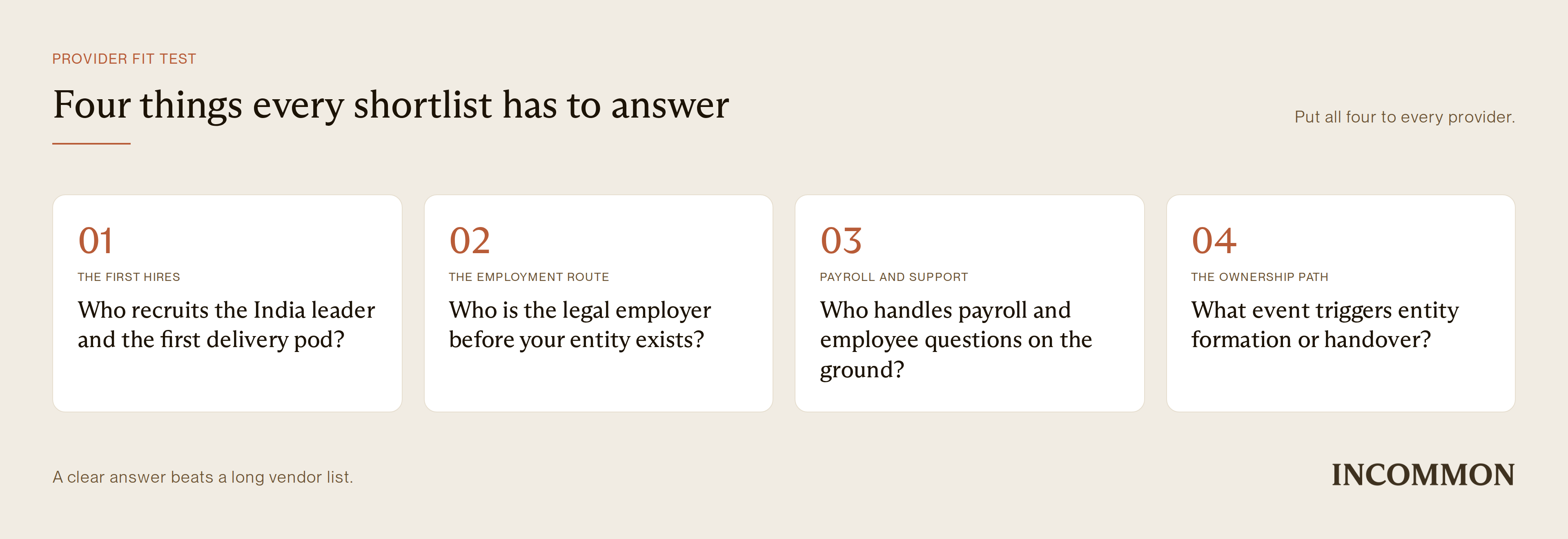
Use this fit test in provider conversations. Ask who will recruit the first leader and delivery pod, and who is the legal employer while an entity is under consideration.
Confirm how payroll and employee questions will be handled. Then ask what event triggers entity formation or handover.
For this team size, operator-led providers fit a dedicated center that needs hands-on hiring and local operations. Incommon staffed 22 people for Accompany Health in 10 weeks, with 100% retention across the build. Our India office service sets out the entity and EOR routes.
An EOR-only model is enough if employment administration is the central requirement. The right answer depends on your end state, not the size of the team.
How to evaluate GCC service providers
Start with the end state. The options are a fully owned India center, a staged move to ownership, or employment infrastructure for a distributed team. Then ask every provider to show how its approach supports that outcome.
The operating plan should show how the first leaders and team are hired and who employs them. It should also show how systems and workspace are ready and who can unblock local decisions.
Ask for references from comparable mandates rather than familiar company names, and read our case studies alongside them.
Commercial and transition detail reveals work your team may still need to coordinate. Clarify inclusions, exclusions and third-party dependencies.
In a BOT or EOR-to-entity route, document the handover. In a managed-services route, document how you can change course.
Ask for a working plan against the same early milestones: the India leader appointed, the first offers out, access and payroll ready. That request separates a credible operating plan from a service catalogue. It also tells you whether the parent company has named the people who will make decisions.
If you would like to put us through the same test, start here.
Everything you need to build and run your India GCC.
Entity, hiring, workspace and ongoing operations under one agreement.
Final thoughts
Choose the intended end state first. Then speak with one or two providers in each relevant category. Advisers strengthen the business case, operators coordinate the setup, EOR platforms make early employment possible, and BOT providers offer a defined transfer path.
Keep the shortlist small enough for real diligence. Give each provider the same ownership, hiring, and transition questions. The responses will reveal whether they are solving the same operating problem, or merely using similar language for different services.
Frequently asked questions
Who sets up GCCs in India?
GCC operators, BOT providers, consulting firms, EOR platforms, and workplace or technology partners can all support parts of a GCC launch. The right fit depends on the intended ownership model, who employs early hires, and who is accountable for the local operation.
What is the difference between a GCC consultant and a GCC operator?
A consultant typically helps with the business case, operating model, governance, or transformation agenda. A GCC operator helps turn that plan into a working local team and operation. Buyers should confirm exactly what each party will deliver and who owns execution.
Can an EOR become an owned entity?
An EOR can provide an employment route while a company prepares an owned India entity. It does not automatically create that transition. Before offers are issued, document the entity plan, employment-transfer process, and the people responsible for the handover.
What does BOT transfer actually include?
A BOT transfer should specify the agreed people, assets, processes, contracts, IP, knowledge transfer, and operating responsibilities that move to the client. The timing, conditions, employee continuity, fees, and exit rights should be written into the agreement.
How many providers should be on a GCC shortlist?
Start with up to two providers in each category that matches your operating model. Compare them against the same ownership, hiring, employment, and transition questions rather than collecting a long undifferentiated list.
Who employs the team before incorporation?
An employer of record can be the legal employer while the parent company directs day-to-day work and prepares its own entity. Confirm the employment terms, local employee support, and the process for moving employees to the entity later.
Written by
CEO, InCommon
Piyush Kedia is the CEO of InCommon, a talent infrastructure company that helps US and global enterprises set up and scale Global Capability Centers (GCCs) in India. He works with founders, CTOs, and heads of talent to design smaller, AI native GCC teams that focus on judgment work, not just headcount, so India offices stay senior, stable, and production ready. Before InCommon, Piyush built Blue Vector into a 50 person creative agency serving brands such as Trump Towers, Audi, and Porsche, giving him a front row view of how high performing teams are hired, managed, and grown.