What a GCC in India actually costs, year one and year two

See how Findigs, Accompany Health, Veramatic and Podifi built their teams.
Real teams, real results, from faster hiring to lasting retention.
Quick look:
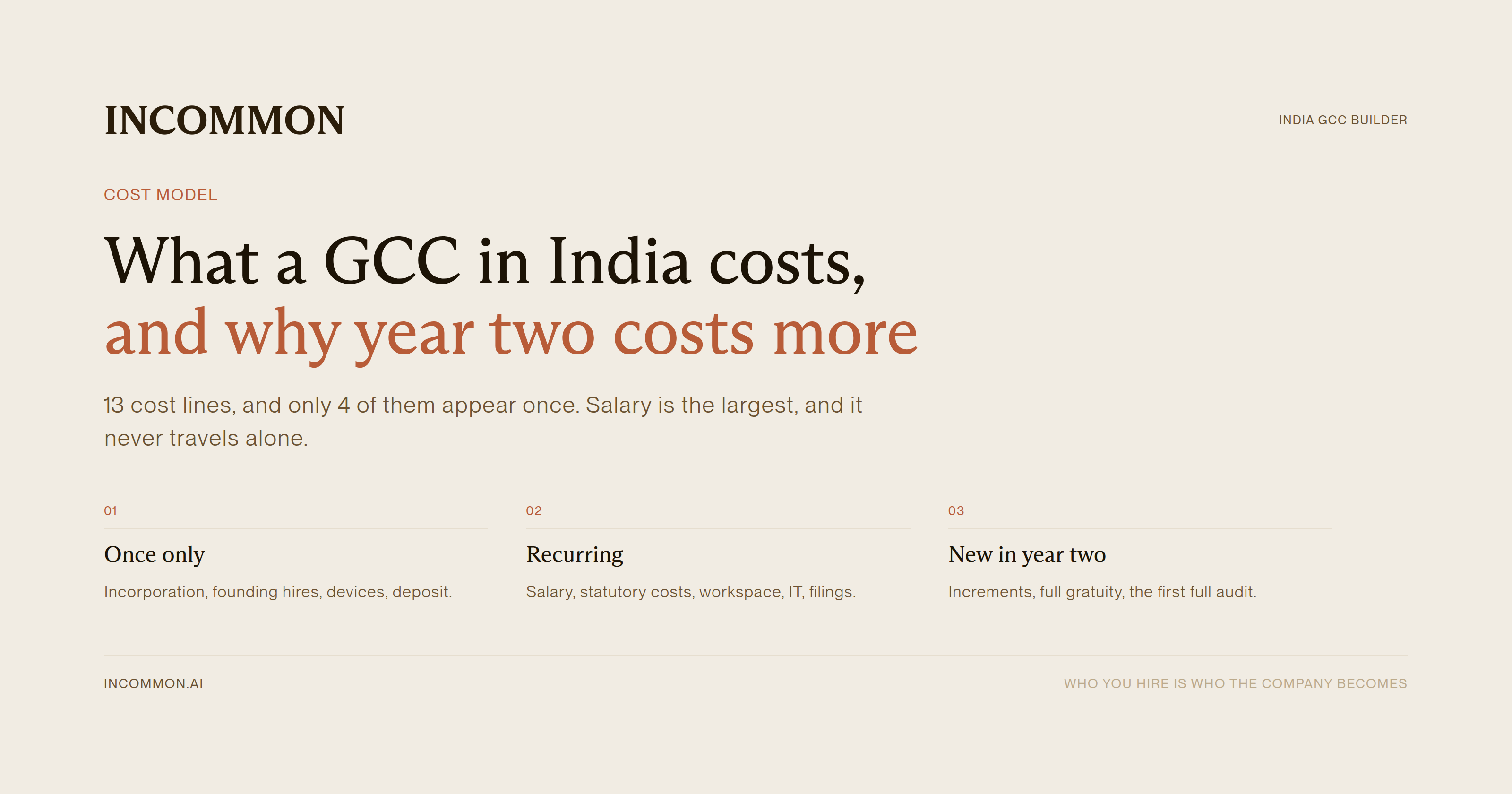
| The cost of a GCC in India is not one straightforward number. It is thirteen lines, and only four of them appear once. Salary is the largest, but it never travels alone. Provident fund, gratuity, a managed office desk, IT, statutory filings, and a transfer pricing markup all attach to it. Year one carries incorporation and founding-team recruitment, which never repeat. Year two carries increments, a full year of gratuity accrual and twelve months of everything else, which is why the second year usually costs more than the first. |
|---|
A board asks what an India engineering center costs. What comes back is usually a salary comparison, which is accurate and also close to useless.
Salary behaves predictably. Everything attached to it moves on its own schedule, including the markup a tax authority expects you to charge yourself.
This piece walks the full line list for a wholly owned subsidiary across twenty-four months.
What does a GCC in India cost?
There are a total of thirteen lines. Four of them appear once, and the rest recur from the day the first person joins.
The four one-time lines are incorporation, the workspace deposit, the devices, and the cost of hiring the founding team. The nine recurring lines run monthly or annually for as long as the center exists:
| Line | When it lands | What drives it |
|---|---|---|
| Incorporation and registrations | Once, before hiring | Structure, number of state registrations |
| Recruitment | Once per hire | Seniority, how scarce the skill is |
| Devices and IT provisioning | Once per person, then refresh | Your own security baseline |
| Workspace deposit and fit-out | Once, at move-in | Desks taken, city |
| Base salary | Monthly | Role, city, seniority |
| Provident fund | Monthly | Wage definition, statutory ceiling |
| Gratuity accrual | Monthly, paid later | Wages and length of service |
| State insurance and professional tax | Monthly | State, wage level |
| Managed office desks | Monthly | Desks taken, city, building |
| Connectivity and software | Monthly | Your existing stack |
| Payroll, accounting and compliance | Monthly | Entity count, transaction volume |
| Statutory audit and annual filings | Annual | Entity size |
| Transfer pricing study and markup | Annual | Service category, transaction value |
Two of these catch people off guard, and neither is salary.
The transfer pricing markup is a cost that most first-time models omit. Gratuity starts accruing in an employee's first month, though nobody collects it for five years.
A number you can defend at board level has all thirteen in it. A number with four is a salary comparison wearing a suit.
What you pay before anyone starts
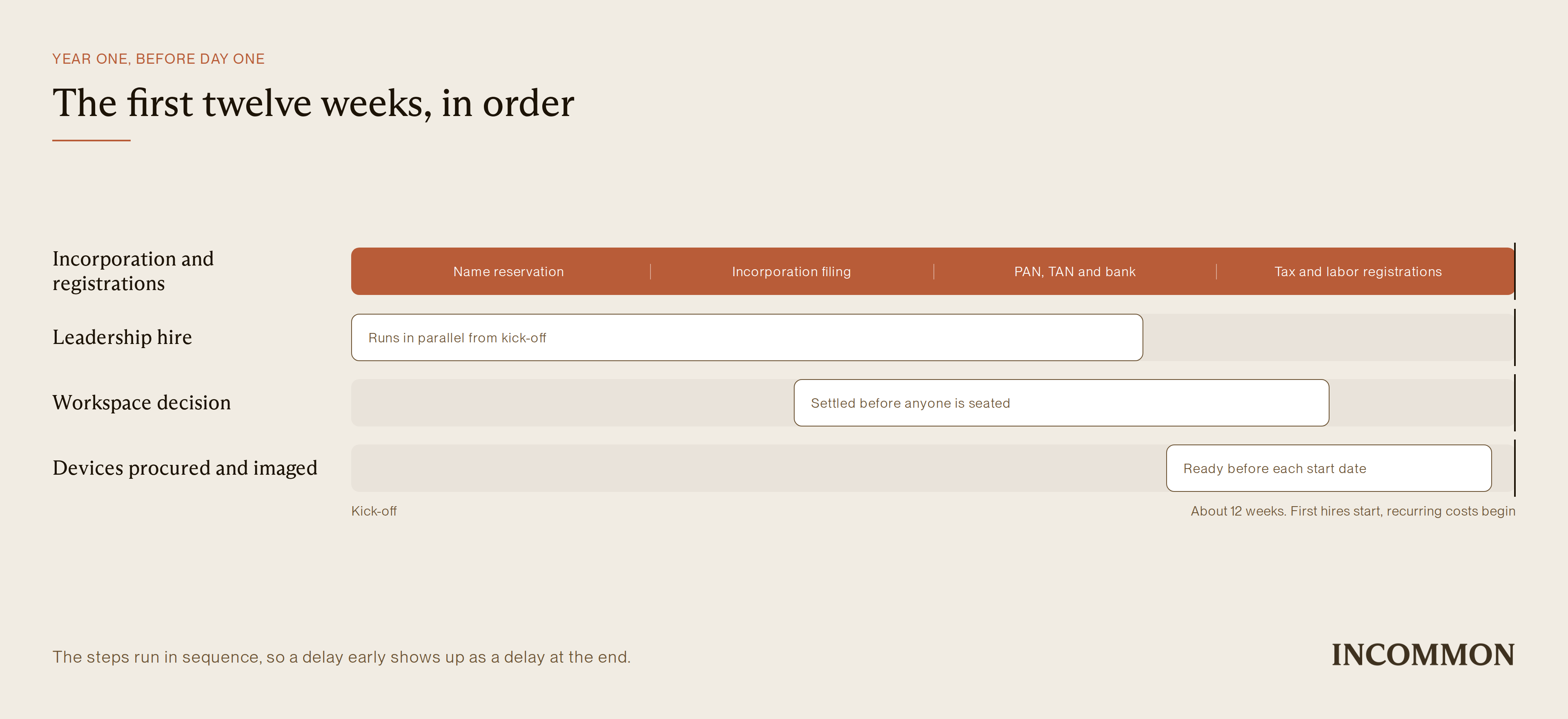
Incorporation of a wholly owned subsidiary runs about 12 weeks from kick-off. That window is itself a cost. The leadership hire usually runs in parallel, and the office decision has to be made before anyone can be seated.
The registrations surprise US finance teams more than the filing does. A private limited company needs name reservation, the incorporation filing, then PAN and TAN. After that comes a funded bank account and four separate registrations.
Those four are goods and services tax, professional tax, provident fund, and state insurance. Foreign investment gets reported to the central bank on allotment. The legal and compliance requirements for setting up in India are not individually expensive.
They are sequential, which is the part that costs money. A missed step in week 3 shows up as a delay in week 9, and the delay is paid for in salaries already committed.
Capitalization is the line nobody benchmarks. You are funding an entity that pays salaries before it invoices anything. The opening balance has to cover several months of operating costs, plus the deposit on space.
Underfund it, and you are into a second capital injection and a second round of filings.
Devices are a one-time line per person, and then a refresh cycle. What makes them awkward in year one is timing. Laptops have to be procured and imaged against your security baseline before a start date, which means spending on people who have not joined yet.
Then there is the cost of hiring itself. It is charged once per person and scales with how hard that person is to find. Your most important hire is therefore your most expensive to source.
The managing director is the clearest case. That person hires the first ten people, and everyone after them is measured against the standard those ten set. Get the appointment wrong and the cost surfaces in year two.
Our view, and you are free to disagree with it. If the leadership hire slips, stop the clock rather than filling seats beneath an empty chair.
What the law adds to salary
Indian statutory contributions are modest against US or European loading. The rules also changed only a few days before this was written.
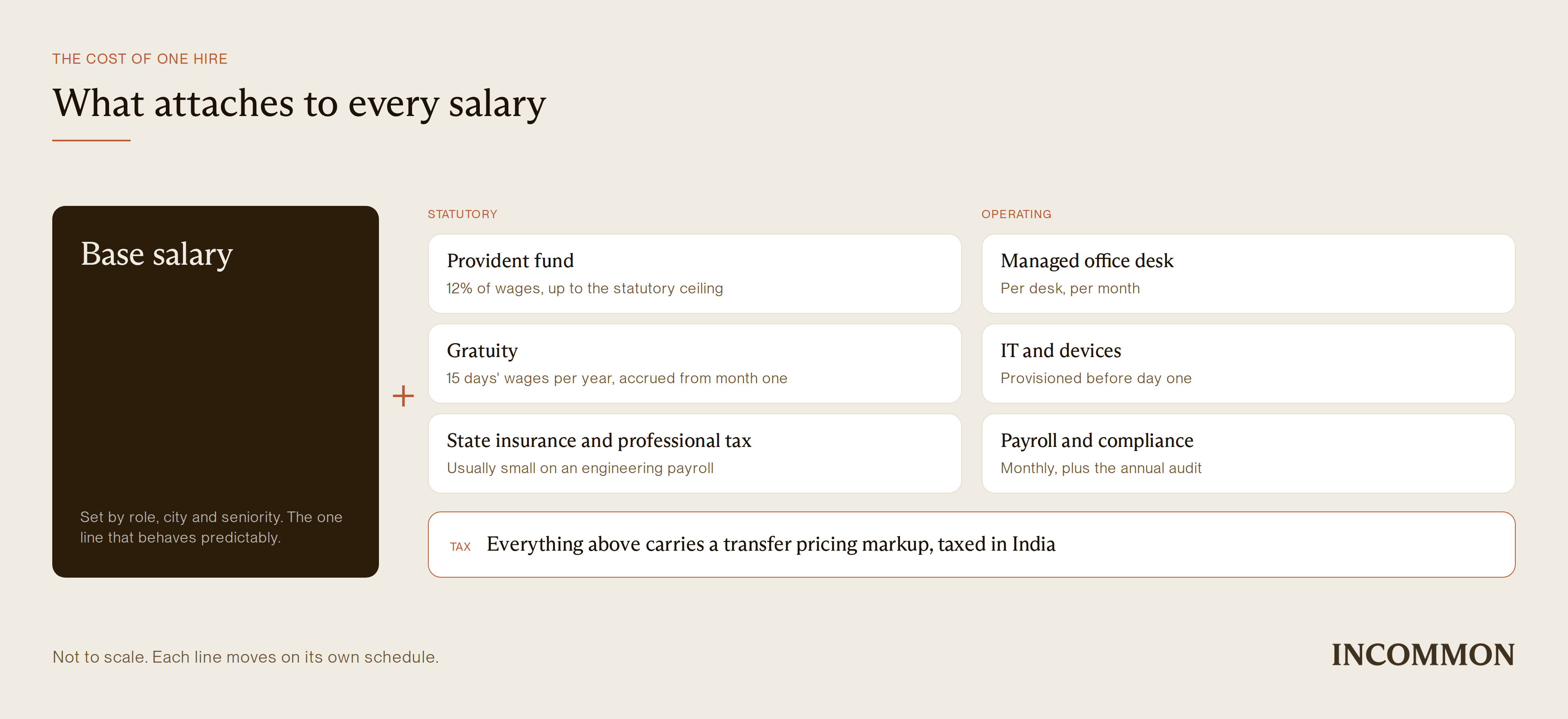
Provident fund is the main one. The employer contributes 12% of wages, and a statutory ceiling caps the wage figure that percentage applies to. On 16th September 2026, the Union Cabinet approved raising that ceiling from Rs 15,000 to Rs 25,000 per month.
It is the first revision since September 2014, and the Ministry of Labour and Employment notified it with effect from 17 September. More than 51 lakh additional employees come into mandatory coverage.
For an engineering team, the direct effect is contained. Contributions above the ceiling are a matter of company policy, so most of a senior salary escapes the statutory calculation.
The floor has still moved by two-thirds. Any model built on the old ceiling is now wrong.
Gratuity behaves differently and matters more across two years. An employee earns 15 days of wages for each completed year of service, payable once they pass five years.
Nobody pays gratuity out in year one or year two. It accrues from the first month, so an auditor expects to see the provision on the balance sheet from the start. Finance teams who treat it as a year-five problem restate their numbers later.
The wage definition connects these two lines. Under the labour codes, wages must make up at least half of total compensation when provident fund and gratuity are calculated. Indian salary structures have historically run a low basic with allowances stacked on top.
Companies restructuring to meet that floor are raising the base both contributions are calculated from. The effect is small per person and compounds across a team.
State insurance applies below a wage threshold most engineers clear, so it rarely bites on a technical team. Professional tax is a small monthly deduction that varies by state.
Where the team actually works
There are two ways this happens, and only one of them belongs in a first-year model.
A leased office is capital expenditure with a three to five year commitment. It also brings a fit-out project and a facilities function to run afterward. A managed office is operating expenditure scaled per desk, with no stated commitment, available in every major city.
At InCommon we place client teams in managed space through WeWork and Indiqube, in whichever city the hiring plan points to. The desks flex with the team, so a pod that grows from 8 to 14 does not trigger a property decision.
The argument for managed space usually gets framed as flexibility. The stronger argument is the hiring one. Candidates judge an employer by the office they walk into, so premium space does the recruiting work you would otherwise pay a recruiter to do.
That turns a facilities line into a retention line. It is a better place for the money to be.
IT is provisioned before anyone starts, and it is more than laptops. Endpoint management, VPN and network access, single sign-on and identity, an asset register, backup and recovery. Your own security baseline gets applied locally.
Assets are tracked and either returned or wiped on the day someone leaves. That last detail is cheap to set up in month 1 and expensive to retrofit in month 20.
City choice moves this line and the salary line together, in the same direction. Work through the main capability center hubs before committing to space you cannot exit.
The trap is treating the cheapest city as the answer. A lower salary band paired with a thinner senior pool costs more across two years. The roles left open are the ones holding the team back.
Choose for the depth of the bench at the seniority you need.
What year two looks like
Year two costs more than year one for most teams.
Incorporation, founding-team recruitment, deposits, and initial devices all drop out.
Four lines disappear. What replaces them is twelve months of everything, plus three lines that only appear once the center has been running.
The first is increments. Aon projects salary increases of 9.3% for global capability centers in India in 2026, against 9.2% actually delivered in 2025. The figure is drawn from more than 1,400 organizations across 45 industries.
Model India payroll flat into year two, and you are roughly 9% short before you start.
Next comes gratuity provision. It now covers two years of service for the founding team, where year one carried a partial accrual only.
Then the second wave of hiring arrives. A delivery pod is 8 people, senior-led and cross-functional, and three or four pods make a center of 30 to 35.
Most teams add their second pod in year two. That brings back the recruitment line they thought they had retired.
Year two also brings the first full compliance cycle. A statutory audit, the annual return, the tax filing, and the transfer pricing study land inside the same few months.
A company incorporated mid-year gets a short first period and a light first close. That makes the second one look expensive when it is only complete.
Monthly accounting, payroll, and labor law compliance run steadily through both years. That line is often left out of budgets altogether. Here is how the costs compare across the two years:
| Year one | Year two | |
|---|---|---|
| Incorporation and registrations | Full cost | Gone |
| Recruitment | Founding team | Second pod only |
| Devices | Per person, upfront | New joiners and refresh |
| Salary | Part year, ramping | Full year plus increments |
| Gratuity provision | Partial year | Full year, two years accrued |
| Workspace | Deposit plus part year | Full year, more desks |
| Compliance and filings | Partial | Full cycle plus statutory audit |
| Transfer pricing | Study only | Study plus markup on a full year |
Budget year two at a clear premium to year one, then treat any saving as upside. Boards that model in reverse spend the second year explaining a variance.
The markup nobody budgets for
Your Indian subsidiary is a related party. It cannot provide services to its parent at cost.
Indian transfer pricing rules expect the entity to charge the parent its operating cost plus a margin. That margin is taxable income in India. The safe harbor route now consolidates four service categories into one, called Information Technology Services.
Software development, IT-enabled services, knowledge process outsourcing and contract research all fall inside it. The margin is 15.5% of operating expenses, applicable from tax year 2026-27. The previous structure ran separate margins between 17% and 24%.
Take the safe harbor and the tax authority accepts your declared price without a detailed audit. Decline it and you are into benchmarking studies and the possibility of a dispute. Either way, the margin is not optional.
Your India cost is operating cost, plus the markup, plus Indian corporate tax on that markup. A model that stops at operating cost understates the total by just enough to matter in front of a board.
An annual transfer pricing study is a recurring line too, filed with the return. A team already running payroll and compliance for the entity absorbs it. A first-time finance team discovers it in month 14.
What the numbers leave out
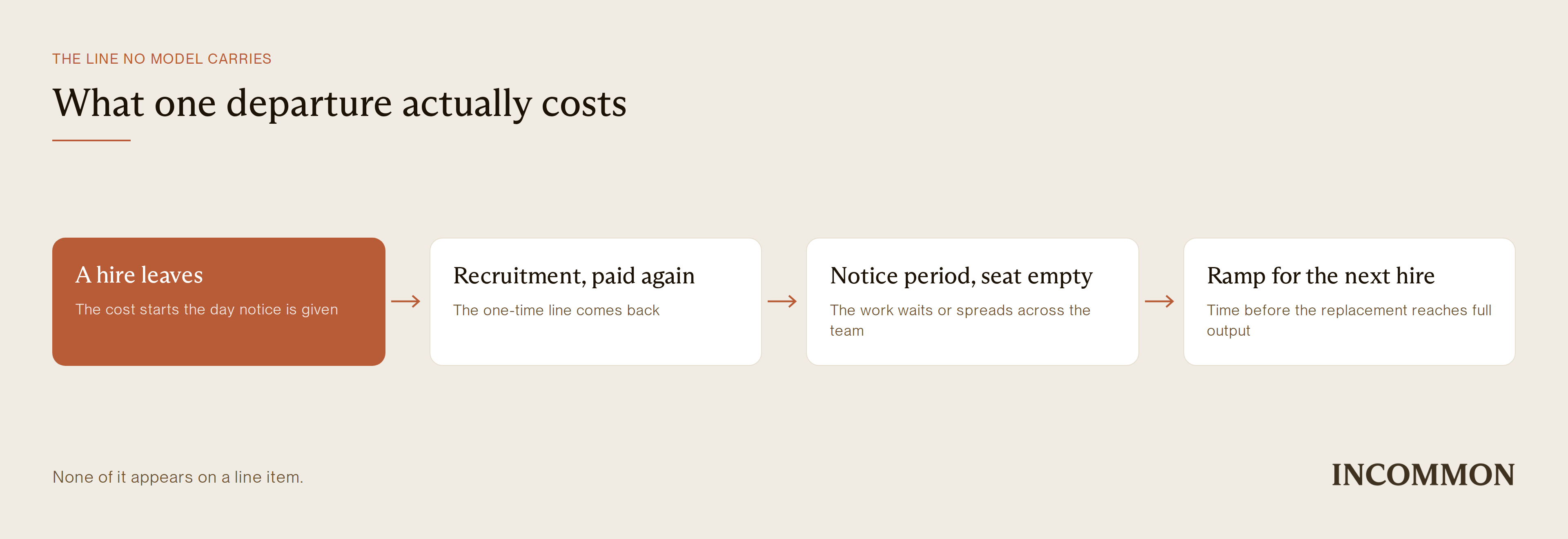
One of the highest costs in an India center is a hire who leaves.
Replace one engineer, and you pay the recruitment line again, carry an empty seat through notice, and potentially absorb another ramp-up. A cost model rarely captures that. The P&L does.
That is why we track who stays, not just how fast seats fill. The published numbers work better as cost data than as marketing.
Accompany Health reached 22 people and a live team in 10 weeks, with 100% retention across the build. Veramatic went live with 21 people in four weeks and held 92% retention. The full set of results is worth reviewing before you model your own ramp.
Speed changes year one too. Podifi went live with 9 engineers in 6 weeks through an employer of record, without waiting for incorporation.
When you hire first and set up the entity in parallel, salary starts sooner while incorporation runs in the background. That changes the year-one cost curve and the cash position at month 6.
That does not make the model wrong. It means the model is missing the operating choices that shape cost in practice. The questions worth settling before committing are mostly operating questions, and they end up determining cost anyway.
For board context, India now hosts 2,117 global capability centers, against the 2,100 to 2,200 projected for 2030 in the Zinnov-Nasscom GCC Value Orbit report. The category reached its projected range four years early.
Buyers are now asking the right questions.
They no longer ask whether the model works. They ask what a good one costs to run.
If you are building that budget now, we can help you plan it.
Everything you need to build and run your India GCC.
Entity, hiring, workspace and ongoing operations under one agreement.
Final thoughts
Most India cost models break in the same two places: they stop at salary, and they stop at month 12.
Fix the first by listing all thirteen lines, including the annual and deferred ones that tend to surface later under audit. Fix the second by modeling twenty-four months from the outset.
Year one is the flattering year, and no board should commit on a five-month picture.
The work that follows the model is harder than the model. It is whether the difference between a captive and a capability center matters to your mandate. It is which city, and who sets the standard for everyone hired after them.
Those decisions move the cost more than any line item does. For companies operating under a value creation plan, they also move the timeline the plan depends on.
Get the leadership hires right, and most of the cost questions answer themselves.
Frequently asked questions
What does it cost to set up a GCC in India?
Setup covers four one-time lines: incorporation and statutory registrations, recruitment for the founding team, devices and IT provisioning, and a workspace deposit with any fit-out contribution. Incorporation of a wholly owned subsidiary takes about 12 weeks. The recurring cost starts the day the first person joins, driven by salary, statutory contributions, managed office desks and ongoing compliance.
Our board wants the total cost of an India engineering center in year one and year two. What goes into that?
Year one carries the four one-time lines plus a partial year of salary, provident fund, gratuity provision, workspace, IT and compliance. Year two drops the one-time lines and adds three things: salary increments, a second year of gratuity accrual, and usually a second delivery pod. It also carries twelve months of every recurring line, where year one carried five or six, which is why year two typically costs more.
Is provident fund a large cost for an engineering team?
The employer contributes 12 percent of wages, calculated against a statutory wage ceiling, not full salary. That ceiling rose from Rs 15,000 to Rs 25,000 per month with effect from 17 September 2026. Contributions above the ceiling are a matter of company policy, so the statutory floor on a senior engineer is contained.
Do we have to pay gratuity in the first two years?
No. Gratuity vests after five years of continuous service, at 15 days of wages per completed year. It accrues from the first month, so the provision appears on the balance sheet from year one even though no payment is made.
What is a transfer pricing markup and why does it increase our cost?
An Indian subsidiary providing services to its overseas parent cannot charge at cost. It charges operating cost plus a margin, and that margin is taxable in India. The safe harbor margin for IT services is 15.5 percent of operating expenses from tax year 2026-27.
Should we lease an office or use managed space?
Managed space is operating expenditure per desk with no long commitment, which suits a team still finding its size. A lease is capital expenditure over three to five years, plus a fit-out project and an ongoing facilities function. Most first-time centers have no reason to sign a lease in year one.
Written by
CEO, InCommon
Piyush Kedia is the CEO of InCommon, a talent infrastructure company that helps US and global enterprises set up and scale Global Capability Centers (GCCs) in India. He works with founders, CTOs, and heads of talent to design smaller, AI native GCC teams that focus on judgment work, not just headcount, so India offices stay senior, stable, and production ready. Before InCommon, Piyush built Blue Vector into a 50 person creative agency serving brands such as Trump Towers, Audi, and Porsche, giving him a front row view of how high performing teams are hired, managed, and grown.