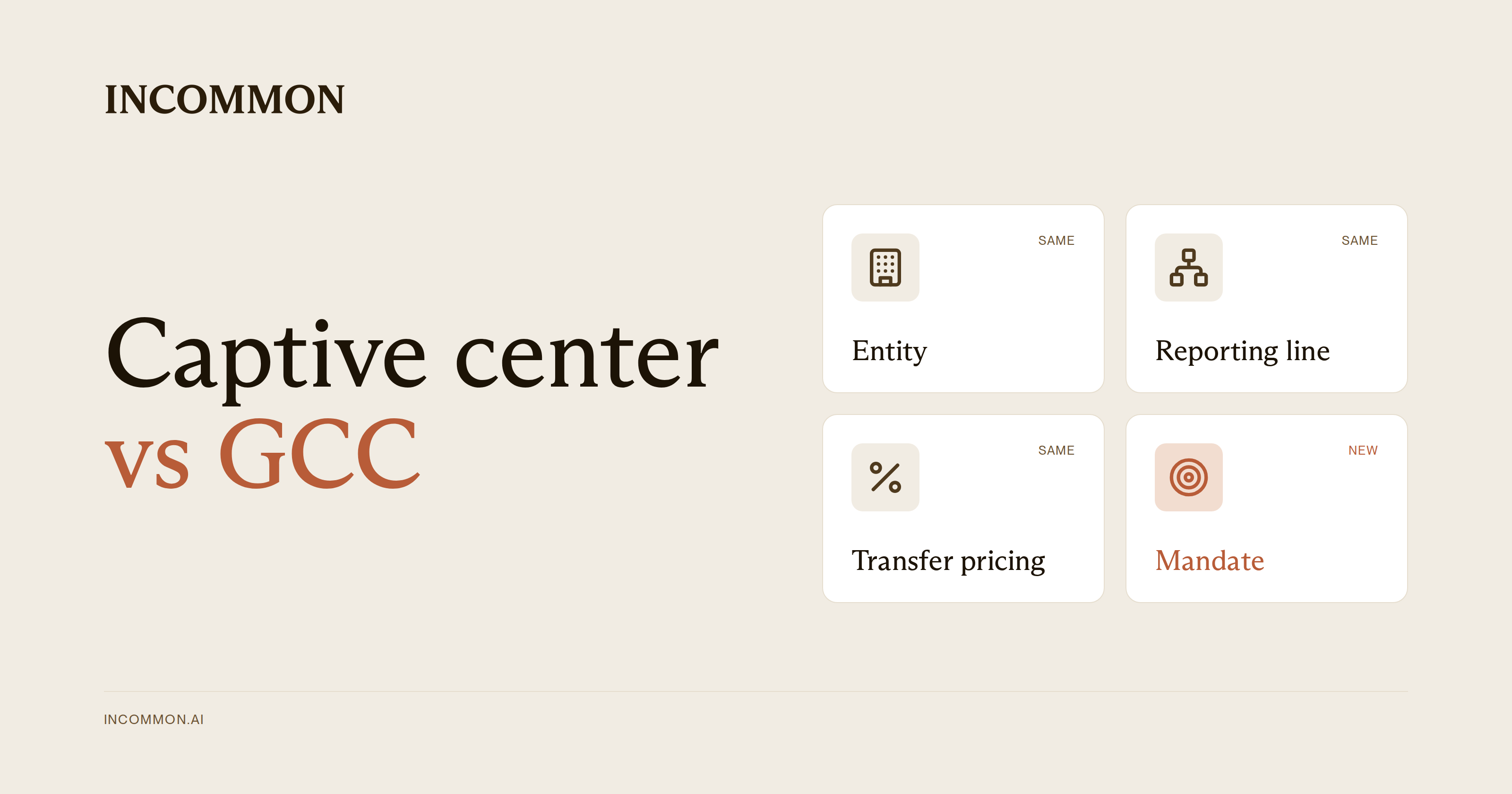
Captive center vs GCC, why the term changed and what still applies

| Quick look: A captive center is an operation a company owns in another country, usually India, staffed by its own employees and doing only its own work. A global capability center is the same ownership model under a newer name. The term changed because the work changed, from defined back-office processes to product engineering, data, and research. Captive still appears in tax documents and on first sales calls. The entity, the transfer pricing, and the reporting line work exactly as they did. |
|---|
If you search for a captive center, you may find pages describing what sounds like a GCC. In law, it is the same thing. The name moved on as the work inside these centers changed, while the legal structure, the tax position, and the reporting line stayed the same.
This guide is for founders, CFOs and operating partners who meet both terms and need to know what the old model still requires.
What is a captive center?
Picture an operation in India that a company owns outright, staffs with its own employees, and gives only its own work. Before a new name arrived, the industry called that a captive center. The word describes the customer relationship, because the center has one customer, its parent, and never sells to anyone else.
The vehicle is usually a private limited company, wholly owned by the parent, which bills the parent its costs plus a margin.
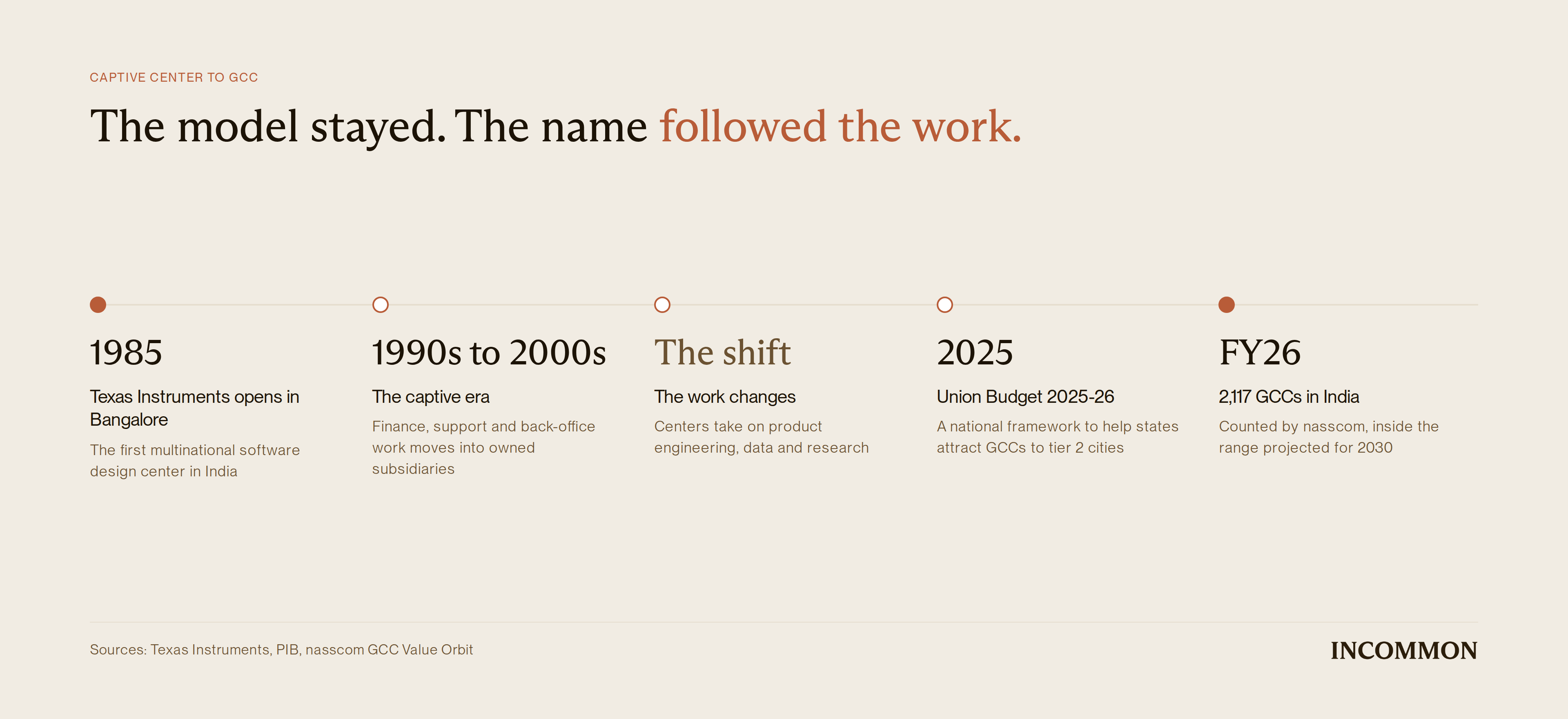
Texas Instruments opened in Bangalore in 1985, the first multinational to set up a software design center in India. Large enterprises followed through the 1990s and 2000s, moving finance, support and back-office operations into Indian subsidiaries of their own.
Why the name changed
The captive label belongs to an era when India centers ran defined processes at lower cost. Payroll, claims handling, IT support, and testing all moved on that brief, and success meant a lower cost per seat.
Then the work advanced. Centers took on product engineering, data platforms, and research that parent companies meant to keep in-house. A name built around one customer and a cost target gradually stopped working.
Global capability center names the mandate. nasscom's GCC Value Orbit counts 2,117 GCCs in FY26, inside the 2,100 to 2,200 projected for 2030, four years early. The Union Budget 2025-26 promised a national framework to help states attract capability centers to emerging tier 2 cities. No statute renamed anything.
Is the term captive still used?
Yes, mostly in tax. Indian transfer pricing still classifies these entities as captive service providers. Tax tribunal rulings use the phrase for subsidiaries that carry no market risk and are paid on a cost-plus basis. There, the word describes a functional profile, not a reputation.
Older enterprise centers still use it, and so do some buyers on a first call. In public policy and marketing, it has mostly gone, because it reads like a term from the outsourcing years.
Use GCC with your board and with candidates. Keep captive for your tax adviser, where it still means something exact.
What still applies under the new name
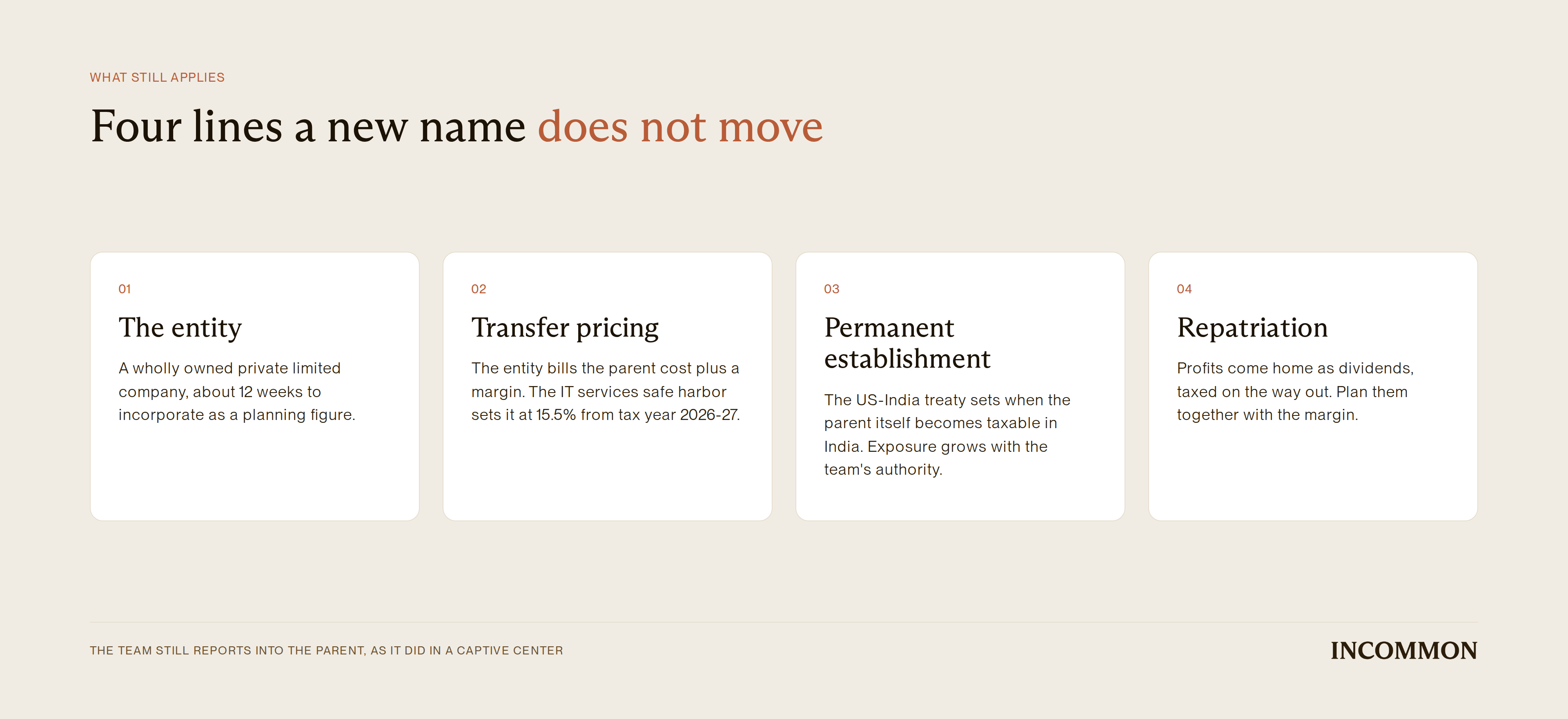
A CFO's checklist from the captive years works line for line. Its four items are the entity, transfer pricing, permanent establishment, and repatriation, and a change of name does not change things.
A wholly owned private limited company remains the standard vehicle, and incorporation takes about 12 weeks as a planning figure. The legal and compliance requirements are the same whatever the center is called.
Your Indian entity is a related party, so it bills the parent its operating cost plus a margin, and India taxes that margin. From tax year 2026-27, the IT services safe harbor sets that margin at 15.5% of operating cost. It belongs in your year-one and year-two costs.
The US-India tax treaty sets out when the parent itself becomes taxable in India, which advisers call a permanent establishment. One trigger is people there who habitually conclude contracts on the parent's behalf. That exposure grows with the Indian team's authority. Profits come home as dividends, taxed on the way out, so plan the margin and the repatriation together.
Cost-plus pricing assumes the parent owns the product and carries the risk. A center that starts making product decisions fits that profile less well, so tell your transfer pricing adviser when the brief changes.
The reporting line did not move either. A captive's team reported into the parent, and a GCC's team does too. That separates both from an offshore development center, where a vendor employs the team.
Some companies reach ownership through the build-operate-transfer model. Others start with an employer of record first.
What actually changed is the mandate
A captive was asked to run defined processes for less. A GCC is asked to own part of the product. The table compares the two briefs, from legal structure to how success is measured:
| Captive center | Global capability center | |
|---|---|---|
| Legal structure | Wholly owned subsidiary | Wholly owned subsidiary |
| Who the team reports to | The parent | The parent |
| Transfer pricing | Cost plus a margin | Cost plus a margin |
| Typical work | Defined processes, support, testing | Product engineering, data, research |
| India leadership | Runs operations to a cost target | Owns outcomes and wins new work |
| Success measured by | Cost per seat | What the team ships, and who stays |
Candidates only ask about the three rows that differ. Engineers choose a center for the work and the leader, and they stay for the same reasons.
A center left on maintenance work declines, and people leave a center with nothing interesting to do. Winning better work from head office is part of the managing director's job for that reason. That pattern runs through why capability centers fail.
A GCC run that runs on a captive brief is a captive center with a new sign on the door.
At InCommon we hire senior-led product teams to the same hiring standard you hold at home. For Accompany Health, the result was 22 people in total, 10 weeks to a live team, 100% retention across the build. For Veramatic, it was 21 people live in four weeks, 92% retention across the build.
When the captive brief is right
For a defined process run at scale, the captive brief still works, because cost per seat is the target there. A large enterprise moving finance operations to India has good reason to run that center on cost and service levels.
Scale changes the partner, too. A company planning several thousand seats, with its own team to run them, needs something different from one hiring its first thirty. The firms that set up GCCs differ on exactly that.
For a growth-stage company, the math runs the other way. Our repeatable unit is a pod of 8 people, senior-led and cross-functional, and 3 or 4 pods make a center of 30 to 35. A center that size has no room for a team that only maintains, because every hire carries part of the roadmap.
Write the mandate before you choose the city. The work decides who will join.
Once the mandate is clear, this is how we help you build the team around it.
Everything you need to build and run your India GCC.
Entity, hiring, workspace and ongoing operations under one agreement.
Final thoughts
Call it a GCC, and run it with the captive checklist. The entity, the margin, the treaty exposure, and the dividend route outlast any label, so put all four in the first board paper.
The brief is the part you choose. Write it for the product, and the name will take care of itself.
Frequently asked questions
What does captive centre mean?
A captive centre, spelled captive center in American English, is an operation a company owns in another country and staffs with its own employees to do only its own work. The word refers to the customer relationship, because the center has one customer, its parent. In India it is usually a wholly owned private limited company.
What is the difference between a captive center and a GCC?
In law there is none. Both are wholly owned subsidiaries whose teams report into the parent, and both bill the parent cost plus a margin. The difference is the mandate. A captive center was set up to run defined processes at lower cost, while a global capability center is asked to own product engineering, data or research work.
Is the term captive center still used?
Mostly in tax. Indian transfer pricing still classifies these entities as captive service providers, and tax tribunal rulings use the phrase for subsidiaries paid on a cost plus basis. Some older enterprise centers and some buyers still use it too, but new centers describe themselves as GCCs.
Does a GCC still need a transfer pricing markup?
Yes. The Indian entity is a related party, so it bills the parent its operating cost plus a margin, and India taxes that margin. From tax year 2026-27, the safe harbor margin for IT services is 15.5% of operating cost.
How is a captive center different from an offshore development center?
The difference is ownership. A captive center or GCC is your own subsidiary, and the team reports to your leadership. In an offshore development center, a vendor employs the team and manages it for you.
When does the captive model still make sense?
For a defined process run at scale, such as finance operations for a large enterprise, cost per seat is an honest target and the captive brief still fits. A growth-stage company with a center of 30 to 35 people usually needs every hire working on the product.
Written by
CEO, InCommon
Piyush Kedia is the CEO of InCommon, a talent infrastructure company that helps US and global enterprises set up and scale Global Capability Centers (GCCs) in India. He works with founders, CTOs, and heads of talent to design smaller, AI native GCC teams that focus on judgment work, not just headcount, so India offices stay senior, stable, and production ready. Before InCommon, Piyush built Blue Vector into a 50 person creative agency serving brands such as Trump Towers, Audi, and Porsche, giving him a front row view of how high performing teams are hired, managed, and grown.