Why companies set up a GCC, 7 reasons that hold up and 2 that do not

See how Findigs, Accompany Health, Veramatic and Podifi built their teams.
Real teams, real results, from faster hiring to lasting retention.
Quick look:
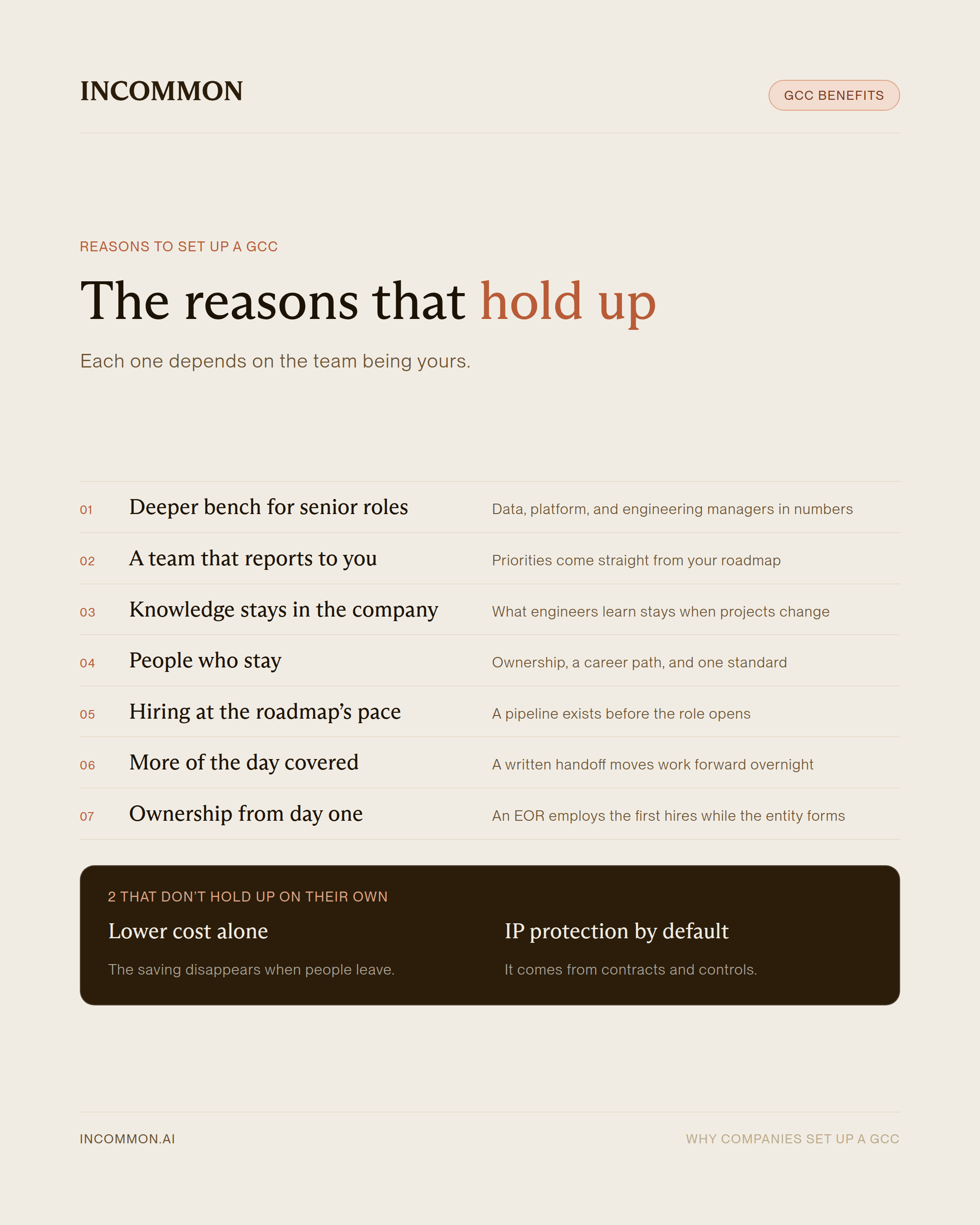
| The GCC benefits that hold up are the ones that come from owning the team. A global capability center gives you a deeper bench for senior roles, a team that reports to your leadership, knowledge that stays in the company, and hiring at the pace of your roadmap. Two common reasons do not hold up on their own. Lower cost alone rarely justifies the effort, and a GCC does not protect your IP unless the contracts and controls do. |
|---|
Companies set up a GCC to own an engineering team in another country rather than renting one. The real benefits follow from that ownership, because the team reports to you, keeps what it learns, and grows on your plan.
Some of the reasons people give are weaker than they sound, and two of them fail on their own.
This guide is for founders, CTOs, and CFOs at growth-stage companies weighing a global capability center in India. It covers the reasons that hold up, the two that do not, and when a GCC is the wrong choice. If you are not familiar with the term, our guide to what a GCC is covers the basics.
The benefits of a global capability center
Each of the seven reasons below depends on the team being yours. A vendor team in the same city delivers few of them, which is why the GCC versus outsourcing decision comes before any of the rest.
1. A deeper pool for senior roles
Hiring 10 senior engineers in one US city is slow, because every growing company is chasing the same people. India has enough experienced engineers that a team of that size does not exhaust the market in one city.
The depth matters most for senior and specialist roles. Data engineers, platform engineers, and engineering managers are hard to hire in numbers anywhere, and India gives you more of them to choose from. Our network includes more than 700 people with experience building and running India teams.
The pool is also spread across cities. Bengaluru, Hyderabad, and Pune each have deep engineering markets of their own, so a team is not limited to one city's supply.
2. A team that reports to you
In a GCC, the engineers report into your engineering leadership. They follow your standards, use your tools, and take priorities straight from your roadmap.
That changes how the work feels day to day. Feedback reaches the people doing the work directly instead of passing through a vendor's account manager first. Decisions about who to hire, promote, or move to a new project stay with you.
The team also joins the same reviews, planning, and engineering culture as everyone else. It does not grow into a separate company with its own habits.
3. Knowledge that stays in the company
Every engineer who works on your product for 2 years knows things that are not written down anywhere. In a vendor arrangement, that knowledge leaves when the contract ends, or the vendor reassigns the person.
A GCC keeps it inside the company. People move between projects, take on harder work, and train the next hires. So the value of the team grows the longer it runs.
4. People who stay, when it is run well
Retention is a benefit you earn, not one that comes with the model. Engineers stay when they own impactful work, see a career path, and work under the same standards as the home office.
When those conditions are in place, the numbers show it. With InCommon, Veramatic reached 21 people live in four weeks, with 92% retention across the build. Our guide to managing an India team covers the habits that keep people.
5. Hiring at the pace of the roadmap
Once the hiring engine is running, a GCC can add people as fast as the roadmap needs them. Across our published builds, the time to a live team has ranged from 4 weeks to 4 months.
Speed comes from a pipeline that exists before the role opens. InCommon does the slow part in advance, so by the time a role is live, the shortlist can take days rather than weeks. Each hire also makes the next one easier, because people already on the team start introducing others they trust.
6. More of the working day covered
An India team works while much of the US is asleep. When the day ends with a clear handoff, work moves forward overnight.
The handoff only works when it is written down. A short note at the end of each day, covering what shipped, what is blocked, and what needs a decision, keeps both offices moving.
For European companies, the benefit is a little different. India shares about half a working day with London, which makes live collaboration much easier than it is from the US. Our guide to India versus nearshore teams sets out the time zones city by city.
7. A route to ownership from day one
You do not have to wait for an entity before the team starts. An employer of record can employ the first engineers while incorporation runs, and the team moves onto your own entity once it exists.
Podifi took this route and had 9 engineers live in 6 weeks, employed through an employer of record with no wait for incorporation. The EOR versus entity comparison explains when each route fits.
Two reasons to set up a GCC that don't hold up
Both of these come up early in most GCC conversations. Each has some truth in it, but neither can justify a GCC setup on its own.
Lower cost on its own
Salaries in India are lower than in the US, and that difference is noticeable. However, it is still a weak reason to set up a GCC, because the saving disappears quickly when people leave.
A hire who leaves in month four is the expensive outcome, because the search, the notice period, and the ramp all start again. The full cost also includes statutory contributions, workspace, devices, and management time. Our breakdown of what an India employee costs shows the lines most budgets miss.
A fair comparison sets the full annual cost of an India engineer against the full cost of the same role at home. Run it over at least 2 years, with one early leaver built in.
Treat cost as a result of running the team well. If it is the only reason on the list, the GCC is likely to disappoint.
IP protection by default
Owning the team does not protect your IP by itself. Protection comes from employment agreements that assign code and inventions to your company, and from security controls on every device and account.
A GCC makes those controls easier to apply, because the people are yours and the systems are yours. However, It does not apply them for you. Agree the IP clause with counsel before the first offer goes out.
India's data protection law also applies to any personal data the team handles. Our GCC compliance guide covers what the DPDP Act asks of an India entity.
Test the reasons against your plan
Before a GCC goes into the plan, run your reasons through four questions:
- Will the team still be needed in 3 years?
- Do you need more than a handful of engineers in the next 12 months?
- Is there someone at home who will own the India team's success?
- Would the plan still make sense if salaries were the same as at home?
If the answer to the last question is no, cost is carrying the case on its own. The plan needs a stronger reason before it goes any further.
If your reasons hold up, this is what building a GCC with us looks like.
Everything you need to build and run your India GCC.
Entity, hiring, workspace and ongoing operations under one agreement.
If you are an early-stage startup
The reasons above apply at any size, but a startup weighs them differently. Cash runway, a small founding team, and investor expectations all change how soon a GCC makes sense and how it should start.
For most startups, the first India hires come through an employer of record, and the entity follows once the team proves itself. If you want the startup view in more detail, our guide to why startups are exploring the GCC model covers it.
When a GCC is the wrong choice
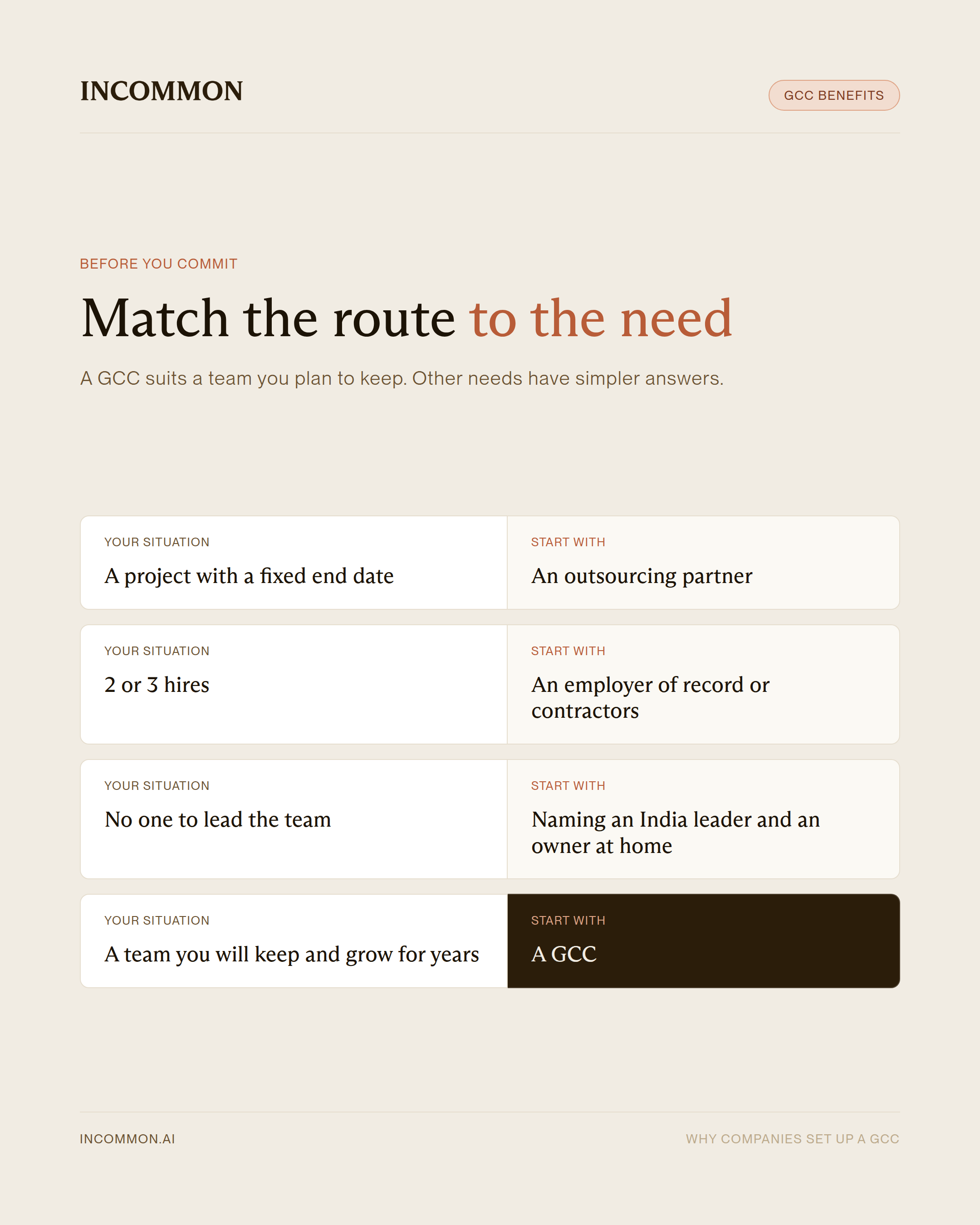
A GCC suits a company that plans to keep a team for years and grow it past a handful of people. But it might be the wrong tool in three common cases:
- A fixed project with a clear end: An outsourcing partner can deliver it without the cost of setting up an entity
- 2 or 3 hires: An employer of record or contractors do the job with far less overhead
- No one to lead it: Without an India leader and an engineering manager at home who owns the relationship, the team drifts
The common reasons GCCs fail start with exactly these gaps.
Final thoughts
The strongest reason to set up a GCC is ownership, and most of the other benefits depend on it. Depth, retention, speed, and knowledge all come from a team that is yours and runs well.
Frequently asked questions
What are the benefits of a global capability center?
The benefits that hold up come from owning the team: a deeper bench for senior roles, a team that reports to your leadership, knowledge that stays in the company, people who stay when the team is run well, hiring at the pace of the roadmap, more of the working day covered, and a route to ownership from day one.
Why do companies set up a GCC in India?
Most set one up to own an engineering team rather than rent one. India offers enough experienced engineers to staff a senior team without exhausting the market in one city, and the team reports to the company's own leadership.
Is a GCC cheaper than hiring at home?
Salaries in India are lower, but cost alone is a weak reason to set up a GCC. The saving disappears quickly when people leave, and the full cost includes statutory contributions, workspace, devices, and management time. Compare full costs over at least 2 years.
Does a GCC protect your intellectual property?
Not by itself. IP protection comes from employment agreements that assign code and inventions to your company and from security controls on every device and account. A GCC makes those controls easier to apply because the people and systems are yours.
When is a GCC the wrong choice?
A GCC is the wrong tool for a fixed project with a clear end, for 2 or 3 hires, or when no one at home will own the India team's success. Outsourcing, an employer of record, or contractors fit those cases better.
How quickly can a GCC have a live team?
Across InCommon's published builds, the time to a live team has ranged from 4 weeks to 4 months. An employer of record can employ the first engineers while incorporation runs, so the team does not have to wait for the entity.
Written by
CEO, InCommon
Piyush Kedia is the CEO of InCommon, a talent infrastructure company that helps US and global enterprises set up and scale Global Capability Centers (GCCs) in India. He works with founders, CTOs, and heads of talent to design smaller, AI native GCC teams that focus on judgment work, not just headcount, so India offices stay senior, stable, and production ready. Before InCommon, Piyush built Blue Vector into a 50 person creative agency serving brands such as Trump Towers, Audi, and Porsche, giving him a front row view of how high performing teams are hired, managed, and grown.