Why more startups are exploring the GCC model

See how Findigs, Accompany Health, Veramatic and Podifi built their teams.
Real teams, real results, from faster hiring to lasting retention.
Quick look:
| Startups are adopting the GCC model, once used mainly by large multinationals, to hire strong talent directly, scale teams faster, and keep control of their product. A GCC is a dedicated team the company owns, which is what separates it from outsourcing to a vendor. For startups in fintech, healthtech, and SaaS, it also keeps sensitive data and intellectual property in-house. When run well, it shows investors growth that is efficient and sustainable. |
|---|
Introduction
For years, Global Capability Centers were the playground of big corporations, multinationals with big budgets, sprawling teams, and a need for speed. But something has changed.
Startups, the scrappy, fast-moving underdogs of the business world, are entering this space.
Why? Because scaling a startup is not an easy task. The talent wars are unforgiving, the burn rates are terrifying, and running everything from a single headquarters doesn't always make sense.
The GCC model, a way to expand operations without spending a lot of extra budget, is the perfect solution.
From tech unicorns to early-stage disruptors, startups are realizing that setting up a dedicated team in a strategic location gives them the control, talent, and cost-efficiency they need to survive and thrive.
But exactly why are startups making this move, and what does it mean for the future of global hiring?
1. Startups want the best talent without paying Silicon Valley prices
Hiring a senior software engineer in San Francisco can severely constrain payroll budget. The same talent in Bangalore or Hyderabad costs a fraction of the price while maintaining the same (or better) skill level.
A GCC lets startups:
- Directly hire top-tier engineers, designers, and analysts without overpaying
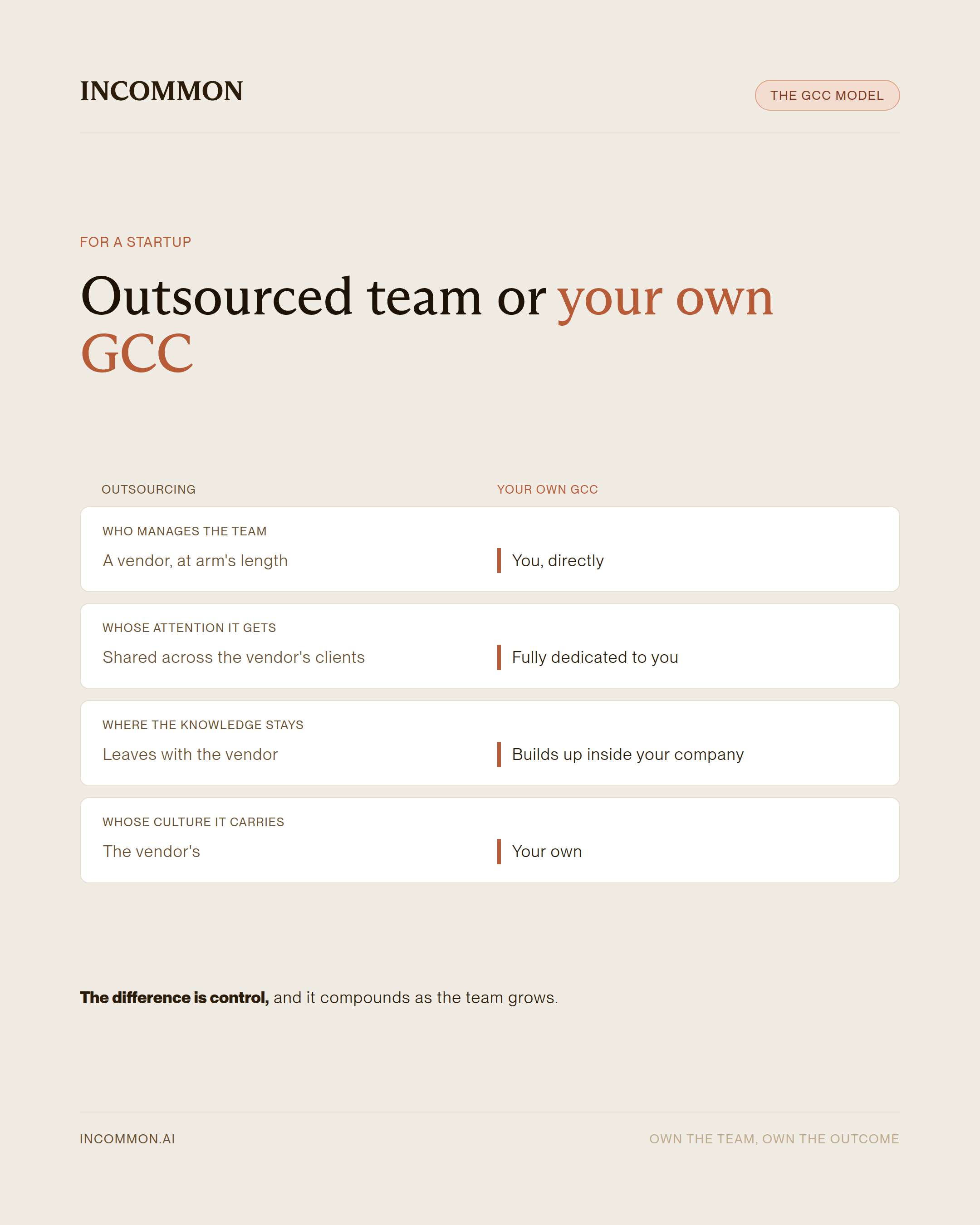
- Build an in-house culture instead of relying on third-party vendors
- Retain control over projects rather than getting stuck in outsourcing loopholes
While outsourcing works for some, it comes with its trade-offs: lack of direct management, slower turnaround times, and potential quality issues.
A GCC eliminates these problems while still keeping costs manageable.
2. GCCs make scaling faster
Startups live and die by how fast they execute. Every delay in product development, customer support, or backend operations means lost revenue and lost momentum.
With a GCC, startups can:
- Rapidly scale teams in tech, customer success, and R&D
- Operate across time zones to keep things moving 24/7
- Expand without massive legal overhead (many startup-friendly locations make GCC incorporation simple)
Instead of waiting months to hire an entire department in one location, startups can quickly set up a GCC and start filling roles within weeks.
3. The war for tech talent is global
A decade ago, startups hired within their city because that's how things worked. But today, the talent pool is borderless.
Smart founders aren't asking, "Where's my company based?" They're asking, "Where's the best talent, and how do I get it?"
Setting up a GCC means hiring from top engineering and innovation hubs worldwide, rather than fighting for overpriced, overworked local employees.
4. Startups need cost efficiency, but not at the expense of quality
Cheap doesn't mean good. Many early-stage companies learn this the hard way when they rely on low-cost agencies or freelancers who may not be fully aligned with their vision.
A GCC allows startups to reduce operational costs without sacrificing quality by:
- Hiring full-time, dedicated teams instead of paying premium contractor rates
- Avoiding the risk of outsourced talent juggling multiple clients
- Building long-term expertise within the company rather than dealing with constant churn
This is especially crucial in high-stakes industries like fintech, cybersecurity, and SaaS, where consistency and institutional knowledge matter.
5. Investors love seeing smart scaling strategies
Burning through funding on overpriced talent doesn't impress investors. Showing that you've built a cost-efficient, high-quality workforce across multiple locations? That's a winning strategy.
When pitching to VCs, startups with a well-structured GCC can demonstrate:
- Lower burn rates and higher efficiency
- Access to global talent without skyrocketing overheads
- Sustainable, scalable operations that won't collapse under growth pressure
Investors aren't just looking for rapid growth. They want smart, efficient growth, and a GCC is a solid way to show that a startup is scaling with strategy, not just throwing money at problems.
6. The GCC model is a huge competitive advantage
For a long time, the "offshoring" narrative was all about cost savings. But today's GCCs are value-driven.
- Google, Amazon, and Meta use GCCs not because they're cheap, but because they work.
- Startups can replicate this model to gain the same competitive edge at an earlier stage
- A well-run GCC is a strategic asset, not just a back-office extension
Companies that figure this out early get ahead because while their competitors are stuck dealing with local hiring bottlenecks, they've built a scalable, multi-location team that keeps their business running smoothly.
7. A GCC means stronger data security and compliance
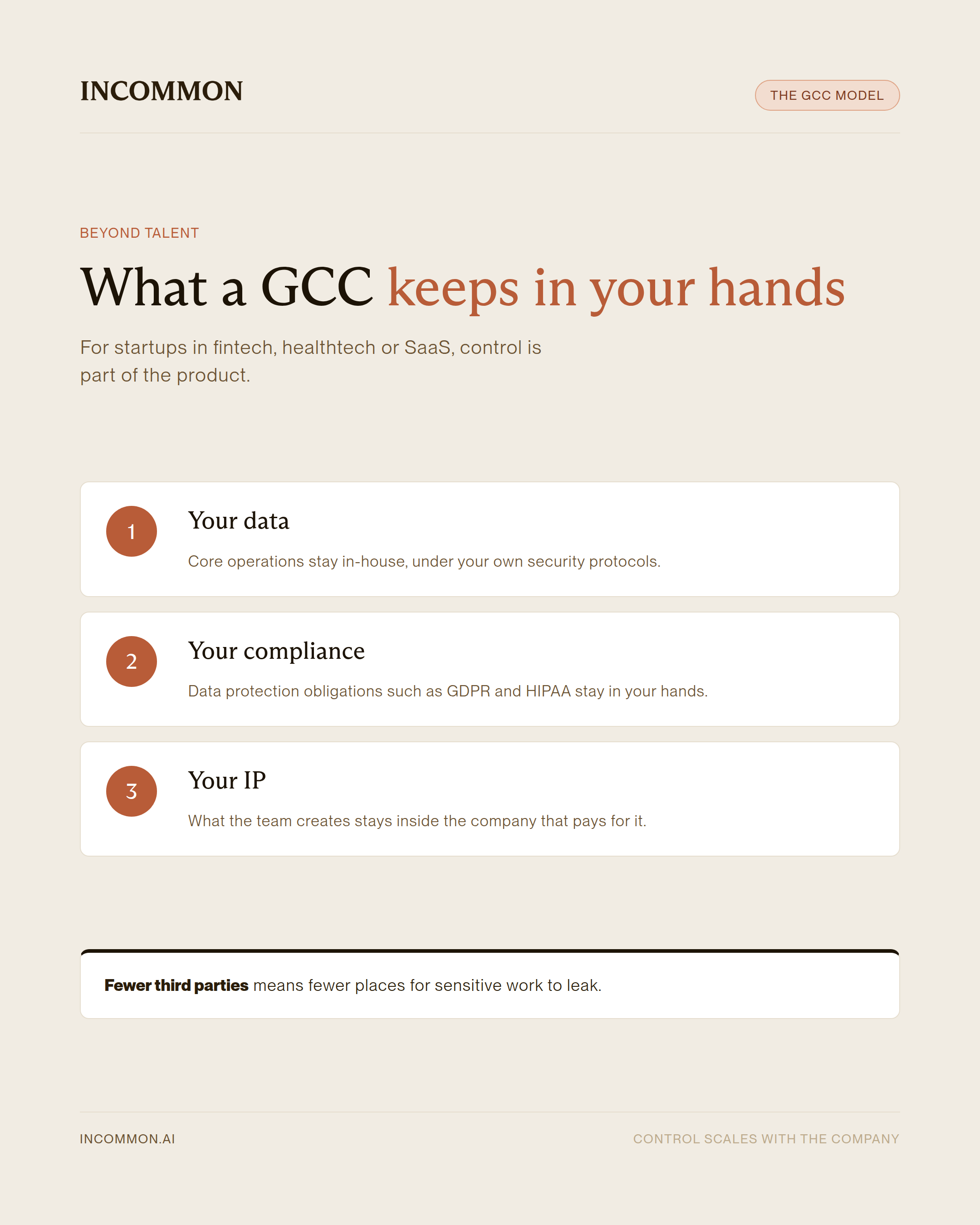
Startups handling sensitive user data in fintech, healthtech, or SaaS need a high level of control over security. Many global companies face compliance issues when relying on third-party vendors.
With a GCC, startups can:
- Ensure compliance with global data protection laws (like GDPR & HIPAA)
- Build internal security protocols rather than trusting external agencies
- Protect intellectual property by keeping core operations in-house
This approach is particularly valuable for startups looking to scale internationally without legal risks.
8. The GCC model enhances product innovation
Startups using GCCs are going the extra mile by:
- Tapping into diverse R&D teams for fresh ideas
- Utilizing multi-region collaboration to improve products
- Speeding up product development cycles with round-the-clock teams
This makes a GCC superior to any outsourcing support.
If a GCC sounds like the right next step, this is how we build one.
Everything you need to build and run your India GCC.
Entity, hiring, workspace and ongoing operations under one agreement.
Conclusion
The startup world moves fast, and traditional hiring models don't always keep up.
A Global Capability Center is a scaling strategy.
By setting up a GCC, startups can:
- Hire elite global talent without breaking the bank
- Move faster and execute more efficiently
- Impress investors with smart, sustainable growth strategies
- Retain full control over critical operations instead of relying on third parties
For startups that want to scale smart, not just fast, the GCC model is quickly becoming the go-to solution.
Frequently asked questions
Why are startups setting up GCCs?
To hire skilled engineers, designers and analysts directly, scale teams faster, keep control over projects, and build long-term expertise inside the company instead of relying on third-party vendors.
How is a GCC different from outsourcing for a startup?
A GCC is a full-time, dedicated team the startup manages directly. Outsourcing can mean less direct management, slower turnaround and vendors juggling multiple clients.
How quickly can a startup start hiring through a GCC?
Instead of waiting months to hire an entire department in one location, a startup can set up a GCC and start filling roles within weeks.
How do investors view a startup's GCC?
A well-structured GCC shows investors efficient, sustainable growth: access to global talent and scalable operations without overheads that rise out of control.
Does a GCC help with data security and compliance?
Yes. Keeping core operations in-house lets a startup build its own security protocols, comply with data protection laws such as GDPR and HIPAA, and protect its intellectual property.
Is the GCC model only for large corporations?
No. GCCs were long the territory of large multinationals, but startups can replicate the model to gain the same advantages at an earlier stage.
Written by
CEO, InCommon
Piyush Kedia is the CEO of InCommon, a talent infrastructure company that helps US and global enterprises set up and scale Global Capability Centers (GCCs) in India. He works with founders, CTOs, and heads of talent to design smaller, AI native GCC teams that focus on judgment work, not just headcount, so India offices stay senior, stable, and production ready. Before InCommon, Piyush built Blue Vector into a 50 person creative agency serving brands such as Trump Towers, Audi, and Porsche, giving him a front row view of how high performing teams are hired, managed, and grown.