Offshore vs nearshore, choosing between India, Latin America and Eastern Europe

See how Findigs, Accompany Health, Veramatic and Podifi built their teams.
Real teams, real results, from faster hiring to lasting retention.
Quick look:
| Offshore vs nearshore is a trade between time-zone overlap and depth of talent at team scale. Nearshore teams in Latin America or Eastern Europe share more of your working day. An offshore team in India shares less of it, but gives you a deeper bench for senior engineering roles and a well-worn route to owning the team. Choose the location by how much of the work needs live conversation, then choose the model by how long you plan to keep it. |
|---|
Offshore vs nearshore comes down to one trade: shared working hours against depth of talent at team scale. Nearshore is better when the work needs hours of live conversation with your home office.
India beats nearshore when you need senior engineers in numbers, and a team you will own for years. The employment model is as important as the map.
This guide is for founders, CTOs, and engineering leaders at growth-stage US and European companies deciding where to put their next engineering team. It compares the two honestly, starting with where nearshore is the better call.
What offshore and nearshore actually mean
Nearshore means a team in a nearby time zone. For a US company, that usually means Latin America, and for a European company it usually means Eastern Europe.
Offshore means a team in a distant time zone. Offshore software development in India is the classic case, with the Philippines more common for support and operations roles.
Search results usually frame the choice as nearshore vs offshore outsourcing, with a vendor doing the work. Who employs the team is a separate question.
That second question shapes the outcome more than the map does. An offshore development center run by a vendor and a team you own can sit in the same city and behave nothing alike.
Where nearshore wins
Start with the cases where a nearby team is the better choice. There are three clear ones.
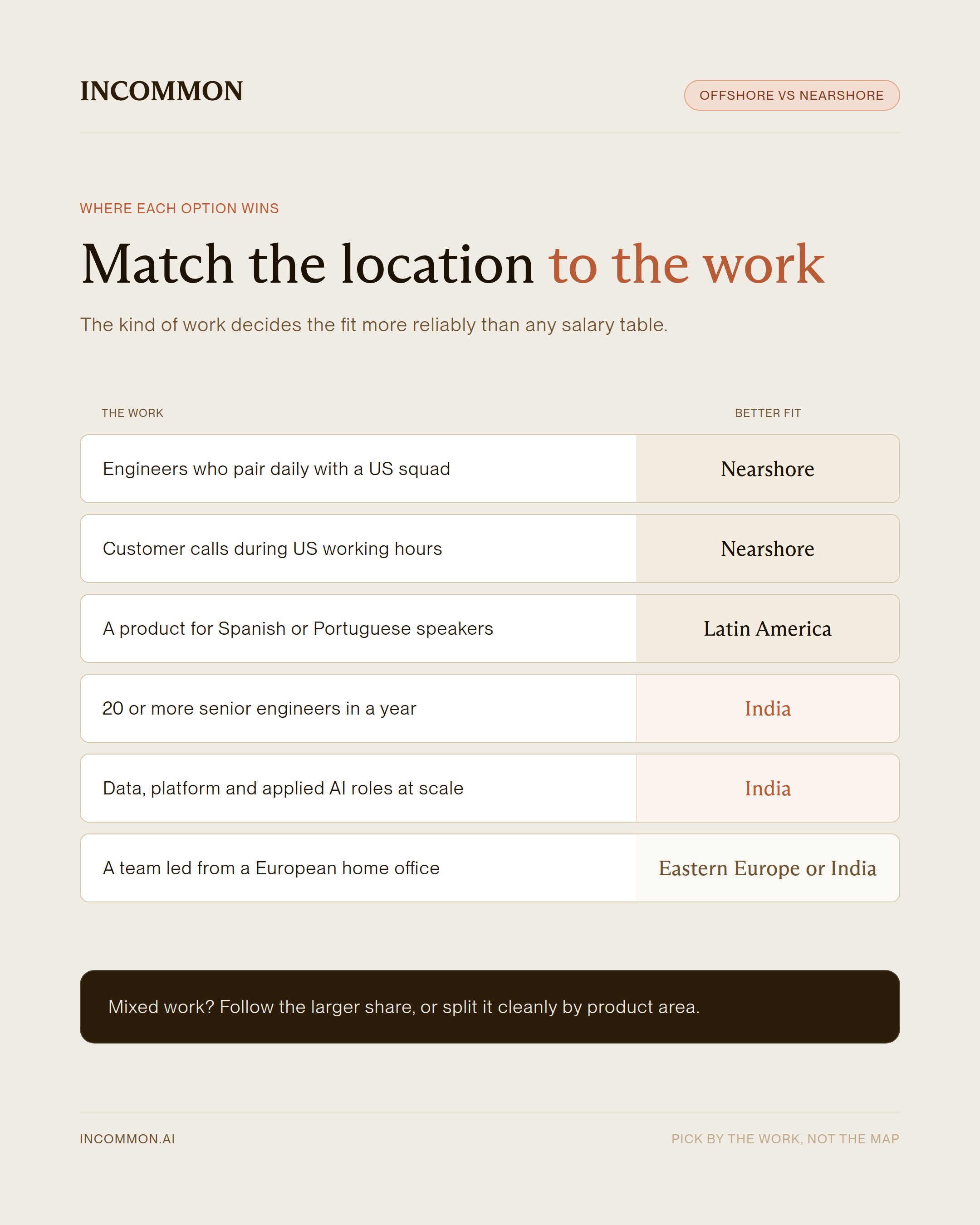
- Overlap-heavy work: small teams embedded in your home squads, pairing daily and joining every standup, need most of the working day in common
- Customer-facing roles in your hours: support, sales engineering, and success roles that talk to US customers live work better from Bogotá than from Bengaluru
- Regional markets: a product built for Spanish or Portuguese-speaking customers gains from a team that speaks their language natively
Nearshore also suits companies hiring one or two people. A small team in a familiar time zone needs less operating structure than a center does.
Travel is easier too. A flight from New York to Mexico City is a short trip, while a visit to India takes most of a day each way.
Nearshore outsourcing in Latin America is the common route for US companies that want shared hours above everything else.
For European companies, the same logic points to the east. Software outsourcing in Eastern Europe keeps the team one or two hours from London. Poland and Romania are also EU members, so your data stays under the same rules as at home.
Where an India team is better
India's case is depth. For senior engineering roles, the bench is deep enough to fill a team of 30 without exhausting the market in one city.
That depth extends to specialist work. Data engineering, platform teams and applied AI roles are hard to hire for in numbers anywhere. Bengaluru, Hyderabad and Pune each run their own deep markets for them, which spreads the competition for any one profile.
The route to ownership is also well worn. Setting up your own entity, running payroll, and staying compliant are standard work there, with an established network of firms that support it. Our guide to setting up a GCC walks through the sequence.
English is the working language of Indian engineering teams, which removes one layer of friction from day one. Once recruitment is in place, the team moves quickly. Our published builds have run from 4 weeks to 4 months to a live team.
For European companies, India shares half a working day. That makes it closer to nearshore than the label suggests.
For a US team, the gap is larger. It works when a day runs on written handoffs and a short overlap window, and it fails when the work needs constant live conversation. Plan for that.
Time zones compared, city by city
The table shows the gap in hours between seven common team locations and two home offices, New York and London. Ranges reflect daylight saving on the US and UK side:
| Location | Hours from New York | Hours from London |
|---|---|---|
| Mexico City | 1 to 2 behind | 6 to 7 behind |
| Bogotá | 0 to 1 behind | 5 to 6 behind |
| São Paulo | 1 to 2 ahead | 3 to 4 behind |
| Warsaw | 6 ahead | 1 ahead |
| Bucharest | 7 ahead | 2 ahead |
| Bengaluru | 9.5 to 10.5 ahead | 4.5 to 5.5 ahead |
| Manila | 12 to 13 ahead | 7 to 8 ahead |
Two hours of shared time is enough for a team that writes things down. Teams that decide things in meetings need far more.
Cost is the wrong tiebreaker
Salary comparisons between regions are easy to find and hard to trust. They mix seniority levels, ignore statutory costs, and say nothing about how long people stay. Treat them as noise.
Compare the whole bill instead of the salary line. Workspace, devices, partner fees, and the cost of each replacement belong in every location's total.
Use the full cost of a person who stays. In India, that means salary plus the statutory contributions in our breakdown of what an India employee costs. The same exercise belongs in every location you compare.
Retention moves the total more than salary does. A hire who leaves in month four is the expensive outcome, because the search, the notice period and the ramp all start again.
With InCommon, Accompany Health reached 22 people, 10 weeks to a live team, 100% retention across the build. Veramatic reached 21 people live in four weeks, with 92% retention across the build.
Each of those builds is written up in full.
See how Findigs, Accompany Health, Veramatic and Podifi built their teams.
Real teams, real results, from faster hiring to lasting retention.
Ownership matters more than distance
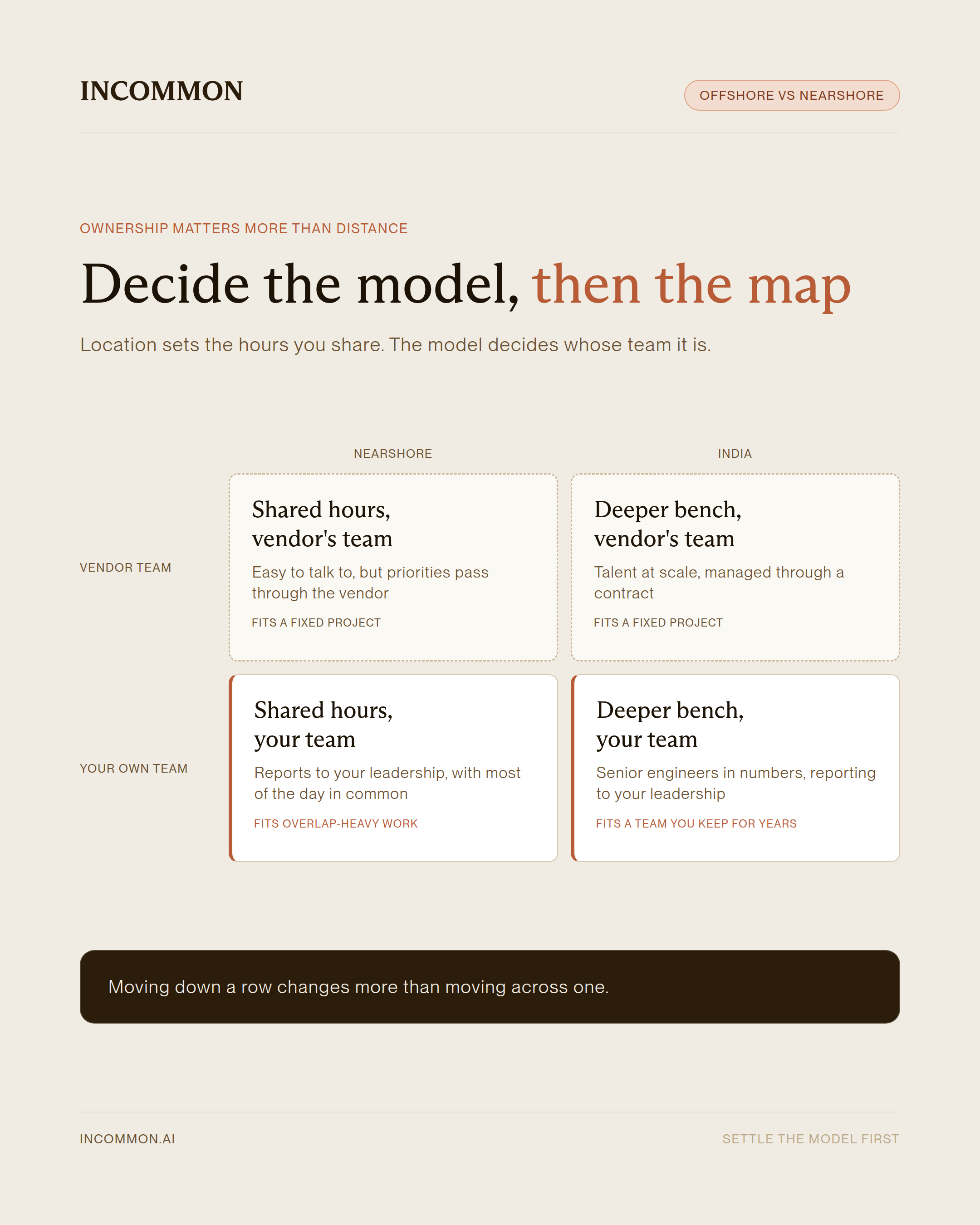
The location decision gets the debate, but the employment model decides how the team performs. A vendor team in a nearby time zone still reports to a vendor. An owned team, such as your own global capability center, reports to your engineering leadership. It follows your standards and keeps what it learns.
So decide the model first. Software outsourcing in India and owning a team in India are two separate decisions, made for separate horizons and judged by separate measures.
A vendor team is fine for a fixed project with a clear end. For the work you plan to keep, an owned team usually outlasts a vendor team in any region.
If you start through an employer of record, you can still own the team later. The EOR versus entity comparison shows when each route fits.
Running both
Some companies split the work. A small nearshore pod handles overlap-heavy work, while an India team owns a product area end to end.
The split works when the boundary between the two is clean. It fails when both teams work on the same code every day, because then you inherit the coordination cost of both time zones.
For example, a US company might keep a four-person nearshore pod on customer integrations, which need US hours. An India team then owns the data platform.
Keep the split simple. One team per product area, with handoffs written down, is the rule that holds up.
How to decide
Four questions settle the choice for most engineering teams:
- How many hours of live conversation does the work need? More than four a day points nearshore for a US company
- How many senior engineers do you need in the next year? If you need a team of 20, pick a market with a larger talent pool
- How long will you keep the team? Three years or more points to owning it, wherever it is based
- Where is your home office? For Europe, India's overlap is half a day, which changes the math
Take two examples. A New York fintech adding 6 engineers who pair daily with its core squad has a nearshore problem. A London software company opening a 25-person product team, with a three-year plan for it, has an India one.
Write the answers down before the first partner call, so no sales conversation reframes the question for you.
If the answers split, weigh the third and fourth most. Overlap can be designed around, but a shallow bench or a vendor relationship cannot. For the timeline, once you decide, the GCC setup timeline shows where the months go.
Final thoughts
The map decides how many hours you share each day, which is why it gets most of the attention in these comparisons. The model decides whether the team is still yours in three years.
Settle the model first. Then pick the location the work can live with.
Frequently asked questions
What is the difference between nearshore and offshore outsourcing?
Nearshore means a team in a nearby time zone, usually Latin America for a US company or Eastern Europe for a European one. Offshore means a distant time zone, most often India for engineering work. Neither term says who employs the team, which is a separate decision.
Is nearshore better than offshore?
Nearshore is better for work that needs hours of live conversation each day, customer-facing roles in your hours, and small teams of one or two hires. An India team is better when you need senior engineers in numbers and a team you will own for years.
Is Latin America or India better for software development?
Latin America shares most of the US working day, which suits overlap-heavy work. India offers a deeper bench for senior engineering and specialist roles at team scale, and a well-worn route to owning your own entity, with a shorter overlap that works when the day runs on written handoffs.
Is India or Eastern Europe better for software development?
For a European company, Eastern Europe sits one or two hours from London and inside EU data rules. India shares about half a working day with London and offers more depth for hiring a team of 20 or more senior engineers.
Which region is best for time-zone overlap with the US?
Latin America. Mexico City and Bogotá are within two hours of New York, and São Paulo is one to two hours ahead. Warsaw is about 6 hours ahead of New York, and Bengaluru is 9.5 to 10.5 hours ahead.
Should you outsource or own your engineering team?
A vendor team is fine for a fixed project with a clear end. For work you plan to keep for three years or more, an owned team that reports to your engineering leadership usually outlasts a vendor team in any region.
Written by
CEO, InCommon
Piyush Kedia is the CEO of InCommon, a talent infrastructure company that helps US and global enterprises set up and scale Global Capability Centers (GCCs) in India. He works with founders, CTOs, and heads of talent to design smaller, AI native GCC teams that focus on judgment work, not just headcount, so India offices stay senior, stable, and production ready. Before InCommon, Piyush built Blue Vector into a 50 person creative agency serving brands such as Trump Towers, Audi, and Porsche, giving him a front row view of how high performing teams are hired, managed, and grown.