GCC vs offshore development center, what actually differs

See how Findigs, Accompany Health, Veramatic and Podifi built their teams.
Real teams, real results, from faster hiring to lasting retention.
Quick look:
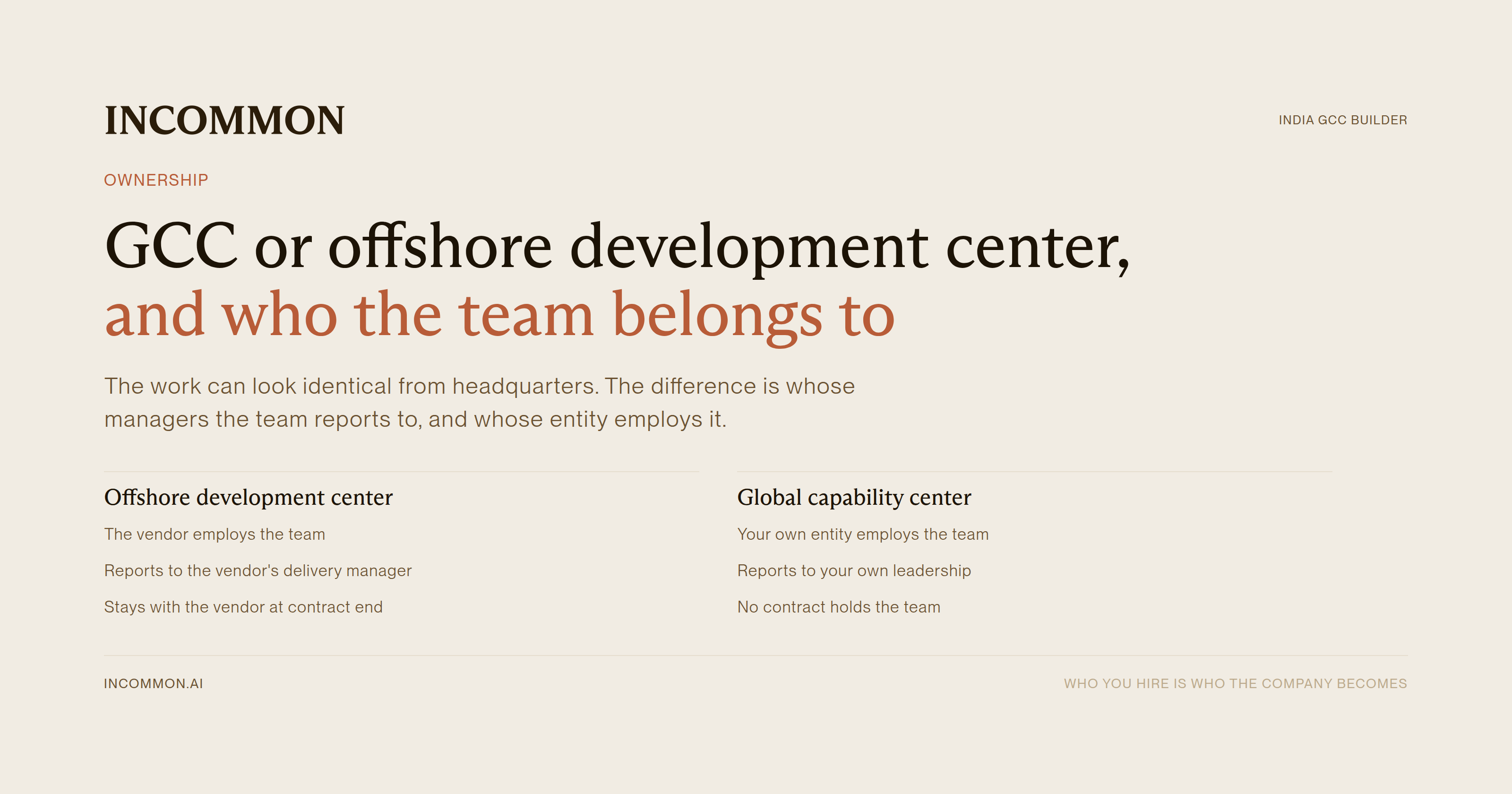
| An offshore development center is a dedicated team that a vendor employs, houses, and manages for you. A global capability center is a team your own company employs, directs, and owns, usually through an Indian subsidiary. From the outside, the work can look identical. The difference comes down to who the team reports to each day, and who owns the entity that employs them. Retention, cost, and what happens at exit all follow from those two answers. |
|---|
Two India teams can do the same work on the same code, and still be different kinds of operations. In an offshore development center (ODC), the engineers belong to a vendor that sells their time to you. In a global capability center, they belong to you.
This one fact decides who they answer to, what happens when someone leaves, and what you keep if the contract ends. This guide is for a founder, CTO or CFO comparing an ODC proposal against setting up their own India team.
What separates a GCC from an ODC?
Two things separate them.
The first is the reporting line, meaning whose managers the engineers answer to on an ordinary Tuesday. The second is ownership, meaning whose legal entity employs them and holds the assets.
In an ODC, both answers point to the vendor. You set the priorities and the scope, but the vendor employs the people, runs their reviews, and decides their pay. In a GCC, both answers point to you, even when an outside firm handles setup and operations underneath.
The table runs both tests across the questions a buyer usually asks first:
| Question | Offshore development center | Global capability center |
|---|---|---|
| Who employs the engineers? | The vendor | Your Indian subsidiary, or an EOR while the entity forms |
| Who do they report to? | The vendor's delivery manager | Your own leadership |
| Who runs reviews and pay? | The vendor | You |
| Who owns the entity? | The vendor | You |
| What happens at contract end? | The team stays with the vendor | Nothing, because no contract holds the team |
| How is it billed? | A monthly rate per person or per team | Salaries and operating cost, paid directly |
Read down the right-hand column, and you will notice a pattern. Every line that belongs to the vendor in an ODC belongs to you in a GCC. That is why the two models feel alike in month one and nothing alike during the long term.
The confusion is understandable. An ODC is dedicated to you and works on your product, so from headquarters it can feel like your own team.
But what happens when you want to change something the vendor controls? Try replacing the team lead, or raising a senior engineer's pay, and see whose approval you need.
What is an offshore development center?
An offshore development center is a team dedicated to one client, employed and housed by a vendor. The engineers work only on your product. They work from the vendor's office, on its payroll, under its HR policies.
The model grew up inside IT services firms. It gave overseas companies a way to reach Indian engineering talent without incorporating, hiring, or running anything locally. The vendor carried all of that and billed for it as a monthly rate per person.
This trade does streamline things. You get a working team without an entity, a payroll function, or an India office of your own. But you do give up direct control of the people, and any claim on them once the arrangement ends.
The market is moving toward ownership. nasscom's GCC Value Orbit counts 2,117 GCCs in FY26, inside the 2,100 to 2,200 projected for 2030, four years early.
Where the reporting line runs
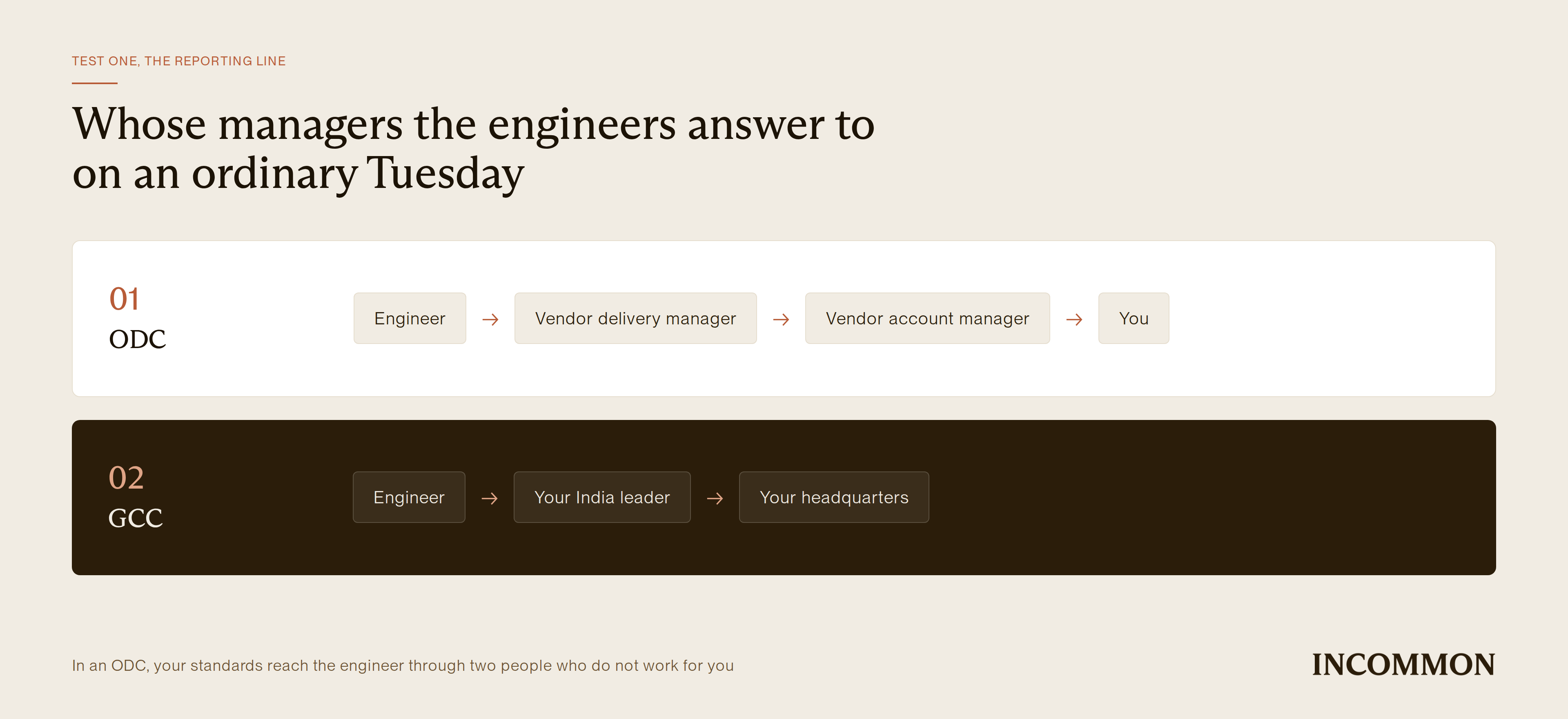
The reporting line is the difference buyers feel first. An ODC engineer reports to a delivery manager, who reports to an account manager, who talks to you.
Your standards reach the engineer through two people who do not work for you. Code review, promotion, and pay all run through frameworks you do not set. Feedback arrives filtered, and so does anything the team wants to tell you.
Hiring is where this bites hardest. The vendor sources and screens against its own bar, and you see the candidates it chooses to show you.
Your own center shortens the chain to one link. The engineers report into your leadership, and the India leader reports to someone at headquarters. The team takes its priorities, the hiring bar, and its promotions from the same place your home team does. Your leaders set that bar and take part in the interviews.
The reporting line decides more than location or price does. Two teams in the same building, on the same salaries, perform differently depending on whose managers they report to. The team that reports to you knows what good looks like, because the person defining it is its own manager.
Underperformance shows the gap fastest. Through a vendor, you raise it with the account manager and wait. When the team is yours, your manager has the conversation that week.
Who owns the entity
Ownership is the first thing a CFO checks. Here the two models point in opposite directions.
With an ODC, the vendor's Indian company employs the team. Your rights to the code depend on the IP assignment clauses in the services contract. When the contract ends, the people stay with the vendor unless the agreement provides for a transfer.
A GCC reverses each of those. Your company owns the entity outright, usually as a wholly owned subsidiary, and the engineers are your employees. The IP, the working knowledge and the relationships stay inside a company you control.
Device and system access split the same way. A vendor applies its own security policy and layers yours on top, while your own entity applies your security baseline directly. Access is yours to grant and revoke.
Incorporation takes about 12 weeks as a planning figure, and a team does not have to wait for it. For Podifi, the InCommon result was 9 engineers live in 6 weeks, employed through employer of record with no wait for incorporation.
An employer of record is not an ODC. The EOR is the legal employer on paper, but your managers direct the work and the team reports to you. It changes who signs the employment contract, while the reporting line and the ownership path stay with your company. The legal and compliance requirements differ for each route.
What changes for the engineers
The comparison usually gets framed from the buyer's side. From the engineer's side, it comes down to whose employee they are.
A vendor engineer assigned to your account has a career that runs through the vendor. When your contract shrinks, they can be moved to another client, so your product is only their current posting.
An engineer you employ is promoted on your product. A strong year on your roadmap is a strong year for them, and when something goes wrong, they escalate to your leadership.
That difference here is who stays.
People commit to a team they belong to, and they plan around it. We measure a center by who stays rather than how fast the seats fill, and the ownership model is the first thing that decides it.
How captive centers fit in
A captive center is the older name for a company-owned operation in India. The term dates from the period when large enterprises moved back-office and support work into their own Indian subsidiaries.
Since then, the word has aged. 'Captive' is now dated, and new centers are described in capability language instead.
A GCC keeps the ownership model and widens the mandate. Captive centers were often set up to cut costs on defined processes. A GCC tends to hold product engineering, data, and research work that the parent means to keep in-house.
A captive center and a GCC both report into the parent, and the parent owns both. The difference between a captive center and a GCC is one of mandate and era, and it barely impacts the ODC comparison.
How the cost shape differs
The two models are priced in different shapes, which makes a direct comparison harder than it looks.
An ODC bills a monthly rate per person. The rate bundles salary, benefits, office space, management overhead, and the vendor's margin into one number. It is simple to budget, and hard to decompose.
A GCC separates those lines. You pay salaries and statutory costs directly, plus workspace, IT, compliance, and whatever setup and operating support you buy. There is more to track, and every line is clearly visible.
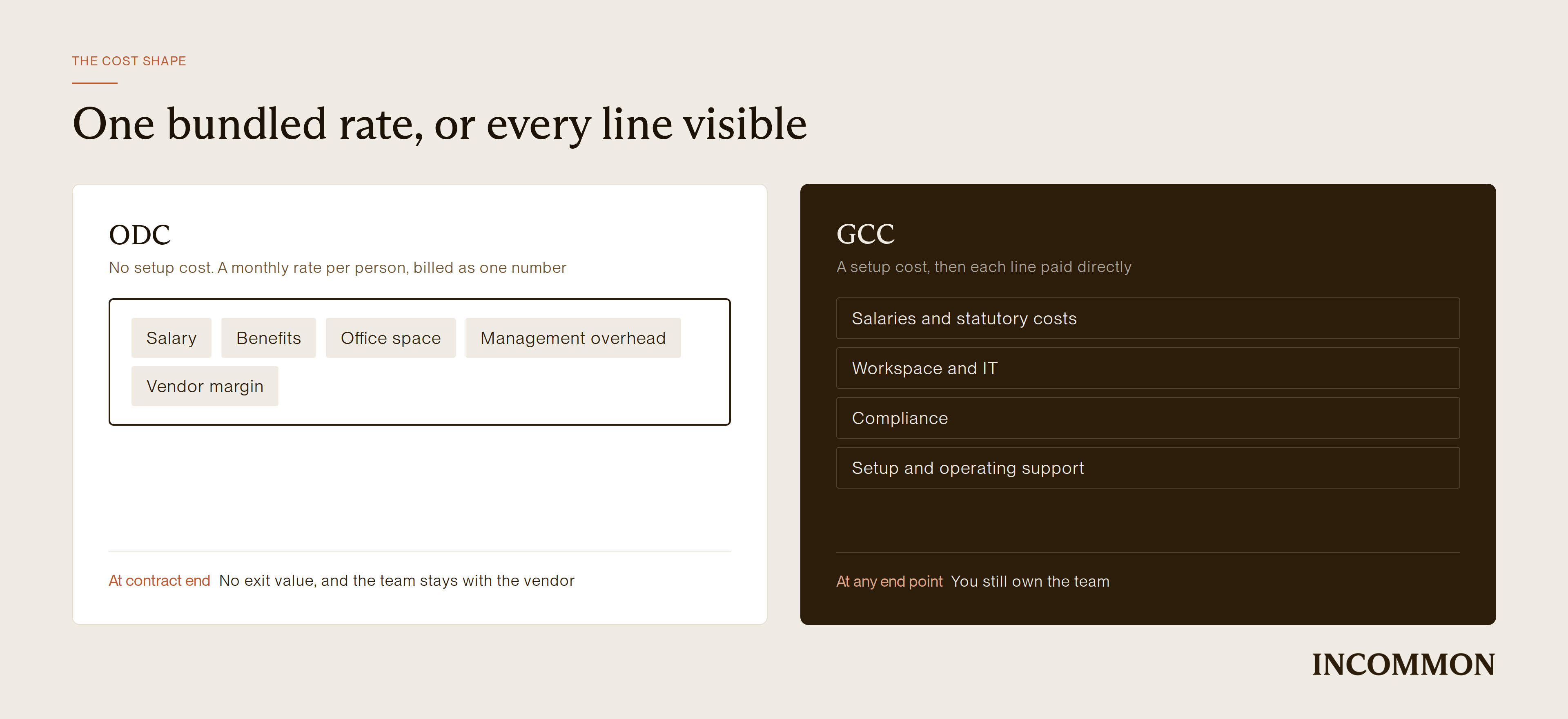
The comparison that matters here is total cost over the life of the team. An ODC carries no setup cost and no exit value. An owned center carries setup cost, and at the end you still own the team.
Scale changes the comparison too. A bundled rate multiplies as the team grows, so the margin grows with it. An owned center spreads its setup cost across every hire you add, which is why the ownership case strengthens as the team gets larger.
When is an ODC the right call?
An ODC is often the better answer. It fits when the work is defined and time-boxed, or when you have no intention of running an India entity.
It also fits work that is useful but not core to your product. A vendor with a bench can staff faster than a direct hire can close. For a fixed-scope migration or a support function, that is often the right trade.
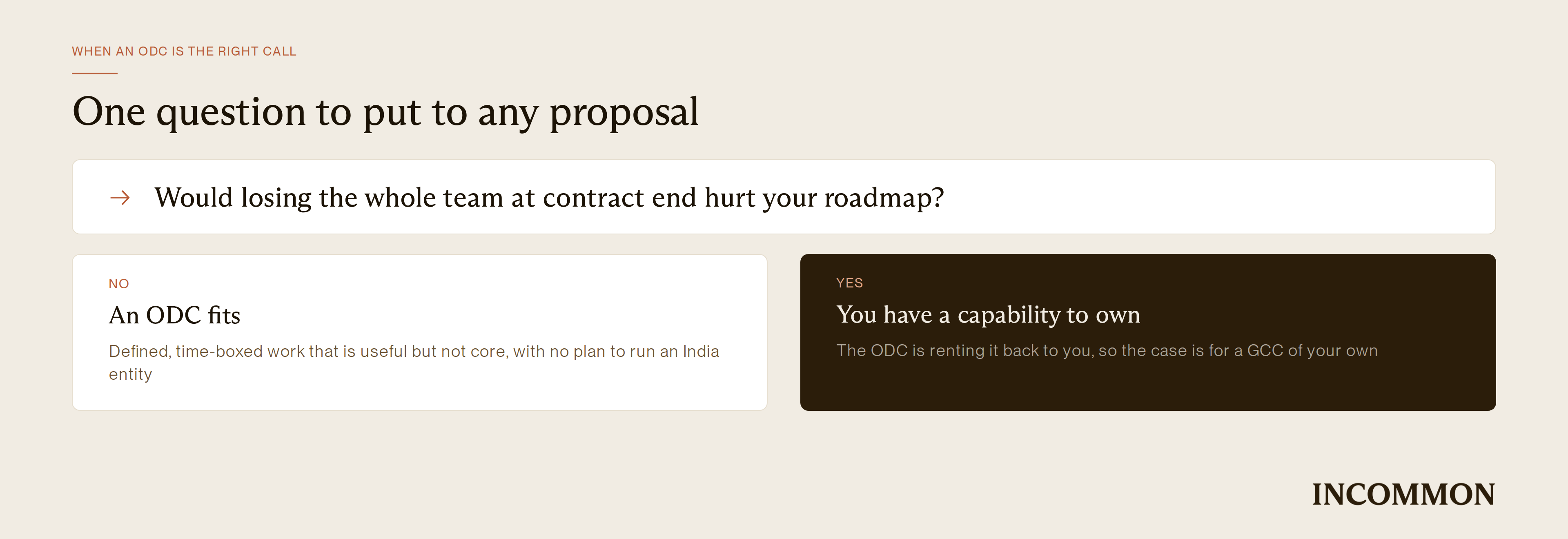
Use a simple test. If the team disappearing at the end of the contract would slow your roadmap, this probably should not stay with a vendor. It is a capability your business depends on, so you should plan to own it.
The same test can work in reverse. A company that sets up its own center for a six-month project has bought an entity that it does not need.
A PE-backed company faces a sharper version of the question. An ODC is a service contract, while an owned center is a subsidiary that becomes part of the business a buyer acquires. The considerations for private equity portfolios can change the answer more than team size does.
Moving from an ODC to a GCC
An ODC that works well tends to become important. That is usually the moment the ownership question arrives, and the answer is that you do not own it.
Conversion has three routes. A transfer clause agreed at signing moves the team to your entity on a defined date. A parallel setup runs your own center alongside the ODC while work migrates across over several months.
A parallel setup costs more for a while, since you pay for two teams during the overlap. It is also the route that keeps delivery running while ownership changes, which is what the business tends to care about.
The third route is rehiring the vendor's people directly, and it is the one most exposed to the contract terms. Check the non-solicitation terms in the ODC agreement first, because they do restrict hiring the vendor's staff during the contract and after it ends.
Plan the exit when you sign, because exit terms are hardest to agree on once the team is hard to lose. Whatever route you take, the people, the IP, and the working knowledge all have to move.
The people only move with their consent, so it belongs on the list of questions to settle before committing.
An owned team can go live in weeks. For Accompany Health, the result was 22 people, 10 weeks to a live team, and 100% retention across the build. For Veramatic, it was 21 people live in four weeks, 92% retention across the build.
The full stories behind those numbers are in our case studies.
See how Findigs, Accompany Health, Veramatic and Podifi built their teams.
Real teams, real results, from faster hiring to lasting retention.
Final thoughts
The ODC question is an ownership question asked early. Answer it at signing, while every option is still open. Month eighteen might be too late, because by then the team is important to your roadmap and still belongs to someone else.
Run the two tests on any proposal in front of you. Ask whose managers the engineers answer to, and whose entity employs them. If both answers name the vendor, you are renting capability, and if both name you, you own it.
The India office service covers the entity, hiring, workspace, and operations for teams taking the second route.
Frequently asked questions
What is an offshore development center?
An offshore development center, or ODC, is a team dedicated to one client but employed, housed and managed by a vendor. The engineers work only on the client's product, on the vendor's payroll and under the vendor's HR policies. The client sets priorities and scope, and the vendor bills a monthly rate per person or per team.
What is the difference between a GCC and an ODC?
Two things separate them: the reporting line and ownership. In an ODC the engineers report to the vendor's managers and are employed by the vendor's entity. In a GCC they report to your own leadership and are employed by an entity you own, usually a wholly owned subsidiary.
Is an offshore development center the same as a captive center?
No. A captive center is company-owned, like a GCC, while an ODC is owned and run by a vendor. Captive is the older term for a company-owned Indian operation, and a GCC is its modern form with a broader mandate.
Can an ODC be converted into a GCC?
Yes, through a transfer clause agreed at signing, a parallel setup of your own center, or rehiring the vendor's staff directly. Rehiring can run into non-solicitation terms in the ODC contract, so plan the exit before you sign.
Is an employer of record the same as an ODC?
No. An EOR is the legal employer on paper, but your managers direct the work and the team reports to you. In an ODC, the vendor employs the team and manages it day to day.
Written by
CEO, InCommon
Piyush Kedia is the CEO of InCommon, a talent infrastructure company that helps US and global enterprises set up and scale Global Capability Centers (GCCs) in India. He works with founders, CTOs, and heads of talent to design smaller, AI native GCC teams that focus on judgment work, not just headcount, so India offices stay senior, stable, and production ready. Before InCommon, Piyush built Blue Vector into a 50 person creative agency serving brands such as Trump Towers, Audi, and Porsche, giving him a front row view of how high performing teams are hired, managed, and grown.