What an EOR in India costs, and when it stops making sense

See how Findigs, Accompany Health, Veramatic and Podifi built their teams.
Real teams, real results, from faster hiring to lasting retention.
Quick look:
| EOR India cost comes in three layers: salary, the statutory contributions every employer pays, and the EOR provider's fee. Only the fee changes if you move to your own entity, because salary and statutory costs stay the same on both routes. An EOR stops making sense when its fees for your whole team cost more each month than running your own entity would, or when you need control the EOR cannot give. For a growing team, that point usually arrives earlier than the bill suggests. |
|---|
An employer of record in India costs you the salary, the statutory contributions on top of it, and a fee for each person it employs. The fee is the only part that changes if you set up your own entity. So the real question is when your total EOR fees overtake the cost of running an entity yourself.
This guide is for founders, CFOs, and operations leaders with a team in India on an employer of record, or about to start one. It explains what goes into the bill, how to find your break-even point, and what to weigh beyond cost. For a wider decision, our comparison of EOR versus your own entity covers when each option offers.
What an EOR is
An employer of record (EOR) is a company that legally employs people on your behalf in a country where you have no entity. It issues the employment contracts, runs payroll, pays the statutory contributions, and handles the filings, while the people work for you day to day. That lets you hire in India without incorporating first. Our guide to EOR, payroll, or both explains how an EOR differs from a payroll provider.
What goes into an EOR bill
Every monthly EOR invoice carries the same three layers:
- Salary: The gross pay you agreed with each employee
- Statutory contributions: The employer's share of provident fund, gratuity accrual, and any state levies
- The EOR fee: What the provider charges for being the legal employer and running payroll and compliance
A few smaller costs fall outside those layers. Devices, health insurance top-ups, and any workspace you rent are usually billed separately or paid by you directly.
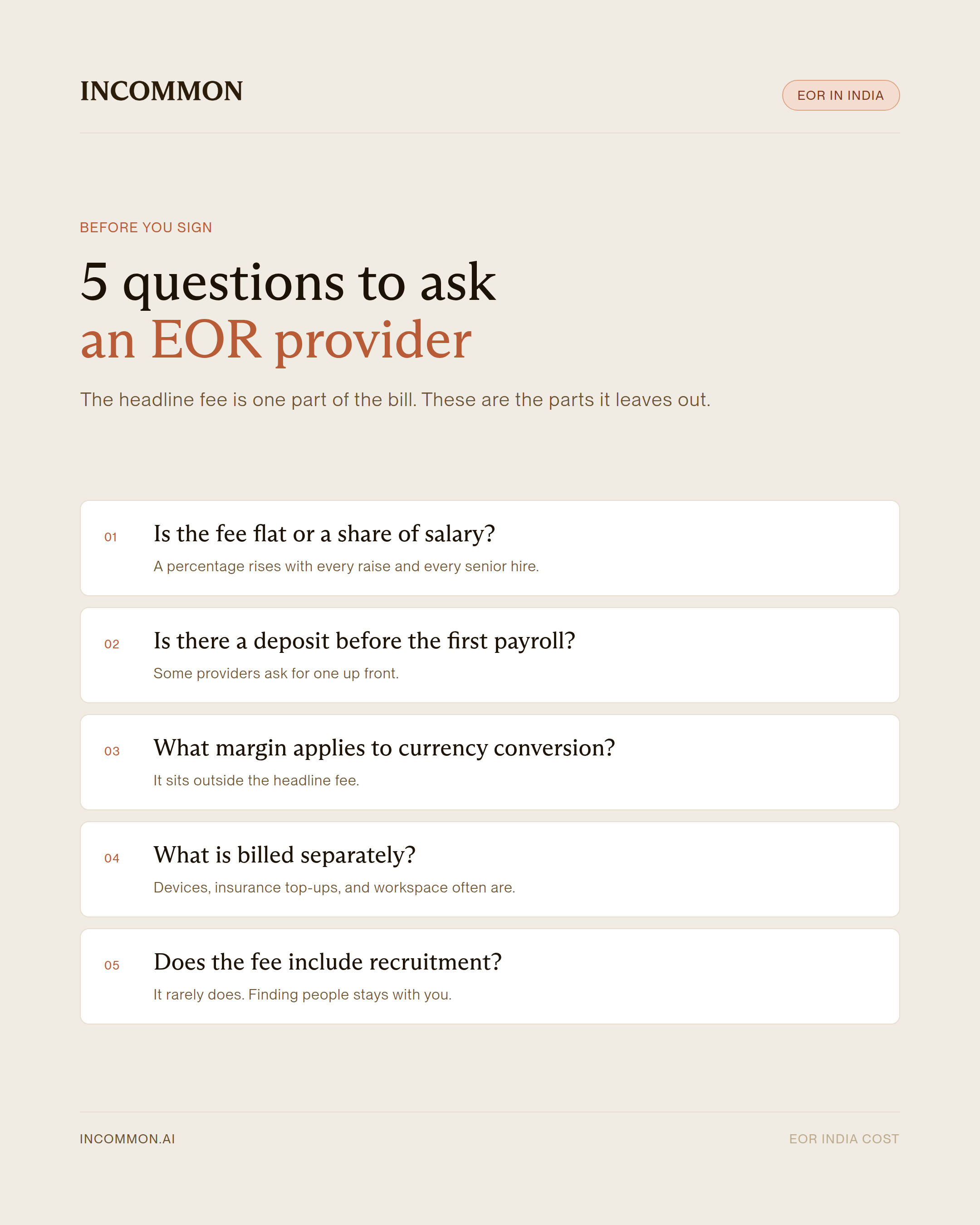
Some providers also ask for a deposit before the first payroll, or charge a margin when they convert your currency into rupees. Ask about both before you sign, because neither shows up in the headline fee.
How EOR pricing works in India
Employer of record India pricing usually takes one of two forms. The common one is a flat monthly fee for each employee. Some providers charge a percentage of each employee's salary instead.
The difference matters as the team becomes more senior. A percentage fee rises with every raise and every senior hire, while a flat fee stays the same per person. For an engineering team with rising salaries, a flat fee is easier to plan around.
The fee typically covers employment contracts, payroll, statutory filings, and benefits administration. It rarely covers recruitment, so finding the people is still your job or a separate cost. Our guide to GCC partner pricing explains how full partners price recruitment alongside the rest.
The costs that do not change with an EOR
Salary and statutory contributions cost the same whether an EOR employs your team or your own entity does. An engineer's pay does not change with the employer's name, and the law sets the contributions.
The employer pays 12% of wages into the provident fund. The minimum is calculated on a wage ceiling of ₹25,000 a month, though an employer can choose to contribute on full wages. Gratuity accrues at about 4.8% of annual wages. Professional tax is capped at ₹2,500 per person per year, and state insurance rarely applies to engineers because of its income ceiling.
Because these lines are the same on both routes, they drop out of the comparison. Our breakdown of what an India employee costs explains each of them in full.
What your own entity costs instead of an EOR
Your own entity replaces the EOR fee with a set of costs that mostly stay flat as the team grows. Some are paid once, and the rest recur every month or year.
One-time costs:
- Incorporation, registrations, and the bank account
- The capital you put into the entity at the start
- Setting up payroll, benefits, and the employment contracts
Recurring costs:
- Accounting, payroll processing, and statutory compliance
- The annual audit, annual filings, and the transfer pricing study
- A director who is resident in India, as company law requires
- Tax on the profit the entity earns from the mark-up it charges your parent company
The last line can be easy to miss. Your India entity bills the parent company for its work at cost plus a mark-up, and it pays tax on that margin. Our five-year cost view shows how tax and the other lines move over time.
EOR vs entity cost, line by line
The table puts the two routes side by side, so the lines that actually differ stand out:
| Cost line | On an EOR | On your own entity |
|---|---|---|
| Salary | Paid through the EOR | Paid by your entity |
| Statutory contributions | The same | The same |
| Provider fee | Charged per employee, every month | None |
| Setup | None | One-time incorporation and setup costs |
| Running the entity | Included in the fee | Accounting, compliance, audit, filings, and a resident director |
| Tax on the markup | None | Paid by your entity |
Only the last four rows decide the comparison. The first two cost the same on either route.
Finding your break-even point
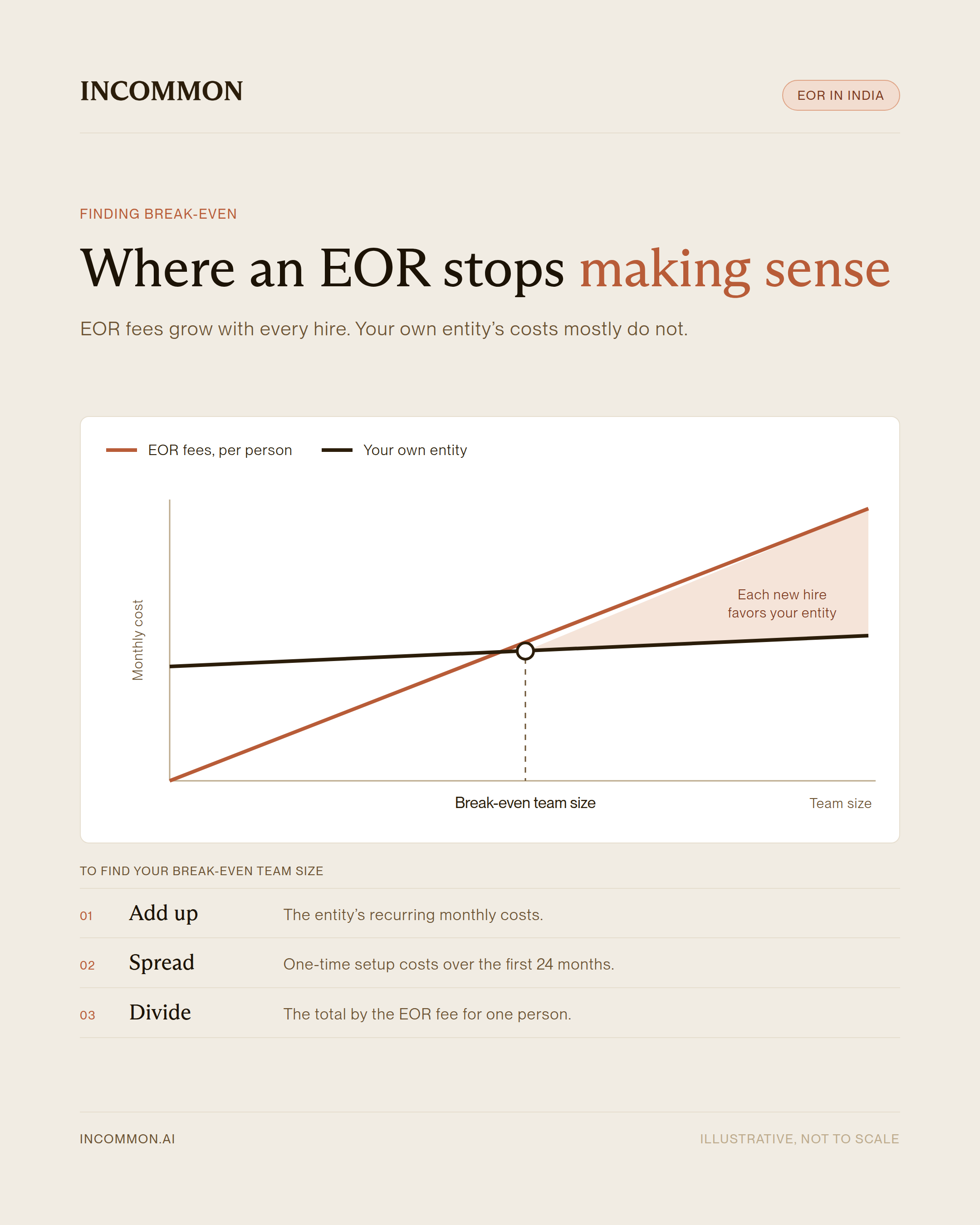
The break-even point is the team size at which your monthly EOR fees equal the monthly cost of running your own entity. Below it, the EOR is cheaper. Above it, every new hire makes the entity look better, because the EOR fee grows with each person and the entity's costs mostly do not.
To find it, add up the entity's recurring monthly costs, and spread the one-time setup costs over the first 2 years. Then divide that monthly total by the EOR fee for one person. The answer is the number of people at which the two options cost the same.
Suppose your entity's monthly costs, with setup spread over 2 years, equal the EOR fee for 12 people. At 12 people, the two routes cost the same. At 18 people, you pay six people's worth of EOR fees each month above the break-even point.
Run the calculation against your hiring plan, not just today's team. A team of 10 that will be 30 by next year has a different answer from a team of 10 that will stay at 10.
Fast-growing teams pass break-even quickly. Veramatic, for example, reached 21 people live in four weeks, with 92% retention across the build.
When to switch from an EOR
If the team will keep growing past break-even, start planning the entity before the bill forces the decision. Incorporation takes about 12 weeks as a planning figure, and payroll, registrations, and contracts need time after that. Waiting until the bill hurts means paying the higher fees for another quarter or two while the entity is set up.
A team that will stay the same size is different. At around 18 people, for example, a stable team may be close enough to break-even that the EOR's simplicity is worth keeping, so run the calculation before deciding.
Cost is only one reason to switch. These reasons matter as much once the team is established:
- Control: Your entity sets the employment terms, policies, and benefits directly, instead of working within the provider's standard terms
- IP: Work is assigned to your own entity from the start, without running through the provider's contracts
- Benefits and equity: You can design benefits and long-term incentives around your team, rather than around what the provider supports
- Presence: An entity can sign its own office lease, open its own accounts, and hire directly as your India center grows
Our overview of how a US company hires in India legally compares all four routes, including direct hiring through your own entity.
When to stay on an EOR
An EOR remains the right choice in several cases. It suits a team below break-even, a market you are still testing, and plans that might change within a year.
It is also the fastest way to start. With InCommon, Podifi had 9 engineers live in 6 weeks, employed through employer of record with no wait for incorporation. That speed is worth paying for when the alternative is waiting a quarter for an entity.
How to make the switch
The switch is easier when it is planned before the first offer. These steps cover most of it:
- Incorporate the entity and complete its registrations
- Set up payroll, benefits, and the new employment contracts
- Agree with the EOR and your counsel how service history, leave balances, and gratuity carry over
- Pick a clean cutover date that lines up with a payroll cycle
- Check your EOR contract for notice periods and any fee for moving people onto your own payroll
The GCC setup timeline shows how long each stage usually takes.
If you are ready to plan the move off an EOR, we can run the switch with you.
Everything you need to build and run your India GCC.
Entity, hiring, workspace and ongoing operations under one agreement.
Final thoughts
An EOR is a sensible way to start in India, and an expensive way to stay once the team grows past break-even. The fee is the only line that changes between routes, so compare it directly with what your own entity would cost.
Work out your break-even point against next year's team, not this month's. If the answer falls inside the next two quarters, start the entity now.
Frequently asked questions
How much does an employer of record cost in India?
An EOR bill has three layers: the salary, the statutory contributions every employer pays, and the provider's fee. The fee is usually a flat monthly amount per employee, though some providers charge a percentage of salary. Salary and statutory contributions cost the same on an EOR or your own entity.
What does an EOR fee cover in India?
It typically covers employment contracts, payroll, statutory filings, and benefits administration. It rarely covers recruitment, devices, or workspace, and some providers add a deposit or a currency conversion margin, so ask about both before signing.
Is an EOR cheaper than setting up an entity in India?
Below the break-even point, yes. Above it, your own entity costs less, because the EOR fee grows with every hire while most of the entity's running costs stay flat.
How do you calculate the break-even point between an EOR and your own entity?
Add up the entity's recurring monthly costs, spread the one-time setup costs over the first 2 years, and divide that monthly total by the EOR fee for one person. The result is the team size at which both routes cost the same. Run it against your hiring plan, not just today's team.
We have 18 people on an EOR in India. Should we switch to our own entity?
If the team will keep growing, start planning the entity now, because incorporation takes about 12 weeks as a planning figure and setup continues after that. If the team will stay at 18, run the break-even calculation first, since the EOR's simplicity may still be worth keeping.
What should you check before moving from an EOR to your own entity?
Agree with the EOR and your counsel how service history, leave balances, and gratuity carry over. Pick a cutover date that lines up with a payroll cycle, and check the EOR contract for notice periods and any fee for moving people onto your own payroll.
Written by
CEO, InCommon
Piyush Kedia is the CEO of InCommon, a talent infrastructure company that helps US and global enterprises set up and scale Global Capability Centers (GCCs) in India. He works with founders, CTOs, and heads of talent to design smaller, AI native GCC teams that focus on judgment work, not just headcount, so India offices stay senior, stable, and production ready. Before InCommon, Piyush built Blue Vector into a 50 person creative agency serving brands such as Trump Towers, Audi, and Porsche, giving him a front row view of how high performing teams are hired, managed, and grown.