GCC-as-a-service vs building it yourself

See how Findigs, Accompany Health, Veramatic and Podifi built their teams.
Real teams, real results, from faster hiring to lasting retention.
Quick look:
| GCC-as-a-service means one partner sets up and runs the operating side of your Global Capability Center. That covers the entity, hiring, payroll, workspace, and compliance, while you own the entity and direct the work. Doing it yourself means contracting a recruiter, a chartered accountant, and a managed office separately, then coordinating them in-house. That route works when you have India operating experience and someone with time to run it. Without both, the gaps between vendors become your job. |
|---|
Every India center starts with the same question from the board. Why pay a partner when a recruiter and an accountant could do the work?
The question is valid, and for some companies the answer is that they should not pay one.
The answer depends on who owns the gaps. Each vendor in the do-it-yourself route owns a slice of the work, and nobody owns the result. That is a manageable problem for a company with the right person on the ground. For a company without one, it becomes the main cost of the center.
This blog is for founders, COOs, and CFOs at growth-stage companies deciding how to stand up an India team. It sets out what each route involves, where the do-it-yourself route breaks, and the conditions under which it is the better choice.
What GCC-as-a-service actually covers
A Global Capability Center is a team in India that belongs to your company. It reports to your leadership and does work you intend to keep. The team also needs an operating layer around it, and GCC-as-a-service hands that layer to one provider.
In practice, the operating layer has four parts:
- The entity: A wholly owned Indian subsidiary incorporated in your name
- Hiring: Starting with the managing director and the first senior people
- Workspace and IT: Desks in a managed office and devices set up to your security baseline
- Running the company: Payroll, statutory filings, and the annual transfer pricing study, month after month
One agreement covers all four.
The distinction from outsourcing is ownership and direction. The entity belongs to you from the first day, and the team takes its priorities from your engineering leadership. A provider running the operating layer does not change who the team works for. Our GCC vs outsourcing comparison draws that line in more detail.
The term is used loosely in this market. Some providers keep your people on their own payroll indefinitely, which is closer to a managed team. Ask any provider who owns the entity, who employs the team, and whose leadership the team reports to. The answers tell you which model you are buying.
What doing it yourself involves
The do-it-yourself route assembles the same four parts from separate suppliers. A typical version looks like this:
- Hiring: A recruiter
- Incorporation and books: A chartered accountant
- Desks: A managed office
- Devices: Your own IT team, shipping from head office
Many companies add an Indian law firm for employment contracts and a payroll provider for the monthly run. Someone at head office coordinates all of them.
Each supplier does its part competently. A chartered accountant can incorporate a subsidiary, register it for tax and labor schemes, and run the monthly filings. A recruiter can fill roles. A managed office can seat a team within weeks.
What none of them does is sequence the work. The entity has to exist, with a funded bank account, before the first payroll. The managing director should be hired before the first 10, because everyone after is measured against the standard those 10 set. Desks and laptops have to be ready before a start date, which means buying for people who have not joined yet.
In this avenue, that sequencing falls to the person at head office. Usually that person already has a full-time job.
Can a recruiter and accountant cover it?
For part of the work, yes. The question is which part, and what is left over.
A chartered accountant covers the entity and its compliance well. Incorporation, tax registrations, provident fund and state insurance registration, monthly accounting, and annual filings are core work for a good firm. The setup sequence behind a subsidiary is familiar to them, and about 12 weeks is a fair planning figure for it.
A recruiter covers the hiring pipeline, within limits. Most agency recruiters are paid when a candidate is placed, so their work ends at the offer. They are strongest with active candidates, the people already looking. The engineers and managers who set the standard for a new center are more often passive, working in good jobs and not answering job posts.
The managing director is the hardest case. The strongest candidates are usually people currently running India centers, and they are rarely on any recruiter's list. The final interview works best when someone who has held the role runs it, which a head-office panel cannot replicate.
What is left over is everything between the suppliers. That includes the office decision, the IT setup, the employment contracts, the offer structure, and the first months of running the team. It also includes the question of who replaces a hire who leaves in month four.
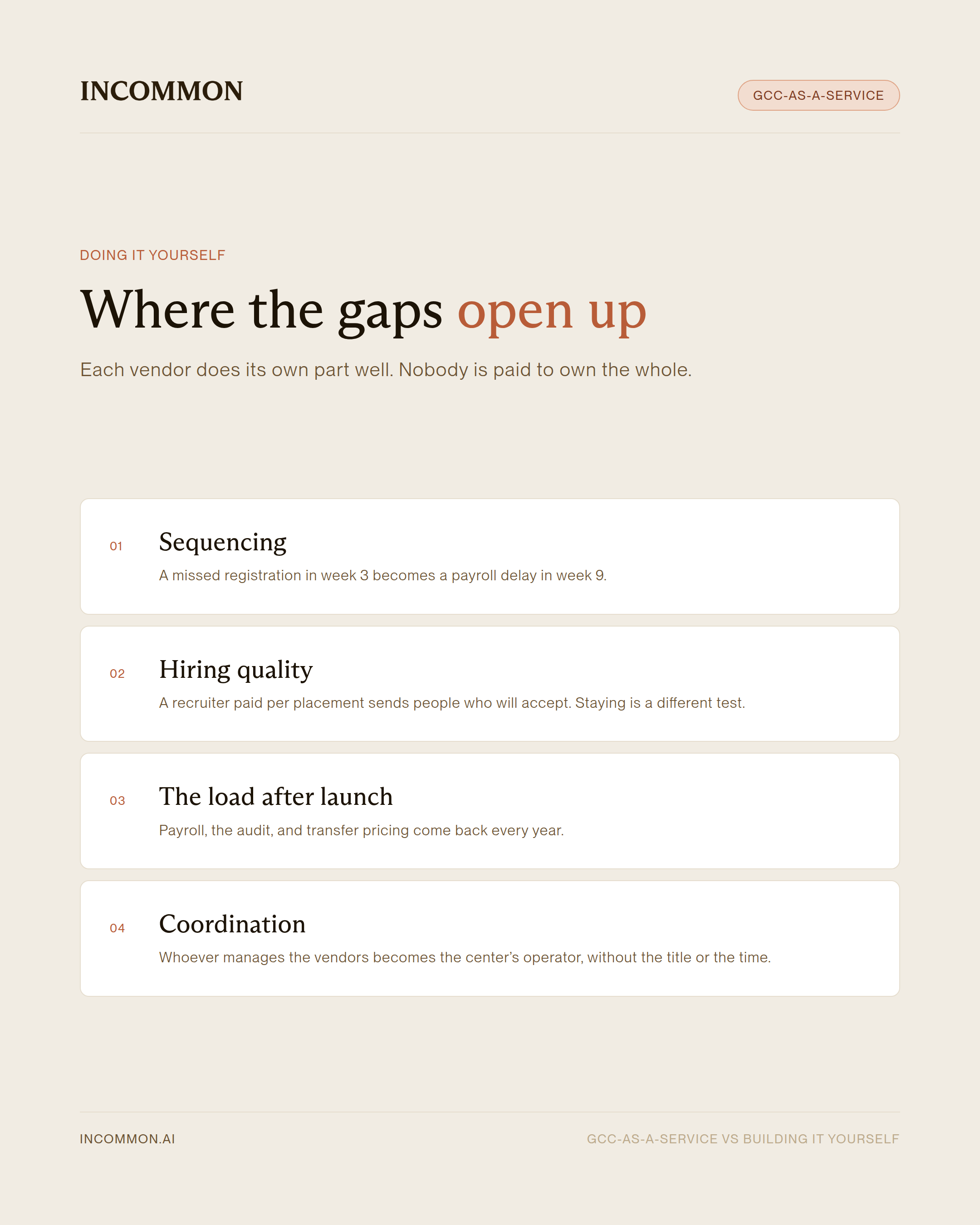
Where the gaps open up
The gaps rarely show up as a single failure. They show up as delays, each owned by nobody in particular.
The first is sequencing. A missed registration in week three becomes a payroll delay in week nine, and by then salaries are committed. The accountant did the filing they were asked to do, but nobody asked about the next one.
The second is hiring quality. A recruiter measured on placements sends candidates who will accept, which is not the same as candidates who will stay. When a hire leaves, the search starts again, and the team carries an empty seat through the replacement's notice period. Turnover is one of the early signals in why capability centers fail.
The third is the operating load after launch. Payroll, benefits, labor law compliance, the statutory audit, and the transfer pricing study all recur. The year-one and year-two costs of a center include 13 lines, and most first-time models leave several out.
The fourth is the one boards notice last. The person coordinating the vendors becomes the center's operating manager by default, without the title or the time. The do-it-yourself route rarely fails at any single task. It fails at coordination, because nobody is paid to own the whole.
When doing it yourself is right
Doing it yourself is the right answer for some companies, and a partner who says otherwise is not being straight with you. Four conditions point that way:
- Experience with time to use it: Strong India operating experience inside the company, paired with dedicated capacity. Experience without time, or time without experience, is not enough
- An existing base: An entity and a trusted person already on the ground
- Low hiring volume: A handful of roles, where relationships are not the constraint
- Control over speed: Control is worth more to you than time, and you understand the trade
When all four apply, the do-it-yourself route can cost less and give you full control of every decision. Recruiters, accountants, and managed offices in India are mature markets, and a company that knows how to use them can assemble a sound center.
There is a simple benchmark for the hiring side. If your own network can produce a managing director candidate you would hire, you have the relationships the route needs. If it cannot, the gap will show up in every hire after that one.
Where an existing advisor fits
Many companies already have an advisor in Bangalore, often a former colleague or someone who has run a center. That advisor is an asset, and it is worth keeping them involved whichever route you choose.
The useful question is whether they are advising on the setup or running it, because those are different jobs. Advising is a few hours a week. Running the setup means incorporating the entity, sitting on interview panels, signing the office agreement, and owning payroll, week after week, for months.
An advisor who wants that job, and has the time, may be the right person to lead a do-it-yourself route. One who does not is still worth keeping on the interview panel. A second opinion from someone you already trust is worth more than anything a partner can say about itself.
The advisor's role and the operating role can sit with different people. Our GCC provider guide sets out how advisors, operators, and employment platforms divide the work.
How the two routes compare
The table shows who owns each job in each route:
| Job | Doing it yourself | GCC-as-a-service |
|---|---|---|
| Entity and registrations | Chartered accountant | Partner, with the entity in your name |
| Managing director hire | Recruiter or your own network | Partner shortlist, your appointment |
| Team hiring | Recruiter, paid per placement | Partner, with a replacement guarantee |
| Workspace | Managed office, contracted separately | Partner, placed in managed space |
| IT and devices | Your IT team, remotely | Partner, to your security baseline |
| Payroll and compliance | Chartered accountant or payroll firm | Partner, monthly |
| Sequencing across all of it | Someone at head office | Partner |
| Who replaces a hire who leaves | You, with a new search | Partner, under the guarantee |
The last two rows decide most cases. In the do-it-yourself route, both land on your own team.
Speed differs too. A partner can employ the first people through an employer of record while the entity is incorporated, so hiring does not wait. How that bridge works is covered in EOR or your own entity.
How to choose between them
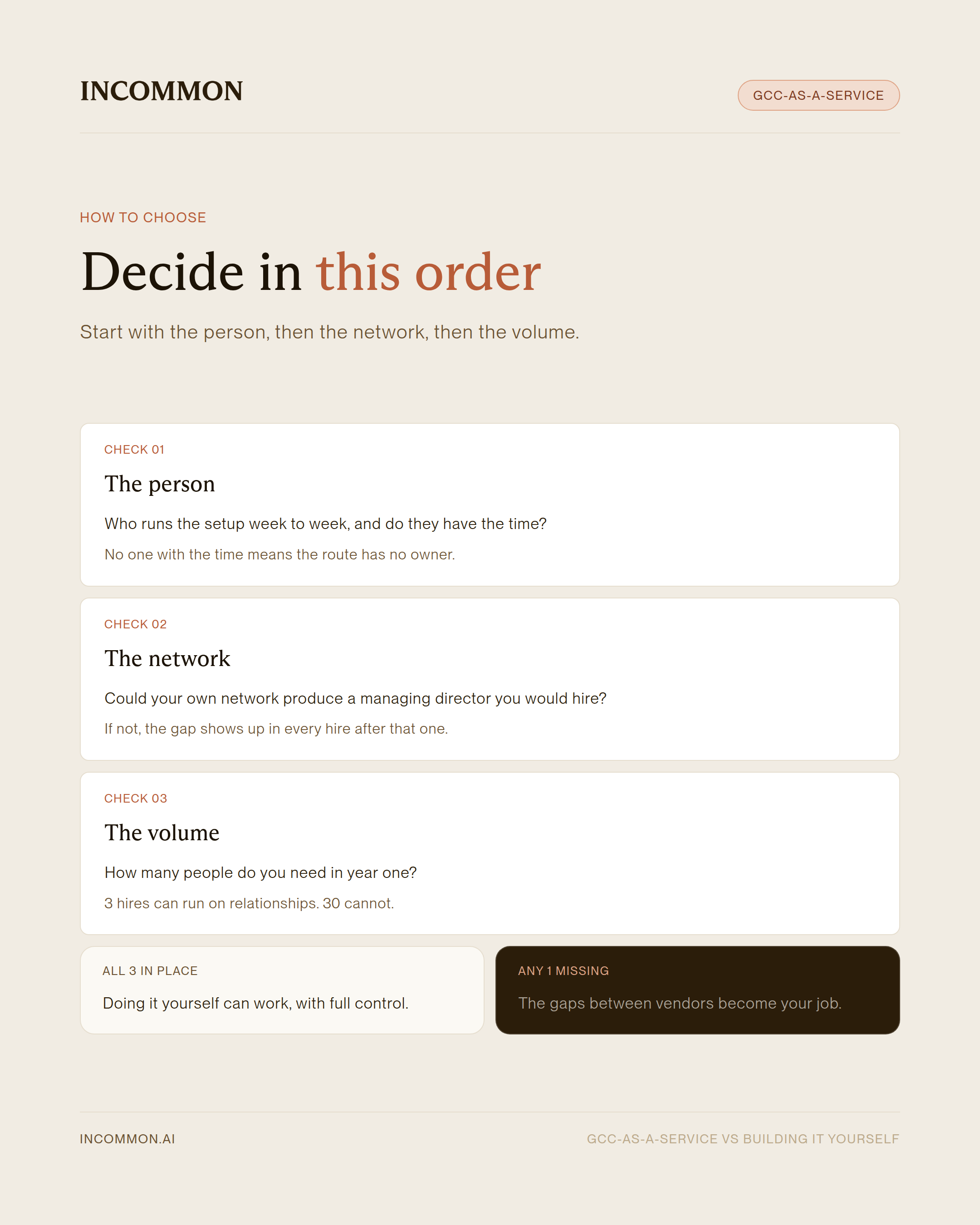
Start with the person, then the network, then the volume.
Name the person who will run the setup week to week, and check their calendar. If that person does not exist, or already runs something else, the do-it-yourself route has no owner.
Test the network against the first senior hire, as above. Then look at volume. Three hires can run on relationships and a good recruiter. Thirty cannot, because informal processes break down well before a center reaches that size.
If the answers point to a provider, ask each one for evidence. Ask how many hires stayed, not how many were placed. Ask who replaces a hire who leaves, and on what terms.
Then ask how the managing director shortlist is built. The strongest version draws on people currently running India centers, with the final interview run by someone who has held the role. You make the appointment. The provider's job is to put candidates in front of you that your own network could not reach.
At InCommon, we run the operating layer under one agreement, with the entity owned by the client from day one. Our talent pool is around 700 people, each of whom we have actually spoken to, and 33% of the candidates we send are hired. We give a six-month replacement guarantee on every candidate, and our India office setup covers the workspace, IT, and payroll.
The published results show what that looks like. Accompany Health reached 22 people, with 10 weeks to a live team and 100% retention across the build. Findigs had 60 underwriters hired in four months, with 90% still in place. Veramatic reached 21 people live in four weeks, with 92% retention across the build.
Those figures are what to ask any partner for, including us. For PE-backed portfolio companies, the same numbers show whether the team will be in place when the value creation plan needs it.
If you would like to ask us for those figures, start here.
Everything you need to build and run your India GCC.
Entity, hiring, workspace and ongoing operations under one agreement.
Final thoughts
The choice turns on who owns the result. With the experience, the time, and the network, the do-it-yourself route gives you control at a lower fee. Without any one of the three, the gaps between vendors become someone's second job.
Decide who runs the setup before you decide how. That one answer settles most of the question.
Frequently asked questions
What is the difference between GCC-as-a-service and setting up the center yourself?
GCC-as-a-service hands the operating layer of your India center to one provider: the entity, hiring, workspace, IT, payroll, and compliance. Doing it yourself assembles the same parts from separate suppliers, such as a recruiter, a chartered accountant, and a managed office, and coordinates them from head office. The difference is who owns the sequencing and the result.
Can we just do the India setup ourselves with a recruiter and an accountant?
They can cover part of the work. A chartered accountant can incorporate the subsidiary and run its compliance, and a recruiter can fill roles, mostly from active candidates. What is left over is the sequencing between them, the managing director search, workspace, IT, and replacing hires who leave. That work falls to someone at head office.
We already have an advisor in Bangalore. Do we still need a setup partner?
Keep the advisor either way. The useful question is whether they are advising on the setup or running it. Running it means incorporating the entity, sitting on interview panels, signing the office agreement, and owning payroll for months. An advisor who wants that job can lead a do-it-yourself route, and one who does not is still worth keeping on the interview panel.
What does GCC-as-a-service include?
It covers four parts under one agreement: a wholly owned Indian subsidiary in your name, hiring from the managing director down, managed workspace and IT set up to your security baseline, and the monthly running of payroll, filings, and the transfer pricing study.
Is GCC-as-a-service the same as outsourcing?
It is not, as long as the entity belongs to you and the team reports to your own leadership. Ask any provider who owns the entity, who employs the team, and whose leadership the team reports to. A provider that keeps your people on its own payroll indefinitely is closer to a managed team.
When should a company set up its India center itself?
Doing it yourself fits when four conditions apply: strong India operating experience paired with dedicated capacity, an existing entity with a trusted person on the ground, low hiring volume, and a preference for control over speed. A useful test is whether your own network can produce a managing director candidate you would hire.
Written by
CEO, InCommon
Piyush Kedia is the CEO of InCommon, a talent infrastructure company that helps US and global enterprises set up and scale Global Capability Centers (GCCs) in India. He works with founders, CTOs, and heads of talent to design smaller, AI native GCC teams that focus on judgment work, not just headcount, so India offices stay senior, stable, and production ready. Before InCommon, Piyush built Blue Vector into a 50 person creative agency serving brands such as Trump Towers, Audi, and Porsche, giving him a front row view of how high performing teams are hired, managed, and grown.