
Transfer pricing for an India captive, safe harbor, margins, and documentation

Quick look:
| Transfer pricing in India applies from the first invoice your Indian subsidiary sends your US or European company. The subsidiary must bill its costs plus an arm's length margin, and India taxes that margin as the subsidiary's profit. From tax year 2026-27, an IT services center can elect safe harbor, which fixes the margin at 15.5% of operating expense for up to five years. On either route, the entity keeps documentation and files an accountant's report every year. |
|---|
Your India entity cannot work for your parent company at cost. Indian tax law treats the two as related parties, so the entity bills its operating cost plus a margin that India taxes as profit. For an IT services center, the 2026 safe harbor rules fix the margin at 15.5%. The real decision is whether to take that number or defend a margin of your own.
This guide is for CFOs and founders of US and European companies setting up their first India entity. It explains how the rules apply and when safe harbor is the right choice, then covers the intercompany agreement and the yearly paperwork.
How transfer pricing reaches your India entity
Transfer pricing is the set of rules for pricing work between companies in the same group. India's rules now live in Chapter X of the Income-tax Act, 2025, which replaced the 1961 Act from 1 April 2026. The sections and forms were renumbered, but the principle carried over unchanged.
That principle is the arm's length price. Your parent and its India entity, usually a wholly owned subsidiary, are associated enterprises. The tax department asks what an unrelated company would charge for the same work. For a center that writes code to your specification and carries no market risk, the accepted answer is a cost-plus markup on operating expense.
Tax rulings still call an entity with that profile a captive. The word describes how little risk the entity carries, not the quality of its work. Because the parent keeps both the upside and the losses, the entity earns a modest, steady margin on its costs.
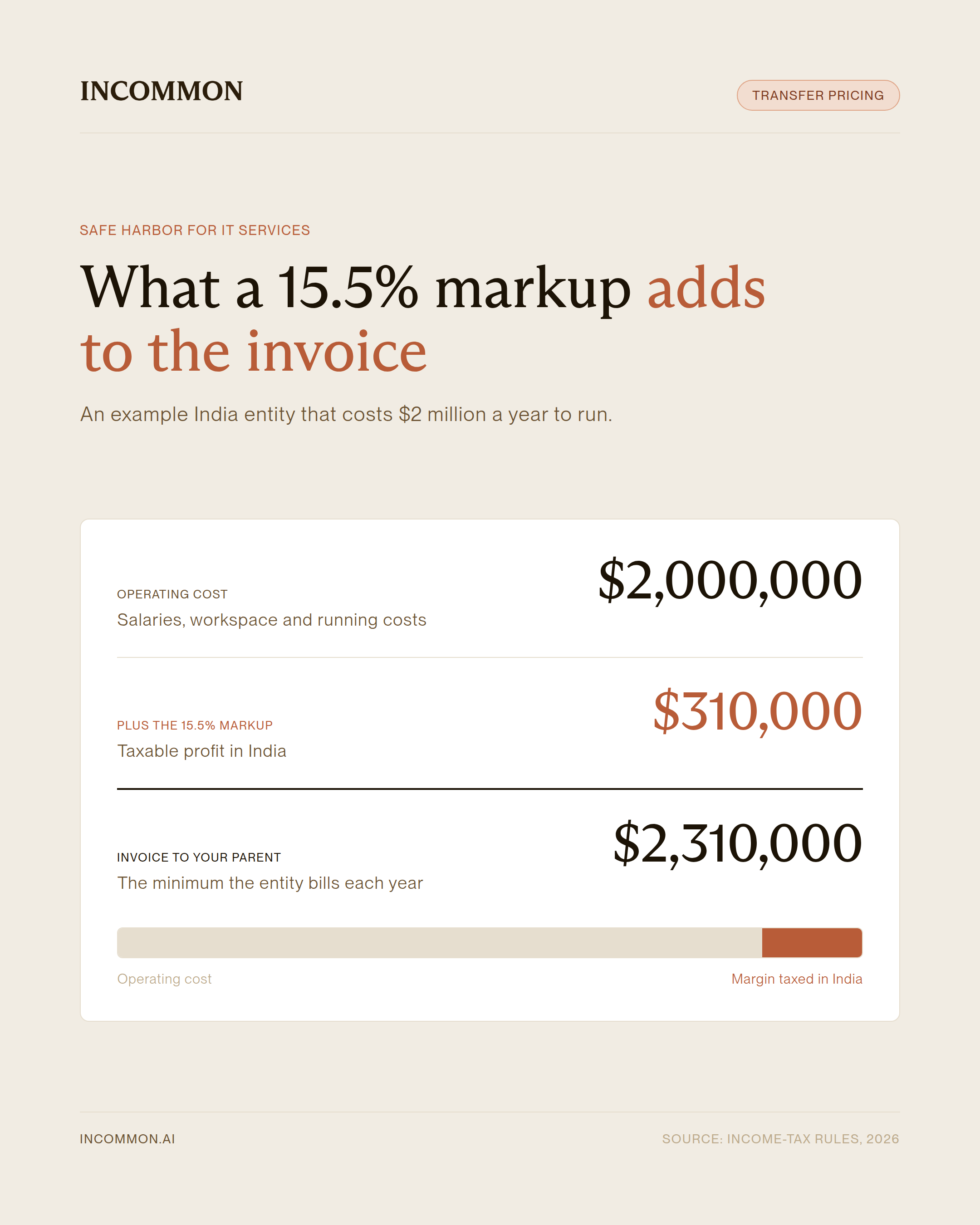
At a 15.5% markup, a center that costs $2 million a year to run bills its parent at least $2.31 million. The $310,000 difference is taxable profit in India. Transfer pricing starts with the first invoice, months before the team is complete, so the tax on that margin belongs in your year-one and year-two costs.
The safe harbor route for IT services
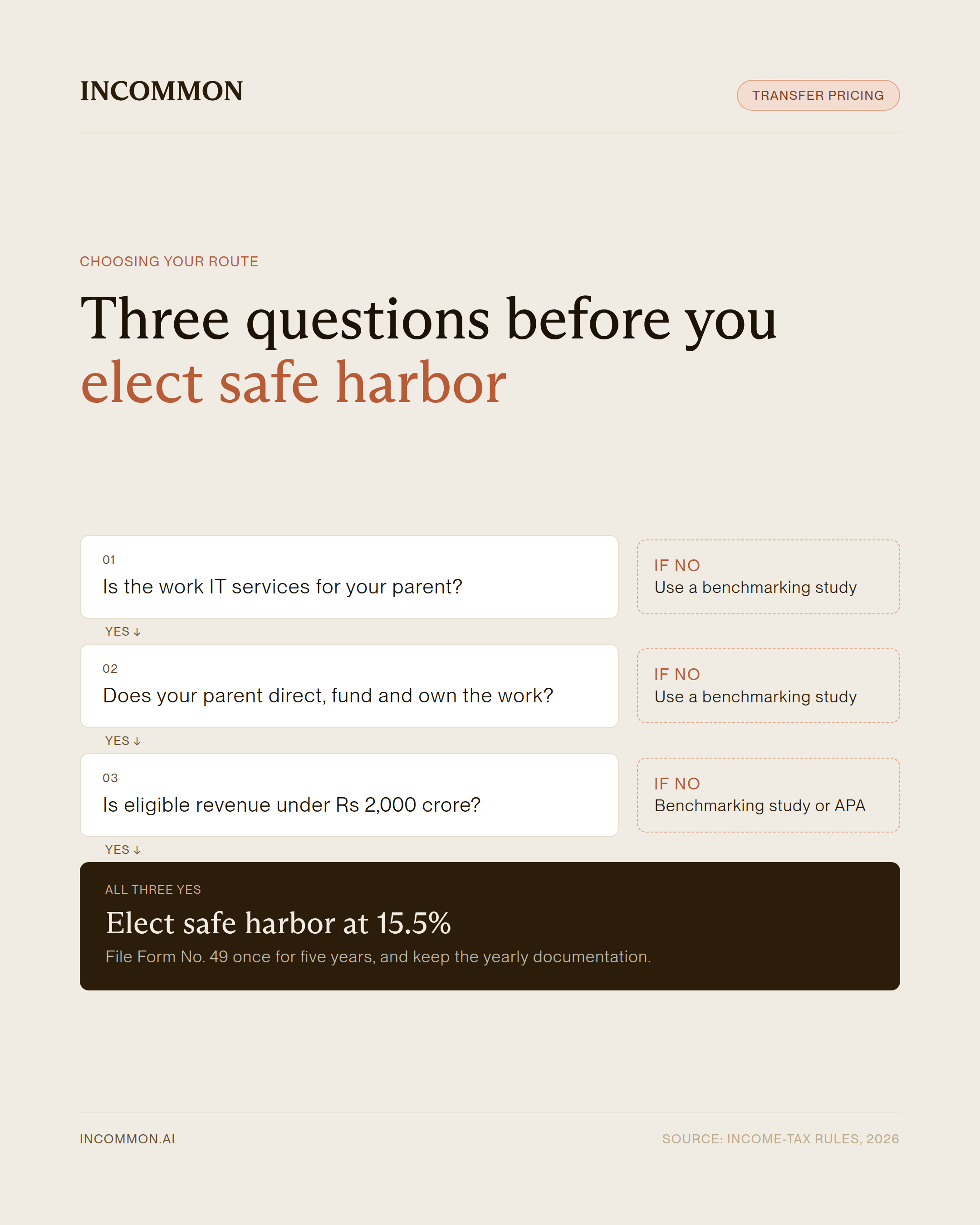
Safe harbor is an election under section 167 of the Income-tax Act, 2025. When a center qualifies and opts in, the tax department accepts its declared margin without a transfer pricing audit of that transaction. The Union Budget 2026-27 reset the terms for IT work, and the new rules apply from tax year 2026-27:
- Software development, IT-enabled services, knowledge process outsourcing, and software-related contract R&D now form one category, called information technology services
- The margin is 15.5% of operating expense across that whole category
- The ceiling on eligible revenue rose from Rs 300 crore to Rs 2,000 crore
- Approval runs through an automated, rule-driven process with no tax officer reviewing the application
- A company that opts in can continue on the same terms for five consecutive years
Rs 2,000 crore is Rs 20 billion, far above what a team of a few dozen engineers bills. What decides eligibility for a center that size is how it works, which the next sections cover.
To opt in, the center files Form No. 49 on the income tax e-filing portal. For IT services, one form covers the five-year period. It is due by 30 June of the year after the first tax year, which is 30 June 2027 for a center electing from tax year 2026-27.
The department's Form No. 49 FAQ also confirms that safe harbor is closed to transactions with associated enterprises in jurisdictions notified as no-tax or low-tax. Check that point if your parent holds the India entity through an intermediate company.
Safe harbor, benchmarking, or an APA
Safe harbor is one of three ways to settle the margin, and each one is the better choice somewhere. A benchmarking study compares your center with independent companies doing similar work, and it supports whatever margin those comparables show. An advance pricing agreement, or APA, fixes the method with the Central Board of Direct Taxes (CBDT) for a set period.
The Budget also proposed fast-tracking unilateral APAs for IT services, with a target of concluding them within two years. The table compares the three routes on the questions a CFO asks first:
| Question | Safe harbor | Benchmarking study | APA |
|---|---|---|---|
| How the margin is set | 15.5% of operating expense | By comparison with independent companies | Agreed with the CBDT |
| Audit risk on the margin | None once the election is accepted | A transfer pricing officer can adjust it | None for the years covered |
| Work each year | Documentation and the accountant's report | A fresh study, documentation, and the report | Annual compliance after the negotiation |
| Time to certainty | An automated decision | Only after any audit closes | Up to two years under the fast track, extendable by six months |
| Best fit | A low-risk IT services center that wants a settled number | A center whose comparables support a lower margin, or whose work falls outside the category | A larger center with complex transactions and a lot riding on them |
At InCommon, we would take safe harbor for a growth-stage center doing engineering under your direction. A benchmarking study only pays off when the comparables support a margin below 15.5%. Even then, the tax saved on the difference is small next to the cost of defending a lower margin in an audit.
An APA earns its negotiation on a large center with complex transactions. For a center of 30 to 35 people, the negotiation costs more than the certainty it buys.
When safe harbor is the wrong choice
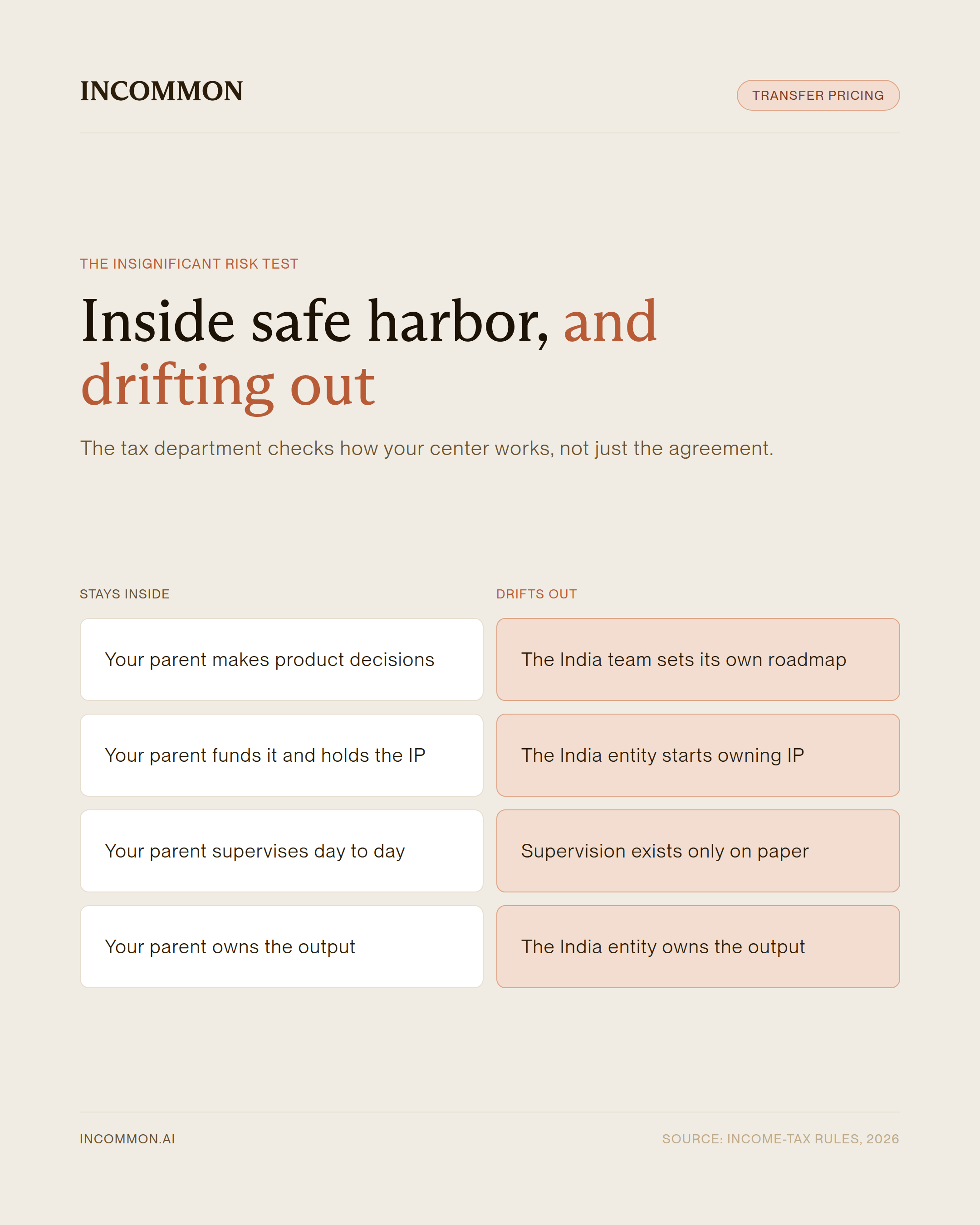
The election comes with conditions, and a center that fails them is better off with a study. The IT services category covers work done with insignificant risk for a non-resident associated enterprise. That is the low-risk profile described in captive center vs GCC, and in practice it means the parent does four things:
- It directs the work and makes the product decisions
- It funds the center and provides the key assets, including the intellectual property (IP)
- It supervises the team in practice, not only on paper
- It owns whatever the center produces
A center that starts owning IP or setting its own roadmap drifts out of that profile, whatever the intercompany agreement says. The tax department looks at how the center actually works, so the agreement and the daily reality have to match. Keeping ownership with the parent starts with the employment and assignment terms, which our guide to protecting your IP covers.
A center that qualifies still accepts three trade-offs when it elects:
- The 15.5% margin is a floor in every year the election covers, including a year when costs rise faster than planned
- Rule 93 of the 2026 Rules bars the treaty's mutual agreement procedure once the price is accepted, so double tax relief is closed for that transaction
- The documentation and the accountant's report are still required, so the paperwork shrinks less than the audit risk does
For a center doing engineering under your direction, none of the three outweighs a settled margin. They count for more when the India team will own product work, or when the group already has a tax dispute in another country.
Set the markup before the first invoice
Agree the intercompany terms before the entity sends its first invoice. A markup settled at year-end has to be applied backward across twelve months of invoices. The correction then arrives as one large payment.
Our default is a cost-plus markup on operating expense, agreed up front, and the intercompany services agreement is where it is written down. The agreement needs four things:
- The services the center provides, described the way the work is actually done
- The cost base, showing which costs carry the markup and which pass through at cost
- The markup itself, which is 15.5% under safe harbor
- The invoicing cadence and how year-end differences are trued up
The cost base is where first-year numbers go wrong, because it moves fastest. A team that grows the way Accompany Health's did changes its cost base every month of its first quarter. The numbers on that build were 22 people, 10 weeks to a live team, 100% retention across the build. Invoice monthly on actual cost, so the markup tracks the team as it grows.
The markup is also a cost to the group in every year, and the tax on it grows with the center. That is why our five-year cost view carries it as its own line, alongside the renewal decision when a five-year election ends.
The documents you keep every year
Every entity with international transactions keeps transfer pricing documentation under section 171 of the Act, and Rule 84 sets out what goes in it. The rule lists 13 items, and they come down to three questions a reviewer asks of the file:
- Who the group is, and how the India entity is owned
- What the center does, the risks it carries, and the assets it uses
- How the price was set, with the method, the comparables or the safe harbor election, and the working
The rule asks for the file to be contemporaneous and to be kept for nine years from the end of the tax year. When a transaction runs unchanged across years, the existing file is updated, and a fresh one is needed only when the terms or the underlying assumptions change.
Below Rs 1 crore of international transactions in a tax year, the full list does not apply. The entity must still show that its income was computed at arm's length. Rs 1 crore is Rs 10 million, so a center with a funded team passes it early in its first year.
Three filings follow from the documentation, and the table shows when each one applies:
| Filing | What it is | When |
|---|---|---|
| Form No. 48 | The accountant's report on international transactions, which replaced Form 3CEB | Every year, at least one month before the return is due |
| Form No. 49 | The safe harbor election for IT services, covering five years | Once, by 30 June after the first elected tax year |
| Form No. 56 | The master file | When group revenue exceeds Rs 500 crore and the entity's international transactions exceed Rs 50 crore |
A chartered accountant signs Form No. 48 and confirms that the documentation exists, so the file has to be finished first. Rule 85 sets the one-month deadline. Form No. 48 also asks for more detail than Form 3CEB did, so allow extra time for the first one under the new Act.
When a provider runs the entity for you, the study belongs on its written list of services, as our guide to GCC partner pricing and contracts explains.
What a missed filing costs
The penalties are set per transaction, and for a services center the main transaction is its entire service fee:
- 2% of the transaction's value for failing to keep the documentation, failing to report a transaction, or keeping incorrect records, under section 442
- A further 2% of the value for failing to produce the documentation within ten days when an officer asks, under section 457
- Rs 100,000 for not furnishing the accountant's report, under section 447
On a $2.31 million service fee, a 2% penalty comes to about $46,000, before any change to the margin itself. A transfer pricing officer who rejects the margin can also raise the entity's taxable income for the year. A file written during the year costs far less than one rebuilt during an audit.
No entity yet, no transfer pricing
Hiring through an employer of record defers all of this. On an employer of record, a third party employs the team and invoices your company. There is no related party in India, so there is no intercompany price to set. Podifi had 9 engineers live in 6 weeks, employed through employer of record with no wait for incorporation.
Transfer pricing begins when you incorporate and the team moves into your own entity. Our comparison of EOR vs your own India entity covers when that move makes sense.
We run the transfer pricing study as part of running the entity, alongside payroll and the annual filings. If you are setting up that entity now, this is how we work.
Everything you need to build and run your India GCC.
Entity, hiring, workspace and ongoing operations under one agreement.
Final thoughts
Transfer pricing is one of the few India costs you can settle before the team exists. Choose the route, sign the agreement, and open the file in the same quarter you incorporate. A center that does those three things early spends its first audit explaining a decision it has already made.
Frequently asked questions
What are India's transfer pricing rules for a captive services company?
An Indian subsidiary that provides services to its foreign parent must charge an arm's length price. For a low-risk services center, that is usually its operating cost plus a markup. The rules are in Chapter X of the Income-tax Act, 2025, and the entity keeps documentation under Rule 84 and files an accountant's report in Form No. 48 every year.
What is India's safe harbor margin for IT services, and does it apply to us?
From tax year 2026-27, the margin is 15.5% of operating expense for information technology services, a category covering software development, IT-enabled services, knowledge process outsourcing, and software-related contract R&D. It applies to a center doing that work with insignificant risk for a non-resident associated enterprise, with eligible revenue up to Rs 2,000 crore, once the center opts in through Form No. 49.
Does electing safe harbor remove the need for transfer pricing documentation?
No. The election removes the audit of the margin for the elected transaction, but the entity still keeps documentation under section 171 and Rule 84 and still files the accountant's report in Form No. 48.
When is Form No. 48 due?
Rule 85 of the Income-tax Rules, 2026 requires the accountant's report at least one month before the due date for the entity's return of income. Form No. 48 replaced Form 3CEB from tax year 2026-27.
Does transfer pricing apply if we hire through an employer of record?
Not to your company. On an employer of record, a third party employs the team and invoices you, so there is no related party in India. Transfer pricing starts once your own Indian entity employs the team and bills your parent.
Does transfer pricing apply in the first year, before the team is complete?
Yes. It applies from the first invoice the entity sends its parent, whatever the team's size. Full documentation is not required where the year's international transactions total Rs 1 crore or less, but the entity must still show its income was computed at arm's length.
Written by
CEO, InCommon
Piyush Kedia is the CEO of InCommon, a talent infrastructure company that helps US and global enterprises set up and scale Global Capability Centers (GCCs) in India. He works with founders, CTOs, and heads of talent to design smaller, AI native GCC teams that focus on judgment work, not just headcount, so India offices stay senior, stable, and production ready. Before InCommon, Piyush built Blue Vector into a 50 person creative agency serving brands such as Trump Towers, Audi, and Porsche, giving him a front row view of how high performing teams are hired, managed, and grown.
RELATED READS
Talk to us about your India team
Bring us your plans for India, and we'll map out how your first team comes together.