How to hire engineers in India without lowering the bar

See how Findigs, Accompany Health, Veramatic and Podifi built their teams.
Real teams, real results, from faster hiring to lasting retention.
Quick look:
| To hire engineers in India without lowering the bar, write the bar down before sourcing starts and use the same scorecard in both offices. Find candidates before roles open, have someone who has done the job vet each one, and test actual work instead of interview polish. Hire the team leads first, and then grow in waves. Check each wave against the standard set by the last. Measure the bar after people join as well, not just at the offer. |
|---|
Companies can hire 20 engineers in India who clear the same bar as their US team. It works when the bar is written down and every interviewer judges candidates against it. Standards rarely drop by decision. They drift, one rushed hire at a time, when a team grows faster than its hiring process.
This guide is for CTOs, engineering leaders, and founders at growth-stage companies who need to scale an engineering team in India without a second, lower standard. It covers how the bar slips, the hiring system that holds it, and how to keep it once people join. If you need the interview questions themselves, our interview playbook lists them.
Why the bar slips as hiring scales
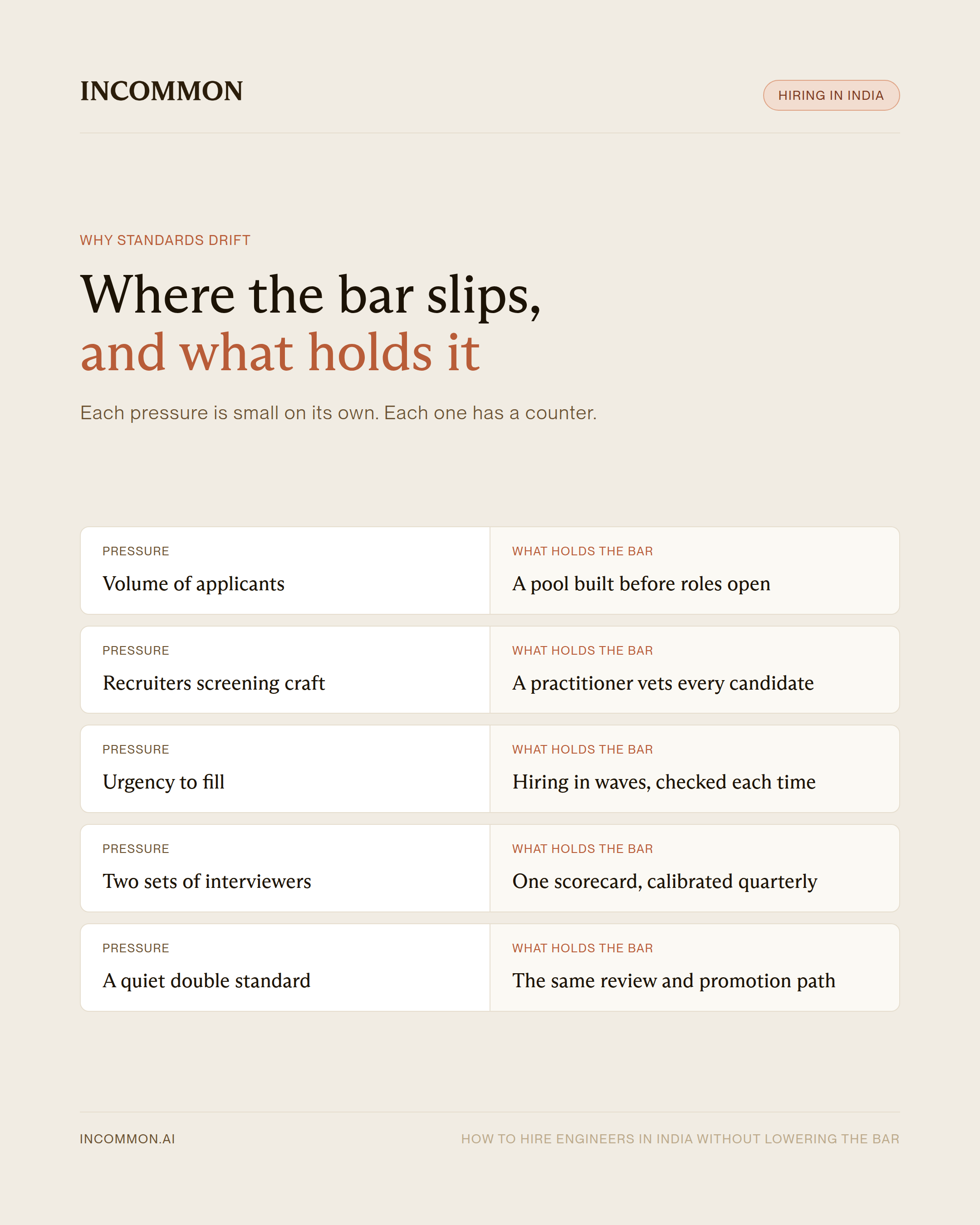
When a company hires at volume, every step of the hiring process is under pressure at the same time, and each step lowers the bar by a little bit.
These are the usual causes:
- Volume: A role with hundreds of applicants leaves seconds for each CV, so screening turns into triage
- Who screens: A recruiter can match keywords against a job description but cannot judge depth in work they have never done
- Urgency: An open role with a deadline makes a good-enough candidate look better every week
- Two sets of interviewers: Interviewers in two offices drift apart unless someone calibrates them against each other
- A quiet double standard: "Strong for India" becomes a separate bar without anyone saying it out loud
Each one is small on its own. Together, they explain most of the gap between what a company meant to hire and who it actually hired.
Write the hiring bar down before sourcing
The bar has to exist on paper before the first candidate is contacted. A written scorecard turns a hiring manager's instinct into a standard that both offices can share.
For each role, the scorecard should answer three questions:
- What will this person own in their first 6 months?
- Which skills will the interviews test, and how?
- What does a strong answer look like, compared with an acceptable one?
Calibrate the scorecard against people you have already hired. Pick 2 or 3 engineers in your home office who clear the bar comfortably, and check that the scorecard would have hired them. If it would not, the scorecard is measures the wrong things.
Use one scorecard in both offices
A single scorecard only works if both offices use it the same way. The same levels, the same interview loop, and the same definition of "strong" apply to a hire in Bengaluru and a hire in your home office.
Calibrate the interviewers as well as the document. New interviewers in India should shadow interviews run by your home team, then run paired interviews before interviewing alone. Compare scores across the two offices every quarter, because drift is easier to catch in the numbers than in the conversations.
Pay is the one thing that differs, and it should. Benchmark it against the India market, and include the full cost of an employee, which our breakdown of what an India employee costs sets out. The bar for the work stays the same.
Find people before the role opens
The strongest engineers in India are rarely applying for jobs. A posting reaches whoever happened to be looking during the two weeks it was live, and that is a small and uneven slice of the market.
A pool built ahead of demand changes that. At InCommon, ours runs to around 700 people, each of whom we have actually spoken to. It is fed by outreach, referrals, inbound interest, and events where we watch people build.
Events show work that a CV cannot. The Better Hack, our hackathon series, ran two editions in 2025 in Pune and Bengaluru, drew over 1,000 applications, and accepted under 2% of them. A 24-hour build shows how a person works when the problem has stakes, and the clock is running.
Referrals gain importance as the team grows, too. Engineers who already clear the bar tend to refer people who would clear it as well.
Have practitioners vet every candidate
A recruiter's limit comes from the role, not the person. Assessing work you have never done is hard, so screening falls back on keywords, titles, and confidence.
Every candidate should reach you only after someone who has done the job has examined their work. That person looks past polished answers to how the candidate reasons through a problem, and signs off on the result. In our process, that is a 45-minute interview with a domain expert, judged on four things:
- Depth of craft: How well the candidate actually does the work, beyond what they can describe
- Real ownership: What they built or decided themselves, as opposed to what their team did around them
- Trajectory: How fast they have grown, which says more about where they are heading than their years of experience
- Signal over polish: Substance in the answers, rather than a well-rehearsed delivery
As a result, your hiring manager sees only a few candidates. We put five candidates in front of you for each role, so your interviewers spend their time on people who already clear the bar.
Test the work, not the interview
Interviews reward people who interview well, which is a different skill from the one you are hiring for. The fix is to make the interview look like the job.
Use a work sample or a pairing session on a problem taken from your codebase, with the candidate explaining their reasoning as they go. Include a review of AI-generated code, because catching its mistakes is now part of the job. Our guide to AI skills assessment covers how to test that.
Run the same exercise for every candidate in a role. A shared exercise is what makes scores comparable across interviewers and across offices.
Hire the team lead first
The first person you hire in India sets the standard for everyone after them. The lead runs interviews, shapes the first 10 hires, and decides what good looks like day to day.
So hire the lead before the team, even if it delays the first engineers. For the senior India leader, we put the top five candidates in front of you, and someone who has held the role runs the final interview. When the leader arrives too late, the first hires set the standard without them.
Hiring 20 engineers without dropping the standard
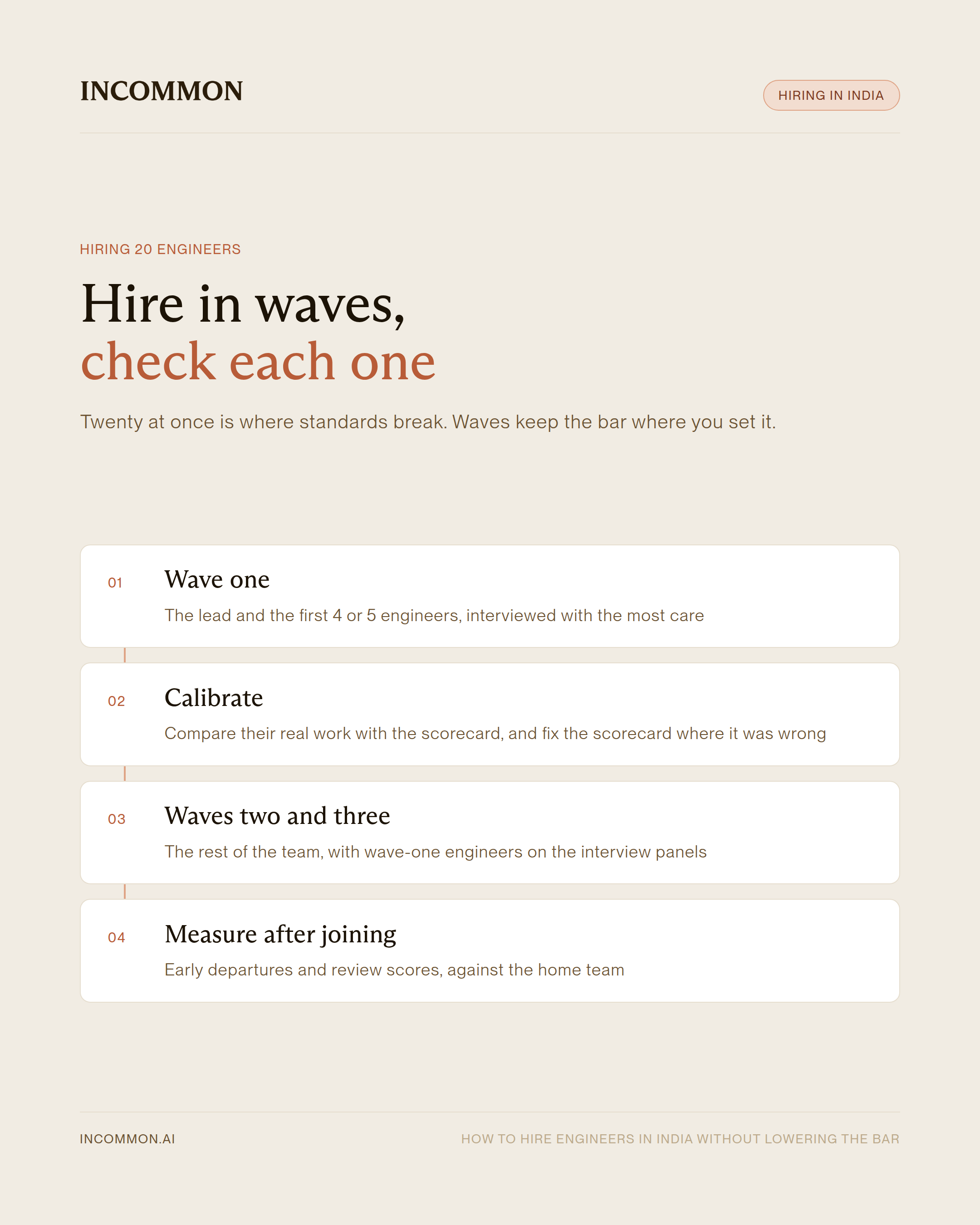
Hiring 20 engineers at once is where most standards break. The answer is to hire in waves, and to check each wave before the next one starts.
A plan that holds the bar looks like this:
- Wave one: The lead and the first 4 or 5 engineers, interviewed with the most care, because they will interview everyone after them
- Calibration: Once wave one has shipped real work, compare their performance with the scorecard and adjust it where it was wrong
- Waves two and three: The rest of the team in groups, with wave-one engineers joining the interview panels
Waves can still move quickly. Veramatic reached 21 people live in four weeks, with 92% retention across the build. Findigs had 60 underwriters hired in four months, with 90% still in place.
Our guide to GCC team structure covers which roles to hire in each wave.
This is how hiring in waves has worked for teams we have built.
See how Findigs, Accompany Health, Veramatic and Podifi built their teams.
Real teams, real results, from faster hiring to lasting retention.
Measure the bar after people join
An offer is not proof that the bar held. The evidence comes later, in how new hires perform and whether they stay.
Track these for every wave:
- Send-to-hire rate: The share of candidates sent who are hired. Ours is 33%, and a sharp drop suggests the shortlist and the bar have drifted apart
- Early departures: Anyone leaving in the first 6 months. Each one is a hiring signal, and we give a six-month replacement guarantee on every candidate for that reason
- Performance at review: India hires scored on the same review cycle as your home team, so the comparison is direct
If India hires consistently score lower on the same review, the bar has slipped somewhere upstream. Go back to the scorecard and the interviewers before blaming the market.
Keep the standard after hiring
Hiring to the bar is wasted if the team is then held to a lower standard once it starts work. New engineers in India need the same onboarding, the same code review standards, and the same promotion path as everyone else.
Promotion is where double standards show first. An engineer who has to move to your home office to reach a senior level will leave before they get there. Our guide to managing an India team covers the habits that keep one standard across both offices.
Final thoughts
Hiring quality in India depends on your hiring system, not on the talent market itself. The talent is there. What slips is the scorecard, the vetting, and the patience to hire in waves.
Write the bar down, make both offices use it, and check it after every wave. Those three steps let you hire 20 engineers who clear the same bar as your home team.
Frequently asked questions
How do you hire engineers in India without lowering the bar?
Write the bar down as a scorecard before sourcing, use the same scorecard in both offices, have someone who has done the job vet every candidate, and test real work rather than interview polish. Hire the team lead first, then grow in waves and check each wave against the standard.
How do you keep an India team on the same standard as the US team?
Use one set of levels, one interview loop, and one review cycle in both offices. Calibrate interviewers through shadowing and paired interviews, compare scores across offices every quarter, and give India engineers the same onboarding and promotion path as everyone else.
We need 20 engineers in India who clear the same bar as our US team. How do we do it?
Hire in waves. Start with the lead and the first 4 or 5 engineers, check their work against the scorecard and adjust it, then hire the rest in groups with wave-one engineers on the interview panels.
Why do hiring standards slip when a team scales?
Volume turns screening into triage, recruiters cannot judge depth in work they have not done, urgency makes good-enough candidates look better, interviewers in two offices drift apart, and a quiet double standard can creep in.
What should a technical interview for India engineers test?
The work the role will actually do. A work sample or a pairing session on a real problem, with the candidate explaining their reasoning, shows more than questions about a CV. Include a review of AI-generated code, and run the same exercise for every candidate in a role.
How do you know the hiring bar held after people join?
Track the send-to-hire rate, early departures in the first 6 months, and how India hires score on the same review cycle as your home team. Consistently lower scores mean the bar slipped somewhere upstream.
Written by
CEO, InCommon
Piyush Kedia is the CEO of InCommon, a talent infrastructure company that helps US and global enterprises set up and scale Global Capability Centers (GCCs) in India. He works with founders, CTOs, and heads of talent to design smaller, AI native GCC teams that focus on judgment work, not just headcount, so India offices stay senior, stable, and production ready. Before InCommon, Piyush built Blue Vector into a 50 person creative agency serving brands such as Trump Towers, Audi, and Porsche, giving him a front row view of how high performing teams are hired, managed, and grown.