GCC roles and team structure, how to set up an India team in year one

See how Findigs, Accompany Health, Veramatic and Podifi built their teams.
Real teams, real results, from faster hiring to lasting retention.
Quick look:
| A first-year GCC team in India is set up in order. The managing director comes first, then the senior leads who set the hiring bar, then delivery pods. We hire in pods of 8 people, each senior-led and cross-functional, and 3 or 4 pods make a center of 30 to 35. The team reports into your engineering leadership. Inside that structure, eight skills separate strong GCC hires from weak ones. |
|---|
Most first-year India teams are planned as a single number of hires. However, the stronger plan is a sequence:
- Who joins first
- What shape the team takes
- Who it reports to
Get these three things right, and the first 30 hires follow a clear pattern. Get them wrong, and each hire becomes its own decision.
This guide is for founders, CTOs, and COOs planning the first year of an India team. It covers the roles and structure first, then the skills to look for in every hire.
What is a GCC?
A Global Capability Center is an offshore unit set up by a company to manage functions like IT, finance, HR, analytics, or customer support. Unlike outsourcing, GCCs are owned by the company itself. They provide cost control, skilled talent, and strategic value while remaining tightly connected to headquarters.
Who to hire first
Hire the managing director before the team. Everyone who joins afterward is measured against the standard the first senior hires set, so those hires shape the center more than any later decision.
The managing director is also the hardest role to fill.
The strongest candidates are usually people currently running India centers, and they are rarely looking. At InCommon we source the role from that group, and someone who has held the job runs the final interview. You make the appointment.
Next come the senior leads for the first pod, the engineering manager and the tech lead. They interview the engineers who follow, so their judgment carries into every later hire.
A deadline should not change the order. Podifi got 9 engineers live in 6 weeks, employed through employer of record with no wait for incorporation. The lead still came first. How that route works is covered in EOR or your own entity.
The pod, your repeatable unit
The pod is your working unit for year one:
| Function | Roles |
|---|---|
| Leadership | Engineering manager, senior product manager |
| Delivery | Tech lead, three senior engineers, product designer, QA and SDET |
Because the pod is cross-functional, it can take on a product area without borrowing design or testing from headquarters. It is senior-heavy by design, which keeps the hiring bar high while the center is still small.
Grow by adding pods.
A second pod copies the shape of the first, so the center scales without redesigning the team each time.
Decide where each pod works before the first offer goes out. Office, hybrid, and remote roles need different workspace and draw different candidates, so settle the arrangement role by role and write it into the job description.
Who the India team reports to
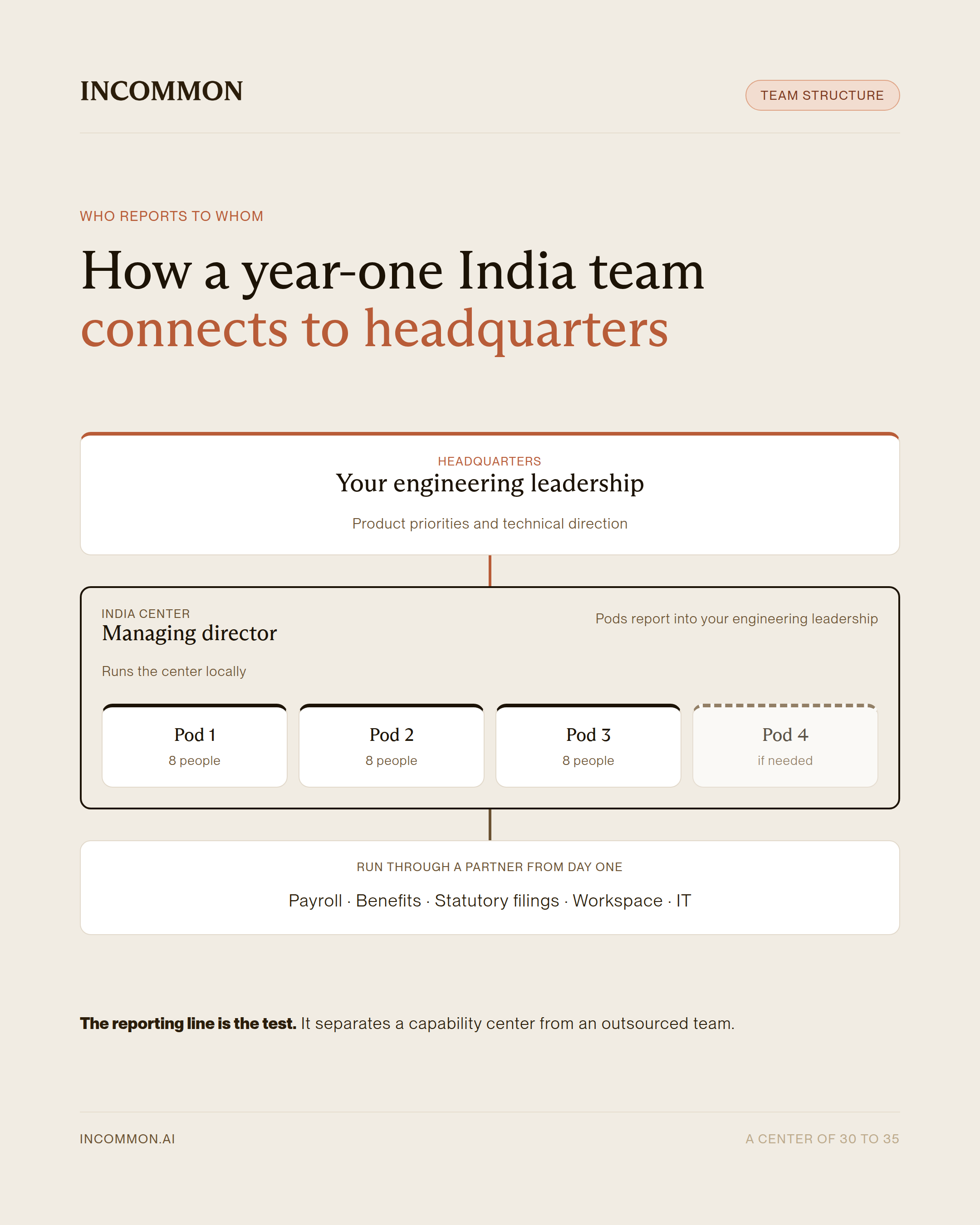
The pods report into your engineering leadership. That line separates a capability center from an outsourced team, and it is the first detail a skeptical CTO checks. Our GCC vs outsourcing comparison covers the difference in full.
The managing director runs the center locally. Product priorities and technical direction come from your own leaders, the same way they would for a team at headquarters.
Support functions in year one
A first-year center needs HR, finance, IT, and compliance, but rarely a full local team for each. Payroll, benefits, statutory filings, workspace and IT can run through a partner from the first day, as they do in our India office setup.
That keeps year-one hiring focused on delivery. Each support function can move in-house later, once the center is large enough to justify it.
A year-one structure, step by step
The table below lays out the order. It shows stages, and not dates, because the pace depends on what route you take:
| Stage | Who joins | What it sets |
|---|---|---|
| 1 | Managing director | Local leadership and the hiring standard |
| 2 | Engineering manager and tech lead | The interview bar for the first pod |
| 3 | The rest of the first pod | The shape every later pod copies |
| 4 | Pods two to four | A center of 30 to 35 |
Across our published builds, the range is 4 weeks to 4 months to a live team.
For Accompany Health, the result was 22 people, 10 weeks to a live team, 100% retention across the build. Our GCC setup timeline covers what sets the pace.
More teams built this way are written up in our case studies.
See how Findigs, Accompany Health, Veramatic and Podifi built their teams.
Real teams, real results, from faster hiring to lasting retention.
Why special skills matter in GCCs
Structure tells you which roles to fill. The skills below tell you exactly who to fill them with.
Working in a GCC isn't the same as a regular office role. Employees operate across time zones, cultures, and shifting global priorities. They need sharp communication, cultural awareness, and the ability to work with limited clarity. They also face new technologies, global reporting structures, and pressure to deliver both efficiency and innovation.
1. People who can handle processes, not just follow them
- GCCs are built on processes. But processes don't stay fixed
- The best hires know when to question, refine, or rebuild them
- Weak hires cling to "this is how it's always done."
2. Communication that brings clarity
- Good communicators are not just polite email writers
- In a GCC, communication has to be situational: what headquarters needs vs. what local teams need
- Endless "keeping everyone in the loop" without real clarity is not enough
3. Tech-savvy beyond Excel
- Tech fluency is no longer optional
- Strong hires are curious about new tools, automation, and AI workflows
- Weak hires panic when platforms change and stick to old methods
4. Cultural fluency
- International work is not just about listing "MNC" on a CV
- Strong candidates understand cultural nuance, etiquette, and expectations
- Poor fits assume "business is business" everywhere and misread signals
5. Comfort with grey areas
- Job descriptions promise structure. Reality is messier
- Good hires can work with incomplete information and still move forward
- Poor hires freeze without detailed instructions
6. The skill of saying "no"
- GCCs often get work dumped on them
- Strong employees know when to push back, and they do it diplomatically
- Weak employees say yes to everything and burn out
7. Influence without authority
- Many GCC professionals work across global teams without formal titles
- Good hires know how to influence, persuade, and get things done
- Weak hires wait for official authority before taking initiative
8. Patience as a core skill
- Decisions in global setups take time. Approvals can drag
- Strong hires stay patient but keep pushing for progress
- Weak hires lose focus when change is slow
Skills that matter in GCC hiring
The table compares how strong and weak candidates show up in each skill area:
| Skill area | What strong candidates do | What weak candidates do |
|---|---|---|
| Process thinking | Question and improve workflows | Follow steps blindly |
| Communication | Adapt messages to audience | Send generic updates |
| Tech fluency | Explore tools, learn fast | Avoid new systems |
| Cultural awareness | Respect differences, adjust style | Assume all cultures are the same |
| Working in ambiguity | Decide with limited clarity | Wait for instructions |
| Diplomacy | Push back when needed | Accept every task |
| Influence | Lead without a title | Only act with authority |
| Patience | Stay steady under slow change | Get frustrated quickly |
How to test for these skills
Degrees and job titles say little about any of these eight skills, so test them directly. A short work sample drawn from the pod's day-to-day tasks reveals process thinking and tech fluency. A conversation about a past project that went sideways tells you how a candidate handles ambiguity and pushback. Our guide to interviewing engineers covers the technical questions.
Training in year one
A new center needs to develop its own leads, so training belongs in the first-year budget. Four areas are worth funding early:
- AI and automation tools: the coding assistants and workflow tools your headquarters team already uses
- Cloud, data, and security: the platforms the team will run, and the access and data rules it must follow
- First-time managers: feedback, hiring, and difficult conversations for leads promoted from inside the pods
- Working with headquarters: writing clear handoffs for a reader in another time zone, and setting expectations with stakeholders in other offices
Train against the work the pods actually do, and revisit the list when a new pod or product area arrives.
Conclusion: hire for skills that stick
Get the order and the shape right first: the managing director, then the senior leads, then pods that report into your engineering leadership. Then hire for the skills that make each seat work.
Hiring for GCCs is not about flashy resumes or buzzwords. It's about finding people who can think critically, communicate clearly, and deliver in complex settings.
Key takeaways:
- Don't just hire process followers. Hire process thinkers
- Look for clarity in communication, not volume
- Prioritize tech curiosity, cultural fluency, and diplomacy
- Value patience and leadership without titles
The best hires are not the ones who wait for instructions. They are the ones who make things better, even when no one asks them to.
Frequently asked questions
Who should a company hire first for its India GCC?
Hire the managing director first, then the senior leads for the first pod, usually the engineering manager and the tech lead. Everyone who joins afterward is measured against the standard those first senior hires set.
How should a GCC team in India be structured in year one?
Around pods. A pod is 8 people, senior-led and cross-functional: an engineering manager, a senior product manager, a tech lead, three senior engineers, a product designer, and QA and SDET. 3 or 4 pods make a center of 30 to 35, and the center grows by adding pods.
Who does an India GCC team report to?
Into the company's own engineering leadership. The managing director runs the center locally, while product priorities and technical direction come from headquarters. That reporting line is what separates a capability center from an outsourced team.
Why is hiring for GCCs different from hiring locally?
Because GCC roles require balancing global expectations with local execution, often in uncertain or complex environments.
What's the top skill GCC hiring managers look for?
The ability to improve processes and communicate clearly across cultures and time zones.
Why is tech fluency important even for non-technical roles?
Because most GCCs rely on automation, digital platforms, and AI-driven workflows in day-to-day operations.
How do cultural skills affect GCC performance?
They prevent miscommunication, build trust across teams, and improve global collaboration.
How can managers spot these skills in interviews?
By asking practical questions about real work situations, such as how candidates changed processes, handled cultural differences, or learned new tools.
Written by
CEO, InCommon
Piyush Kedia is the CEO of InCommon, a talent infrastructure company that helps US and global enterprises set up and scale Global Capability Centers (GCCs) in India. He works with founders, CTOs, and heads of talent to design smaller, AI native GCC teams that focus on judgment work, not just headcount, so India offices stay senior, stable, and production ready. Before InCommon, Piyush built Blue Vector into a 50 person creative agency serving brands such as Trump Towers, Audi, and Porsche, giving him a front row view of how high performing teams are hired, managed, and grown.