How to attract and retain top talent in a Global Capability Center

See how Findigs, Accompany Health, Veramatic and Podifi built their teams.
Real teams, real results, from faster hiring to lasting retention.
Quick look:
| Attracting talent to a Global Capability Center (GCC) is only half the battle. Keeping them is where many organizations fail. Top talent leaves when career growth is unclear, salaries lag, or the work feels disconnected from strategy. To fix this, GCCs must align hiring with business goals, pay competitively, create meaningful career paths, and build a culture that employees believe in. Retention isn't just HR's responsibility. It's a company-wide priority that shapes whether people stay or walk away. |
|---|
Introduction
New Global Capability Centers (GCCs) are always set up with ambitious hiring plans. The best resumes flood in. Smart, highly skilled professionals follow.
And six months later, they're already on LinkedIn looking for their next gig.
This is a structural problem. Many GCCs focus so much on getting people through the door that they forget what happens after they walk in.
Attraction is one thing, and retention is another. In an era where top talent can quit via Slack and have multiple job offers surprisingly quickly. Keeping them engaged is a whole different game.
So, what does it take to not just hire, but actually keep top talent in a GCC? Here's the guide.
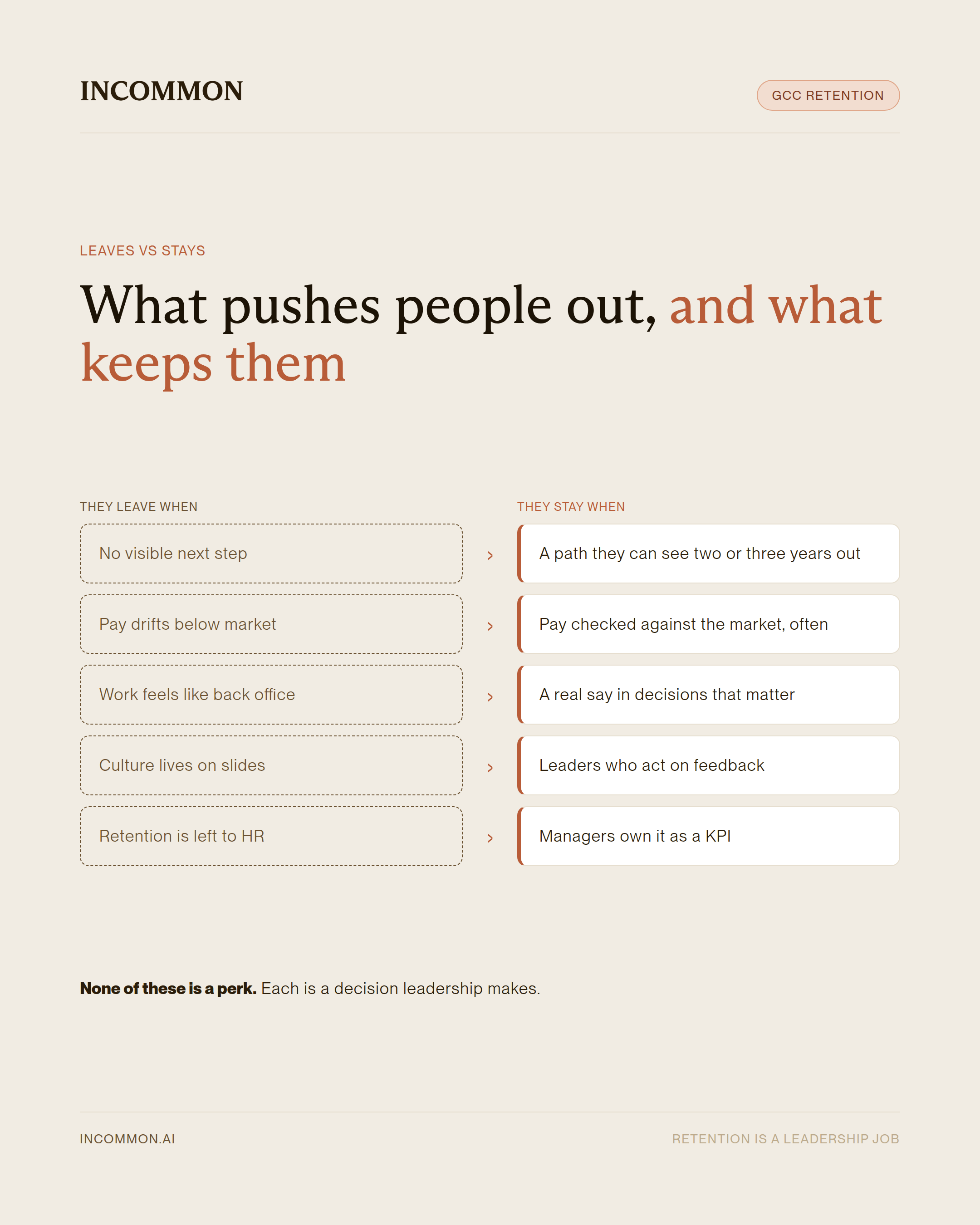
1. Align business goals and hiring
The challenge
Hiring strategies often run on autopilot, disconnected from the GCC's true purpose.
The solution
- Define why the GCC exists: cost efficiency, R&D, operational excellence, or innovation
- Hire with growth in mind, not just immediate needs
- Focus on skills that add value beyond cost savings
- Build strong local leadership to avoid over-reliance on offshore managers
2. Offer careers, not just jobs
The challenge
Generic promises about global exposure don't convince top candidates to stay.
The solution
- Map clear career paths: where an employee can be in 2–3 years
- Provide mentorship and transparent promotion criteria
- Give employees a sense of progress, not just tasks
3. Tailor perks to people
The challenge
Standard perks like coffee bars and game tables don't retain professionals.
The solution
- Ask employees what they value most
- Offer learning stipends or mentorship for early-career hires
- Provide flexibility and family support for working parents
- Create leadership opportunities or international exposure for mid-career employees
4. Pay competitively
The challenge
Top professionals know their market worth. Low salaries drive them out.
The solution
- Benchmark pay regularly
- Be transparent about salary ranges
- Stop relying on "culture" or "exposure" as justification for underpayment
5. Move beyond the "back-office" label
The challenge
Employees who feel like support staff rather than strategic contributors disengage quickly.
The solution
- Involve GCC teams in decision-making
- Allow them to lead initiatives, not just execute them
- Give direct access to global counterparts without excessive hierarchy
6. Build real culture
The challenge
Culture slides don't make employees stay. Lived experience does.
The solution
- Hire leaders who inspire, not just assign tasks
- Encourage open feedback and act on it
- Remove needless red tape so employees can focus on meaningful work
7. Retain with purpose, not fear
The challenge
Retention strategies built on restrictions or guilt only drive talent away faster.
The solution
- Create an environment where employees want to stay, not feel trapped
- Provide growth, purpose, and recognition
- Make staying the better choice, not the only choice
8. Make retention a business priority
The challenge
Companies often treat retention as an HR afterthought, reacting only when resignations spike.
The solution
- Train managers to take responsibility for retention
- Treat employee engagement as a leadership KPI
- Review exit interviews carefully and act on the feedback
What retention looks like in practice
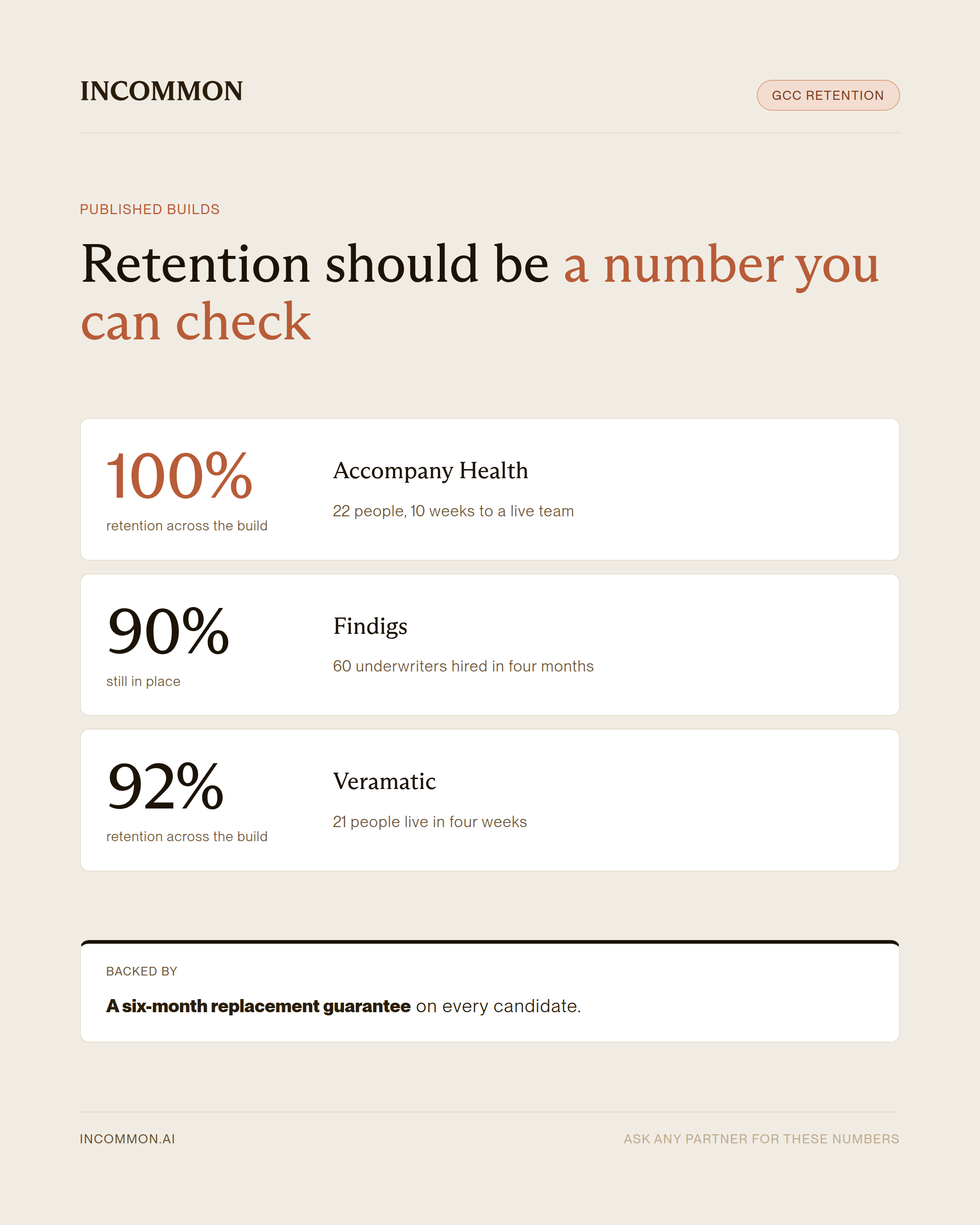
The eight moves above only work if they are measured. Retention is the number that shows whether a center is working, and it should be tracked from the first hire.
Our published builds show what that looks like.
For Accompany Health, the result was 22 people, 10 weeks to a live team, 100% retention across the build. Findigs had 60 underwriters hired in four months, with 90% still in place. For Veramatic, a PE-backed company, the result was 21 people live in four weeks, 92% retention across the build.
Much of that is decided before anyone joins, because retention starts at selection. Our talent pool is around 700 people, each of whom we have actually spoken to, and 33% of the candidates we send are hired. For the managing director, the final interview is run by someone who has held the role.
When a hire does leave, the cost should not land on the client. At InCommon we give a six-month replacement guarantee on every candidate. It is the question to ask any partner: who replaces a hire who leaves, and on what terms? Turnover is also one of the early signals in why capability centers fail.
This is what retention has looked like on the teams we have built.
See how Findigs, Accompany Health, Veramatic and Podifi built their teams.
Real teams, real results, from faster hiring to lasting retention.
Attraction vs. retention in GCCs
| Area | Attraction focus | Retention focus |
|---|---|---|
| Hiring strategy | Competitive packages, strong branding | Clear career paths, leadership growth |
| Perks and benefits | Generic perks to attract applications | Tailored benefits that employees value |
| Compensation | Market awareness | Regular benchmarking, fair pay |
| Role positioning | Global exposure, brand name | Real strategic involvement |
| Culture | Recruitment messaging | Day-to-day experience and trust |
| Leadership | Employer pitch during hiring | Manager quality and consistent guidance |
Employer brand for a new center
A new center has no name in the local market yet, so candidates judge it by how it hires. Three things shape that first impression:
- Job descriptions: say what the team will own and which product it works on, beyond the tech stack
- Interviewers: everyone on the panel should be able to explain why the center exists and what the team is responsible for
- Referrals: your first hires know who else is worth hiring, so ask them early and reward it
Over time, the first cohort becomes the brand. Candidates in the next wave will ask them what working at the center is like.
Conclusion: the best talent won't beg to stay
A GCC's success depends not just on who it hires, but on who it keeps.
Remember these key takeaways:
- Align hiring with business goals
- Offer careers, not just roles
- Pay fairly and tailor benefits
- Give employees a seat at the strategy table
- Build culture through action, not slides
- Make retention a leadership priority
Top professionals always have choices. To keep them, your GCC must be one of those choices for the right reasons.
Frequently asked questions
Why do GCCs struggle with retention?
Because they focus heavily on hiring without building strong career paths, competitive pay, and meaningful work experiences.
What is the difference between attraction and retention?
Attraction gets candidates in the door. Retention keeps them engaged and motivated long term.
How can GCCs keep top talent from leaving?
By offering clear growth, fair pay, strong leadership, and involvement in strategic work.
What perks actually matter to employees?
Perks that fit their stage of life: learning support, flexibility, family benefits, or leadership opportunities.
How can GCCs change the back-office perception?
By giving employees decision-making authority and direct interaction with global teams.
Is retention just an HR issue?
No. It is a company-wide responsibility, led by managers and leadership as much as HR.
Written by
CEO, InCommon
Piyush Kedia is the CEO of InCommon, a talent infrastructure company that helps US and global enterprises set up and scale Global Capability Centers (GCCs) in India. He works with founders, CTOs, and heads of talent to design smaller, AI native GCC teams that focus on judgment work, not just headcount, so India offices stay senior, stable, and production ready. Before InCommon, Piyush built Blue Vector into a 50 person creative agency serving brands such as Trump Towers, Audi, and Porsche, giving him a front row view of how high performing teams are hired, managed, and grown.