| Quick look: India leads the world as a hub for Global Capability Centers. Its holds a skilled workforce spanning tech, finance, and engineering makes this possible, backed by strong digital and office infrastructure. The setup and operating costs are competitive against other major hubs, business-friendly policies and tax incentives lower the barrier to entry further. India has a mature GCC ecosystem, with a long track record of proven success stories, means new entrants aren't figuring this out from scratch. If you plan to set up a GCC in India, focus on location, compliance, talent retention, and operational readiness. |
India and the Global Capability Center Ecosystem
India has emerged as the top choice for companies building GCCs.
The country’s talent pool, policy support, and mature ecosystem make it attractive for global firms. Cities like Bangalore, Hyderabad, Pune, and Chennai have become magnets for tech, finance, and business operations.
But success isn’t automatic. A GCC in India needs careful planning which includes everything from compliance to cultural understanding. Companies that rush in without preparation face challenges like legal hurdles, attrition, or misaligned expectations.
This guide breaks down what a GCC is, why India stands out, and what you must know before making the move.
What is a Global Capability Center (GCC)?
A GCC is a company-owned offshore hub that handles specialized functions such as:
- IT and product engineering
- R&D and data analytics
- Finance, HR, and compliance
- Customer support and business operations
Unlike outsourcing, GCCs are part of the company itself. They keep intellectual property safe, build long-term expertise, and align directly with global strategy.
A well-built GCC isn’t just a cost-saving unit. It becomes a center of excellence, driving:
- Digital transformation (AI, cloud, automation)
- Operational efficiency (process standardization, automation)
- Risk management and continuity (redundancy across regions)
- Long-term growth (support functions turning into strategy hubs)
Why India? The Advantages
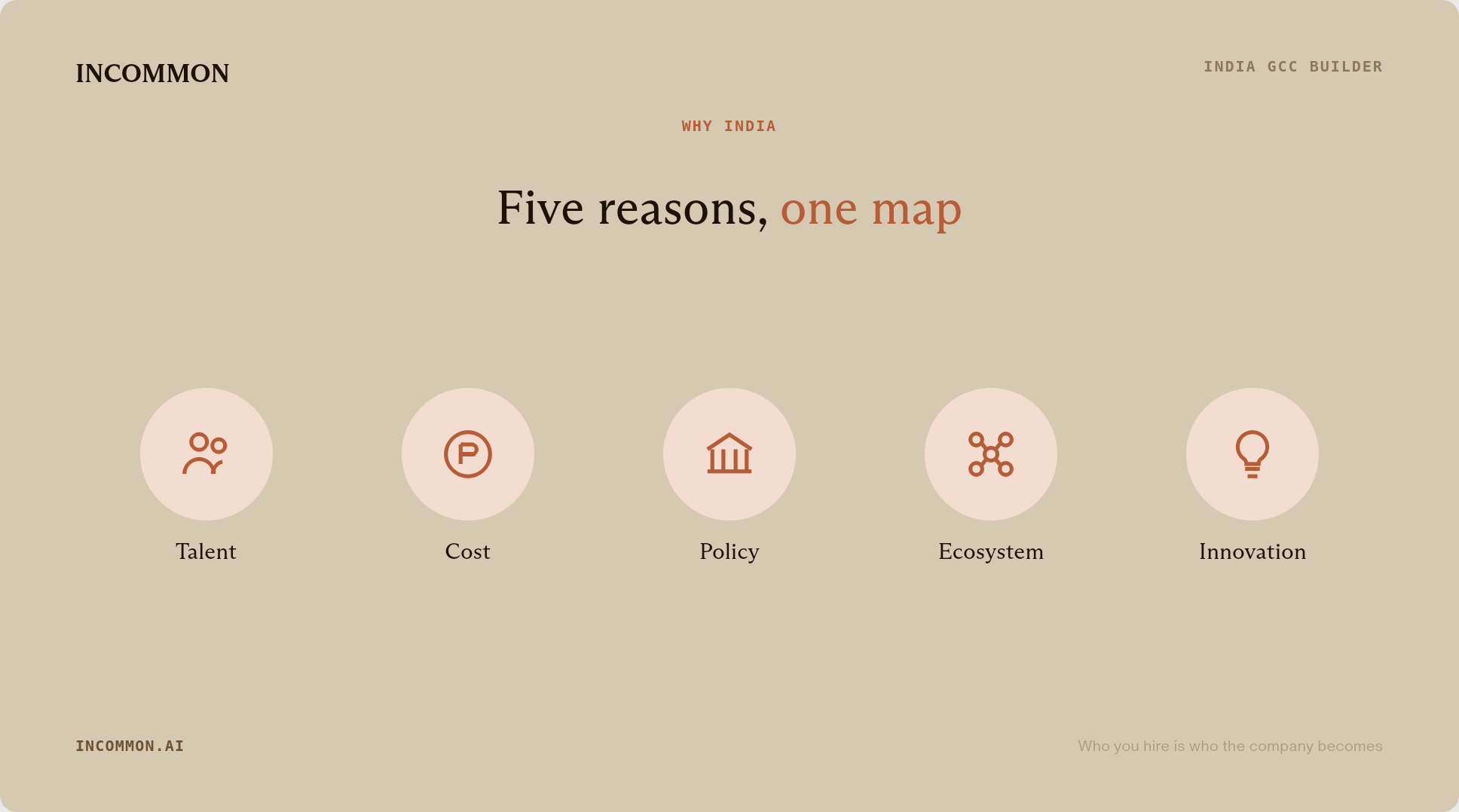
1. Skilled Workforce
India produces a large base of engineers, analysts, and finance professionals every year. Beyond numbers, the workforce is trained in global collaboration, making integration smoother.
2. Cost Advantage
Running a GCC in India costs significantly less than Western markets. Salaries, real estate, and support services are more affordable without compromising on quality.
3. Government Support
Special Economic Zones (SEZs), tax incentives, and simplified investment rules encourage foreign businesses to set up operations.
4. Mature Ecosystem
India’s cities already host hundreds of GCCs. This creates a support network of vendors, talent pools, and shared best practices.
5. Innovation Beyond Support
India’s GCCs are no longer just “back offices.” They now drive product innovation, advanced analytics, and digital transformation for global companies.
What You Need to Know Before Setting up a GCC in India
Location Matters
Each city has unique strengths:
- Bangalore – Tech and R&D hub with deep innovation networks
- Hyderabad – Lower costs, advanced infrastructure, IT parks
- Pune – Finance, automotive, and engineering services
- Chennai – IT, BPO, and manufacturing support
- Delhi NCR – Legal, financial, and corporate hubs
📌 Tip: Match your business function with the right city. For example, a fintech GCC may prefer Pune or NCR, while an AI-driven product team would thrive in Bangalore.
Legal and Compliance Framework
Getting compliance right is critical. You’ll need to navigate:
- Entity registration – Private Limited or LLP structures
- Taxation – Corporate tax, GST, transfer pricing rules
- Labor laws – PF, gratuity, leave policies
- Data protection – Compliance with India’s PDP Bill and global standards like GDPR
- Contracts – Vendor and lease agreements
📌 Tip: Partner with local legal advisors to avoid surprises.
3. Hiring and Retaining Talent
India’s talent market is competitive. Companies must stand out with:
- Competitive pay packages that align with market standards
- Leadership hiring – Recruiting local managers who understand both Indian and global expectations
- Retention focus – Clear career growth paths, training programs, mentorship opportunities
- Cultural alignment – respect for hierarchy, teamwork, and local etiquette
📌 Tip: A clear career progression framework has a higher impact on reducing attrition compared to offering perks.
4. Infrastructure and Costs
A GCC cannot run without strong infrastructure.
- Office spaces – Grade A IT parks, co-working hubs, and SEZ campuses
- Technology setup – secure cloud systems, VPNs, cybersecurity frameworks
- HR and payroll – often outsourced to local service providers for efficiency
- Real estate costs – vary by city; Bangalore is costlier, Hyderabad and Pune are more affordable
📌 Tip: SEZs offer tax benefits but come with compliance requirements.
5. Scaling and Management
Once the GCC is operational, scaling is the real test. The key
- Build a governance model with KPIs and reporting lines
- Keep training ongoing, especially in AI, automation, and data analytics
- Use automation tools like RPA for efficiency
- Align daily operations with HQ to prevent silos
📌 Tip: A GCC should feel like part of the global team, not a separate unit.
6. Challenges and How to Overcome Them
- Talent Poaching → Mitigate with competitive salaries and growth opportunities
- Regulatory Complexity → Hire local compliance experts
- Cultural Gaps → Provide cross-cultural training and leadership support
- Time Zone Misalignment → Structure shifts and use collaboration tools
- Infrastructure Gaps → Have backup systems for power, connectivity, and data security
📌 Tip: Anticipate problems early; prevention is cheaper than fixing breakdowns.
If you would rather have those problems handled before they start, this is how we work.
Everything you need to build and run your India GCC.
Entity, hiring, workspace and ongoing operations under one agreement.
Comparative Table: GCC Cities in India
|
|
|
|
| City |
Best For |
Cost Level |
Key Advantage |
| Bangalore |
Tech, AI, R&D |
High |
Deep innovation ecosystem |
| Hyderabad |
IT services, large operations |
Medium |
Modern IT parks, cost edge |
| Pune |
Finance, automotive, engineering |
Medium |
Balanced costs + talent |
| Chennai |
IT, BPO, manufacturing support |
Medium |
Strong process-driven base |
| Delhi NCR |
Legal, finance, corporate ops |
High |
HQ integration advantage |
Final Thoughts
India is the most proven location for building GCCs. With the right planning, compliance, and talent strategy, your GCC can grow from a small offshore office into a global powerhouse.
Companies that treat their India centers as strategic assets — not just cost-saving units — unlock innovation, resilience, and long-term growth.
Bottom line: If global expansion is on your agenda, India offers the workforce, infrastructure, and policy support to make your GCC succeed.