Top tech talent hubs outside the US, beyond Silicon Valley

See how Findigs, Accompany Health, Veramatic and Podifi built their teams.
Real teams, real results, from faster hiring to lasting retention.
Quick look:
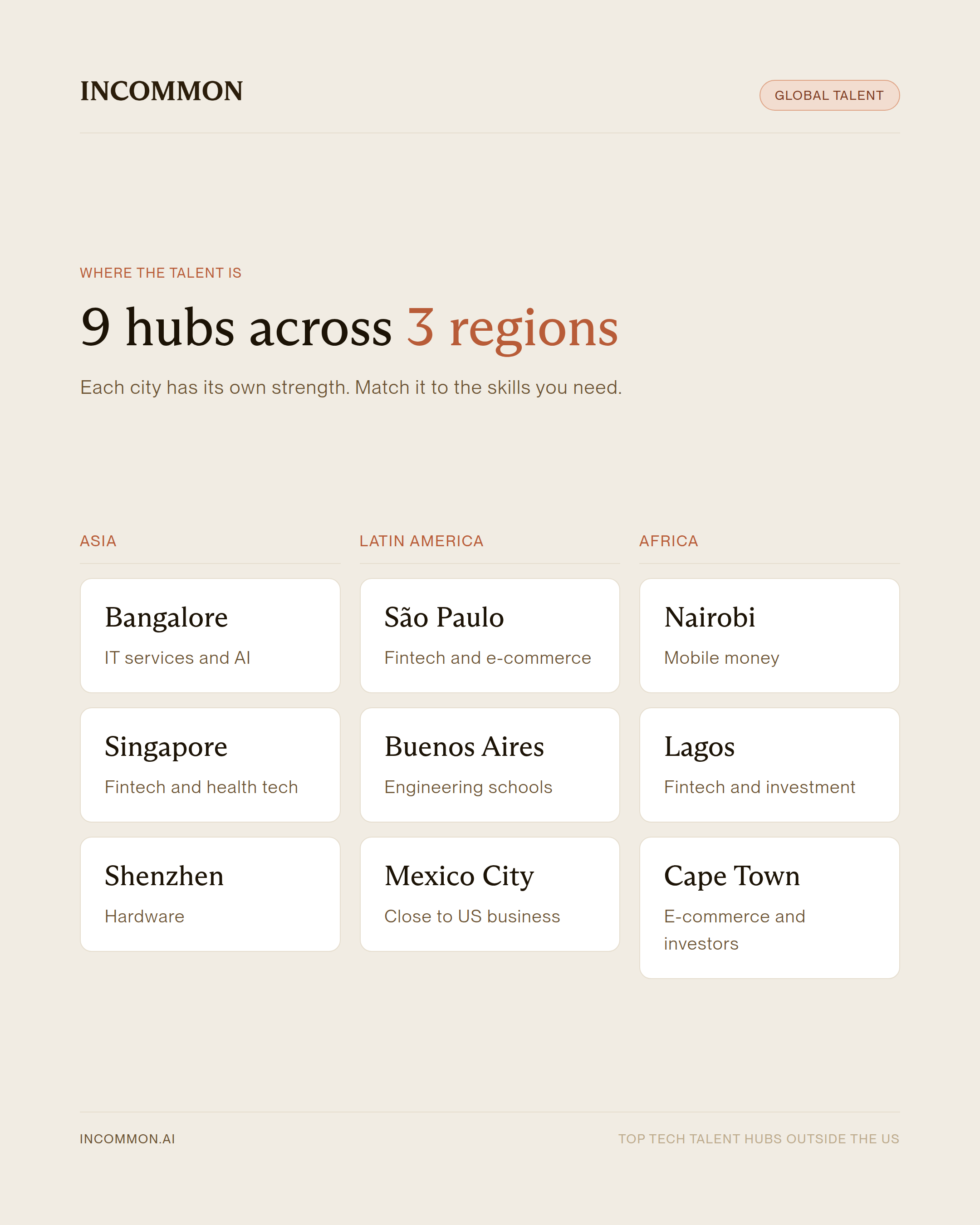
| Tech talent is spread far beyond Silicon Valley. In Asia, Bangalore, Singapore, and Shenzhen lead in IT services, fintech, and hardware. In Latin America, São Paulo, Buenos Aires, and Mexico City pair strong universities with time zones close to the US. In Africa, Nairobi, Lagos, and Cape Town have grown around fintech and mobile. Before you build a team in any of them, check whether the hub can scale with you, which skills it is strongest in, and how well connected it is. |
|---|
Let's be real. Silicon Valley is Silicon Valley because of the amount of tech talent it contains. Every other beneficial aspect of it is a byproduct of having many unbelievably talented individuals in the same space. It reaped the rewards for almost twenty years, but then the inevitable happened.
It became saturated, and the cost of living there grew exponentially. It also became clear that relying on a single region for global tech innovation was risky. Multiple tech hubs create a more resilient tech ecosystem, and this is why we now have many hubs better positioned to fit the needs of small and emerging businesses. For example, tech hubs in Africa are creating solutions for mobile banking to serve populations with limited access to traditional banking services. Asian tech hubs use urban planning technology to meet the needs of fast-growing urban populations. As new tech hubs emerge, they create more opportunities for teams to work across borders.
The tech industry, which has traditionally been dominated by a few large players in the US, is now decentralized. Newer players can now challenge the status quo. Established companies are often held back by their own legacy, and it simply isn't possible for one region to supply the rising global demand for tech.
What to consider when choosing a hub
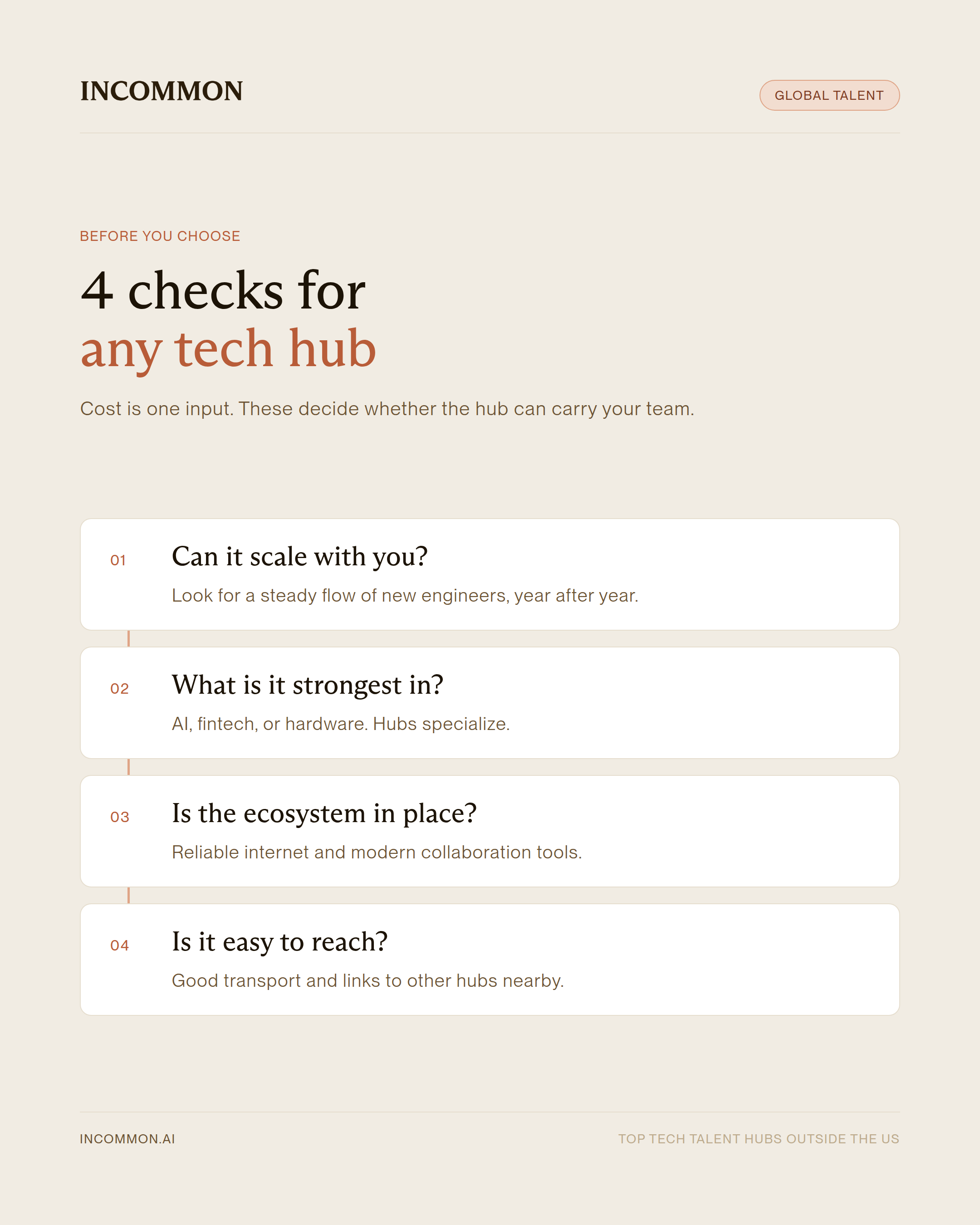
The right hub depends on your budget and tech requirements. As a rule of thumb, always consider if the offshoring location has long-term potential. Does it have the capacity to scale with your business? Is it adapting to the latest tech trends? Will it have a consistent flow of tech talent?
If the region has a healthy tech ecosystem in place (great internet connectivity and access to the latest collaboration tools), it can support your business ops instead of becoming a burden to the organization.
Different regions also support different talent pools. Some places have AI experts, and a few others excel in fintech. Another may be a pool of hardware specialists. This usually follows the industries already established there. Weigh cost against the quality of tech talent in the region, so a quick decision does not become one you regret. Also consider the region's accessibility. A good tech hub is easily reachable by public transportation and has excellent connectivity with other tech hubs nearby. Your business cannot operate in a vacuum.
Tech talent hubs in Asia
Asia has grown enormously in the last decade, and its economic progress is closely studied in the US and Europe.
India is a top choice for building an overseas tech team because of the amount of skilled tech talent it has. With advanced infrastructure and English proficiency, communication is smooth. The time gap means work can continue while the US is offline. Additionally, India's supportive government policies and incentives attract foreign investment. For a side-by-side look at India, Latin America, and Eastern Europe, see our guide to offshore vs nearshore teams.
Bangalore
What began as a viable outsourcing center for a handful of IT firms in the US is now the go-to destination for global IT services and consulting firms. It's not limited to just IT. Bangalore nurtures numerous biotech, fintech, and AI startups, apart from being home to large offices for Google and Microsoft. Companies like Flipkart, Infosys, and Wipro are headquartered in Bangalore, which shows the depth of its leadership talent. Bangalore is also home to the Indian Institute of Science (IISc), one of the country's top technical institutes.
Singapore
Singapore is a gateway to Asia's emerging markets. Its strong intellectual property laws attract tech companies and startups. With steady support from the MAS (the Monetary Authority of Singapore), it has become known as a leader in health tech and fintech.
Investment is another strength. It isn't unique to Singapore, but firms there (Qualgro and Genesis, for example) put a great deal of money into tech. That is a good sign, because a talent pool without investment ends up unproductive.
Shenzhen
Shenzhen is a former fishing village in China's Guangdong province. Designated as a Special Economic Zone (SEZ) in the 1980s, Shenzhen quickly attracted manufacturers and entrepreneurs, laying the groundwork for its tech boom. It hosts companies like Huawei, Tencent, and DJI. The startup culture there is also quite strong.
In short, Shenzhen leads in computer hardware, and software companies are moving there too. However, China's internet restrictions can make day-to-day collaboration with teams abroad harder.
Tech talent hubs in Latin America
Brazil has strong regional influence in Latin America, though it does not dominate the region. It sets the tone for Latin American work culture, which is known for its informality and friendliness.
Mexico is close to the US geographically and culturally, and that is its biggest advantage when it comes to building overseas teams. Guadalajara, Mexico City, and Monterrey are vibrant, historically rich tech hubs where most skilled professionals speak Spanish and English.
São Paulo
São Paulo's focus on fintech, e-commerce, and mobile technology has transformed it. With a large digital-savvy population, the city is an incubator for fintech innovation, particularly in areas like digital banking and payment systems. Nubank, one of the world's largest digital banks, is headquartered in São Paulo. Additionally, São Paulo is home to numerous tech accelerators, such as Cubo Itaú, which support the growth of startups.
Buenos Aires
Argentina has its share of economic challenges, but Buenos Aires has produced several unicorns and is an important player in Latin America's tech scene.
Part of the reason is the University of Buenos Aires, one of the region's best tech and engineering schools. Mercado Libre, the largest e-commerce and payments ecosystem in Latin America, was founded there. Globant, a software company that scaled quickly and has now expanded globally, also highlights the region's commitment to tech growth.
Mexico City
Mexico City's main advantage is how close it is to North American business centers.
Many people in Mexico have no bank account, which creates demand for fintech. Startups like Clip, a leading payment solutions provider, and Konfío, a fintech company focused on lending to small businesses, have grown by meeting it. Startups offer plenty of opportunities for tech graduates, and larger companies like Kavak and Bitso hire many of them.
Internet connectivity is also not a problem there. The startup scene is not at San Francisco's level, but it is lively, and some top developers live and work there.
Tech talent hubs in Africa
Africa is an adventure, and not just because of Mount Kilimanjaro and the wildlife reserves.
Its tech scene is transforming. Nigeria, Zimbabwe, and Algeria have growing startup scenes, and many of those startups are succeeding. Accessibility may be an issue in places far away from cities (this would be true about many wealthier countries too), and niche tech products are likely to cost more in remote places. Demand for tech talent in Africa comes from both local and foreign companies, the time zones are workable, and most tech graduates speak very good English.
Nairobi
The Silicon Savannah gave the world M-Pesa, a mobile money platform that streamlined financial services in Kenya and has since been adopted in other parts of the world. Startups like BRCK and Twiga Foods are also heavily invested in tech innovation. Most of Kenya's startups are based in Nairobi, alongside offices for industry leaders like Google, Microsoft, and Visa.
Innovation hubs like iHub and incubators such as Nailab help beginners find tools, mentorship, and funding.
Lagos
Lagos is the biggest city in Nigeria and a center of fintech. Paystack (which was acquired by Stripe in 2020) and Flutterwave, a payment tech company, are from Lagos. The success of these companies encouraged other investors, and Lagos still attracts plenty of venture capital today.
The city has excellent internet coverage, and CcHub (Co-Creation Hub) is a startup accelerator that helps new tech startups get going.
Cape Town
Tourist destinations often have an edge in tech, because they are well connected and their exposure to foreign cultures helps them adapt and innovate. Cape Town, Africa's most famous tourism spot, is no exception.
Naspers, a leading tech investor, is situated here. The presence of Takealot, a popular South African e-commerce platform, also makes a difference. LaunchLab and the Khayelitsha Bandwidth Barn help startups with working spaces and mentorship.
If you are weighing where to build your next team, we are glad to help.
Final thoughts
The takeaway from this isn't that Silicon Valley is now irrelevant.
It will always be a trailblazer in tech, and its example can help other cities build similar ecosystems. But depending on one hub creates a bubble, and tech built inside a bubble can lose touch with what customers need.
These cities are not recreating the bubble. Each one is changing its field by solving the needs of its own country. All in a day's work for focused and dedicated tech pros all over the world.
Frequently asked questions
What makes a city a strong tech talent hub?
A strong tech talent hub has a deep pool of skilled engineers, good universities, steady investment, and reliable internet and collaboration tools. A mix of startups and large companies keeps that talent growing.
Which tech hubs outside the US are strongest for software teams?
In Asia, Bangalore is strong in IT services, AI, and fintech, Singapore in fintech and health tech, and Shenzhen in hardware. In Latin America, São Paulo, Buenos Aires, and Mexico City stand out. In Africa, Nairobi, Lagos, and Cape Town lead.
Why is India a common choice for overseas tech teams?
India has a large pool of skilled tech talent, strong English proficiency, and advanced infrastructure. The time gap with the US means work can continue overnight, and government policies support foreign investment.
Is Latin America a good option for US companies?
Latin America is close to the US in time zone and culture. Mexico City is close to North American business centers, Buenos Aires has one of the region's best engineering universities, and São Paulo leads in fintech.
What should you consider before building a team in a new tech hub?
Check whether the hub has long-term potential and can scale with your business. Look at the steady flow of talent, the skills the region is strongest in, the quality of its internet and tools, and how accessible it is.
Is Silicon Valley still relevant for tech talent?
Silicon Valley remains a trailblazer in tech. But no single region can supply global demand, and newer hubs are growing by solving the needs of their own markets.
Written by
CEO, InCommon
Piyush Kedia is the CEO of InCommon, a talent infrastructure company that helps US and global enterprises set up and scale Global Capability Centers (GCCs) in India. He works with founders, CTOs, and heads of talent to design smaller, AI native GCC teams that focus on judgment work, not just headcount, so India offices stay senior, stable, and production ready. Before InCommon, Piyush built Blue Vector into a 50 person creative agency serving brands such as Trump Towers, Audi, and Porsche, giving him a front row view of how high performing teams are hired, managed, and grown.