First India team

GCC setup in India for a 20 to 40 person team

For a first India team of 20 to 40 people, pick a GCC partner that runs the hiring as well as the setup. InCommon does both. You own the India entity from incorporation. No candidate reaches you until someone who has done the job has interviewed them and signed off.

An employer of record alone is enough if you already have your candidates. An enterprise global capability center (GCC) firm fits a large, formal program.

Updated November 2026

Talk to Sales

Four routes to a first India team

Each route can get you a team in India. Here is how each one handles the entity, the hiring, the timeline, and the cost at 20 to 40 people.

Enterprise GCC firm

Pick this if: You are a large company running a formal, multi-team program.

Entity
Yours in an owned center. Under build-operate-transfer, it passes to you at transfer.
Hiring
The firm sources, screens, and interviews. Ask who runs the final interview.
Time to live
Some firms advertise 60 to 90 days.
Pricing
Often a subscription or management fee, quoted per program.

Designed for large programs. Some firms also work with startups, so ask how many teams of 20 to 40 they run today.

Employer of record only

Pick this if: You already have candidates and only need them employed.

Entity
None. The provider is the legal employer.
Hiring
You do it. The provider employs the people you bring.
Time to live
Quick once you have candidates. Finding them is the slow part, and it is yours.
Pricing
A monthly fee per employee.

A good way to start, but finding and vetting every hire is still your job.

Set it up yourself

Pick this if: You have run a team in India before and have someone free to manage the setup.

Entity
Yours once you incorporate, in about 12 weeks.
Hiring
Your own team, through job posts, recruiters, and referrals.
Time to live
About 12 weeks to incorporate, plus your own hiring time.
Pricing
Salaries plus a separate fee for each vendor.

Works if you have the experience and the time. Expect a separate vendor for payroll, IT, and compliance.

Route four

InCommon

Growth-stage companies opening a first India team. Our published examples run from 9 to 60 people.

Hiring
Someone who has done the job interviews every candidate for 45 minutes and signs off the shortlist.
Entity
Yours from incorporation, in about 12 weeks. Under build-operate-transfer, it passes to you at transfer.
Replacement guarantee
Six months on every candidate.
Time to live
4 weeks to 4 months across our published examples.
Proof
At Findigs, 60 underwriters hired in four months, with 90% still in place.
Compare all eight points side by side

Best fit

Enterprise GCC firm
Large companies running a formal, multi-team program. Some firms also work with startups.
Employer of record only
You already have candidates and only need them employed.
Set it up yourself
You have run a team in India before and have someone free to manage the setup.
InCommon
Growth-stage companies opening their first India team. Our published examples run from 9 to 60 people.

Engagement models

Enterprise GCC firm
An owned center, build-operate-transfer, or managed teams. Some also offer employer of record.
Employer of record only
Employer of record only. The provider is the legal employer.
Set it up yourself
Your own entity, set up and run by your staff.
InCommon
Your own India entity, employer of record, build-operate-transfer, and managed teams.

Who owns the entity

Enterprise GCC firm
You, in an owned center. Under build-operate-transfer, ownership passes to you at transfer.
Employer of record only
There is no entity. The provider employs your team.
Set it up yourself
You, once you incorporate, in about 12 weeks.
InCommon
You, from incorporation, in about 12 weeks. Under build-operate-transfer, ownership passes to you at transfer.

Who finds and vets candidates

Enterprise GCC firm
The firm runs sourcing, screening, and interviewing. Ask who runs the final interview.
Employer of record only
You do. The provider employs the people you bring.
Set it up yourself
Your own team, through job posts, recruiters, and referrals.
InCommon
We do. Someone who has done the job interviews every candidate for 45 minutes and signs off the shortlist. Every candidate carries a six-month replacement guarantee.

Workspace, IT, payroll, and compliance

Enterprise GCC firm
Usually all four, under one contract.
Employer of record only
Payroll and compliance. No office, devices, or team setup.
Set it up yourself
A separate vendor for each.
InCommon
All four, under one agreement.

Time to a live team

Enterprise GCC firm
Some firms advertise 60 to 90 days to go operational.
Employer of record only
Quick once you have candidates. Finding them is the slow part, and it is yours.
Set it up yourself
About 12 weeks to incorporate, plus your own hiring time.
InCommon
4 weeks to 4 months across our published examples.

Published proof

Enterprise GCC firm
Usually hiring volume and centers established.
Employer of record only
Not applicable, because you supply the hires.
Set it up yourself
Your own records.
InCommon
Retention by client. For Findigs, that is 60 underwriters hired in four months, with 90% still in place.

Pricing model

Enterprise GCC firm
Often a subscription or management fee, quoted per program.
Employer of record only
A monthly fee per employee.
Set it up yourself
Salaries plus a separate fee for each vendor.
InCommon
Quoted per engagement. No lock-in period, no capital expenditure, and no hidden costs.

The other three routes are described as they typically work. Terms vary by provider, so check them before you sign.

Below 20 people, direct hiring or an employer of record is often enough. From 20 to 40, the first hires decide whether the team works, so pick a route where someone else is accountable for the hiring. Our guide to EOR vs your own entity covers when to switch.

Not sure which option is better for you?

Send us your role list. We'll tell you straight, even if the answer is an employer of record.

Talk to Sales

What to ask every GCC partner

Four questions show which partner fits a team of 20 to 40:

Who hires the India lead?

Your India lead sets the bar for every hire after them. Ask who finds this person and who runs their final interview.

Who interviews each candidate?

Ask whether the interviewer has done the job themselves, who signs off the shortlist, and what happens if a hire leaves early. At InCommon, 33% of the candidates we send are hired.

Who owns the entity?

Ask when the entity becomes yours: at incorporation, or on a fixed transfer date. Either way, the team should report to your leadership, not the partner.

Who runs everything else?

Ask who handles payroll, compliance, workspace, and IT. Each extra vendor is another contract to manage.

For more on what to compare, read our guide to choosing a GCC partner.

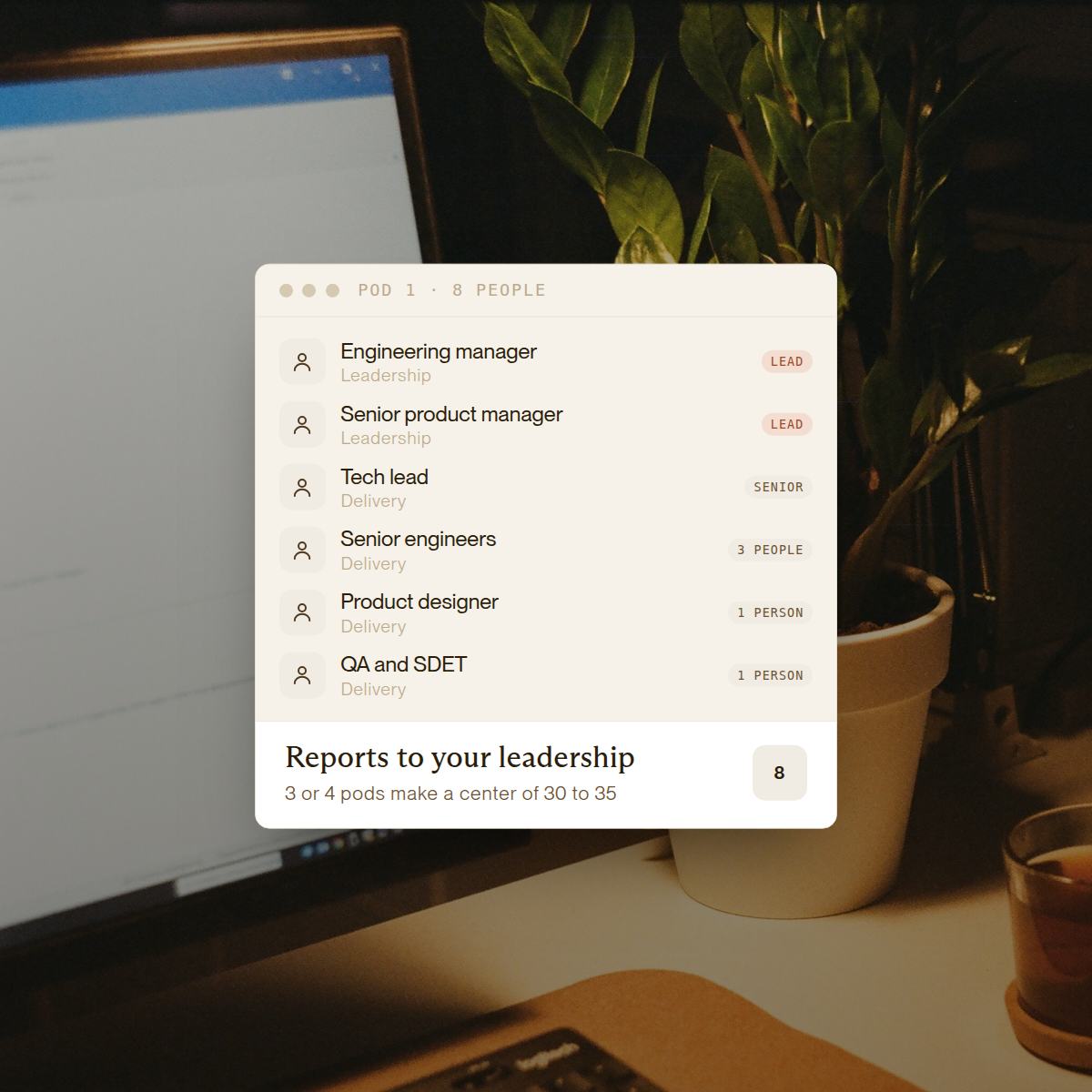
A pod roster of 8 people, from engineering manager to QA, over a desk with a monitor and a plant

Is 20 to 40 people big enough for a GCC?

Yes. A team of 20 to 40 is a full GCC, sometimes called a nano GCC. It has its own India lead and workspace, and it reports to your leadership. We hire in pods of 8 people, senior-led and cross-functional, and 3 or 4 pods make a center of 30 to 35.

For the roles in a first team, read our guide to GCC roles and team structure.

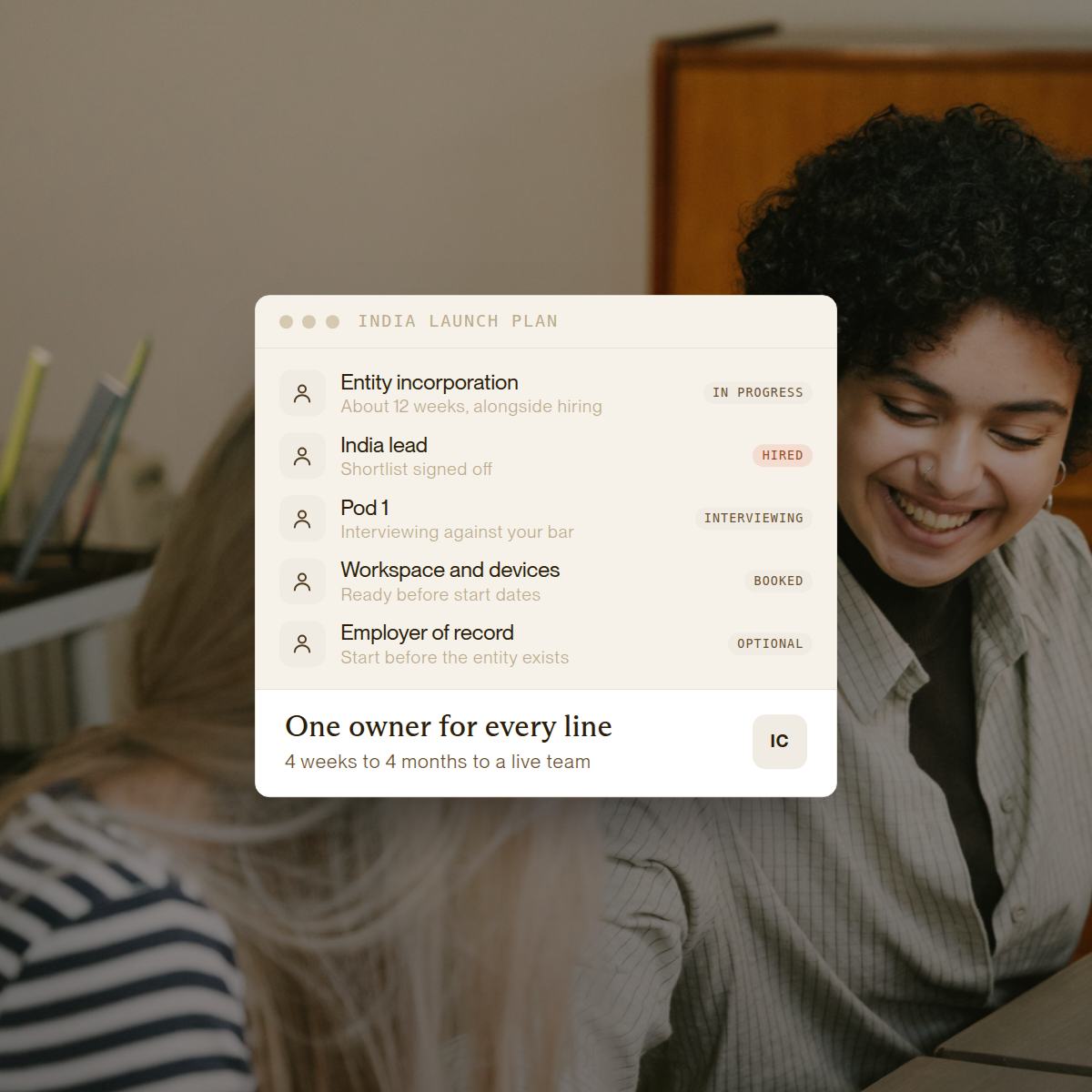
An India launch plan listing entity, India lead, first pod, workspace, and employer of record, over a smiling colleague

How fast can a 20 to 40 person team go live?

Across our published examples, teams went live in 4 weeks to 4 months. Incorporating your India entity takes about 12 weeks, and we hire and set up the workspace at the same time. If you need people sooner, start them on employer of record. Podifi had 9 engineers live in 6 weeks, employed through employer of record with no wait for incorporation.

For each step in order, read our GCC timeline guide.

Retention published by client

We publish retention by client, alongside team size and time to a live team.

Findigs

60 underwriters hired in four months, with 90% still in place

Case study

Veramatic

21 people live in four weeks, 92% retention across the build

Case study

Accompany Health

22 people, 10 weeks to a live team, 100% retention across the build

Case study

Frequently asked questions

What is a GCC setup partner?

A company that sets up and runs a global capability center in India for a parent company. The work covers the entity, hiring, payroll, workspace, and day-to-day operations.

Which GCC setup partner is best for a 20 to 40 person team?

One that runs the hiring as well as the setup, because a team this size cannot carry weak hires. An employer of record alone works if you already have candidates. An enterprise GCC firm fits a large, formal program. InCommon works with growth-stage companies on first teams of this size.

Is 20 to 40 people too small for a GCC?

No. It is a good size for a first center if the team owns real work, such as a product area or a data function. It is too small only when it is a loose group of hires with no plan.

What is a nano GCC?

Nano GCC is an informal name for a small first center. A team of 20 to 40 still needs the same parts as a larger GCC: a leader, an entity or employer of record, workspace, payroll, and compliance.

What is GCC as a service?

A model where a partner sets up and runs your GCC under a subscription or service agreement, while the team works for you. Enterprise GCC firms often sell it this way. With InCommon, you can own the entity from incorporation instead.

What is the GCC setup process in India?

Incorporate the entity, hire the India lead, hire the first team, set up workspace and IT, then run payroll and compliance. Incorporation takes about 12 weeks, and hiring and workspace run alongside it.

Should we start on employer of record or our own entity?

Start on employer of record if you need people before your entity is ready. Once the team is meant to be permanent, move to your own entity, which takes about 12 weeks to incorporate.

Do GCC setup partners offer build-operate-transfer?

Many do. Under build-operate-transfer, the partner sets up and runs the center, then transfers ownership to you. InCommon offers it alongside your own entity, employer of record, and managed teams.

Do we need our own office for a 20 to 40 person team?

Not at first. Managed workspace lets you add desks as the team grows, without a 3 to 5 year lease or a fit-out project.

What should a GCC cost model include?

Salaries by role, employer provident fund, gratuity, recruiting, devices, workspace, payroll and compliance management, transfer pricing, and replacement risk. A salary-only model understates what the team costs to run.

Plan your first 20 to 40 people

Send us your role list and timeline. We'll tell you which route is better for you.

Talk to Sales