AI talent shortage, and why offshoring your machine learning team might help

See how Findigs, Accompany Health, Veramatic and Podifi built their teams.
Real teams, real results, from faster hiring to lasting retention.
Quick look:
| Demand for AI and machine learning skills has grown far faster than the supply of trained professionals. The shortage means longer hiring cycles, overworked teams, and people who leave for the next offer. Offshoring your machine learning team gives you access to larger talent pools, more room to scale, and work that continues across time zones. Plan for communication, time zone overlap, quality control, and real integration with your local team before you start. |
|---|
Demand for people who can build with AI has outgrown the supply of engineers trained to do it. For many companies, that gap now decides how fast their AI plans can move.
AI now runs through almost every part of daily life. From the moment we start scrolling on our food delivery apps to when we Venmo the delivery agent their tip, we are being served by AI in some form or another. AI is transforming finance, healthcare, and even automobile engineering. But how, exactly?
By making things simpler. The first effect of any automation is a simpler, better process. Machine learning, a subset of AI, is at the core of this boom. ML involves training algorithms to learn from data and make predictions or decisions without being explicitly programmed.
The number of job openings for AI and ML roles has grown sharply in the last few years, and the number of available AI professionals has not kept pace. The gap is widest in applied AI: engineers who build products on large language models, test how those models behave, and work alongside AI coding tools.
The impact of the AI talent shortage
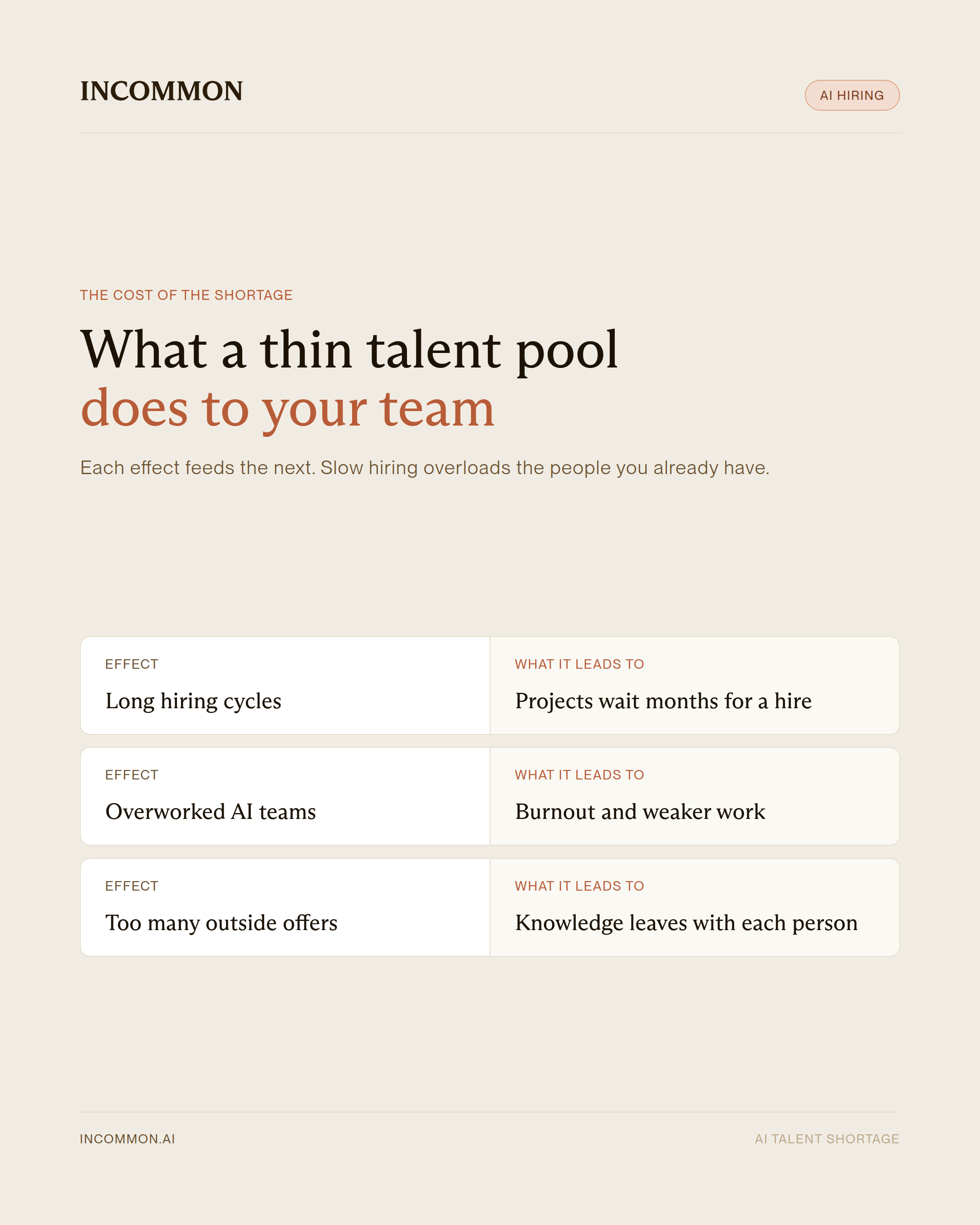
The AI talent shortage has a few grim implications for businesses. It means longer hiring cycles. Companies spend months searching for qualified candidates, which delays every project that depends on AI. This extended hiring process can also drive up talent costs as businesses compete for the same talent pool.
The shortage also affects the work itself. Existing AI teams tend to be overworked and often too burnt out to develop high-quality solutions. Overall, the company falls short of its AI potential.
AI talent shortages can also make retention difficult. When AI talent is in high demand, skilled people have plenty of offers, and frequent job changes become common. Every time a qualified colleague leaves, the company loses knowledge that is hard to replace.
Why offshoring can solve the shortage
The availability of AI experts varies by region. Some countries already have a large AI talent pool, which keeps growing. India, for instance, has one of the world's largest and fastest-growing pools of AI professionals, spread across several cities (see our India location guide). AI talent may be scarce in other countries.
Offshoring is one of the most direct ways to counter this uneven distribution of talent. Moving part of your AI work to a talent-rich country gives you access to people whose skills are on par with the best professionals in the US.
For many companies investing in AI, offshoring the machine learning team is a reasonable decision.
This is why:
Access to a much larger AI talent pool
India and Eastern European countries have many skilled AI and machine learning professionals. Bengaluru, Hyderabad, and Budapest have excellent tech institutes producing strong candidates in STEM fields, including AI and ML. Companies can find the level of expertise they need, which is especially valuable for those based in regions with little local AI talent.
Less competition for the same people
Hiring AI professionals in the United States and Western Europe is hard. There is intense competition for talent, which constantly drives salaries up and stretches hiring cycles. In talent-rich countries, more qualified people are available for each open role, so good candidates are easier to reach.
Increased flexibility
A team abroad can also grow quickly. This flexibility is essential for companies that need to scale their AI operations quickly to meet business demands. Additionally, offshoring often means 24/7 operations. With teams in different time zones, businesses know that work continues even when their local team is offline. Projects finish sooner, and development feels more agile.
However, offshoring your AI team is easier said than done. There are challenges that cannot be ignored, and many of them are the flip side of the benefits. Coming up with an excellent offshoring strategy takes time. Communication barriers, cultural differences, and time zone disparities must be considered.
Each one needs planning, but most can be handled quickly.
A few companies have already built AI and engineering teams in India this way.
See how Findigs, Accompany Health, Veramatic and Podifi built their teams.
Real teams, real results, from faster hiring to lasting retention.
Judging a location for ML hiring
Graduate numbers say little about whether a location can staff an ML team. Judge each option against the roles you actually need to fill:
- Senior depth: how many engineers have shipped and maintained models in production, not only trained them
- Room to scale: whether the market can supply your tenth and twentieth hire at the same bar as your first
- Support on the ground: recruiters, payroll, and legal help that already know how to employ engineers for a foreign company
- Retention: how often ML engineers in that market change jobs, and what keeps them in a role
A location that fills the first few roles quickly but cannot supply the next ten will slow you down in year two. Test each option against the team size you plan to reach.
Building your offshore AI team
Possible communication issues
Communication problems are less likely in high-performing teams. Most tech talent in India, LATAM, or Eastern Europe is fluent in English and conversant with American and Western European culture. Clear communication protocols also help. Regular meetings and updates can also keep everyone on the same page. If there are slight language gaps, investing in language training for both the offshore and local teams can help bridge them.
Time zone disparities
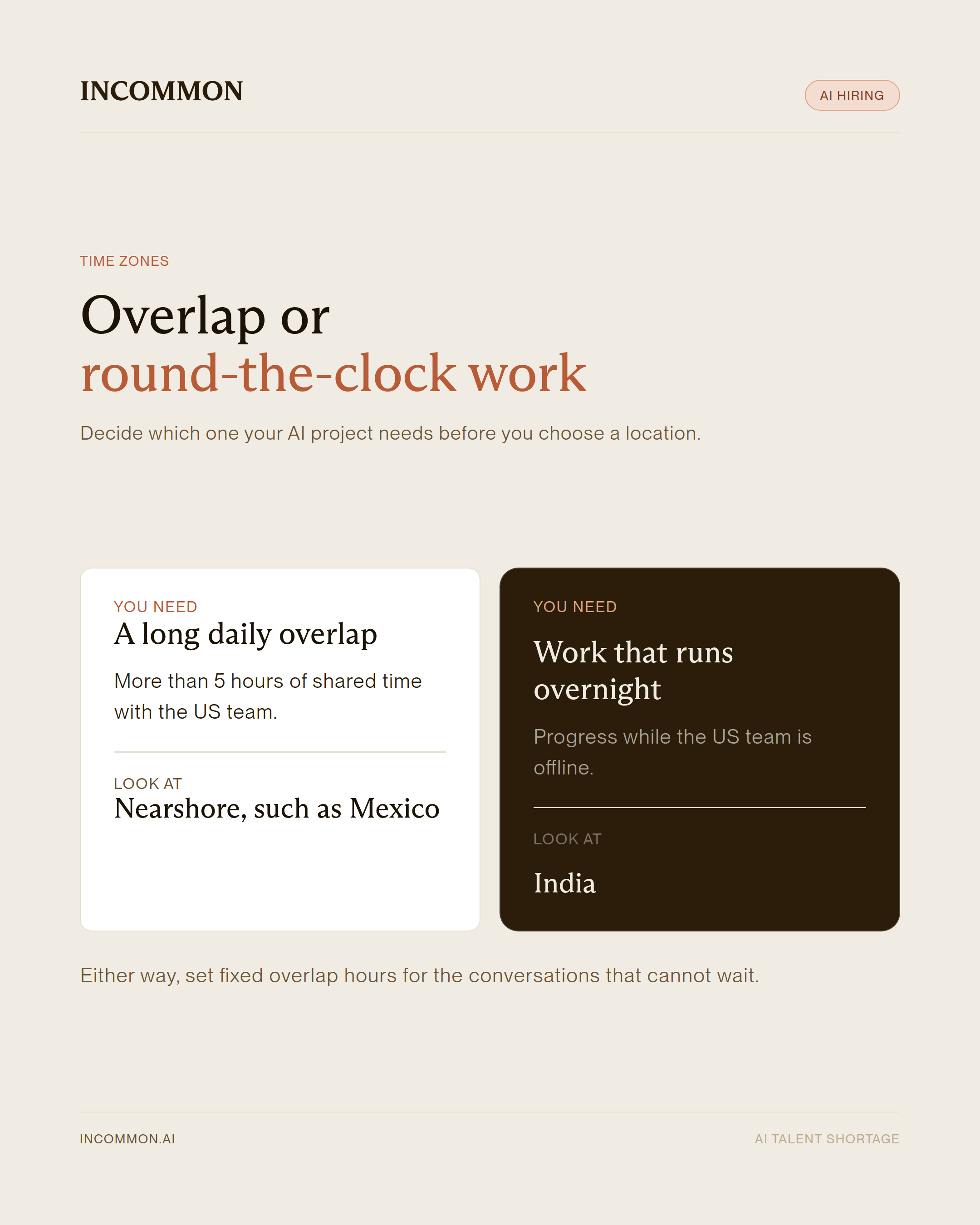
Time zone differences are a challenge and an advantage in offshoring. While they allow round-the-clock work, they can also make real-time collaboration difficult. To manage this, most companies can schedule overlapping work hours where both the local and offshore teams are online. How you handle this will depend on the nature of your AI project. If you need more than a 5-hour time overlap between the offshore and onshore teams, consider Mexico your offshoring destination. If round-the-clock work matters more to you, India is a good option.
Quality control in offshore work
The best locations for AI roles earn that status through skill, not cost. Quality control is critical for offshoring machine learning teams from day one. It should start while shortlisting candidates, which is the most reliable point to catch a weak fit. Regular work reviews and feedback sessions can also help maintain high standards. AI is an evolving field, so make sure your offshore team has the freedom and time to upskill while on the job.
Strengthen relationships with offshore teams
Mutual respect is vital to the success of a project. If the offshore team is not part of your regular workday, nothing else will make up for the lack of alignment. Teams on either side must share a commitment to achieving the project's goals. If possible, visit the offshore team in person. It creates camaraderie, and the local team gets better visibility into the offshore team's working environment and challenges.
Final thoughts
The AI talent shortage is an opportunity in disguise. A large pool of untapped tech talent is ready to take on the same work as its American and European counterparts. Offshoring is a viable solution to this problem, offering access to this talent pool and the flexibility to grow.
Frequently asked questions
What is causing the AI talent shortage?
Demand for AI and machine learning skills has grown much faster than the number of trained professionals. Companies across finance, healthcare, and engineering are competing for the same people.
How does the AI talent shortage affect businesses?
It lengthens hiring cycles and delays AI projects, pushes up the cost of talent, overloads existing AI teams, and makes retention harder because skilled people have many options.
How can offshoring help with the AI talent shortage?
Offshoring gives you access to larger talent pools in countries such as India and those in Eastern Europe, with less competition for each candidate and teams that can keep work moving across time zones.
Which countries have strong AI talent pools?
India and Eastern European countries have many skilled AI and machine learning professionals, with strong tech institutes in cities such as Bengaluru, Hyderabad, and Budapest.
How do you manage time zones with an offshore AI team?
Schedule overlapping hours when both teams are online. If you need a long daily overlap with the US, a nearshore location like Mexico fits. If round-the-clock work matters more, India is a common choice.
How do you keep quality high in an offshore AI team?
Start quality control at the shortlisting stage, hold regular work reviews and feedback sessions, and give the team time to keep learning in a fast-changing field.
Written by
CEO, InCommon
Piyush Kedia is the CEO of InCommon, a talent infrastructure company that helps US and global enterprises set up and scale Global Capability Centers (GCCs) in India. He works with founders, CTOs, and heads of talent to design smaller, AI native GCC teams that focus on judgment work, not just headcount, so India offices stay senior, stable, and production ready. Before InCommon, Piyush built Blue Vector into a 50 person creative agency serving brands such as Trump Towers, Audi, and Porsche, giving him a front row view of how high performing teams are hired, managed, and grown.