AI data annotation outsourcing, boosting efficiency without compromising quality
See how Findigs, Accompany Health, Veramatic and Podifi built their teams.
Real teams, real results, from faster hiring to lasting retention.
Quick look:
| AI data annotation is the work of labeling data so machine learning models can learn from it, and model accuracy depends on how well it is done. Outsourcing it gives you access to trained annotators, room to scale with each project, and faster turnaround. The risks are uneven quality, communication gaps, and data security. Choose a partner with a track record, set detailed guidelines, run a strict quality control process, and agree on security measures before any data changes hands. |
|---|
Imagine you are the founder of an AI data annotation startup. The company is in its earliest stages. You're dealing with the stress of clients, marketing, and sales.
You are still unsure exactly where to position the company. And local data annotation experts are either unavailable or too expensive to hire.
What would be the easier option: scouring the local market for the right fit, turning to the global talent pool for the best candidates, or relying on a trusted vendor to deliver good work?
The scenario is hypothetical, but the shortage of trained, available, and reasonably priced annotation experts is factual.
AI data annotation is critical in machine learning. The accuracy of an AI model depends mainly on the quality of the labeled data on which it is trained. As demand for AI increases, so does the need for efficient and accurate data annotation. Outsourcing is one of the most efficient ways to close that gap.
Let's explore the benefits, challenges, and best practices of outsourcing AI data annotation.
Why AI data annotation matters
AI models require labeled data to learn patterns and make predictions. Data annotation is the process of labeling or tagging data, so that machines can recognize the same patterns in new data. With accurate annotation, an AI model can provide reliable outcomes.
The need for AI data annotation spans multiple industries, including healthcare, autonomous driving, retail, and finance. Companies need massive datasets to train their models, but labeling large volumes of data by hand is slow and expensive.
Outsourcing the annotation is a flexible, scalable, long-term solution.
Why outsource AI data annotation?
If data annotation is so central to training AI models, why outsource it at all? Here's why:
1. Cost efficiency
Hiring and training an in-house data annotation team is costly, especially if the project lasts only a few months. By outsourcing, companies can reduce overhead costs and pay for the service only when needed. If you choose a full-time data annotation team offshore instead, you still get trained professionals without building the team from scratch yourself.
2. Access to skilled annotators
You gain access to a large team of trained annotators with experience in different types of data annotation. You can also find specialists in niche areas, which matters for complex tasks that need high accuracy, such as image or video labeling. Outsourcing vendors typically have specialized teams well-versed in industry-specific annotations, which helps keep the output consistent.
3. Scalability
Outsourcing AI data annotation allows companies to scale their projects quickly. Outsourcing providers can add annotators to meet the demand if a project's scope expands or a large dataset needs to be labeled fast. This flexibility is especially valuable for startups and smaller companies that lack the internal capacity to handle large-scale data annotation.
4. Faster turnaround time
With a dedicated outsourced team, companies can expect faster project completion. Outsourcing vendors are often located in different time zones, allowing for continuous work on the project. This means quicker deployment of AI models.
5. Adaptation to new technologies
A good outsourcing partner will set up a team with access to the latest tools and technologies for data annotation. Sometimes, a company can use these advanced solutions without investing in new software or retraining employees, making it easier to stay agile and respond quickly to technological advancements.
Challenges of outsourcing data annotation
While outsourcing AI data annotation offers numerous benefits, there are also challenges.
1. Maintaining quality standards
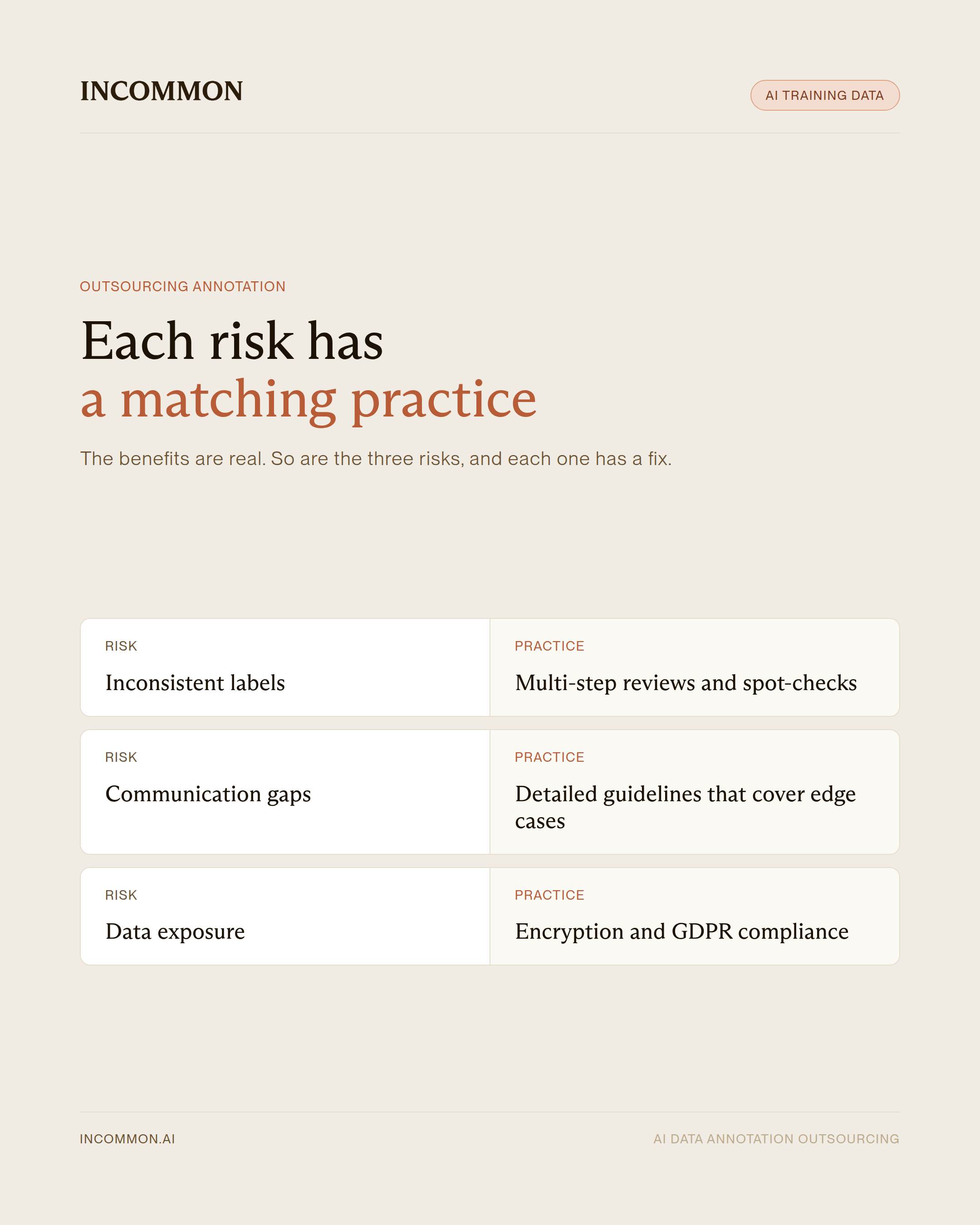
Mislabeling or inconsistent annotations can result in poor model performance. To avoid this, companies should choose a vendor with a track record of high-quality annotation services and establish clear quality control measures.
2. Communication barriers
Working with an offshore outsourcing provider can sometimes lead to communication challenges. These can arise due to language differences, time zone variations, or a lack of clear project guidelines. To mitigate this, it's essential to establish open and consistent communication channels from the start.
3. Data security risks
Sensitive data may be shared with the outsourcing provider, which can raise concerns about data privacy and security. Companies must ensure their chosen provider follows strict data security protocols and complies with relevant regulations, such as GDPR.
A well-run remote team can reduce these risks, but it does not remove them. Know where the risks are, and agree with your vendor on how each one will be handled.
Best practices for outsourcing annotation
To maximize the benefits and mitigate the challenges of outsourcing AI data annotation, companies should follow these best practices:
1. Choose the right partner
Choosing a provider on your own is risky, especially if you know little about the country you are outsourcing to.
There are two paths you can take. A vendor can own the annotation work outright, or a partner can build you a dedicated team of skilled annotators. Either way, choosing the right partner is the first step to high-quality annotation. Look for vendors and experts with experience in their industry and a track record of delivering accurate, high-quality annotations. Proactively checking client reviews, testimonials, and case studies can help.
2. Set clear guidelines and expectations
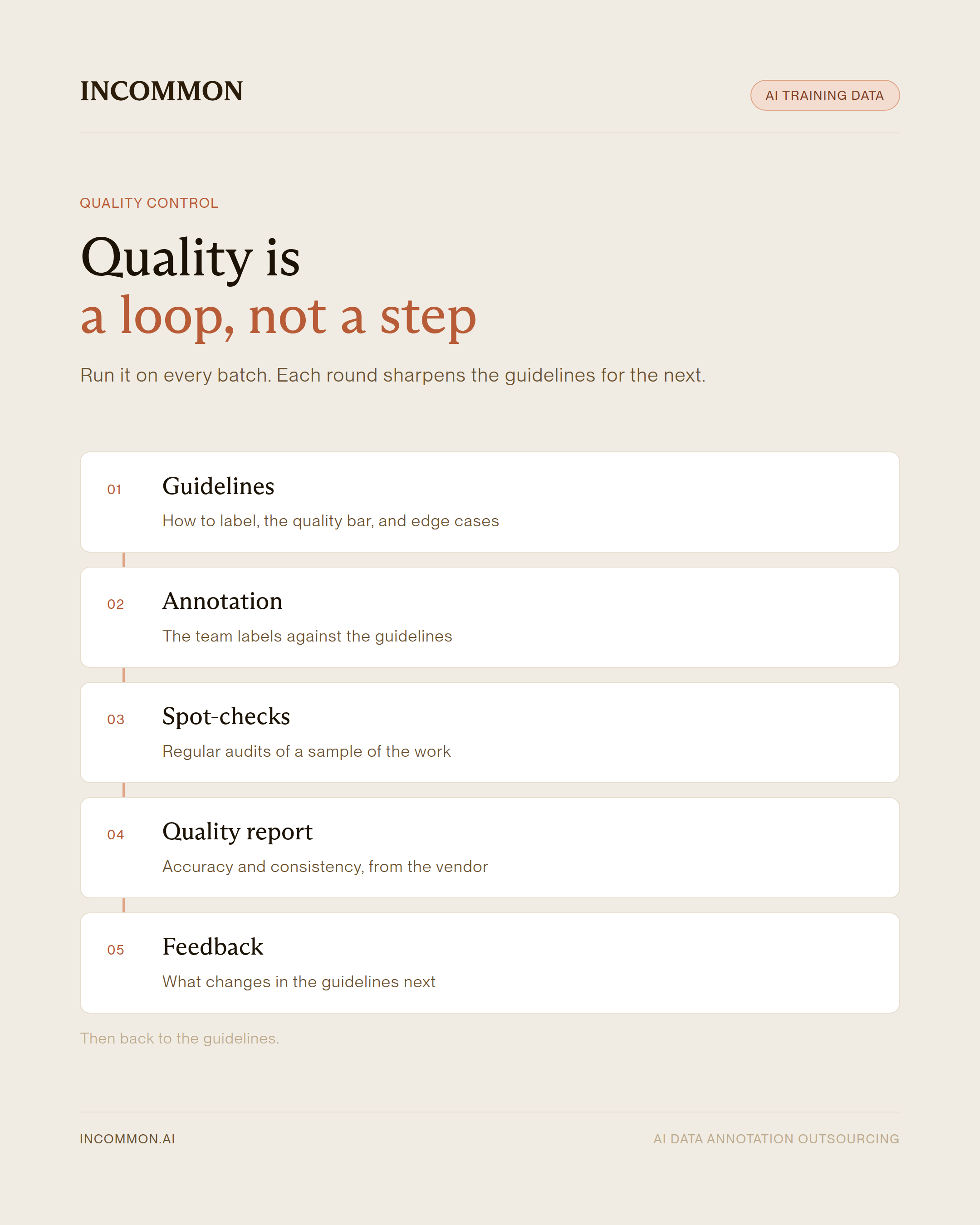
Before the project starts, give the outsourcing partner, or your full-time remote team, clear and detailed guidelines. This should include specific instructions on how the data should be annotated, what the quality standards are, and any edge cases that might arise. The more detailed the guidelines, the less room there is for errors or misinterpretation.
3. Implement a strict quality control process
Quality control is the most important part of outsourcing AI data annotation. Companies should set up a multi-step review process, including regular audits and spot-checks of the annotated data. It's also a good idea to ask the vendor to provide detailed reports on quality metrics, such as accuracy and consistency.
A capable remote team still needs clear performance standards that everyone follows.
4. Automate simple tasks
While human annotators are essential for complex annotation tasks, automation can be used for simpler tasks. By using automated tools for tasks such as object detection or text classification, companies can reduce the workload on human annotators and speed up the overall process.
5. Prioritize data security
Companies should be confident that their chosen provider has strict security measures in place to protect sensitive data. This might include encryption, secure data transfer methods, and compliance with relevant data protection regulations.
6. Monitor progress and provide feedback
Companies should set up regular check-ins to monitor progress and provide feedback as needed. This ensures that any issues can be addressed promptly and that the project continues to meet quality and timeline expectations.
Keep the remote team updated, too. Feedback only has an impact if it is collected and passed on.
To discuss an annotation project of your own, get in touch.
Where annotation outsourcing is heading
As AI adoption grows, so will demand for high-quality data annotation, and outsourcing will remain popular with companies that want to scale their AI projects efficiently. Advances in automation and AI-driven annotation tools will complement human efforts, improving the speed and accuracy of the annotation process.
Outsourcing providers will also continue to improve their services by adopting new technologies and adhering to stricter quality control measures. Companies can rely on their outsourced partners to provide high-quality annotated data.
Companies can confidently scale their AI operations with the right outsourcing partner, knowing that experienced professionals are handling their data annotation needs. As AI continues to reshape industries, the importance of efficient, high-quality data annotation will make outsourcing a valuable part of any company's AI strategy.
Frequently asked questions
What is AI data annotation?
AI data annotation is the process of labeling or tagging data so a machine learning model can learn patterns from it. The accuracy of the model depends mainly on the quality of that labeled data.
Why do companies outsource AI data annotation?
Outsourcing gives companies access to trained annotators, lets them scale the work up or down with each project, and speeds up turnaround. It also avoids hiring and training an in-house team for work that may only last a few months.
What are the risks of outsourcing data annotation?
The main risks are inconsistent labeling, communication gaps across languages and time zones, and the security of sensitive data shared with the provider.
How do you keep annotation quality high when outsourcing?
Give the team detailed guidelines that cover edge cases, run a multi-step review with regular audits and spot-checks, and ask the vendor for reports on accuracy and consistency.
How do you protect data when outsourcing annotation?
Choose a provider with strict security measures, such as encryption and secure data transfer, and confirm it complies with data protection rules like GDPR before any data is shared.
Can annotation tasks be automated?
Simple tasks such as basic object detection or text classification can be automated. Human annotators are still needed for complex work that requires judgment and high accuracy.